-
-
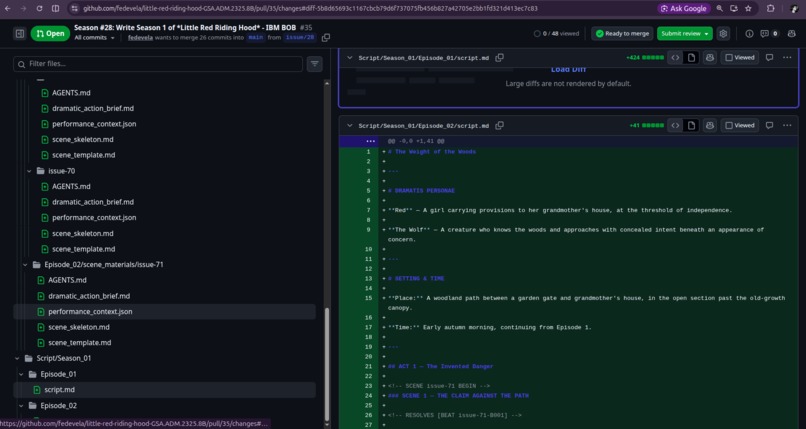
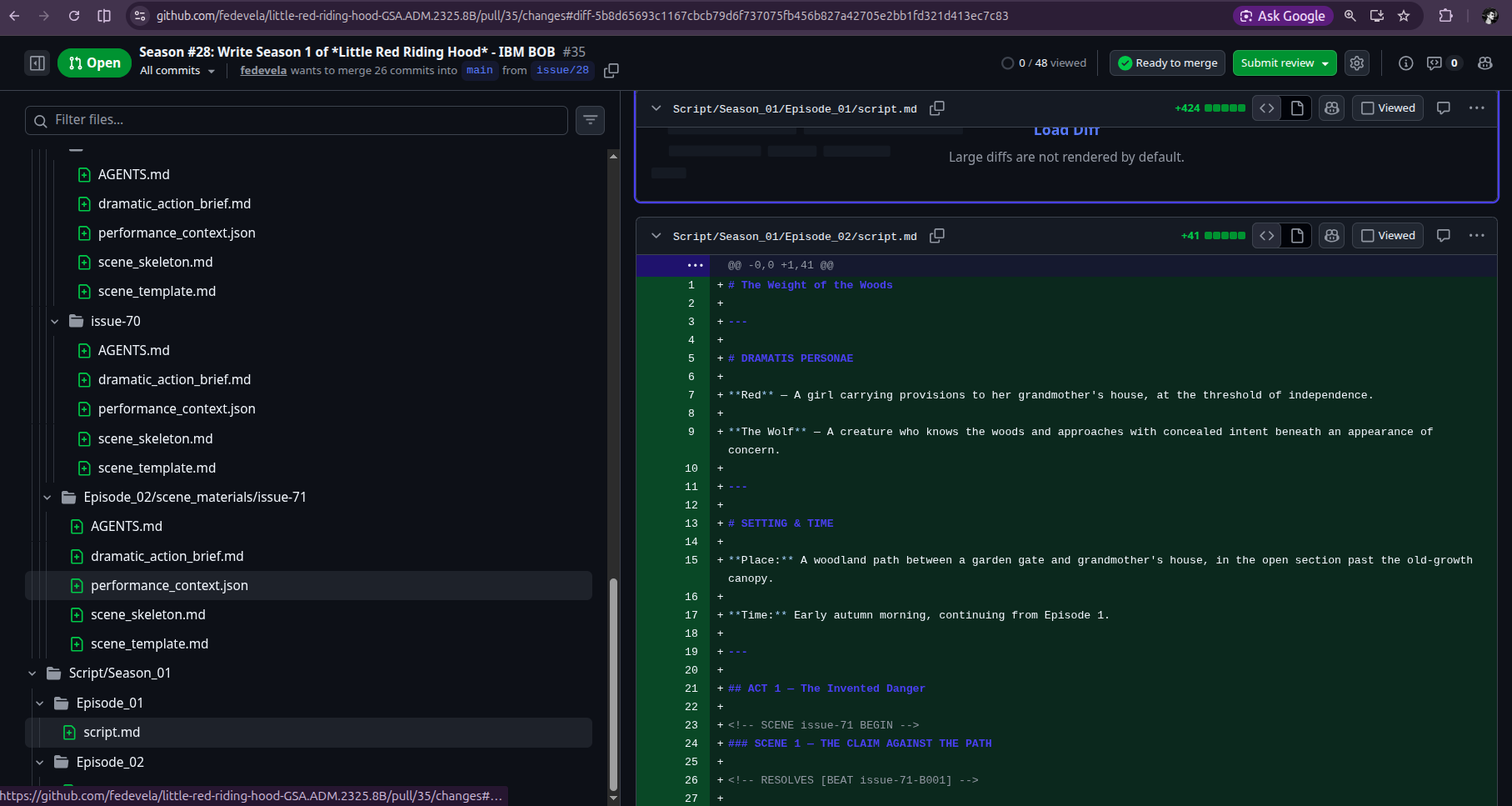
Browsing the finished script in github
Inspiration
Agentic American Playwright grew out of a software development harness I wrote while implementing my own take on full SDLC agents. After building a similar flow for exploring, planning, and implementing software, I wondered if I could use it for my other passion: theater and film.
I wanted to move beyond asking AI to “write a story” and explore a process where different perspectives challenge an idea, characters develop distinct voices, and scenes emerge through interaction.
What it does
Agentic American Playwright turns a story idea into a script through two complementary techniques.
First, three independent perspectives explore the same premise: one discovers possibilities, another challenges them through conflict and consequences, and a third grounds them in believable circumstances and relationships. An editorial voice brings their findings together into a coherent direction. This process develops the story from broad ideas into individual scenes.
Then, a director works with separately played characters to perform those scenes. Each character has its own background, private thoughts, and understanding of what is happening.
Characters respond to what they can observe, while the director guides the dramatic progression. The script grows out of their performances.
How we built it
I adapted my existing set of agents for my own personal software development workflow into a creative process, using Python, IBM Bob, and GitHub.
The central design choice was to separate responsibilities: different voices explore the story, an editor shapes its direction, a director guides each scene, and individual actors inhabit the characters. The surrounding system preserves their contributions and brings it together into a manuscript.
Challenges we ran into
The hardest challenge was balancing structure with freedom. Too little preparation lets the story drift; too much leaves the characters with nothing to discover.
We also had to manage what each character knows. The director needs the whole picture, but a character should not automatically know another character’s private thoughts.
Long context, interrupted runs, and model usage limits tested whether the process could preserve progress and continue reliably.
## Accomplishments that I am proud of
I built a working process that takes any story universe (commonly called a story bible) —in this case I used Little Red Riding Hood and USG harrassment guideliens—through exploration, dramatic development, and performed scenes.
I am especially proud of the two techniques I have developed, exploration of the same problem through different agents with separated memories, giving different creative voices genuinely different responsibilities. The story is challenged before it is written, and the characters have room to respond to one another during the performance.
## What we learned
We learned that how AI agents collaborate matters as much as what we ask them to produce, and that is where the sweetspot of determinism vs creativity was found.
## What's next for Agentic American Playwright
I would love to give the American Agentic Playwright a proper langgraph backend and go back and streamline and minimalize the agent.

Log in or sign up for Devpost to join the conversation.