-
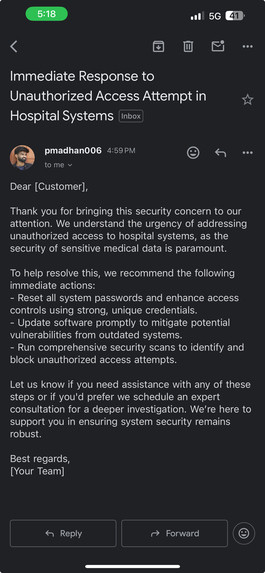
email response
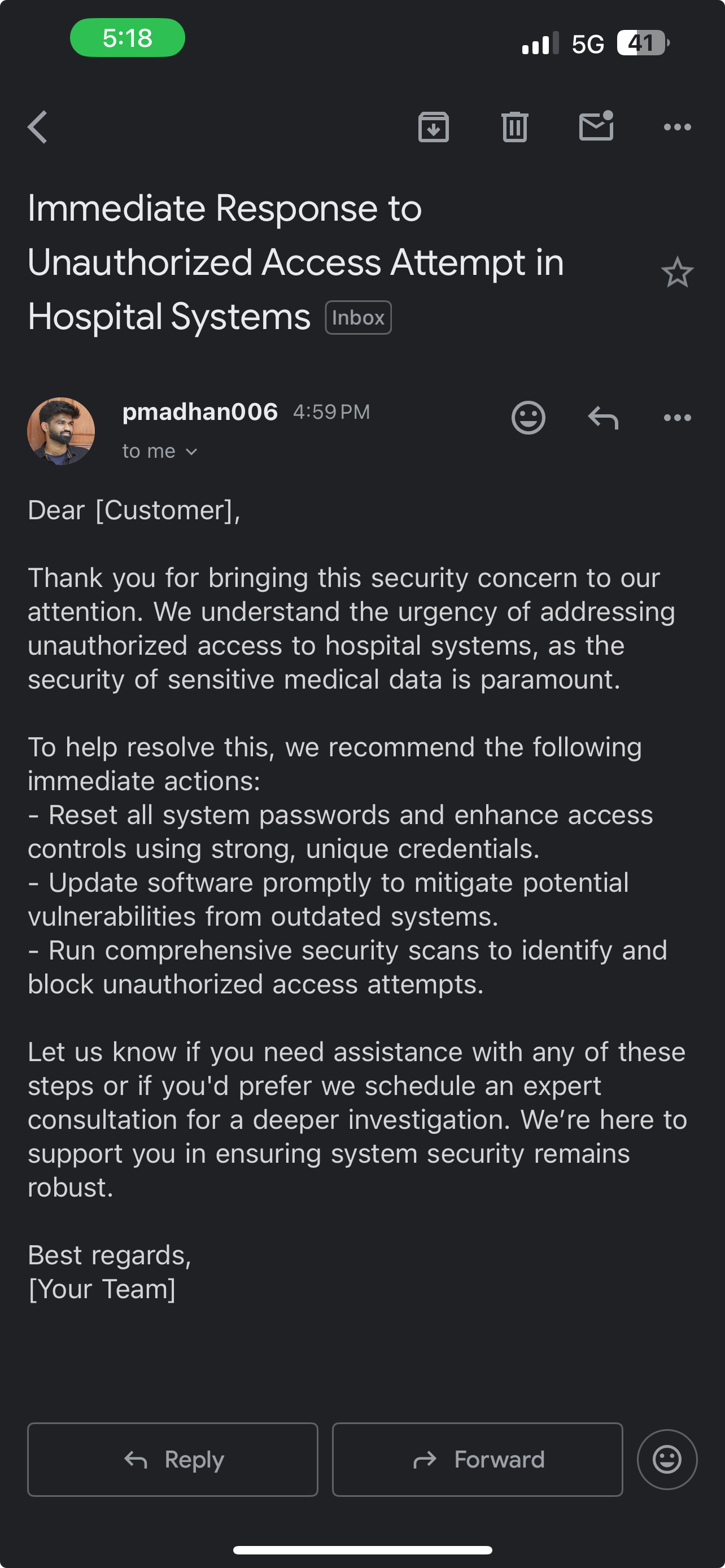
Inspiration
The idea came from witnessing the inefficiencies in IT support workflows and customer service. High volumes of tickets often lead to delayed responses, inconsistent answers, and repetitive work. I wanted to explore how multi-agent AI systems could automate triage, retrieval, and response, creating a smarter, faster, and more reliable support process.
What it does
This project uses agentic AI to process IT support tickets end-to-end:
Intake Agent: Cleans, normalizes, and classifies incoming tickets.
Retriever Agent: Performs semantic search on past tickets and documentation to find relevant solutions.
Composer Agent: Drafts detailed, contextual email responses to the original sender. The system can automatically reply to support requests while maintaining accuracy, context, and traceability.
How we built it
Built a multi-agent orchestration system using Semantic Kernel and Python.
Integrated TiDB Vector Client and SentenceTransformers for semantic search.
Used Gmail SMTP with app passwords to send automated email replies.
Orchestrated agents over SSE plugins, allowing real-time asynchronous communication.
Implemented token usage tracking, logging, and context preservation across conversations.
Challenges we ran into
Handling sensitive data and PII without breaking ticket context.
Ensuring smooth asynchronous communication between multiple agents.
Debugging SMTP authentication issues with Gmail app passwords.
Fine-tuning vector search parameters to balance relevance and retrieval speed.
Accomplishments that we're proud of
Fully automated end-to-end ticket processing pipeline.
Agents that can understand and respond to complex IT support issues.
Seamless integration of semantic search, RAG, and automated email responses.
Built a system that demonstrates real-world applicability for enterprise IT support.
What we learned
How to design and orchestrate multi-agent AI systems.
Practical experience with vector databases, embeddings, and RAG.
Best practices for cleaning, labeling, and processing real-world support tickets.
Techniques to handle async workflows, email automation, and token tracking.
What's next for agentic AI project
Extend support for multi-language tickets.
Implement dynamic decision routing, allowing agents to escalate or forward tickets intelligently.
Integrate more external knowledge sources, like documentation wikis or internal SOPs.
Explore advanced agentic behaviors where multiple AI agents collaboratively solve complex IT problems in real-time.
Built With
- gamil
- openai
- semantic-kernal
- tidb

Log in or sign up for Devpost to join the conversation.