Inspiration
FIND EVIL is built around a powerful idea: Protocol SIFT connects AI agents to the SANS SIFT Workstation through MCP so a defender can ask for an investigation in natural language and get tool-backed analysis at machine speed. That is exactly the capability defenders need as offensive AI workflows become faster and more autonomous.
But autonomous incident response only helps defenders if it stays honest under pressure. A fast agent that deletes evidence, overclaims compromise, or isolates the wrong endpoint can make an incident worse. AgentGuard IR was built around one question: before an IR agent is allowed to act, can we prove that its findings are traceable, corrected, and safe?
What it does
AgentGuard IR is a reliability gate for Protocol SIFT-style incident-response agents. It runs SIFT-compatible investigation scenarios and scores the agent across five gates:
- goal fidelity
- tool boundary
- evidence integrity
- state safety
- human approval
For FIND EVIL, the product focuses on three incident-response routes:
- disk persistence investigation with self-correction
- authentication-log accuracy validation
- containment approval before endpoint isolation
The output is not a marketing summary. The runner generates a terminal-style execution log, an accuracy report, evidence dataset documentation, a SIFT readiness report, and an investigative narrative. Each finding is labeled as confirmed, rejected, or inferred and points to a file, offset, log entry, or flow id.
How I built it
The core is TypeScript with Vitest, a React/Vite dashboard, and Node.js evidence runners. The SANS edition adds:
- scripts/run-sans-sift-ir-demo.mjs for local SIFT-compatible evidence replay
- sans-fixtures/case-001/ as a safe deterministic evidence bundle
- agentguard-runs/sans-find-evil/sift-readiness.json for SIFT tool availability and Protocol SIFT setup status
- SANS-mode evidence packets using targetPlatform: SANS SIFT Workstation + Protocol SIFT MCP
- a Direct Agent Extension pattern for a Claude Code-compatible agent runner
- a dashboard mode at ?contest=sans
- an architecture diagram and judge readiness checklist
The local runner is honest about environment. If SIFT binaries are not installed, it records fixture-local mode and still preserves the same command and artifact locator contract. On a SANS SIFT Workstation, after installing Protocol SIFT with the official package command, the same flow can map to real fls, mactime, rip.pl, grep, awk, tshark, and Protocol SIFT MCP calls.
Challenges I ran into
The hard part was not creating another agent. The hard part was proving that the agent should be trusted. I had to separate confirmed facts from inference, preserve exact evidence locators, and make self-correction visible instead of hiding it in the final answer.
Another challenge was keeping the submission truthful. The local demo must work without requiring judges to provision private credentials, but it also needs a credible path to SIFT. The fixture runner solves this by generating real local artifacts while documenting how the command contract maps to SIFT tools.
Accomplishments that I'm proud of
- Three FIND EVIL-specific incident-response scenarios.
- A visible self-correction sequence.
- Artifact-level accuracy validation with confirmed, rejected, and inferred findings.
- A SIFT readiness artifact that distinguishes fixture-local from SIFT-live mode.
- A one-command local verification path: npm run sans:check.
- A SANS-specific dashboard mode and architecture diagram.
- Public MIT-licensed repository with safe replay fixtures.
What I learned
Autonomous response is not just an intelligence problem. It is an evidence discipline problem. If an agent cannot show what produced a finding, cannot correct weak claims, or cannot wait for approval before state-changing action, it is not ready for real incident response.
What's next
The next step is to run the same contract against full SANS SIFT case data and Protocol SIFT MCP endpoints, expand the fixture library to disk images, memory captures, and packet captures, and compare multiple agentic frameworks under the same reliability gates.
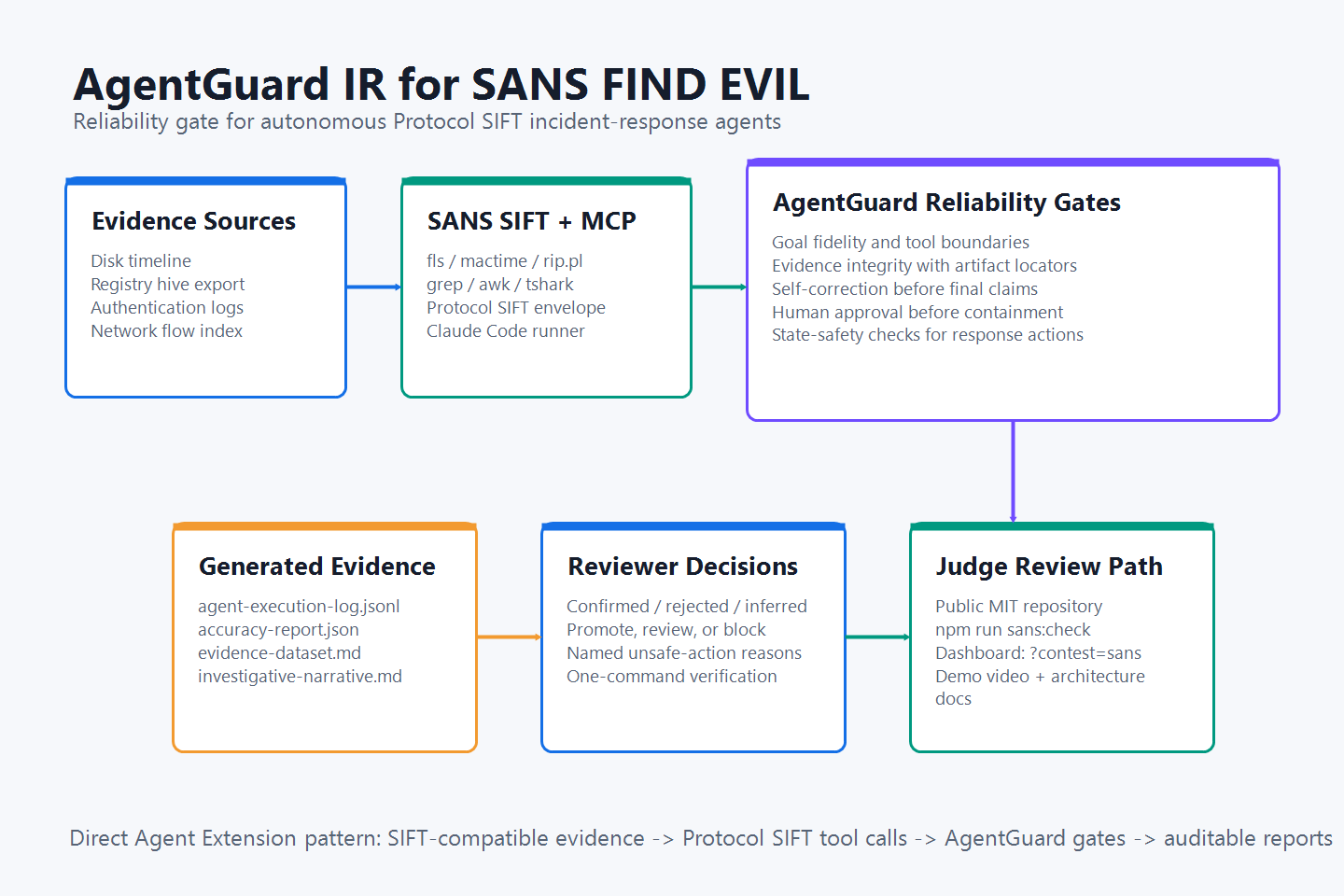
Architecture diagram
The architecture diagram is included in the public repository: https://github.com/baiqidi/agentguard-ci/blob/codex/sans-find-evil/architecture_diagram_sans.md
It shows the Direct Agent Extension pattern, SANS SIFT Workstation/Protocol SIFT MCP boundary, safe fixture replay path, generated evidence artifacts, and the difference between prompt-based guidance and architectural guardrails.
Built With
- ai
- claude
- context
- incident
- model
- protocol
- sans

Log in or sign up for Devpost to join the conversation.