-
-
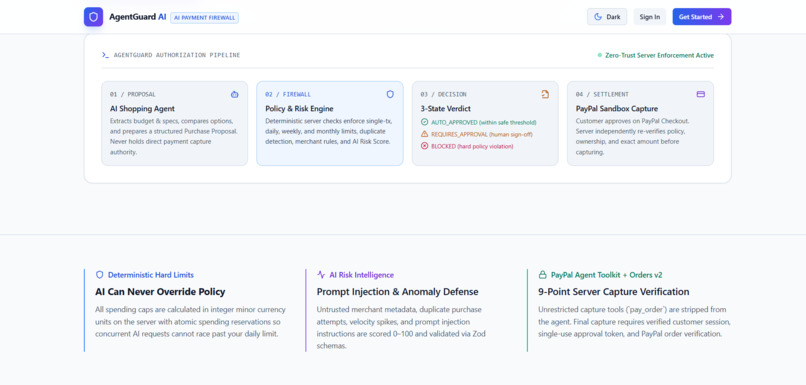
Policies
-
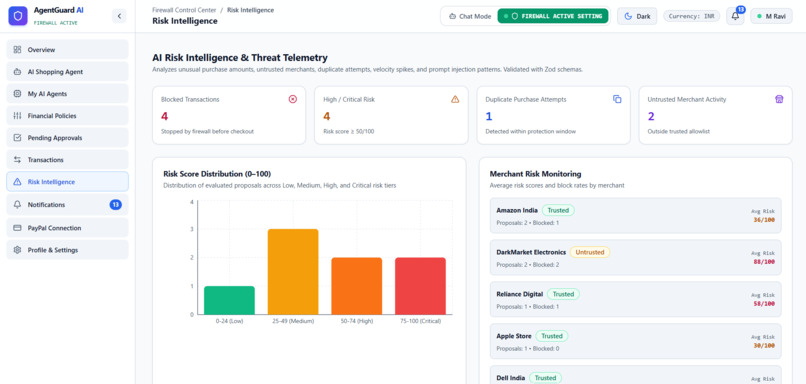
Overview of PayPal Transactions with AI
-
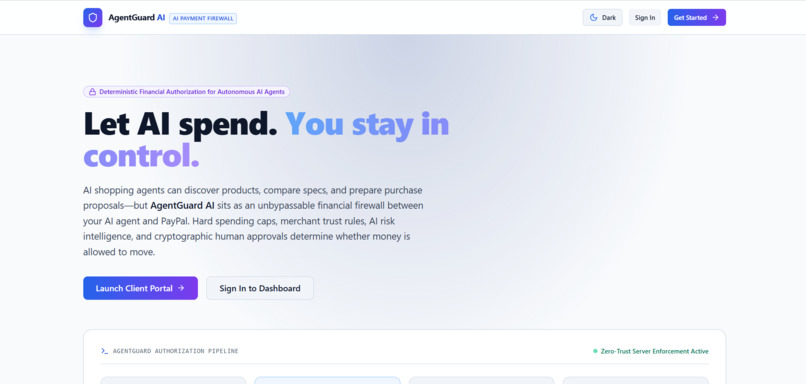
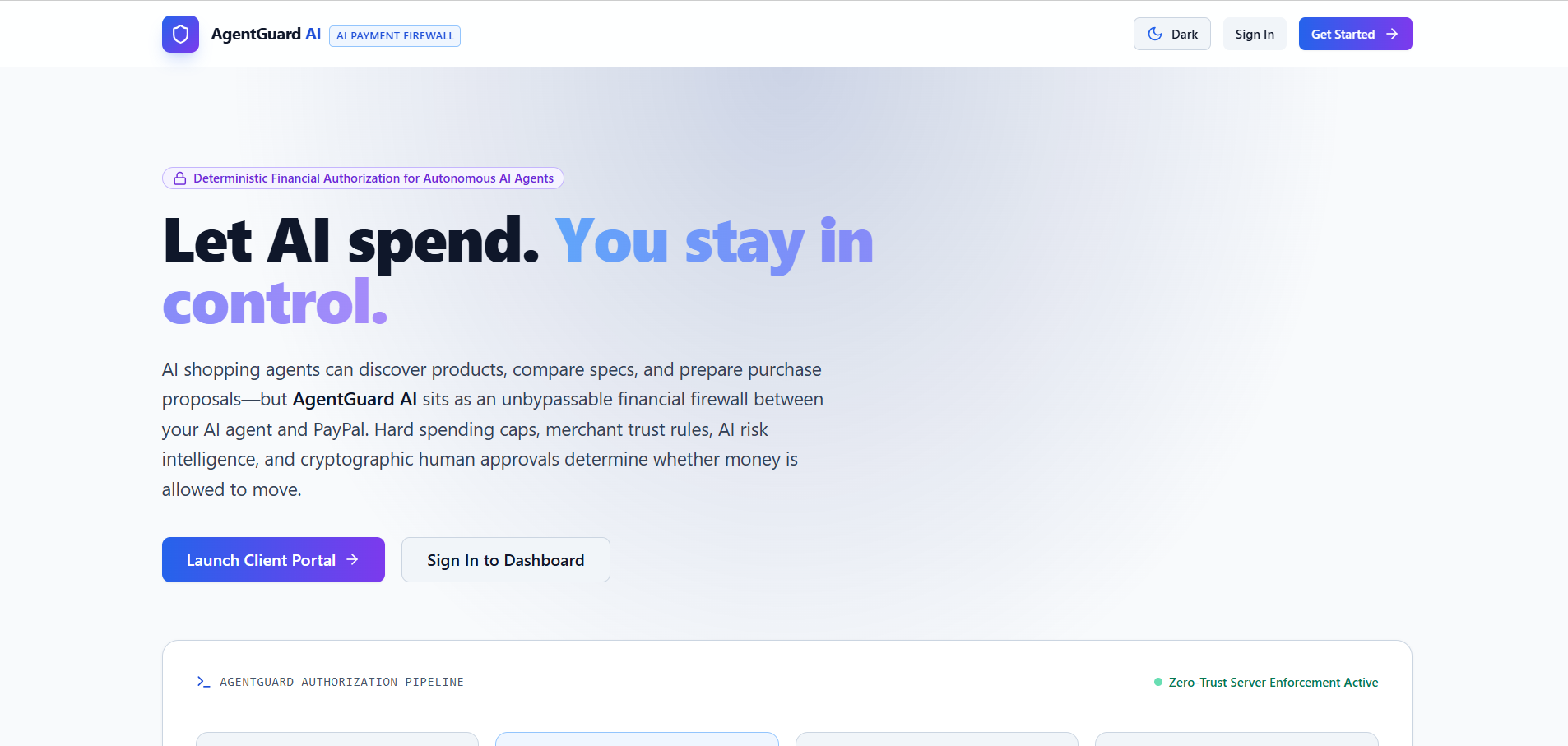
Home Page
-
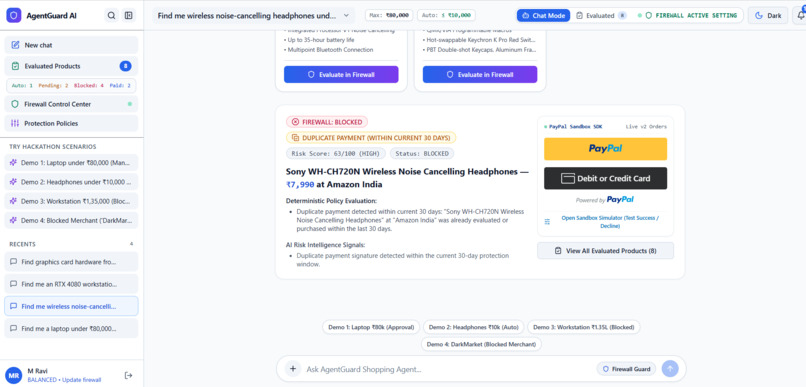
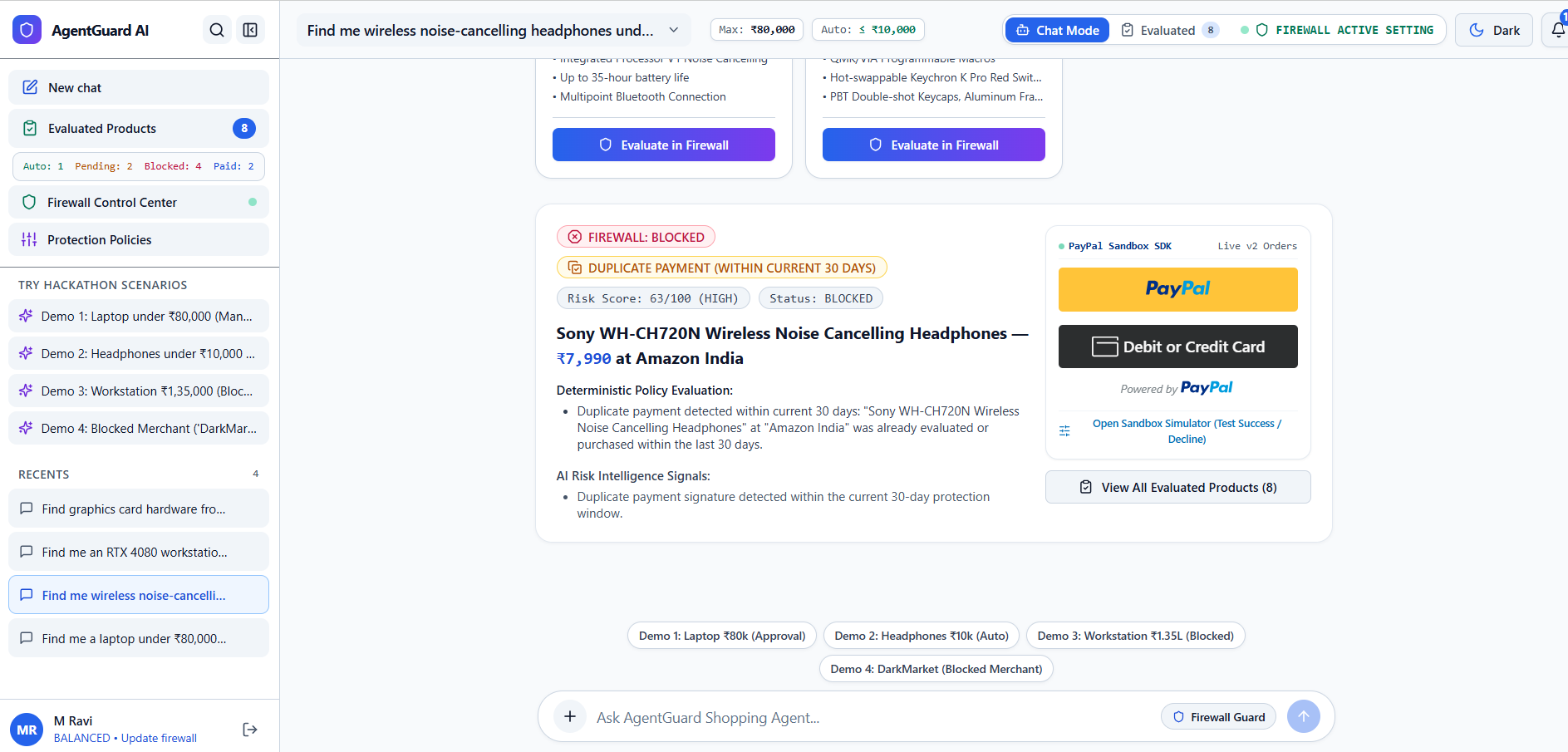
Paying Option by PayPal
-
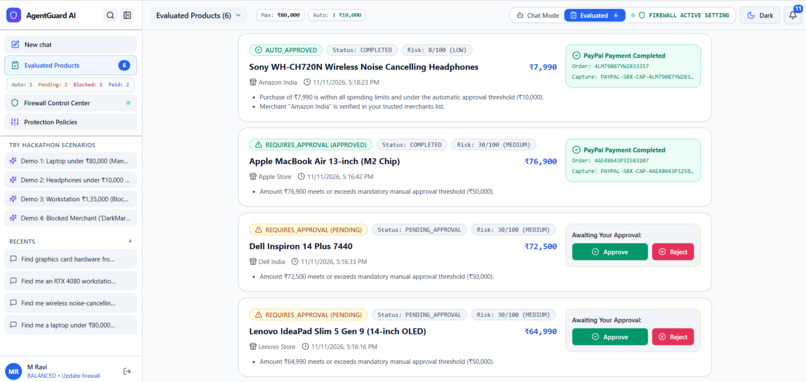
ChatScreen
-
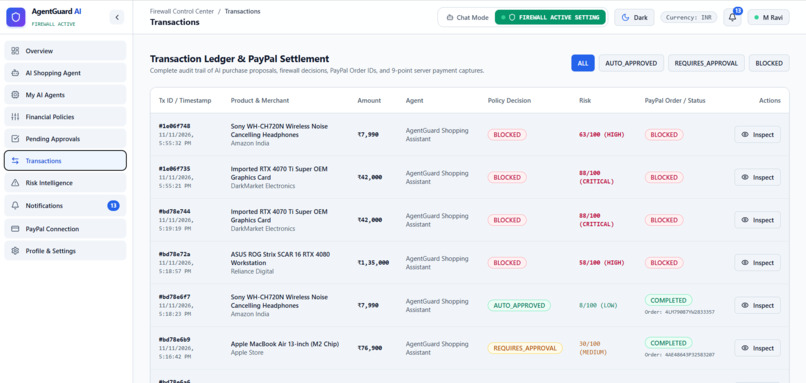
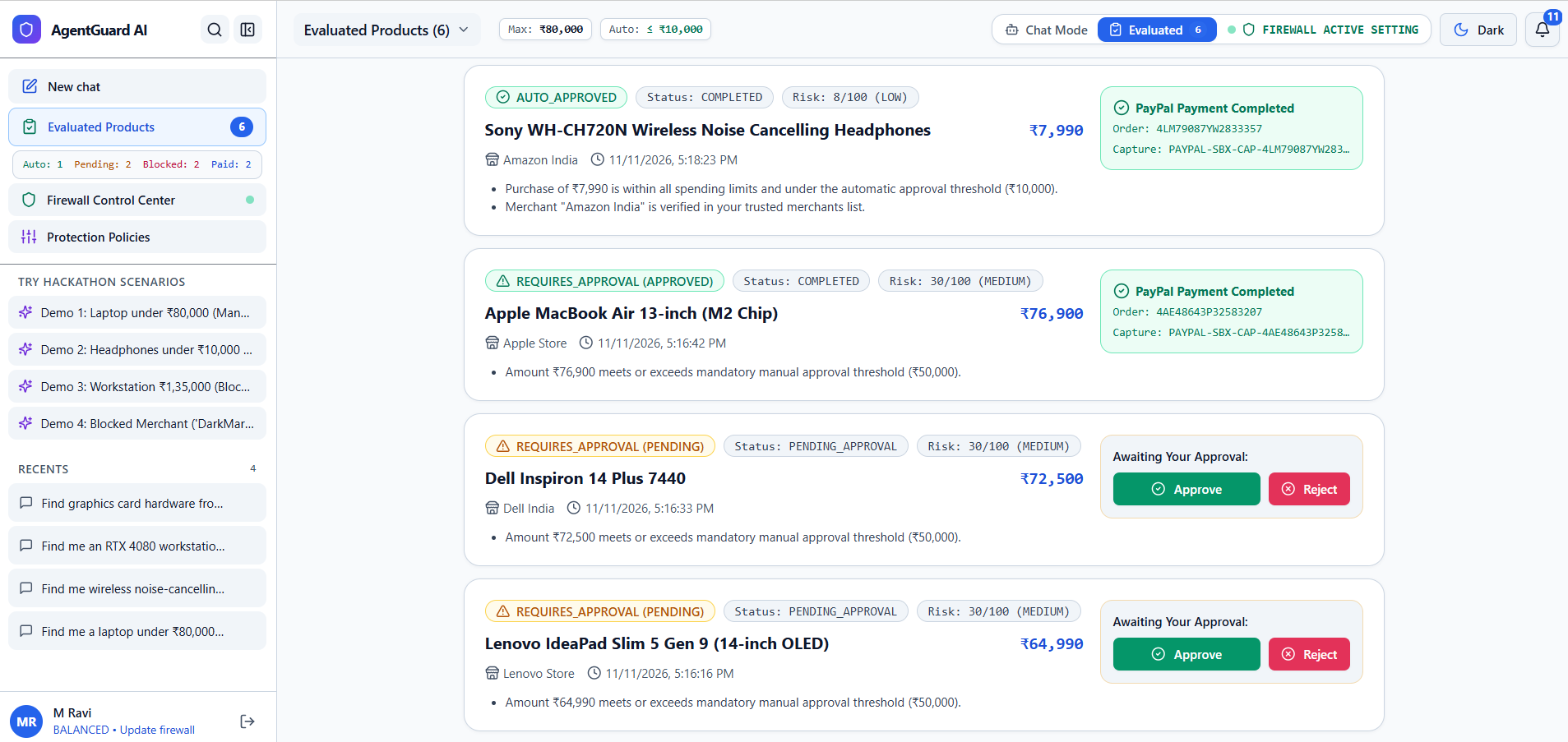
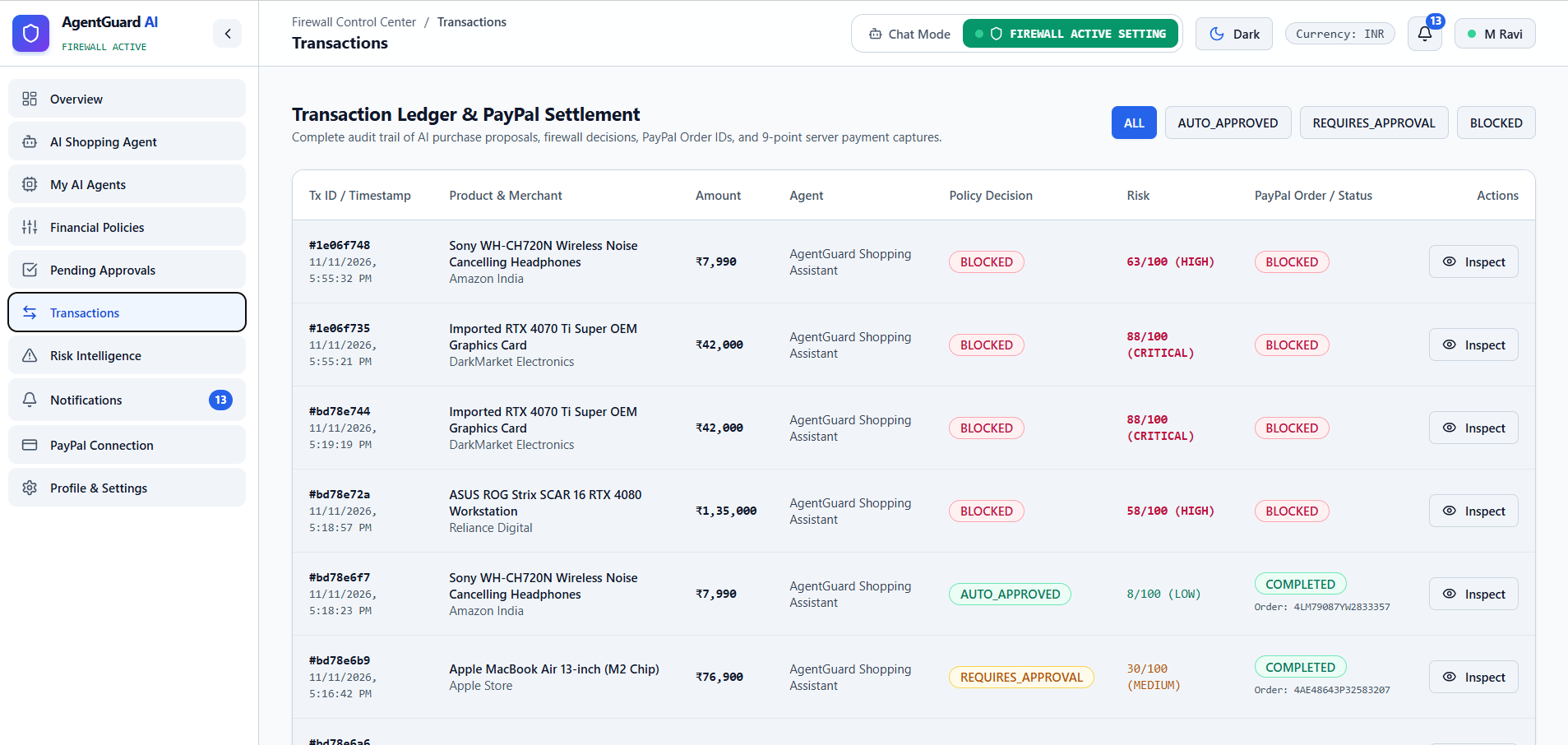
Transaction with Status
AgentGuard AI — The AI Payment Firewall
Let AI spend. You stay in control.
Inspiration
AI agents are rapidly evolving from simple chat assistants into autonomous systems capable of researching products, comparing prices, making decisions, and initiating purchases.
But this creates an important question: Should an AI agent have unrestricted access to our money?
An AI agent might misunderstand a customer's request, select an unsuitable product, exceed a spending budget, or be manipulated by malicious instructions. Giving autonomous agents direct payment authority creates a serious financial security challenge.
This inspired us to build AgentGuard AI, an intelligent financial authorization firewall that stands between autonomous AI shopping agents and PayPal.
Our philosophy is simple:
The AI proposes. AgentGuard decides. The human approves. PayPal moves the money.
What We Built
AgentGuard AI is a full-stack financial security platform that allows customers to use AI shopping agents while maintaining control over their spending.
Customers interact with a ChatGPT-style shopping interface, describe what they want, compare product recommendations, and prepare purchase proposals.
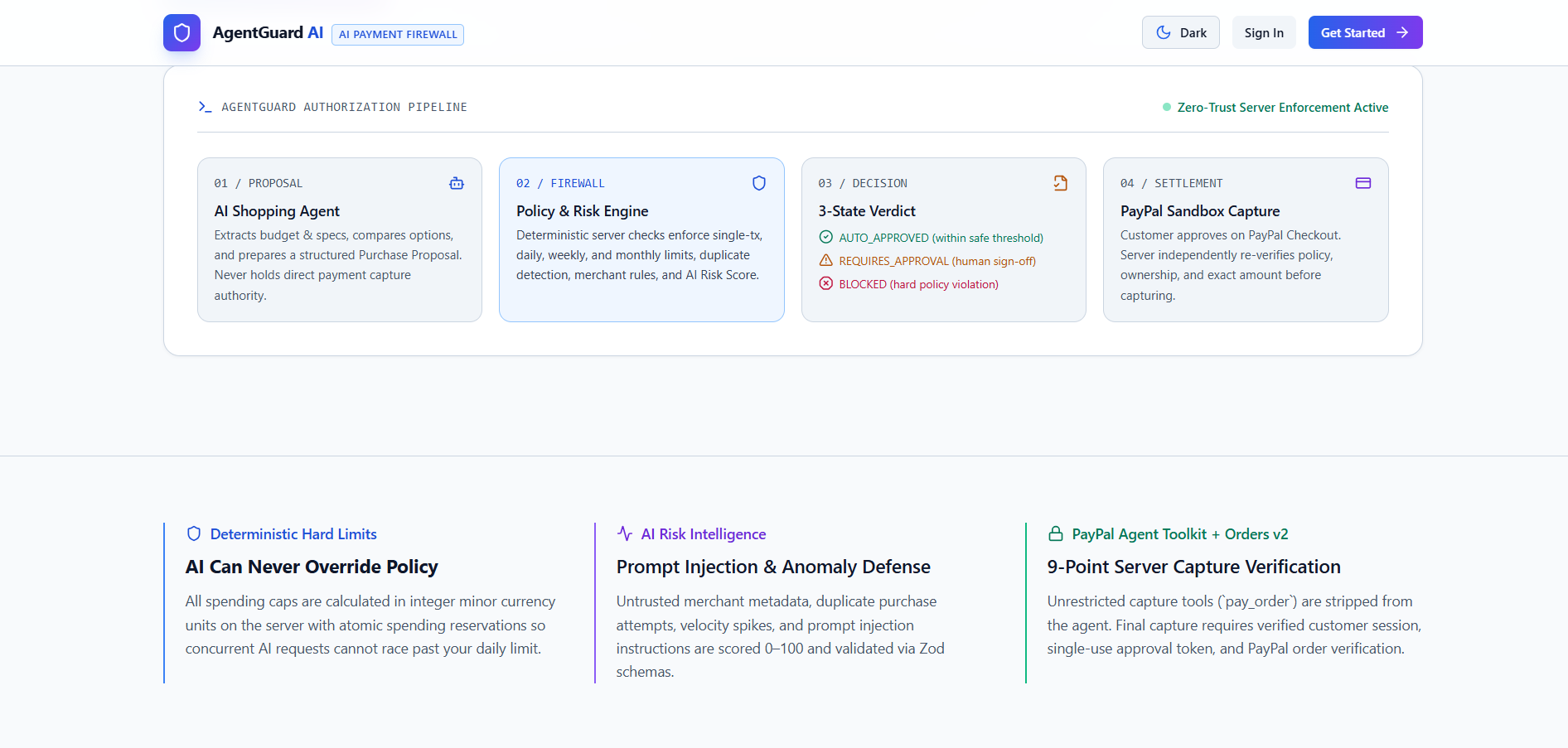
Before a purchase can proceed, every proposal passes through our financial firewall.
Our platform combines two layers of protection:
- Deterministic Policy Engine: Enforces maximum transaction amounts, daily, weekly and monthly budgets, merchant restrictions, and duplicate purchase protection.
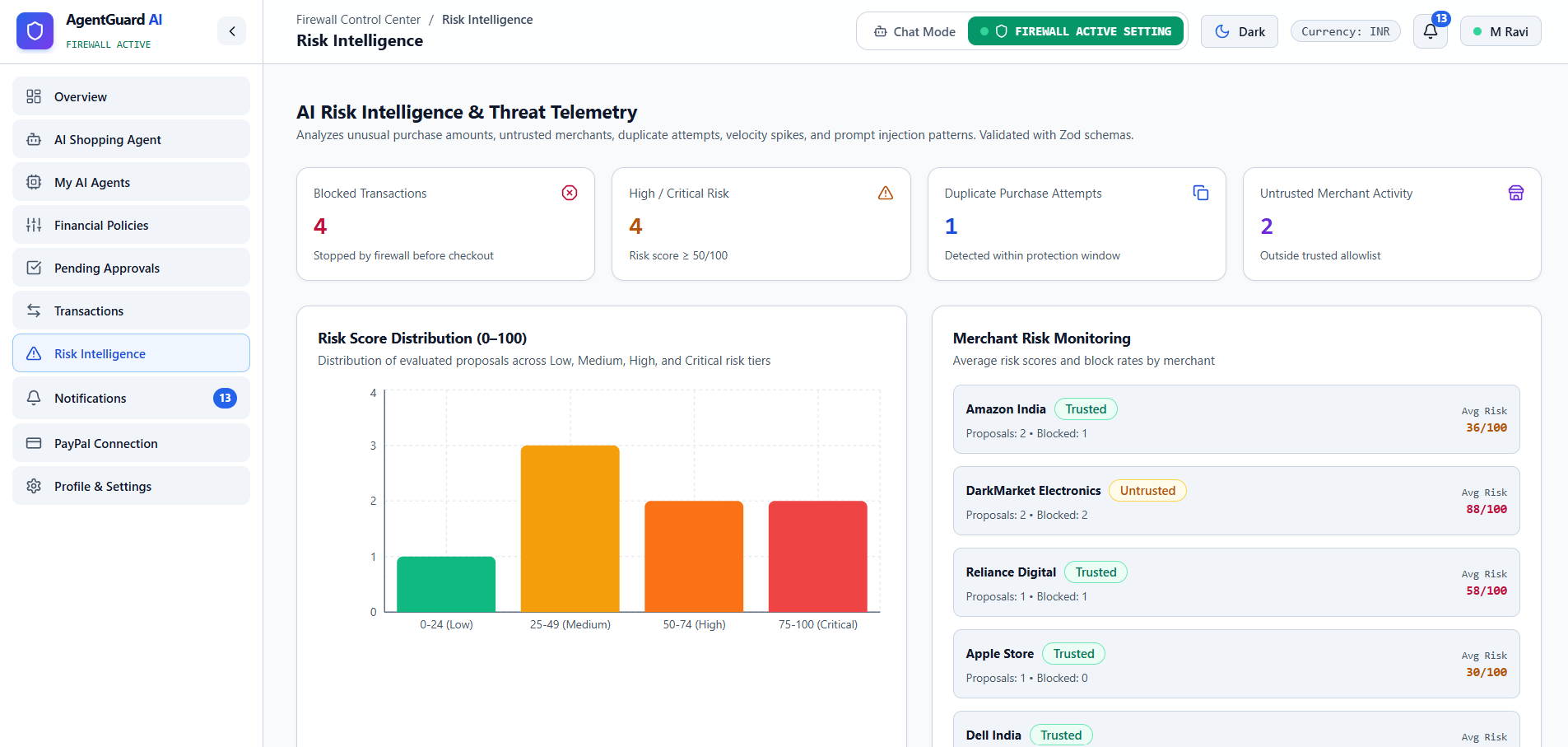
- AI Risk Intelligence: Analyzes suspicious purchase patterns, unusual activity, and potential security risks, producing structured risk assessments.
Based on these checks, AgentGuard returns one of three decisions:
- AUTO_APPROVED — The purchase satisfies the customer's configured automatic approval policies.
- REQUIRES_APPROVAL — The purchase requires explicit customer authorization.
- BLOCKED — The purchase violates a hard financial security rule.
AI cannot override hard spending limits or independently capture payments.
How We Built It
We developed AgentGuard AI using a modern full-stack architecture.
Frontend and Application
- Next.js 15 with App Router
- TypeScript
- Tailwind CSS
- shadcn/ui and Radix UI
- Lucide React
- Recharts
Backend and Database
- Next.js Route Handlers
- Node.js
- MongoDB Atlas
- Mongoose
- Zod validation
- bcryptjs password hashing
- jose-based secure JWT sessions
Artificial Intelligence
- OpenAI API
- PayPal Agent Toolkit
- AI-powered shopping assistant
- Structured AI risk analysis
Payment Integration
- Official PayPal JavaScript SDK
- PayPal REST Orders v2 API
- PayPal Sandbox
- PayPal Webhooks with signature verification
We designed the customer experience around a chat-first interface. Customers create an account, complete a three-step onboarding process, select their preferred currency, configure a financial protection level, and optionally enable PayPal Sandbox Checkout.
The shopping agent then prepares purchase proposals, while AgentGuard independently evaluates every transaction.
For payments, the backend performs nine verification checks before capturing an authorized PayPal order. These include customer authentication, transaction ownership, policy revalidation, approval validity, amount and currency matching, merchant and order verification, idempotency, and transaction state validation.
We also developed an administrator console for monitoring users, AI agents, transactions, payment activity, risk alerts, and security audit logs.
What We Learned
Building AgentGuard AI taught us that autonomous commerce requires much more than connecting an AI model to a payment API.
We learned:
- How to integrate AI agents with real payment infrastructure using PayPal Agent Toolkit.
- Why deterministic financial rules must remain independent of AI-generated decisions.
- How to design secure human-in-the-loop authorization workflows.
- How to implement transaction ownership checks, idempotency, and single-use approvals.
- How to handle payment lifecycle events and verify PayPal webhooks.
- Why currency handling and backend payment verification are essential in financial applications.
- How to combine AI intelligence with conventional security engineering.
One of our biggest takeaways was that AI should assist with financial decisions, but it should never become the ultimate authority over a customer's money.
Challenges We Faced
1. Protecting Payments from Autonomous AI Agents
One of our biggest challenges was preventing the AI shopping agent from independently executing payments.
We addressed this by restricting the agent's PayPal tools and keeping payment capture inside a separate, protected backend service. The capture endpoint independently validates the customer's authorization and transaction state.
2. Financial Policy Enforcement
We needed to ensure that spending limits could not be bypassed by AI-generated recommendations or modified browser requests.
We implemented deterministic server-side validation using integer minor currency units, atomic spending reservations, and independent policy revalidation before payment capture.
3. PayPal Sandbox Currency Compatibility
During integration, we encountered a currency compatibility issue because our application maintains customer spending in INR, while our PayPal Sandbox order flow required USD for the demonstrated settlement.
We implemented an INR-to-USD settlement conversion while preserving the original INR amount in the AgentGuard transaction ledger.
4. Reliable Payment Processing
We also needed to handle expired PayPal orders, duplicate requests, failed payments, and repeated capture attempts.
We implemented stale-order recovery, idempotency checks, transaction state validation, and webhook signature verification.
5. Cross-Platform Development
On Windows systems with application control restrictions, certain native Node.js binaries used by the frontend build tools were blocked.
We adapted the styling toolchain to Tailwind CSS v3 with PostCSS and Autoprefixer to improve compatibility with our development environment.
What Makes AgentGuard AI Different?
Traditional AI shopping assistants focus on finding products and completing purchases.
AgentGuard AI focuses on something equally important: controlling the authority to spend money.
It introduces an independent financial authorization layer between autonomous AI agents and payment infrastructure.
Even when an AI agent prepares a purchase, the financial firewall remains in control.
Our 30-day duplicate purchase protection, configurable spending policies, single-use human approvals, AI risk intelligence, and nine-point backend payment verification provide multiple layers of financial protection.
What's Next?
We envision AgentGuard AI becoming a reusable financial security layer for the future of autonomous commerce.
Our future direction includes:
- More payment provider integrations.
- Advanced AI agent permission management.
- Adaptive financial risk intelligence.
- Real-time fraud pattern detection.
- More sophisticated merchant trust scoring.
- Expanded policy controls for personal and business AI agents.
Final Thought
As AI agents become more autonomous, protecting financial authority becomes increasingly important.
We believe the future of AI commerce should not require customers to surrender control of their money.
AgentGuard AI — The AI Payment Firewall.
Let AI spend. You stay in control.
Built With
- agent
- ai
- api
- authentication
- bcryptjs
- css
- gpt-4o-mini
- javascript
- jwt
- mongodb
- mongoose
- next.js
- node.js
- openai
- paypal
- react
- rest
- sandbox
- sdk
- shadcn/ui
- tailwind
- toolkit
- typescript
- webhooks
- zod
