-
-
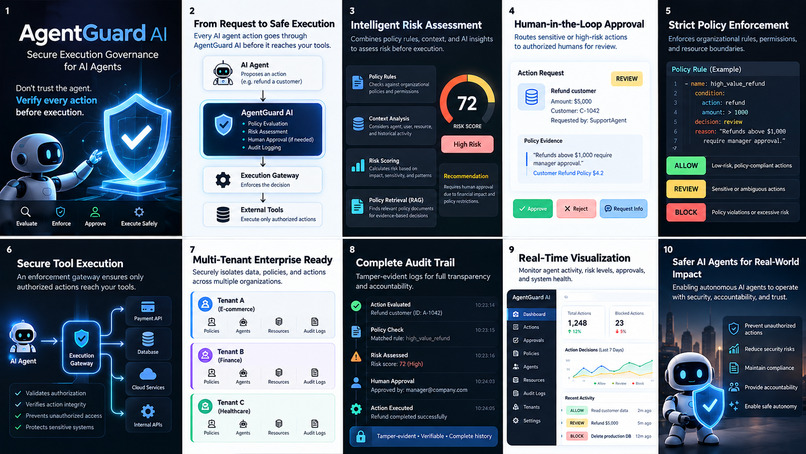
Complete Workflow
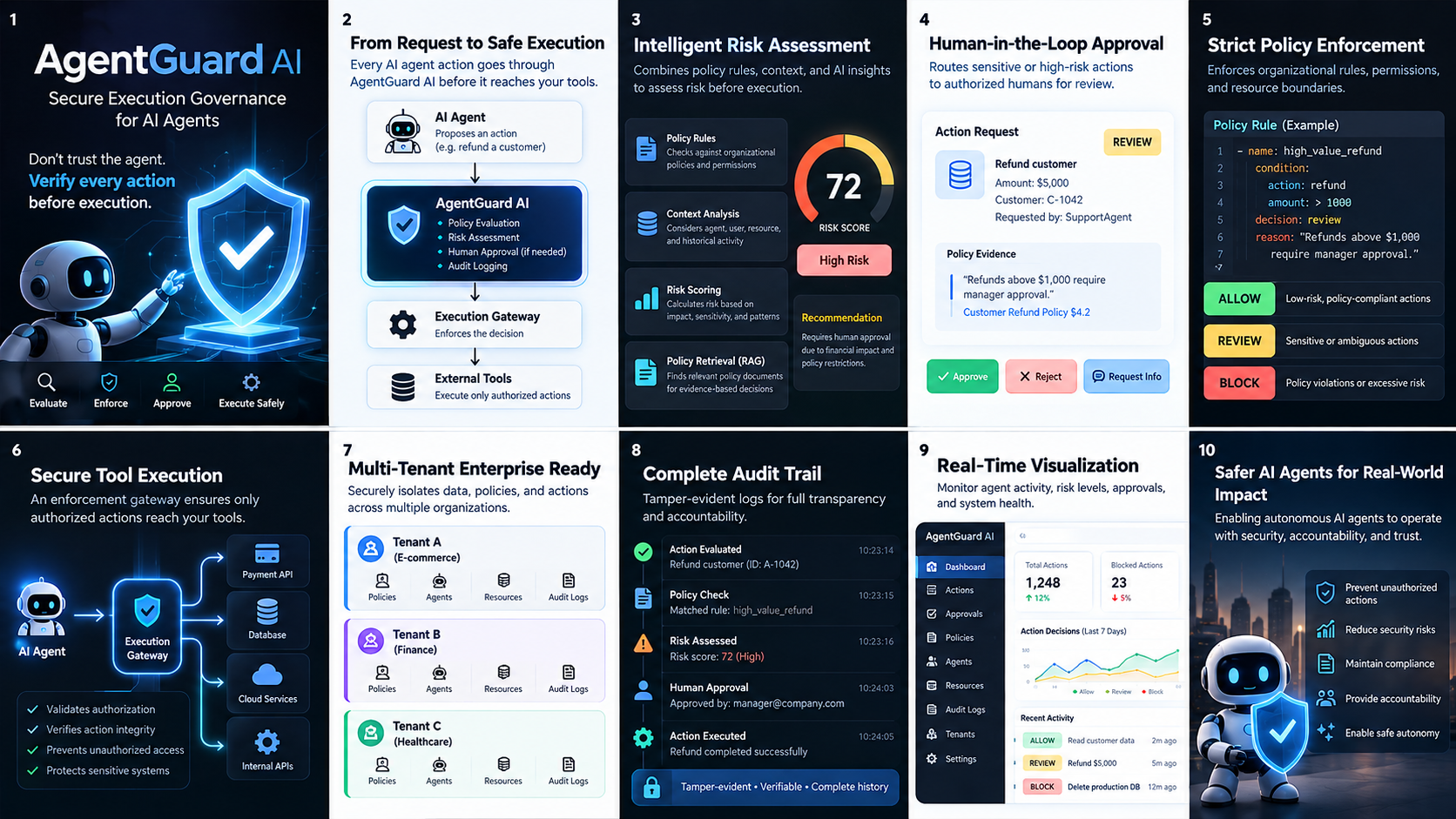
About AgentGuard AI
Inspiration 💡
Autonomous AI agents are becoming capable of interacting with enterprise tools, databases, APIs, and financial systems. However, granting an AI agent the ability to act also creates risks: a single incorrect decision, manipulated instruction, or unauthorized tool call could cause significant damage.
We were inspired by a fundamental question: What if every AI agent action had to pass a security check before execution?
This led to AgentGuard AI, a pre-execution governance layer designed to evaluate, authorize, review, or block actions before they reach sensitive systems. Our guiding principle is simple: Don't trust the agent. Verify the action.
What It Does 🛡️
AgentGuard AI acts as a security checkpoint between autonomous AI agents and the tools they want to use. It evaluates proposed actions against policies, permissions, risk factors, and contextual information.
- ALLOW: Permit actions that satisfy the applicable security policies.
- REVIEW: Send sensitive or ambiguous actions for human approval.
- BLOCK: Reject actions that violate policies or exceed permitted risk limits.
The system is designed to support risk assessment, policy enforcement, human-in-the-loop approvals, audit logging, and cumulative risk checks. Its goal is to make autonomous AI systems more controllable, accountable, and secure.
How We Built It ⚙️
We designed AgentGuard AI around a separation of responsibilities: the AI agent proposes an action, the governance layer evaluates it, and an execution gateway enforces the authorization decision.
The prototype includes several core components:
- Policy Engine: Evaluates actions against configured rules and permission boundaries.
- Risk Assessment: Considers factors such as action type, potential impact, and cumulative activity.
- Approval Workflow: Supports human review for operations that require additional authorization.
- Execution Gateway: Provides an enforcement layer between the governance decision and the protected tool.
- Audit Trail: Records decisions to support traceability and investigation.
- Policy Document Retrieval: Explores retrieving relevant organizational policy documents to provide supporting evidence for action evaluation and human review.
We implemented a working prototype with a modular backend, API endpoints, policy and risk components, approval workflows, audit mechanisms, and simulated tool integrations. We also developed automated tests to validate important system behaviors.
Challenges We Faced 🧩
The most challenging part was recognizing that evaluating an action is not the same as securely enforcing a decision.
A governance system can return a BLOCK decision, but that decision is ineffective if an agent can bypass the gateway or access a tool using unrestricted credentials. Similarly, an approval must apply only to the exact action reviewed; otherwise, an attacker could modify an approved request before execution.
We also explored challenges involving:
- Preventing unauthorized access and forged role claims.
- Maintaining strict isolation between different tenants.
- Preventing repeated or replayed authorization requests.
- Handling failures safely rather than accidentally allowing risky operations.
- Treating retrieved documents and external content as untrusted inputs.
- Maintaining reliable, tamper-evident audit records.
- Balancing security controls with usability and low-latency execution.
These challenges helped us understand that security must be enforced at the actual execution boundary, not merely represented in an API response or dashboard.
What We Learned 📚
Building AgentGuard AI taught us to think beyond AI model accuracy and focus on the security of the entire action lifecycle. We learned the importance of least-privilege access, server-side authorization, tenant isolation, action-bound approvals, replay protection, and fail-closed behavior.
We also learned that passing automated tests is valuable but does not prove that a system is secure. Security requires adversarial testing, careful threat modeling, and verification of the complete path from an agent's request to the tool's execution.
What's Next 🚀
Our next steps are to strengthen identity verification and role-based access control, enforce tenant-scoped authorization, validate signed and single-use authorization tokens at the tool boundary, improve idempotency and concurrency handling, and expand adversarial security testing.
We also aim to improve policy-document retrieval, integrate additional enterprise tools, and develop clearer approval and audit interfaces.
AgentGuard AI is our step toward a future where AI agents can operate autonomously without receiving unchecked authority.We believe autonomy and accountability should work together: agents may propose actions, but security policies and authorized humans must retain control over what actually executes.


Log in or sign up for Devpost to join the conversation.