Inspiration
As AI agents become more capable, they are moving beyond answering questions and starting to perform real-world tasks, including purchasing products, paying vendors, and managing subscriptions.
But giving an AI agent access to payments introduces an important question: How can we trust an AI agent with money?
An agent might misunderstand a request, select an unverified vendor, or be manipulated by malicious instructions. We were inspired to build AgentGate to address this trust gap.
Our vision was to create a secure layer between autonomous AI agents and payment systems that allows agents to make payments while keeping spending under control and humans in charge of important decisions.
What it does
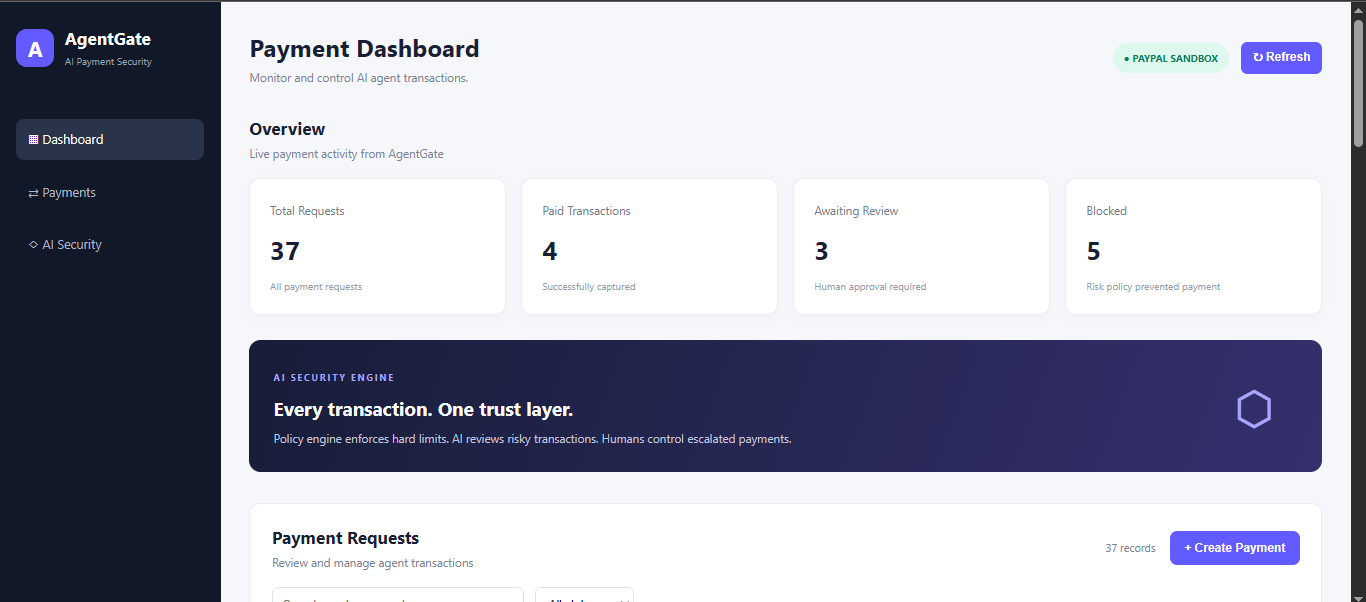
AgentGate – Secure AI Agent Payments is an AI-powered payment security and approval platform that protects transactions initiated by autonomous AI agents.
It evaluates every payment request through a combination of predefined spending policies and AI-powered risk assessment.
Its key features include:
Policy Engine: Enforces transaction limits, spending rules, and an approved vendor list.
AI Risk Assessment: Reviews suspicious or unusual transactions and provides a decision with a human-readable explanation.
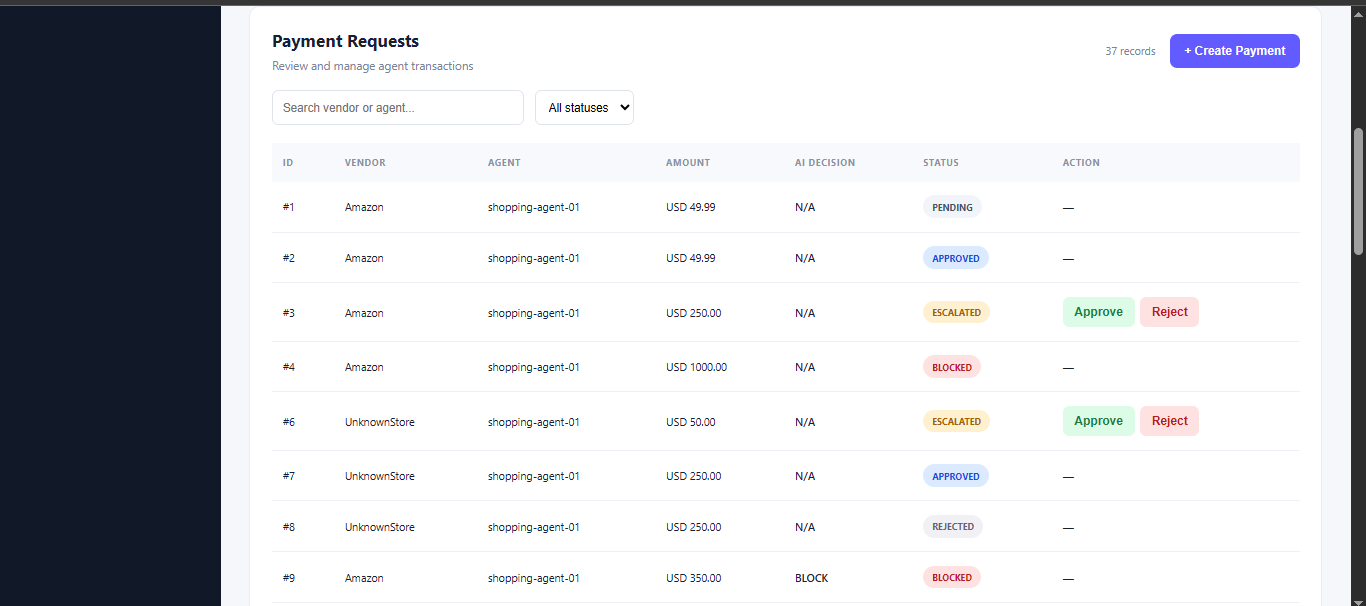
Human-in-the-Loop Approval: Sends uncertain transactions for manual approval or rejection through the dashboard.
PayPal Integration: Creates PayPal Sandbox orders and securely captures approved payments.
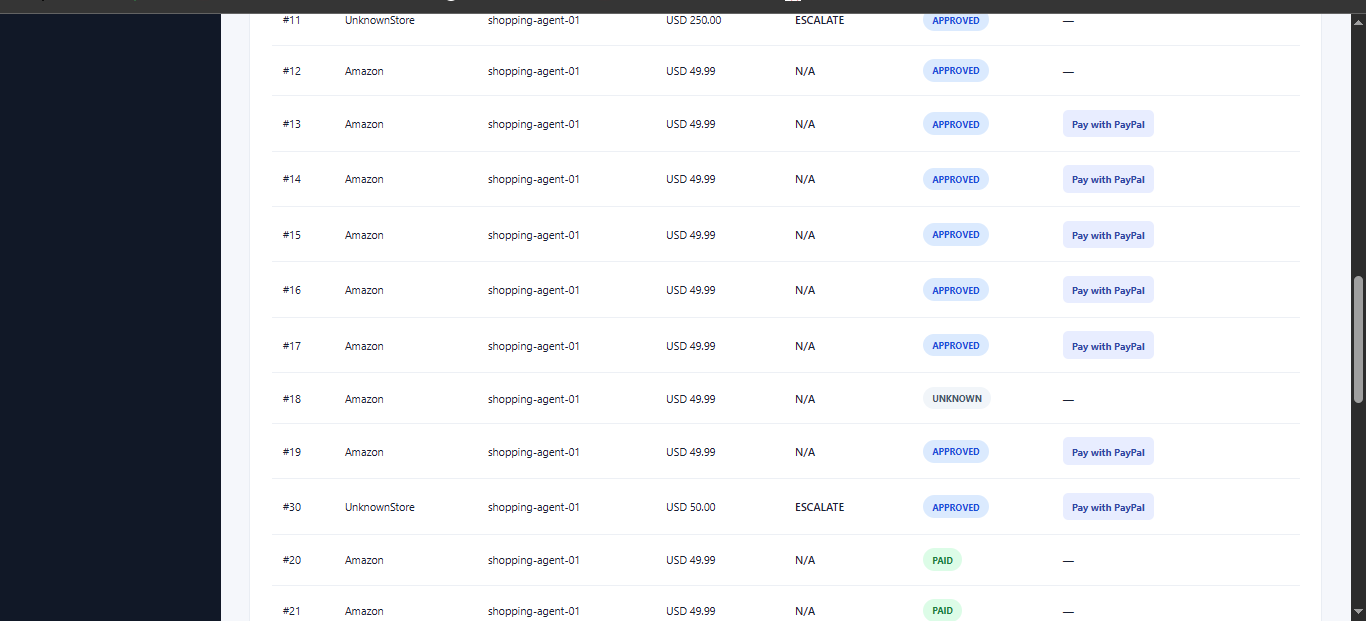
Payment Dashboard: Displays payment requests, amounts, vendors, decisions, and transaction statuses.
Audit Trail: Stores payment information and decision outcomes in PostgreSQL.
AgentGate supports three main outcomes:
ALLOW: The payment satisfies the policy rules and can proceed.
ESCALATE: The payment requires human verification.
BLOCK: The payment violates a security rule or is identified as high risk.
An important security principle is that AI can make a decision more restrictive, but it cannot override hard spending limits or approve a transaction that the policy engine has blocked.
How we built it
We built AgentGate as a full-stack application using Java and Spring Boot.
The backend handles payment requests, policy evaluation, AI risk assessment, human approval workflows, and PayPal communication.
The main technologies used were:
Java 17 – Core application logic.
Spring Boot – REST APIs and backend architecture.
Spring Data JPA / Hibernate – Database operations.
PostgreSQL – Persistent storage of payment requests and transaction records.
PayPal Server SDK – Creating and capturing PayPal orders.
PayPal Sandbox – Testing payments without transferring real money.
HTML, CSS, and JavaScript – Interactive payment dashboard.
Maven – Dependency management and project builds.
The payment workflow is:
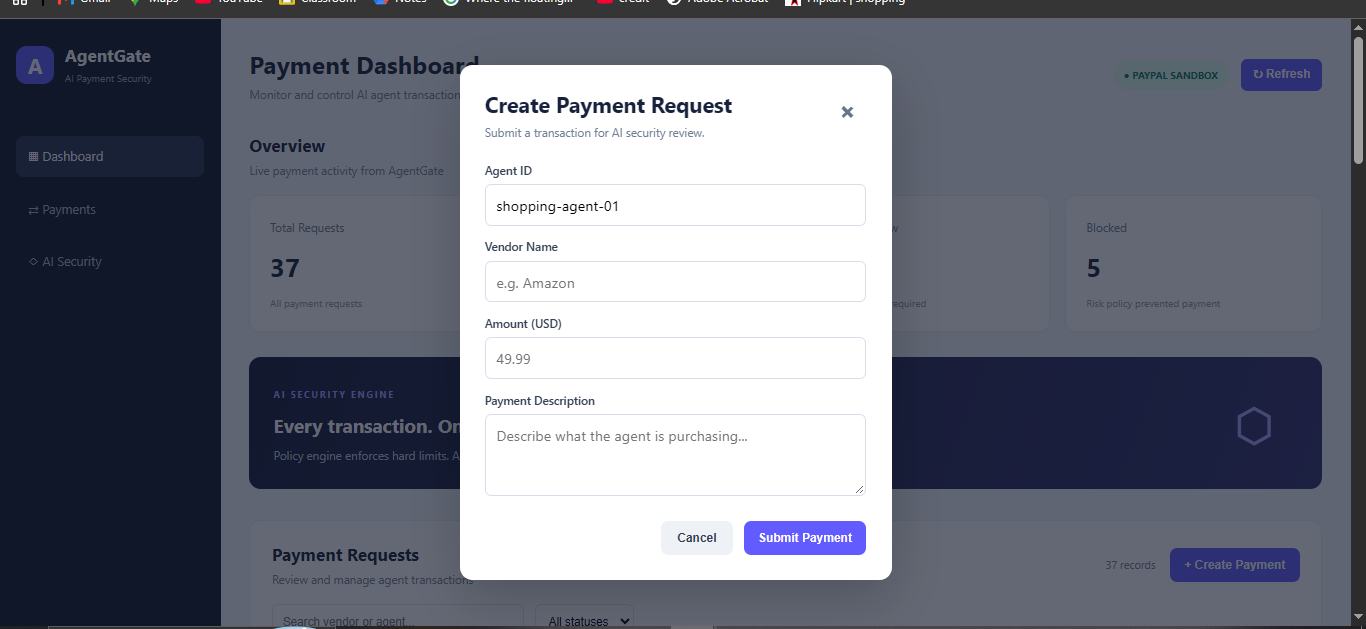
An AI agent submits a payment request.
The Policy Engine checks the vendor, transaction amount, and spending rules.
The AI Risk Reviewer evaluates transactions that need additional scrutiny.
AgentGate allows, escalates, or blocks the payment.
If human approval is required, an administrator can approve or reject it from the dashboard.
Approved payments proceed through PayPal Sandbox checkout.
After successful checkout, AgentGate captures the payment and updates its status in PostgreSQL.
We tested the complete workflow, including creating a payment from the dashboard, completing PayPal Sandbox checkout, capturing the payment, and verifying the final PAID status in the database.
Challenges we ran into
One of our biggest challenges was integrating PayPal Sandbox with our Spring Boot application.
We faced authentication and OAuth token issues while connecting to the PayPal API. We also encountered problems with payment order creation, checkout redirects, and payment capture. We resolved these issues by checking the API responses, validating credentials, and testing the order lifecycle step by step.
Another challenge was designing the relationship between policy-based decisions and AI-based risk assessment. We wanted AI to improve transaction security without giving it unrestricted authority over payments.
We addressed this by ensuring that hard policy rules remain authoritative and AI can only make decisions more restrictive.
We also worked through backend validation, database persistence, payment status management, and frontend integration to make sure the complete workflow functioned reliably.
Accomplishments that we're proud of
We are proud to have built a working end-to-end prototype that connects AI-assisted payment decisions with a real payment provider's sandbox environment.
Some of our key accomplishments include:
Successfully integrated PayPal Sandbox order creation and payment capture.
Implemented automatic payment approval for transactions that satisfy predefined policies.
Built an AI-assisted risk review process for suspicious transactions.
Implemented human approval and rejection for escalated payments.
Prevented high-risk transactions from proceeding.
Built a dashboard to monitor payment requests and their statuses.
Persisted payment and transaction information in PostgreSQL.
Successfully completed an end-to-end PayPal Sandbox payment and verified its PAID status in the database.
Most importantly, we demonstrated that autonomous payments can be made more controlled, transparent, and accountable.
What we learned
Throughout this project, we learned how to integrate a payment provider into a Spring Boot application and manage the complete payment lifecycle.
We gained practical experience with REST API development, PostgreSQL, JPA, OAuth authentication, PayPal order creation, payment capture, and frontend-backend communication.
We also learned an important lesson about AI in financial workflows: AI should assist decision-making, but critical financial controls should remain deterministic, transparent, and enforceable.
Building AgentGate helped us understand that trust in autonomous systems requires more than intelligence. It requires policies, human oversight, accountability, and reliable execution.
What's next for AgentGate – Secure AI Agent Payments
We see AgentGate as a foundation for a broader trust and security platform for autonomous AI agents.
Our future plans include:
Integrating more advanced AI risk analysis and anomaly detection.
Supporting multiple payment providers.
Introducing configurable spending policies for different agents and organizations.
Adding daily, weekly, and monthly budget controls.
Implementing role-based access control for administrators and approvers.
Supporting recurring payments and subscription monitoring.
Adding real-time notifications for escalated and completed transactions.
Exploring integrations with popular AI agent frameworks.
Our long-term vision is to make AgentGate a trusted payment gateway for the growing ecosystem of autonomous AI agents, enabling them to transact independently while keeping humans in control.
Built With
- css
- hibernate
- html
- java
- javascript
- maven
- paypal
- paypalsandbox
- postgresql
- restapi
- springboot
- springdatajpa
