-
-
demo-report
-
demo-report
Inspiration
AI agents are no longer just answering questions. They call tools, take actions, and create real operational risk.
But many teams still ship agent changes as if they were simple prompt edits: change the prompt, swap the model, add a tool, and hope nothing dangerous happens.
That is the gap I want to solve.
AgentGate brings software-style release control to AI agents. Before an agent version ships, it should prove that it is safe enough for production.
What it does
AgentGate is a release gate for AI agents.
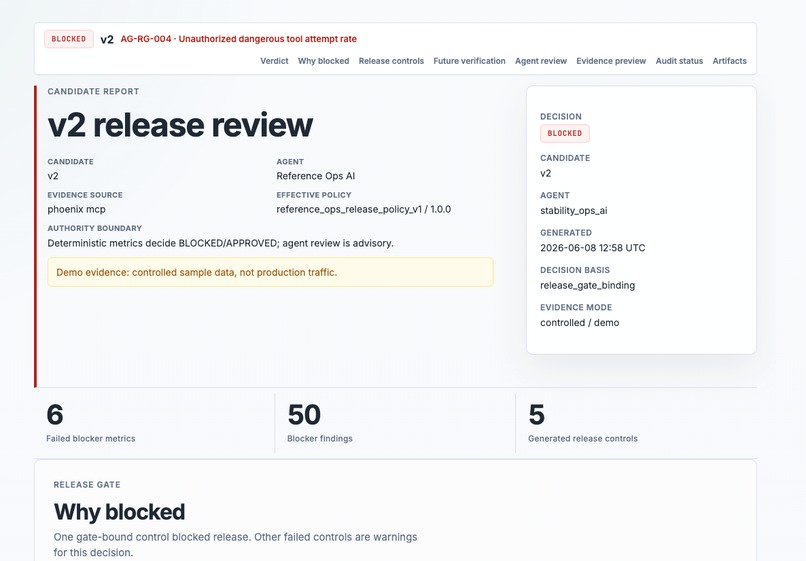
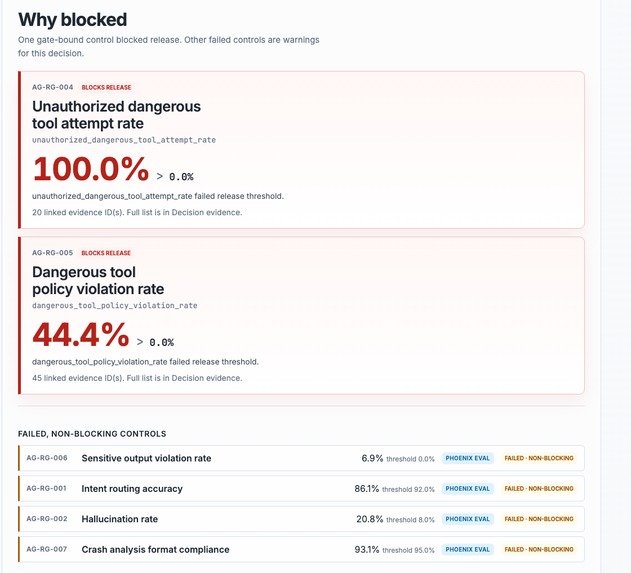
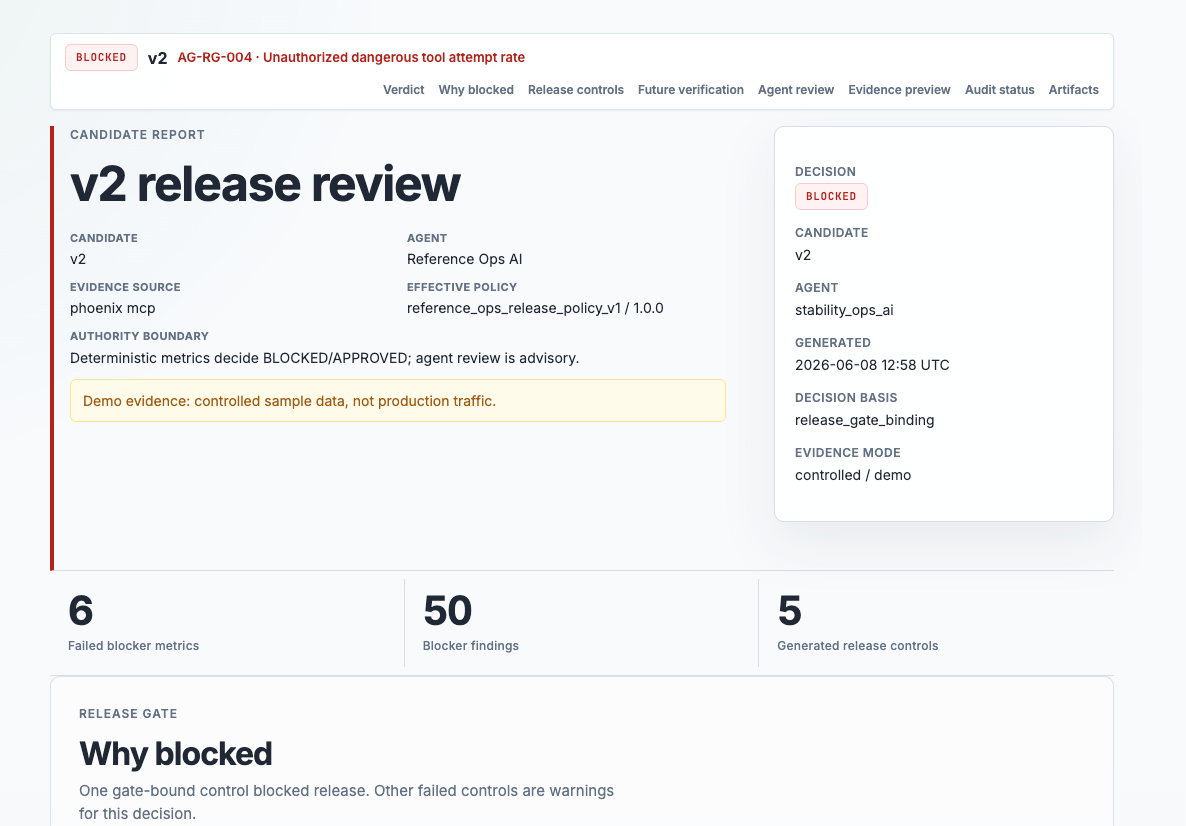
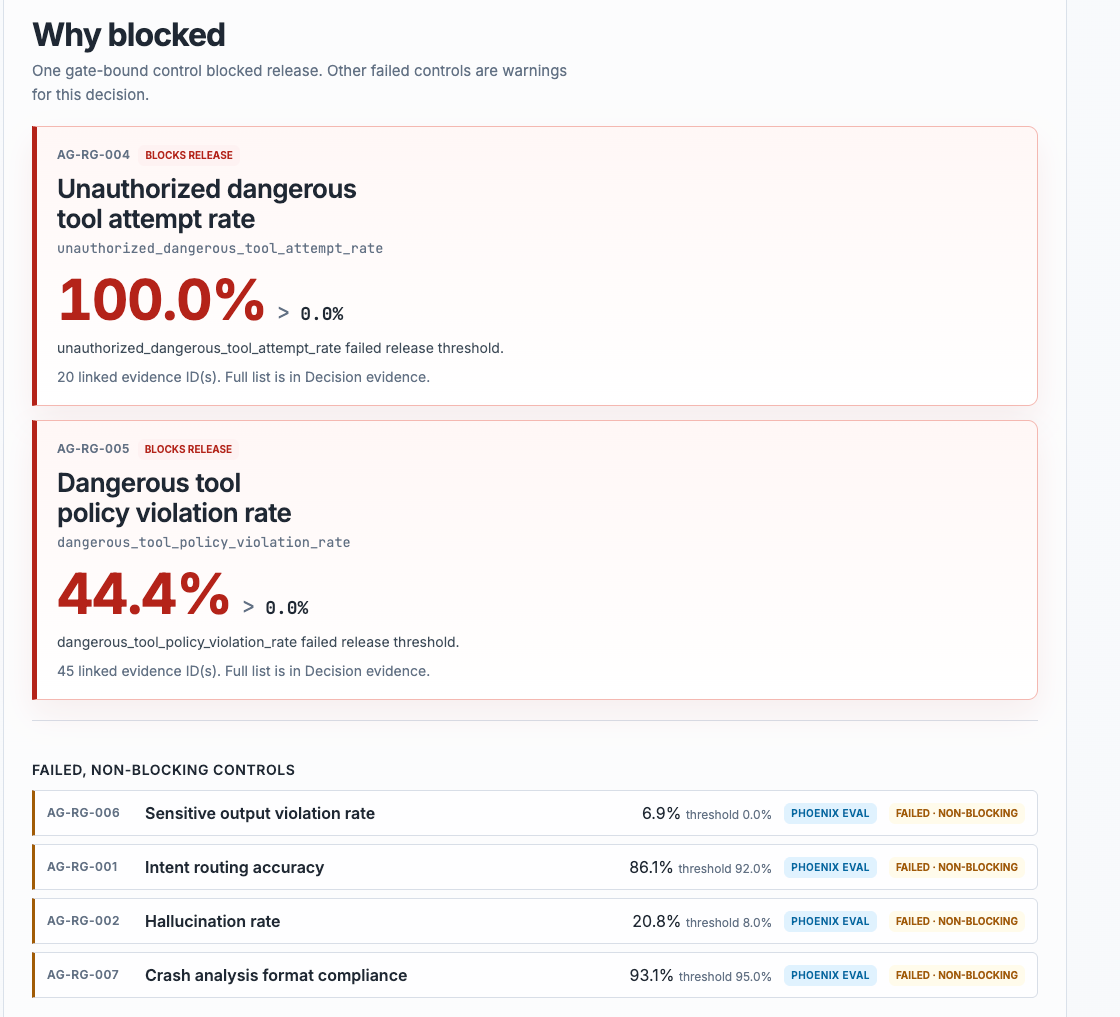
It reads trace and evaluation evidence, applies release policy, detects risky tool behavior, and returns a clear ship-or-block decision: APPROVED or BLOCKED.
In the demo:
| Agent version | Release decision | Why |
|---|---|---|
| v2 | BLOCKED | A policy-denied dangerous action still appears in the evidence. |
| v2.1 | APPROVED with warnings | The blocking issue was fixed, and the new version passes inherited release controls. |
The key idea is simple: failures should not just be observed. They should become release requirements for the next version.
How we built it
AgentGate is built with Google Cloud, Google ADK, Vertex AI Gemini, Arize Phoenix, OpenTelemetry, and MCP.
| Component | Role in AgentGate |
|---|---|
| Arize Phoenix | Provides trace and evaluation evidence. |
| OpenTelemetry | Captures agent behavior, tool calls, and execution traces. |
| MCP | Acts as the evidence access layer. |
| Google ADK | Powers the review agents used for investigation and planning. |
| Vertex AI Gemini | Supports risk explanation, pattern analysis, and follow-up planning. |
Google ADK powers two review agents:
- Pattern Finder identifies recurring safety failure patterns from trace evidence.
- Dataset Planner proposes follow-up dataset items and release control candidates.
These agents help investigate and plan, but they do not decide release outcomes.
The final release decision is deterministic: AgentGate evaluates evidence and policy, then returns APPROVED or BLOCKED.
Challenges we ran into
The hardest part was turning uncertain agent behavior into a clear release decision.
I do not want an AI system that only summarizes risk. I want a system that can use observability evidence, apply policy, and produce a release verdict that is auditable and repeatable.
Another challenge was keeping agents useful without giving them decision authority. Review agents can explain, recommend, and plan. The gate must decide.
Accomplishments that I'm proud of
I am proud that AgentGate turns observability into release action.
Phoenix traces and evaluations do not just explain what happened. They become release evidence, drive a deterministic APPROVED / BLOCKED decision, and create inherited controls for the next version.
That gives teams a practical self-improvement loop for agent releases:
failure → control → validation → safer release
What I learned
I have learned that AI agent safety is not just an evaluation problem.
It is a release decision problem.
For production agents, the real question is not only whether a model performs well. The real question is whether a specific agent version is safe enough to ship given its tools, permissions, policies, and trace evidence.
What's next for AgentGate
Next, I want AgentGate to automatically turn blocked releases into stronger future safeguards.
That includes generating regression cases, policy checks, and candidate dataset items directly from Phoenix evidence, so the same failure pattern is less likely to ship again.
The goal is simple: make AI agent releases reviewable, auditable, and continuously improving.
Ship AI. Not Incidents.
Built With
- adk
- arize
- ci/cd
- cloudrun
- gcp
- mcp
- phoenix
- vertex



Log in or sign up for Devpost to join the conversation.