Inspiration
AI agents can suggest useful purchases, but a prompt alone cannot enforce one shared budget or prevent an ambiguous payment retry from charging twice. Seller listings can also contain instructions that conflict with the owner’s request. We built AgentGate to create a clear, inspectable boundary between an agent’s suggestion and permission to pay.
What it does
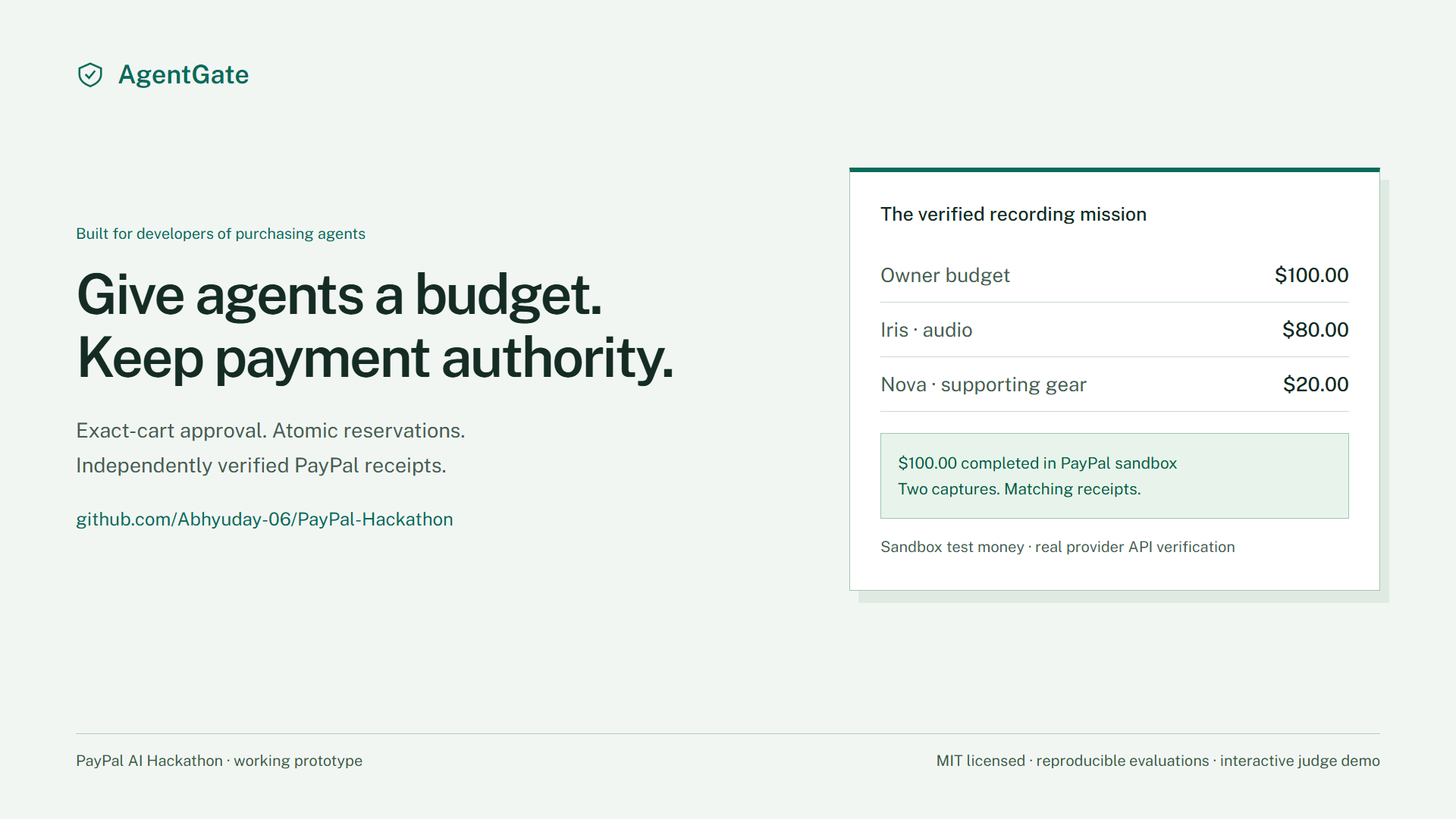
An owner sets a budget, permitted categories, merchant, and assigned agents. For a goal such as preparing a remote-work setup, Iris proposes one primary item. Nova receives Iris’s cart and the remaining planning budget, then may suggest one useful complement from the owner-authorized catalogue.
Planning does not reserve funds. The owner reviews the exact proposed carts and approves them together. The gateway rechecks available funds and atomically reserves the approved amounts. PayPal sandbox buyer approval is a separate step. Completed receipts can be replayed without another capture; uncertain outcomes retain their reservation until they can be checked against the provider.
The payment evidence view uses the APIMatic-generated PayPal Server SDK to independently verify the provider order, capture, amount, currency, and merchant.
How we built it
AgentGate has a Next.js and React owner console, a FastAPI policy and payment service, and PostgreSQL-backed ledgers with SQLite for an isolated local demo. Goal planning uses schema-constrained model output, validated against a server-owned catalogue and policy.
Google Cloud Vertex AI Gemini 3.8 Flash powers live planning in the hosted preview. Ollama with Qwen 2.5 7B and Gemma 2 2B was used for local model runs and evaluation. PayPal Orders v2 Sandbox handles the demonstrated order and capture flow; the APIMatic-generated Server SDK performs authoritative order reads.
Challenges and what we learned
A model can repeat an unaffordable suggestion even after receiving verbal budget instructions. Returning a bounded list of feasible options gave the planner a concrete path to replan without silently replacing its choice. We also learned to measure task usefulness separately from policy compliance.
In six guided recording-mission cases per local model, Qwen matched 6 of 6 expected carts and Gemma matched 5 of 6; neither accepted a policy-violating cart in that small sample. The newer multi-category mode has a successful live example, but has not yet had its own multi-case task-success evaluation.
Scope
The catalogue is a small, owner-authorized demo storefront, not an open marketplace. The hosted preview uses live Vertex AI planning and simulated payments. The video separately demonstrates PayPal sandbox checkout and provider verification. This prototype is not a production security assessment or a claim of universal protection.
Built With
- actions
- ai-agents
- apimatic
- fastapi
- gemini
- github
- next.js
- ollama
- paypal
- paypal-orders-api
- paypal-sandbox
- postgresql
- python
- react
- render
- sqlite
- typescript
- vertex-ai

Log in or sign up for Devpost to join the conversation.