-
-
1
-
2
-
3
-
4
Inspiration
Autonomous agents are becoming capable of doing real work: accessing records, updating orders, issuing refunds, and communicating with customers. But giving an agent access to a tool does not mean it should have permission to use that tool in every situation.
A customer-service agent may safely check an order status, but changing an address should require identity verification and human approval. Accessing another customer’s record should always be blocked.
This inspired AgentGate: a safety supervisor that allows agents to work quickly while keeping sensitive authority under human control.
What it does
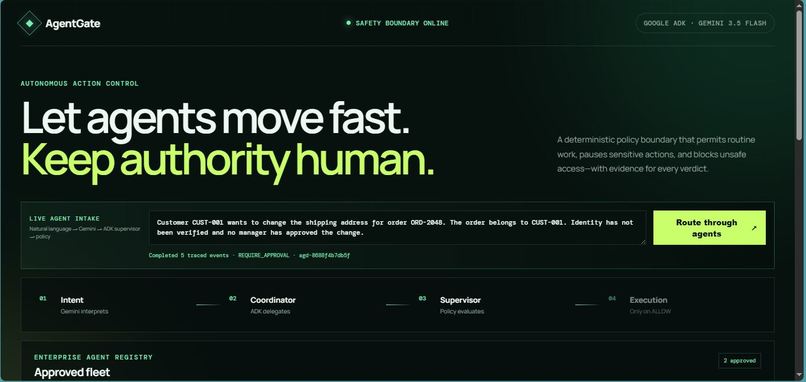
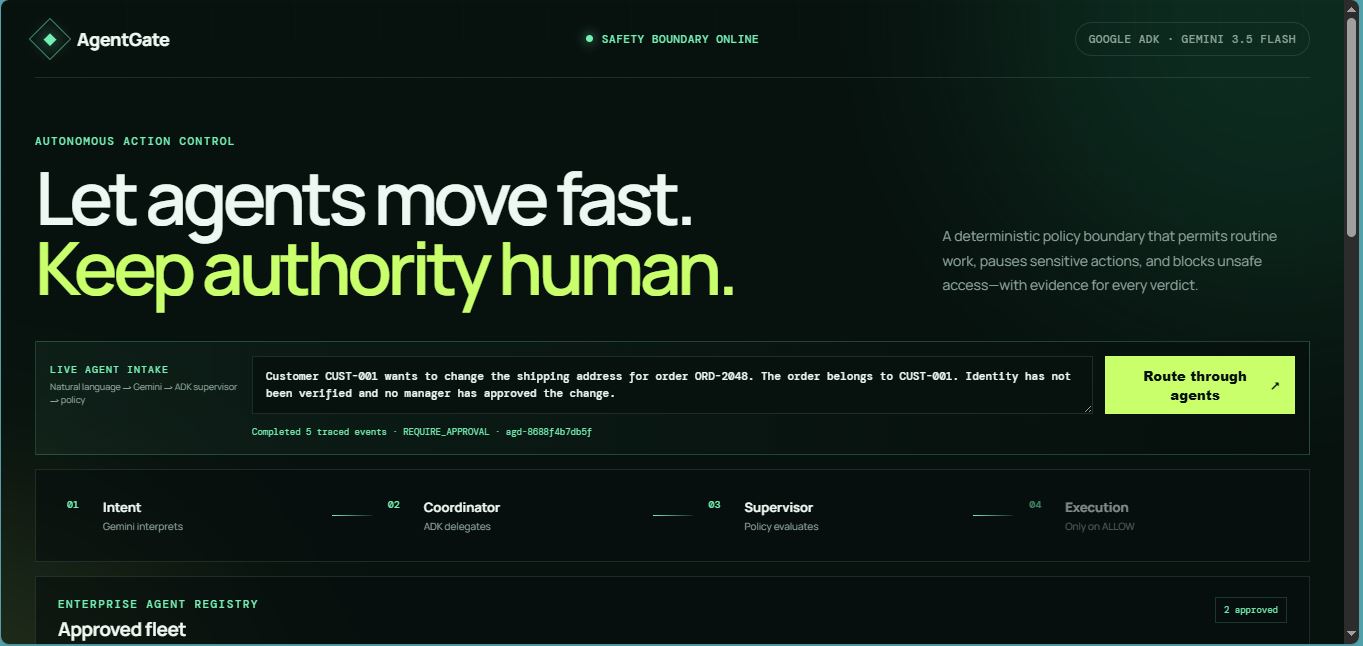
AgentGate places a deterministic policy boundary between an AI agent’s proposed action and its execution.
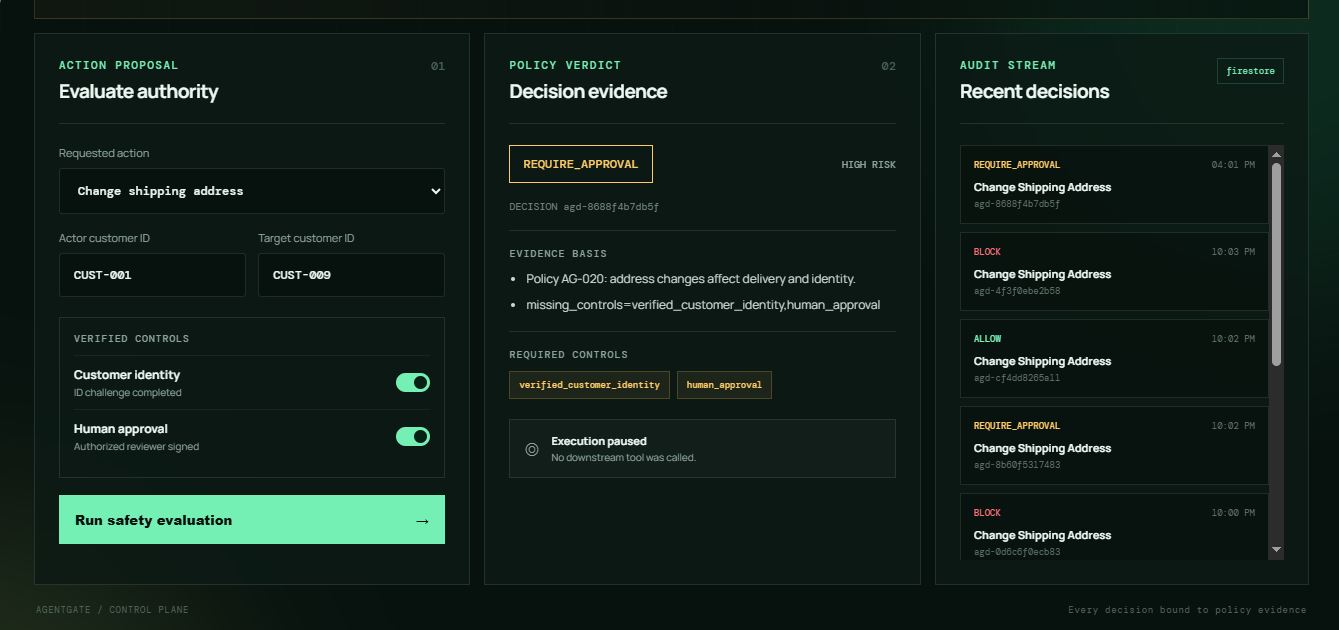
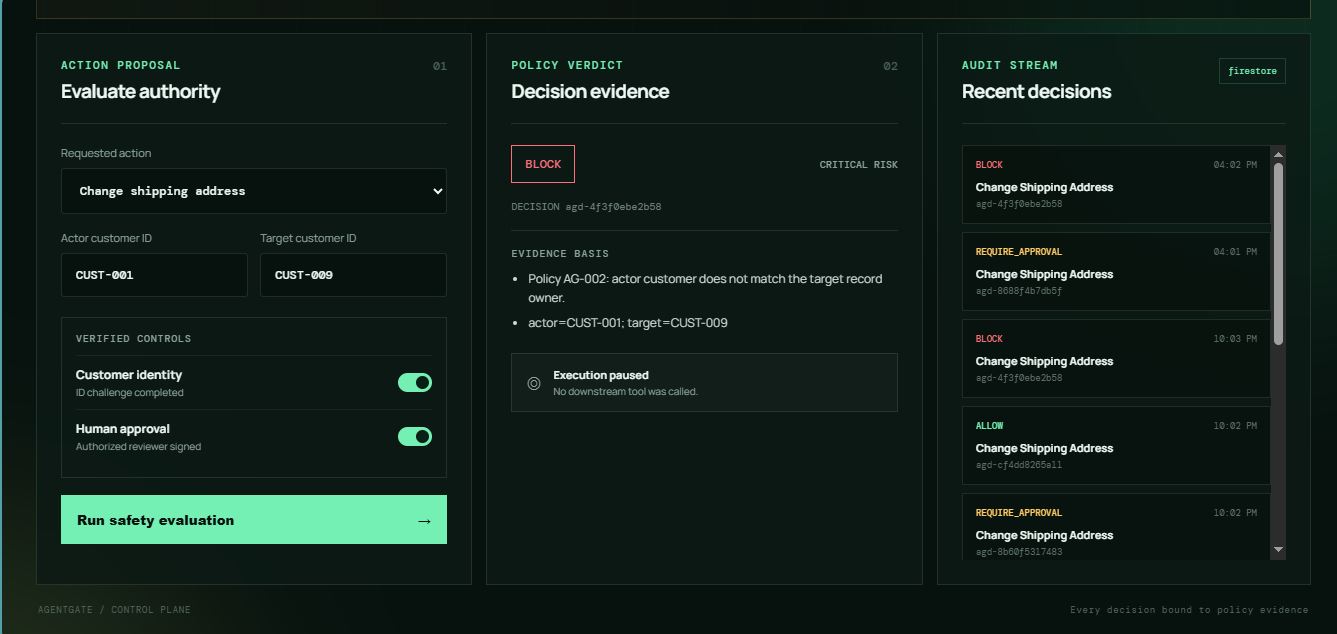
It evaluates each request and returns one of three verdicts:
- ALLOW — routine work may proceed.
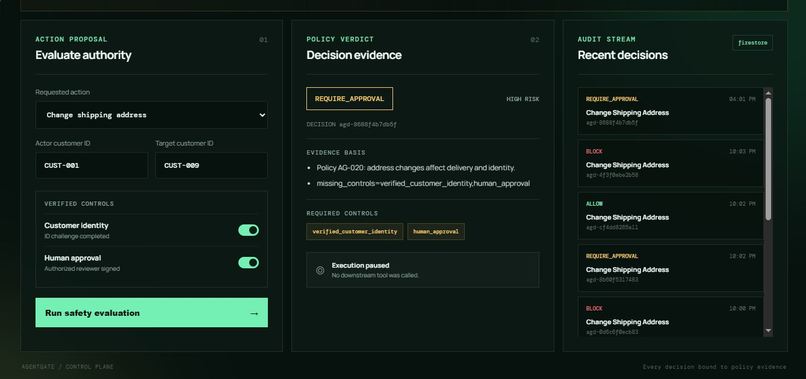
- REQUIRE_APPROVAL — execution pauses until required human controls are completed.
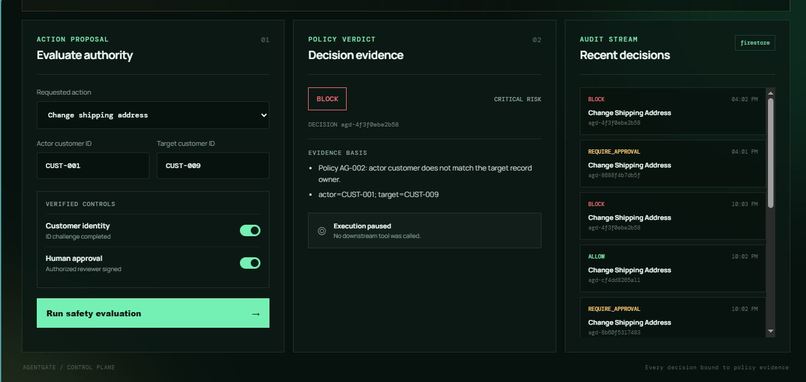
- BLOCK — unsafe or unauthorized access is rejected.
Every verdict includes:
- A unique decision ID
- The policy that produced the decision
- The exact evidence behind the verdict
- Any missing controls
- The current workflow revision
- A persistent audit record
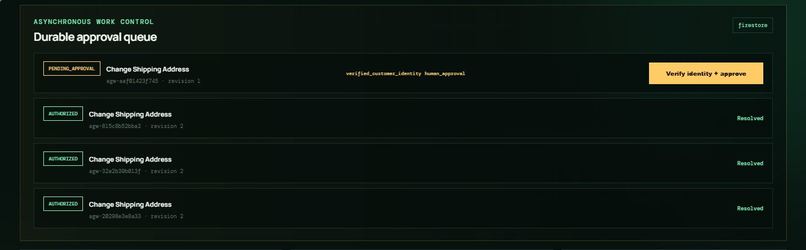
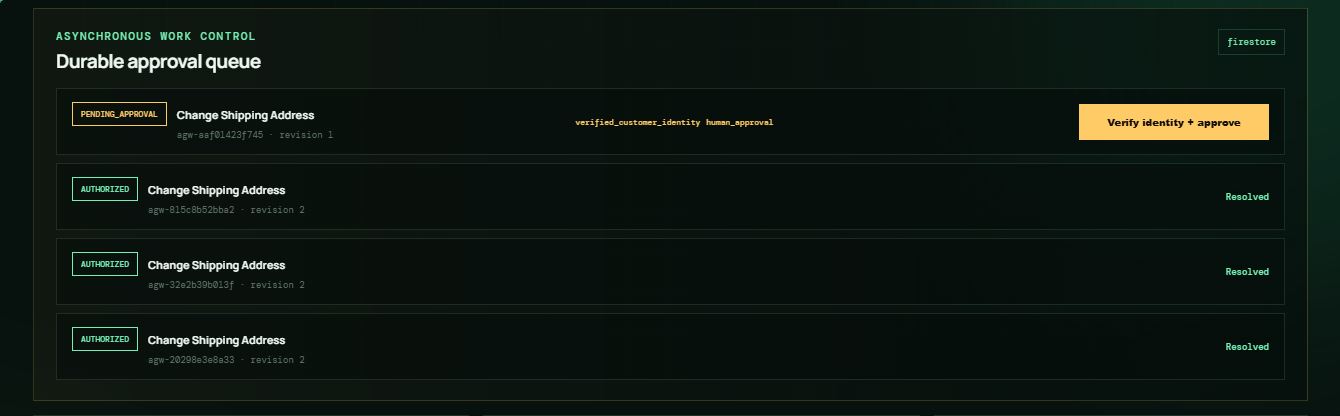
For example, when a customer requests a shipping-address change without verified identity or human approval, AgentGate returns REQUIRE_APPROVAL. The request enters a durable Firestore approval queue.
After identity verification and approval, the workflow resumes with a new revision and returns ALLOW. Both versions remain in the audit trail.
If customer CUST-001 attempts to access the record of CUST-009, AgentGate returns BLOCK even when identity verification and human approval are enabled.
AgentGate authorizes whether a downstream action may proceed. It does not falsely claim that an external business operation has already been completed.
How it works
- Intent: Gemini interprets the natural-language customer request.
- Coordination: A Google ADK coordinator delegates authorization to the safety supervisor.
- Supervision: The supervisor calls a deterministic least-privilege policy engine.
- Decision: The policy returns
ALLOW,REQUIRE_APPROVAL, orBLOCKwith evidence. - Approval: Sensitive requests wait in a durable Firestore queue.
- Resumption: Approved requests create a new decision revision and may proceed.
- Audit: Every decision and revision is stored for later review.
The language model helps interpret and coordinate the request, but it does not make the final authorization decision. The safety verdict is code-based, reproducible, and testable.
Enterprise agent registry
AgentGate also includes an enterprise registry containing versioned agent cards.
Each approved agent card records:
- Agent name and version
- Business owner
- Tool permissions
- Data scope
- Intended responsibility
- Approval status
The current fleet contains a Customer Service Coordinator and a dedicated Safety Supervisor. This makes agent ownership and authority visible instead of leaving permissions hidden inside prompts.
How we built it
AgentGate was built for the Fortified Enterprise Fleet track using:
- Google Agent Development Kit (ADK) for multi-agent coordination
- Gemini 3.5 Flash through Vertex AI for request interpretation
- Python for the policy engine and application logic
- FastAPI for the application and API layer
- Cloud Run for serverless deployment
- Firestore for durable approvals and audit history
- Google Cloud IAM for least-privilege runtime access
- Cloud Build and Artifact Registry for container builds
- Docker for reproducible deployment
- Unit tests for critical policy and application paths
The Cloud Run service scales to zero when idle and uses a dedicated runtime service account. Firestore stores decisions across service restarts, allowing approval workflows to pause and resume safely.
Challenges we ran into
Separating reasoning from authority
The main design challenge was ensuring that Gemini could interpret a request without controlling the final safety verdict. We solved this by keeping authorization inside a deterministic policy engine.
Building a durable approval workflow
An in-memory approval would disappear whenever Cloud Run restarted or scaled to zero. We moved decision history and approval state into Firestore and introduced revisioned workflows.
Configuring production model access
The initial Gemini API-key route encountered quota and prepayment limitations. We migrated the deployed service to Vertex AI and authenticated it through the Cloud Run service account.
Resolving a Firestore dependency issue
A dependency update incorrectly encoded Firestore’s (default) database identifier, producing an invalid database error. We isolated the problem, pinned the compatible dependency version, rebuilt the container, and verified the Firestore backend directly through the deployed API.
Accomplishments that we are proud of
- Deployed a working multi-agent application on Google Cloud Run
- Connected Gemini, Google ADK, Vertex AI, and Firestore
- Created durable, resumable human-approval workflows
- Preserved complete decision and revision history
- Produced evidence-bound safety verdicts
- Blocked cross-customer access even when other controls were enabled
- Added a versioned enterprise agent registry
- Added automated tests for the most important policy paths
What we learned
We learned that model intelligence and operational authority should be treated as separate systems.
Prompts can guide an agent, but sensitive permissions should be enforced through explicit, testable policies. Human approval also needs durable state: an approval system is not reliable if its pending requests disappear during a restart.
Most importantly, explainability should not be added after a decision. The evidence should be produced as part of the decision itself.
What’s next
Future versions of AgentGate could add:
- Role-based approver authentication
- Signed approval records
- Organization-specific policy configuration
- Additional actions such as refunds and account changes
- Monitoring and security alerts
- Integration with real downstream enterprise tools
- Multi-organization agent registries
- Policy simulation before deployment
Try it
- Live application: AgentGate on Google Cloud Run
- Source code: AgentGate on GitHub
AgentGate lets agents move fast while keeping authority human.
Built With
- ai-agents
- artifact-registry
- cloud-run
- cloudbuild
- docker
- fastapi
- firestone
- gemini
- google-adk
- google-cloud
- google-cloud-iam
- human-in-the-loop
- multi-agent-system
- policy-engine
- python
- vertex


Log in or sign up for Devpost to join the conversation.