Inspiration
Workflow automation tools are powerful and hostile. Building anything real in n8n, Zapier or Make means knowing which of hundreds of nodes exist, what each one expects, and how to wire them together — before you get any value at all. The tool assumes you already know the shape of the solution.
Two things follow from that. The blank canvas is the hardest part, and most people who would benefit from automation never get past it. And the workflows you can build are static: every branch has to be anticipated and hand-wired at design time, so anything requiring actual judgement — "is this customer complaint urgent?" — gets a brittle keyword rule, or a human.
I wanted to attack both at once. Describe the outcome, get a working workflow. And let the workflow itself make the judgement call at runtime, instead of pretending a regex can.
What it does
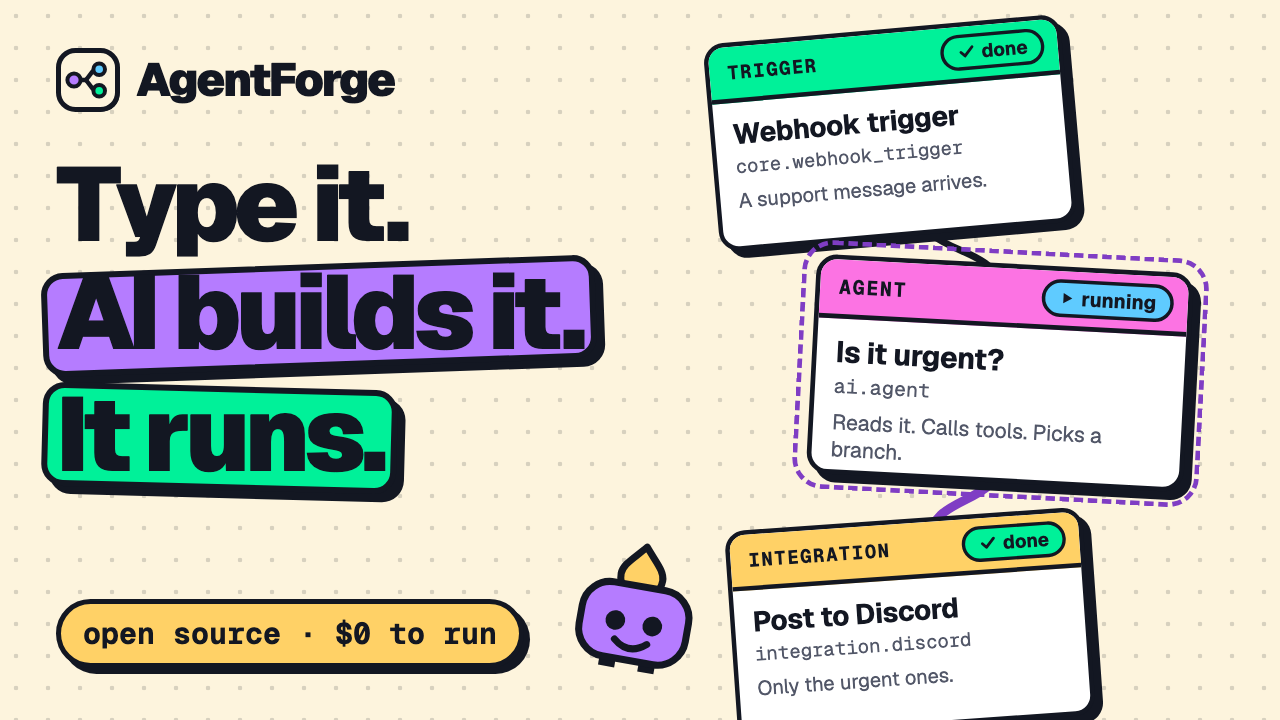
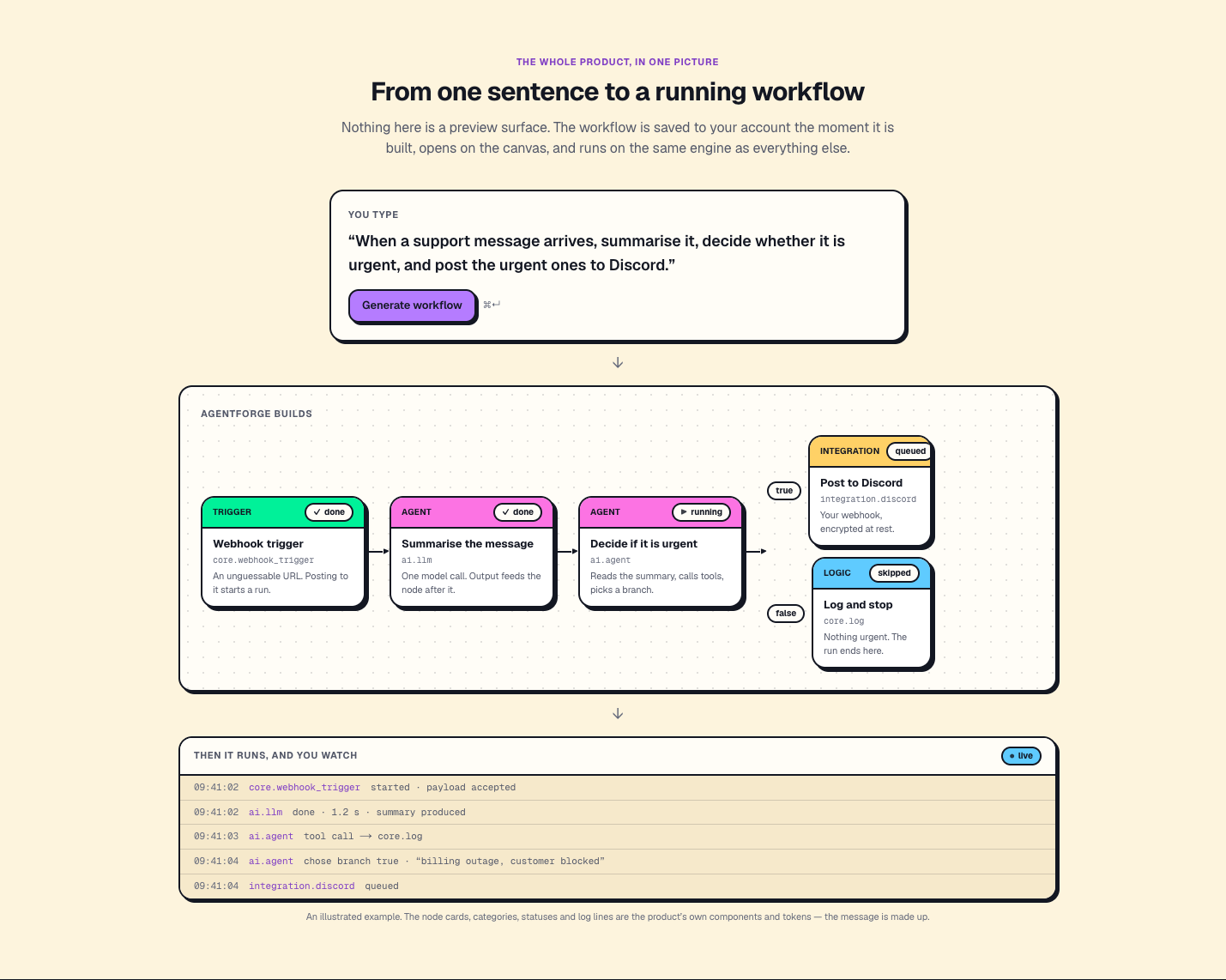
You type what you want in plain language — "when my form webhook fires, summarise the submission, decide whether it's urgent, post urgent ones to Discord, and log every one to my Google Sheet" — and AgentForge builds a real workflow on a canvas. Real nodes, real connections, saved to your account, editable field by field. Not a mockup, not a chat transcript.
Then it runs, and this is the part that isn't a flowchart: its agent nodes call other nodes as tools and decide what to do at runtime. Nobody wrote a rule for "urgent". The agent reads the message, judges it, and the workflow takes that branch. Send a polite feature request instead and it takes the other one.
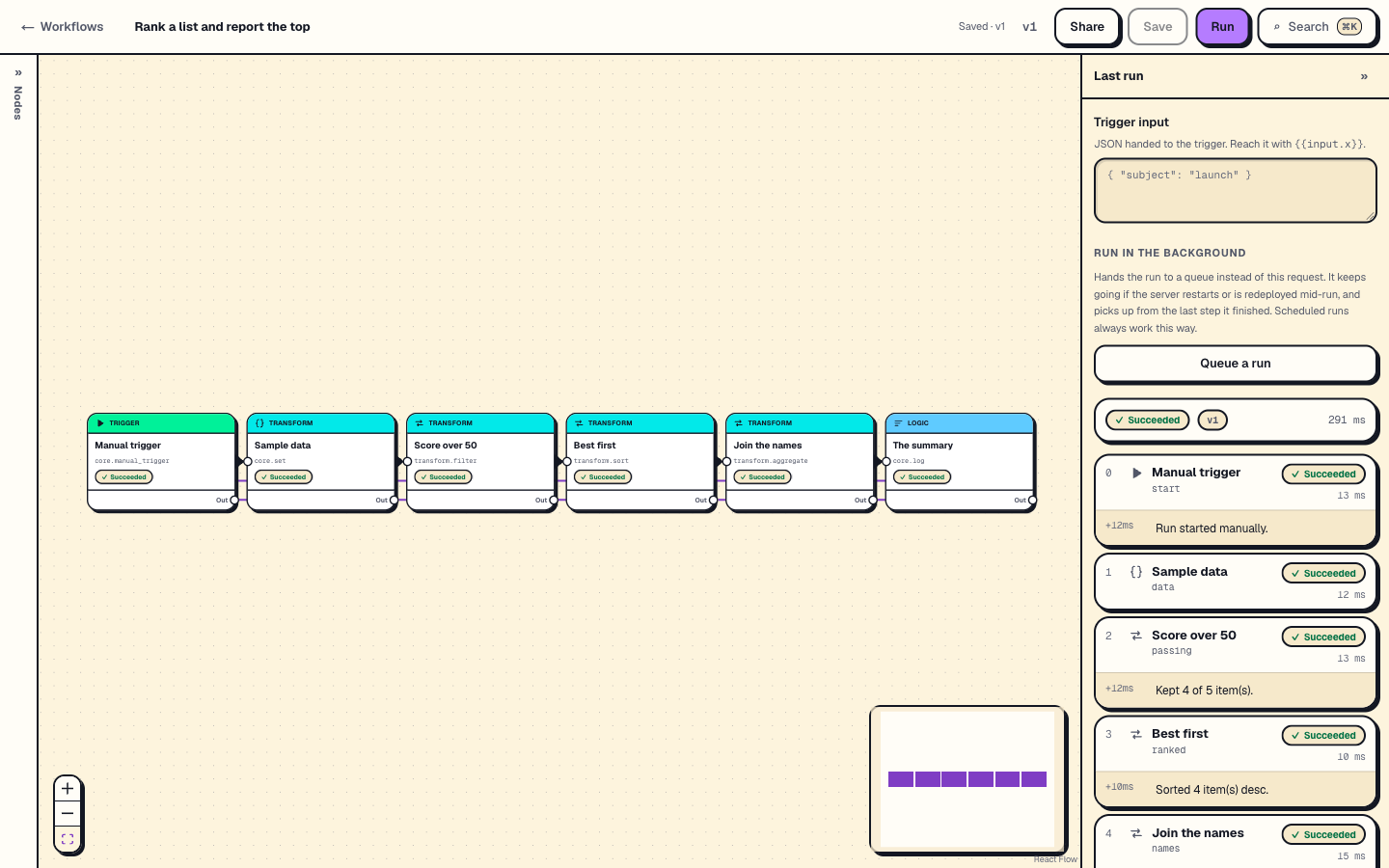
Start it from a webhook, a schedule, or a click. While it runs, per-node status and the agent's own reasoning stream live to the canvas over SSE — including for a run fired by an external webhook while you are just sitting there watching.
15 nodes across triggers, AI, logic, transform and integrations. Four integrations that reach real services: HTTP, Discord, Google Sheets, Gmail. It is deployed, public, and runs entirely on free tiers.
How we built it
One Next.js 16 container on Google Cloud Run serving both UI and API, Neon Postgres over Drizzle, Auth.js v5 with Google OAuth, React Flow for the canvas, Gemini behind a provider-agnostic adapter, and Cloud Scheduler for cron. No queue — the executor runs in-process. Nine runtime dependencies, no Redis, no worker, no component library, no test framework (tests run on Node's built-in runner).
The whole thing hangs on one design decision: a single node registry feeds three consumers — the execution engine's dispatch table, the canvas palette, and the agent's tool set. Three things fall out of that:
- Adding an integration automatically widens what the agent can do. No separate tool definitions, nothing to keep in sync.
- It is the security boundary. The agent can call registry entries and nothing else — no shell,
no filesystem, no arbitrary network. Each node opts in explicitly (
agentCallabledefaults to false), so adding a node can never silently widen the agent's reach. - The registry is the generator's entire vocabulary, so a natural-language request cannot
produce a workflow referencing something that does not exist. Whatever the model could not build
is reported back in
unsupportedrather than faked.
Two deliberate omissions. The Vercel AI SDK was adopted early and then dropped: Gemini signs
every functionCall with a thoughtSignature and returns 400 for a history that has lost one, so a
tidy normalising abstraction passes its first tool call and fails on the second. The adapter carries
the provider's own content back verbatim instead. And {{ }} is lookup, not an expression
language — no eval, no operators, no function calls, because a config field is exactly where
arbitrary code execution would re-enter the product. A test asserts that {{1+1}} stays literal.
This was built one phase per session with the context window cleared between every single one, so the repository — not the conversation — had to carry the whole state forward.
Challenges we ran into
A generated workflow can be valid and still do the wrong thing. The graph validates, the run
succeeds, and the behaviour is wrong — the failure mode nothing reports. It happened three distinct
ways. A model wrote {{steps.x.output}} where it meant {{steps.x.output.text}}, so a branch
compared the string "[object Object]" and took the wrong path. The fix was making every node
declare its own output shape and feeding that to the generator. Then, found only by rehearsing the
demo in a browser: 5 of 12 generations wrote maxIterations: 1 on the agent node — schema-valid,
graph-valid, and a guaranteed failure the moment the agent reaches for a tool, because it spends one
call making the tool call and needs a second to read the result. Now 0 of 12.
Testing the server is not testing the product. A 178-check API suite and a ten-walk smoke test both passed while a webhook-triggered run was completely invisible on the canvas. The page only opened a stream if it happened to load mid-run — and the demo fires from a terminal while the browser sits idle. The smoke script opens its own stream and fires 400 ms later, so it proved the server streams and never that the canvas was still listening 25 seconds after it loaded. A whole class of bug lived in that gap, and only driving a real browser found it.
Retrying is easy; knowing what not to retry is the work. The integrations shipped with no retry, so a single Discord 429 would end the demo with an empty channel. But a blanket retry is worse than none — a POST that creates may have taken effect before the response was lost, and two copies of the same message on a shared screen is not recoverable. So retries are opt-in per call site, HTTP 500 is deliberately excluded as ambiguous, and eight of the thirteen tests assert what must not be repeated.
An agent that can call an HTTP node is SSRF by design. Bounded by a guard rather than by trust:
HTTPS only, and every resolved address must be public — not any, or a split-DNS name passes the
check and fetch picks the other one.
Deployment lied to me more than once. A redirect built from request.url pointed at
0.0.0.0:8080 inside the container, so every successful Google connection landed on
ERR_CONNECTION_REFUSED — invisible to curl, obvious in a browser. A model catalogue listed models
the key could not actually call. And a demo spreadsheet set up by hand had its id recorded nowhere,
and the Sheets scope grants no way to search Drive, so it was simply gone and had to be recreated.
Accomplishments that we're proud of
It is live, and it has been live and verified since day one — every phase after the first deploy ended with the deployed system proven to still work, or the phase was not finished.
The demo path walks clean ten times in a row. Ten consecutive full end-to-end walks, zero failures, with the workflow generated correctly on the first attempt every time. Generation takes ~3 seconds; a six-node run completes in 3–5 seconds. 178 deployed API checks (176 pass, 0 fail, 2 skip by design) and 297 unit tests that need no database and no network.
The agent genuinely decides. It is not a scripted branch dressed up as reasoning — change the tone of the input and the workflow takes the other path, live, on stage.
Nine dependencies and one container. No queue, no worker, no microservices, and still real webhooks, real schedules, real streaming and four real integrations.
No arbitrary code execution anywhere in the product, not even "just for the demo" — and the registry makes that a structural property rather than a promise.
Rollback is tested, not assumed. A traffic shift to the previous revision takes ~15 seconds and I have actually done it.
What we learned
The repository is the memory. Building with the context cleared between every session meant anything not written down was genuinely gone. That turned documentation from overhead into the actual mechanism — and the lesson landed hardest with the spreadsheet that could not be found again. Setup that only exists in someone's terminal history is setup that is already lost. Everything that replaced it is created by a script that can be re-run.
Verify, never assume. A deploy that exits zero is not a working deploy. A catalogue of models is not the set of models your key can call. A demo script that has only ever been walked by a test harness is not a demo script — rehearsing this one in a real browser found three beats that could not have worked as written, including one that looked, from the terminal, like everything was fine.
Validation proves a workflow can run, never that it does what was asked. That gap is where every hard bug in this project lived.
Abstractions over LLM providers leak at exactly the wrong moment — the second tool call, not the first.
What's next for AgentForge
- Credential rotation — the sharpest missing piece. A stored Discord webhook and a workflow's own webhook token can currently only be replaced by recreating the thing that holds them.
- Human-in-the-loop approval nodes for actions that leave the account, so an agent can draft the email and a person is still the one to send it.
- More integrations — and because of the registry, each one also widens what the agent can do, for free.
- Workflow templates and a richer run-history view than the current per-run inspector.
- More providers behind the adapter — the seam is already there, it just has one implementation today.
Built With
- app-router
- auth
- drizzle
- gemini-api
- google-cloud
- next.js
- postgresql
- react
- react-flow


Log in or sign up for Devpost to join the conversation.