Inspiration
AI agents are powerful, but building one still takes coding skills, API keys, servers, and deployment knowledge. A shop owner who wants a customer support bot, or a student who wants a mock interviewer, usually can't build one, and hiring a developer is out of reach for many.
We asked a simple question: what if building an AI agent was as easy as describing it?
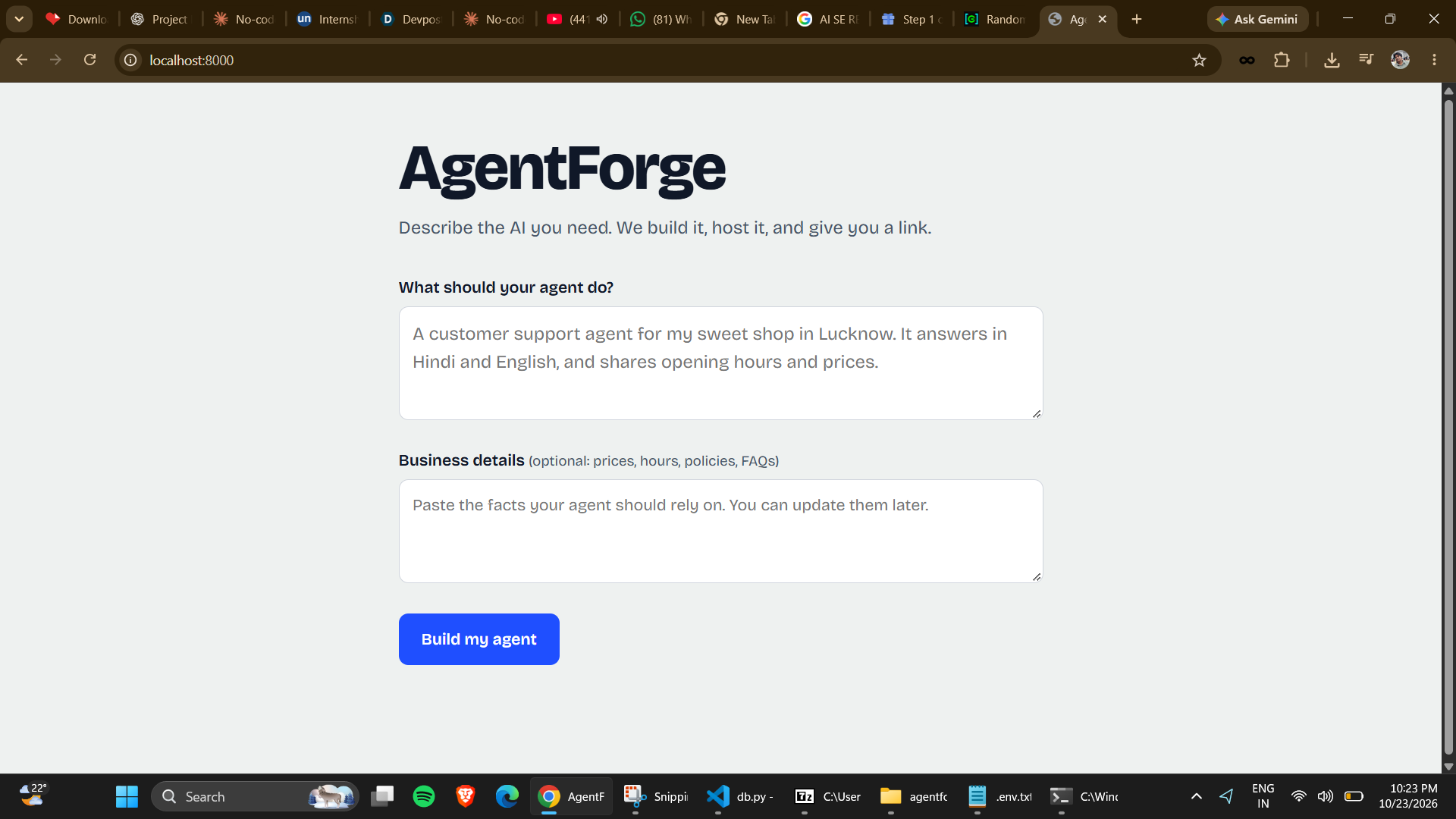
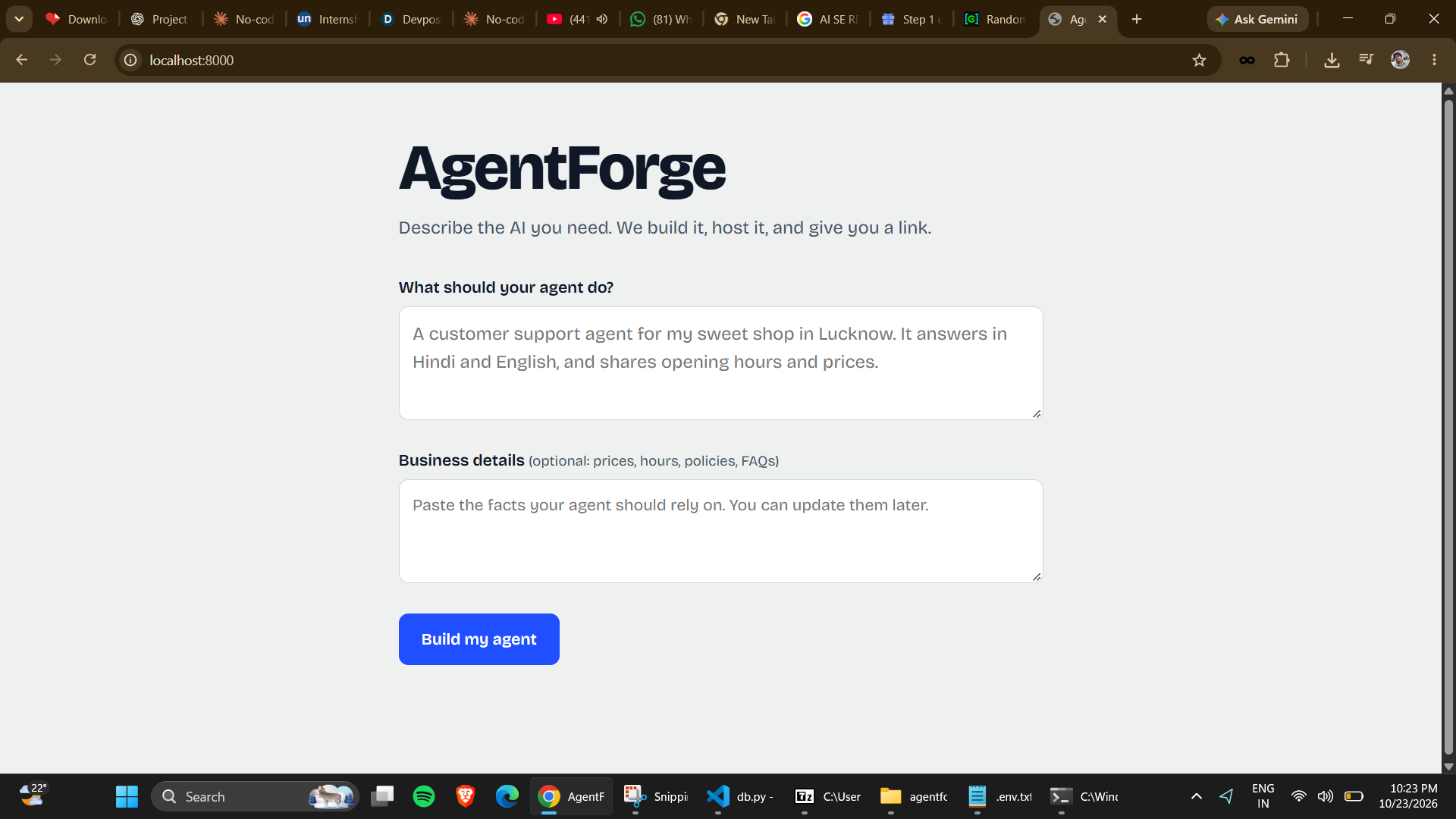
That idea became AgentForge: say what you want, and the platform builds, deploys, and hands you a working AI agent you can use right away.
What it does
AgentForge turns one plain-language command into a ready-to-use AI agent.
- Describe it: "I need a customer support AI for my shop."
- AgentForge builds it: it understands the request, picks a template, and generates the agent's prompt, knowledge, tools, and chat interface.
- It deploys automatically: the user gets a shareable link or chat widget.
- Use it immediately: no code, no setup, no server.
Our first templates are:
- Customer Support Agent: answers customer questions from the owner's own FAQs and documents, and hands off to a human when it isn't sure.
- Interview Agent: runs mock interviews for a chosen role and gives feedback and a score at the end.
How we built it
AgentForge has five layers:
| Layer | Role |
|---|---|
| Command Understanding | An LLM converts the user's request into a structured spec |
| Template Engine | Blueprints for each agent type |
| Builder | Generates the agent's config, system prompt, and UI |
| Deployer | Makes the agent live and returns a URL |
| Runtime + Memory | Runs agents and stores chat history and knowledge |
The key design decision was not to generate new code for every agent. Instead, one shared runtime serves every agent, and each agent is just a configuration (prompt, knowledge, tools, theme). This keeps the system cheaper, more reliable, and easier to secure.
Our stack: [your frontend, e.g. HTML/JS or React], [your backend, e.g. Node.js or FastAPI], the Claude API for language understanding, and [your database, e.g. Postgres / Neo4j / vector DB].
For cost planning, we estimate the monthly cost of one agent as:
$$C_{agent} = M \times (T_{in} \cdot p_{in} + T_{out} \cdot p_{out})$$
where $M$ is the number of messages, $T$ is tokens per message, and $p$ is the price per token. This is why usage limits and plans are part of the design from the start.
Challenges we faced
- Keeping answers grounded: a support bot that makes things up is worse than none, so we restrict answers to the uploaded knowledge and add a human-handoff path.
- Cost control: every message costs money, so we had to think about limits and pricing early.
- Isolation and security: user-created agents must never see each other's data, and agents that read documents have to resist prompt injection.
- Quality before delivery: an agent shouldn't be handed over untested, so we are adding an automatic test step where the builder asks the new agent a few questions first.
- Scoping: the vision is huge, so we focused on one working flow (command → agent → link) before adding more.
What we learned
- Config-driven agents scale far better than generating code for each one.
- Non-technical users need simple outcomes, not options. The fewer questions we ask, the better.
- Trust matters more than cleverness: grounded answers, honest handoffs, and testing build confidence.
- A strong template beats a blank canvas. Most people want "a support bot", not "a configurable agent framework".
What's next
- Knowledge upload (PDFs and docs) and tools like email and WhatsApp
- Voice agents and an analytics dashboard
- A marketplace where people share and sell their agents
- Custom domains and team accounts
AgentForge: Say it. Build it. Use it.
Built With
- ai-agents
- anthropic-api
- claude
- cloudflare
- css3
- docker
- fastapi
- generative-ai
- html5
- javascript
- llm
- neo4j
- no-code
- node.js
- postgresql
- prompt-engineering
- python
- rag
- railway
- react
- rest-api
- vector-database
- vercel
- websockets

Log in or sign up for Devpost to join the conversation.