-
-
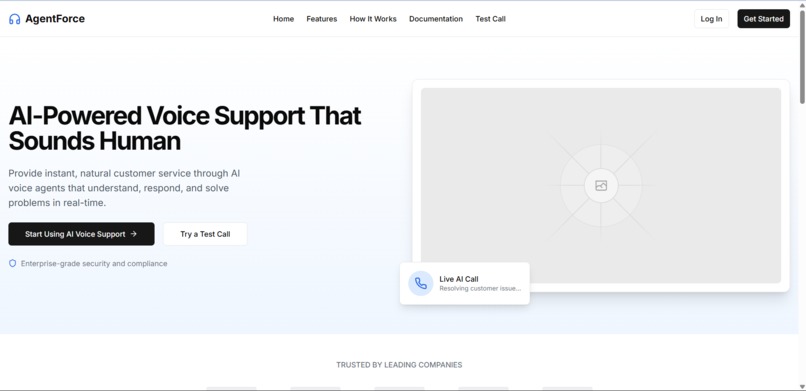
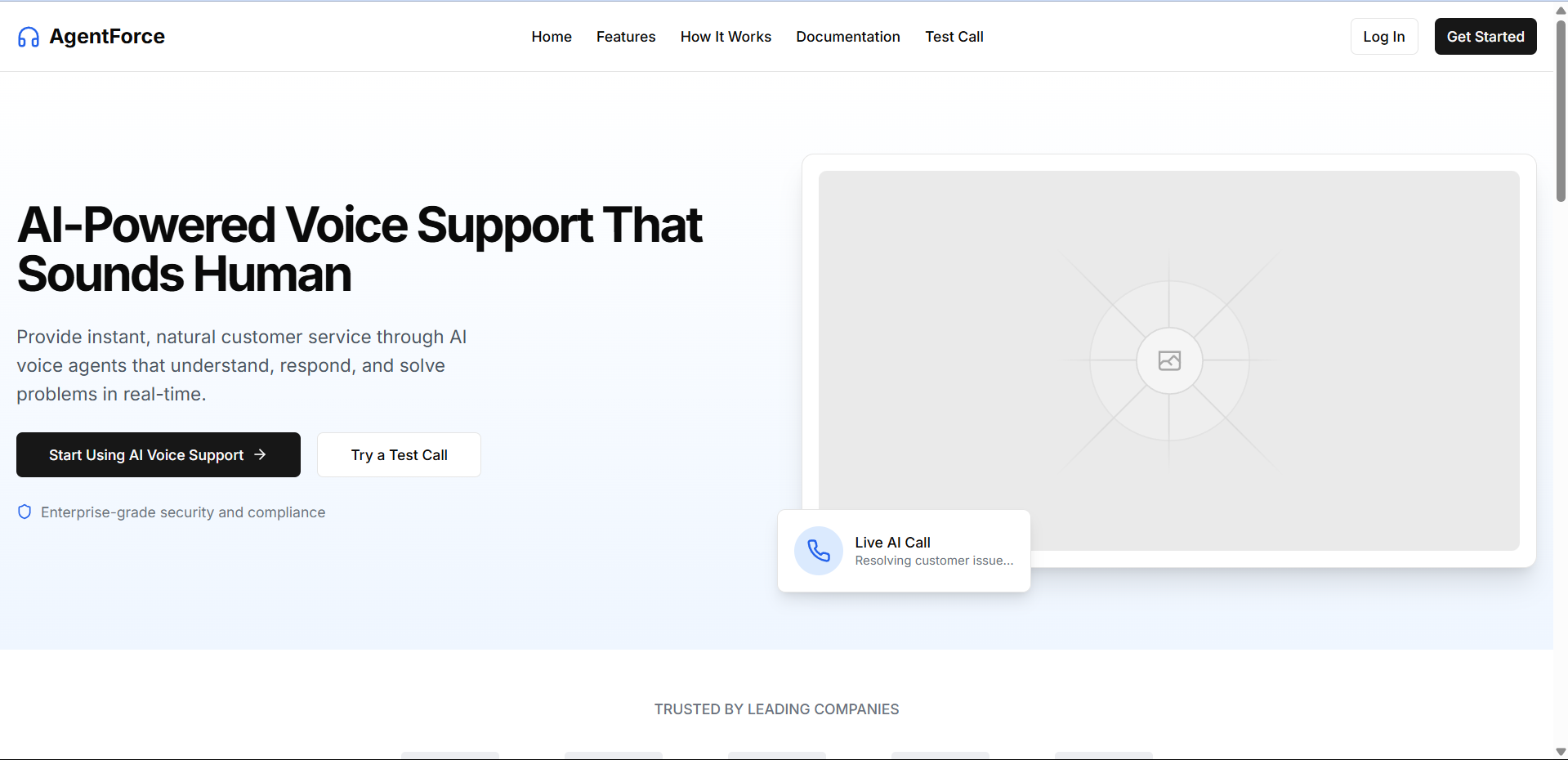
Hero Section
-
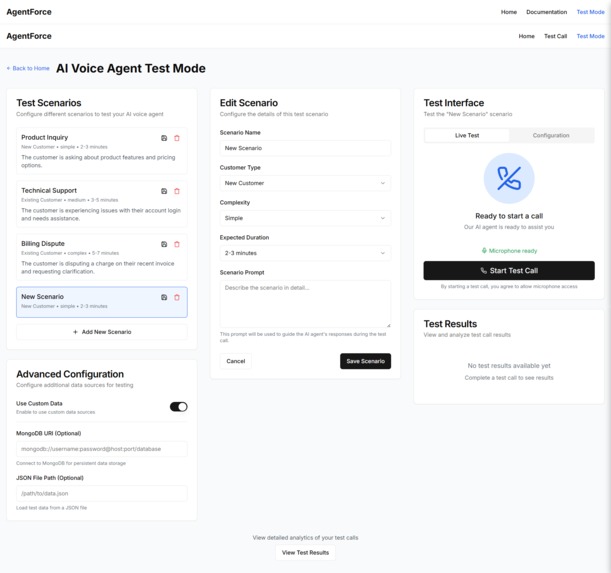
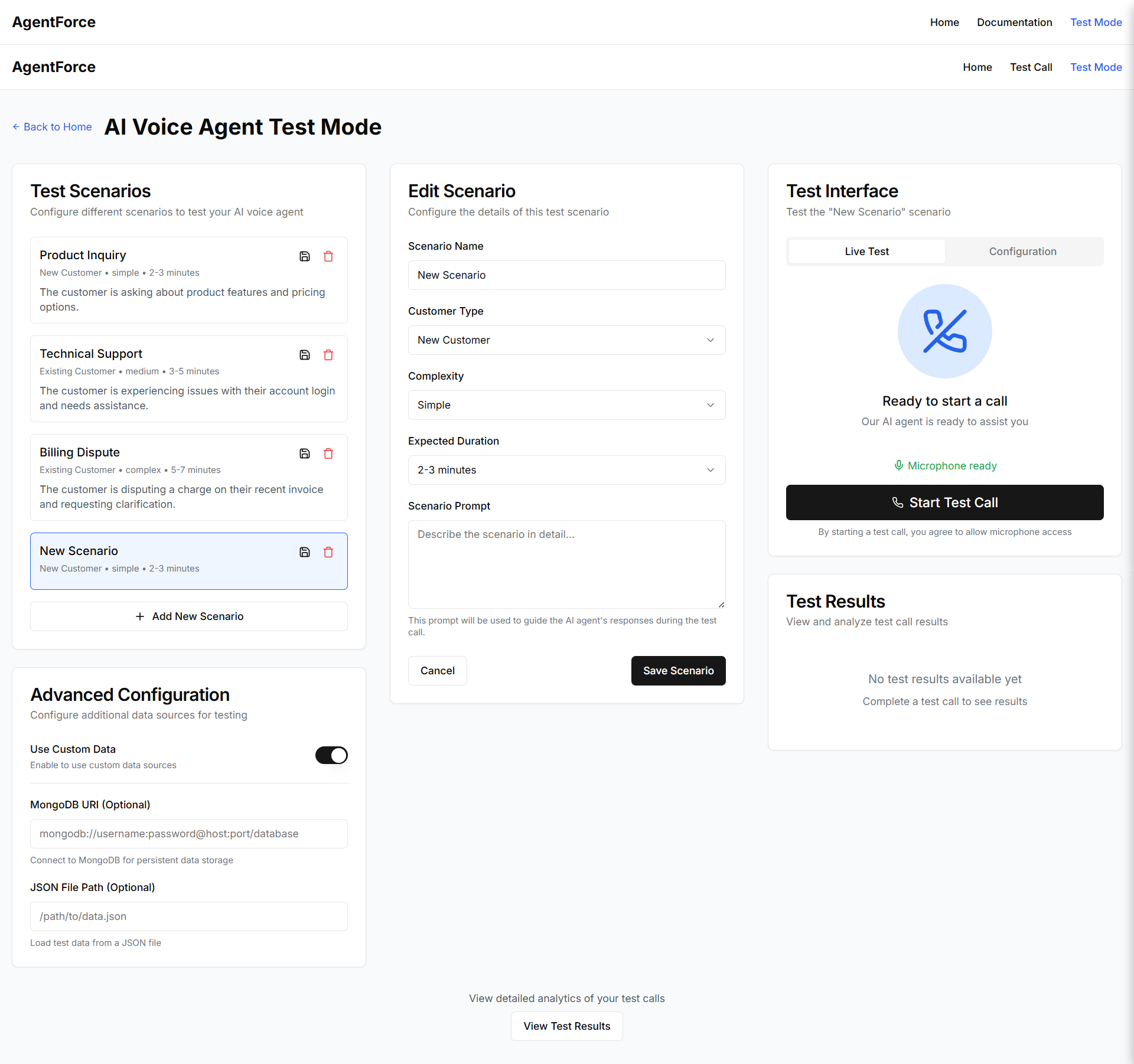
Test Call Page
-
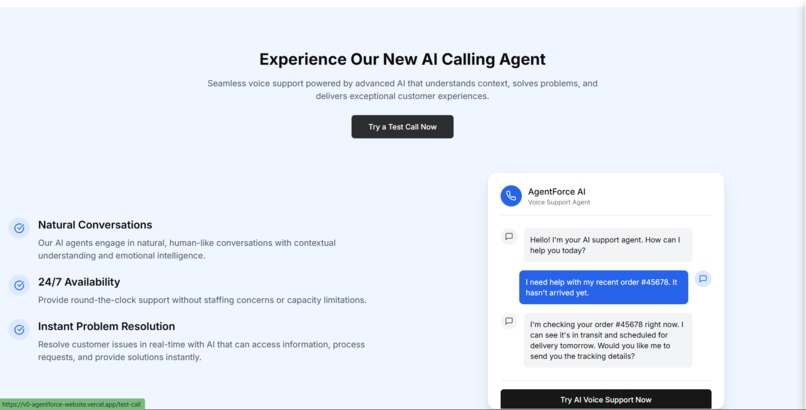
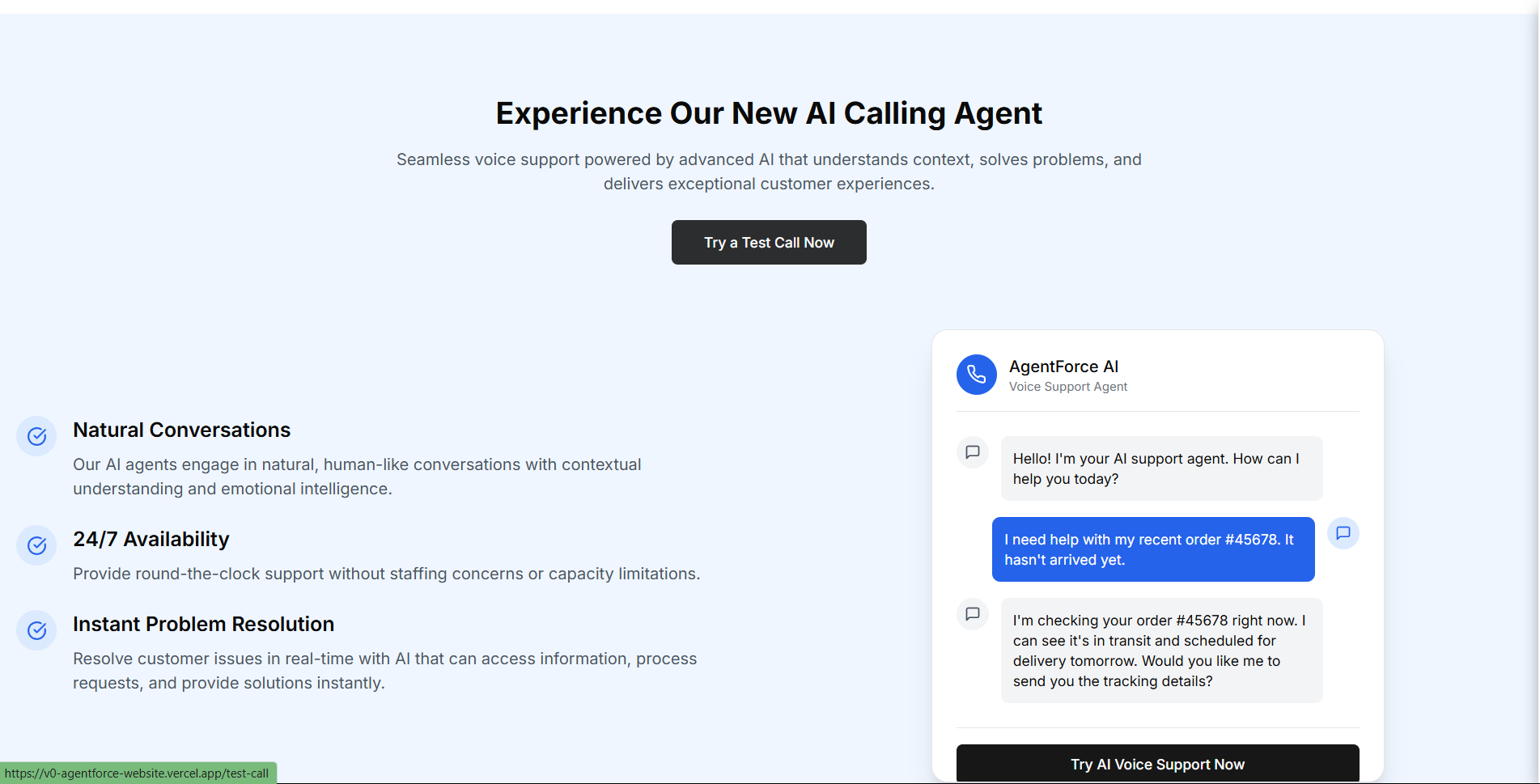
Feature Section
-
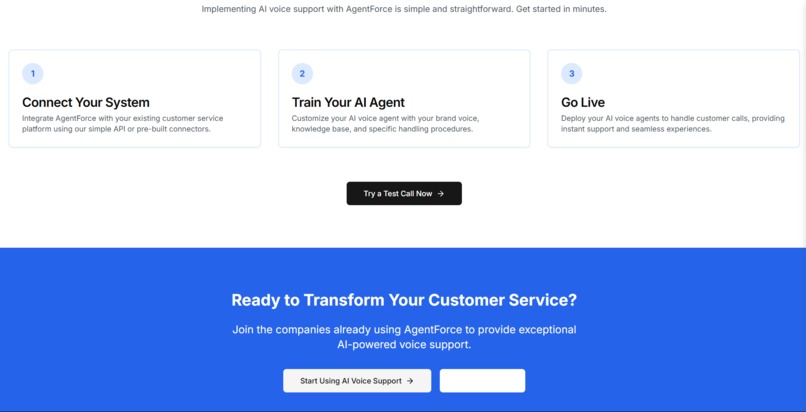
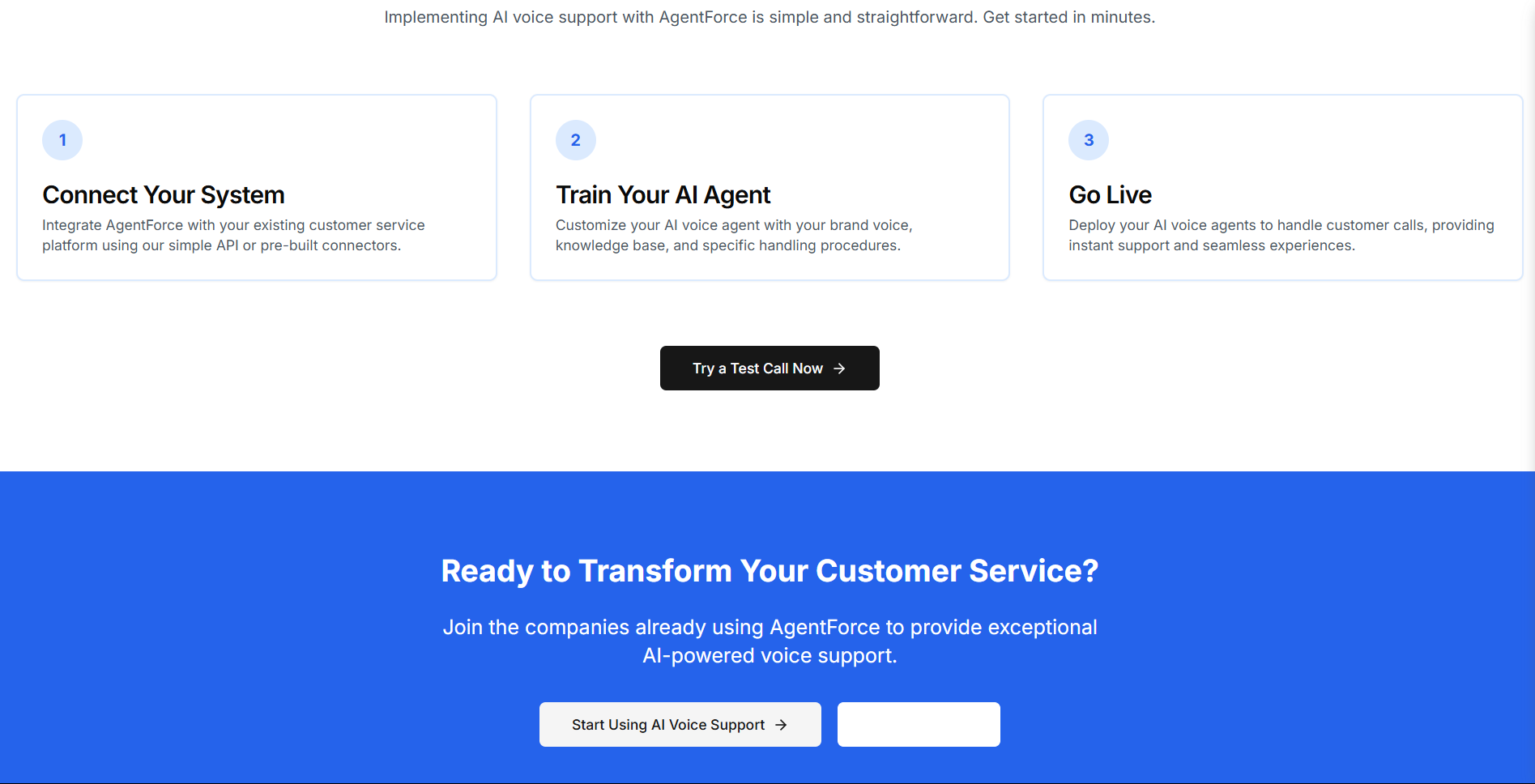
How its work section
-
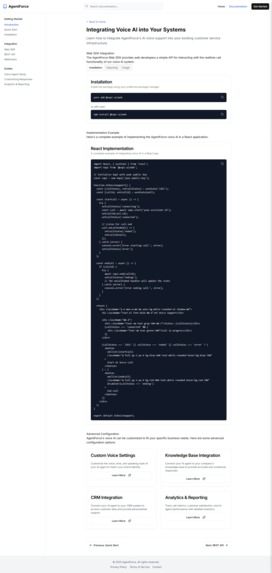
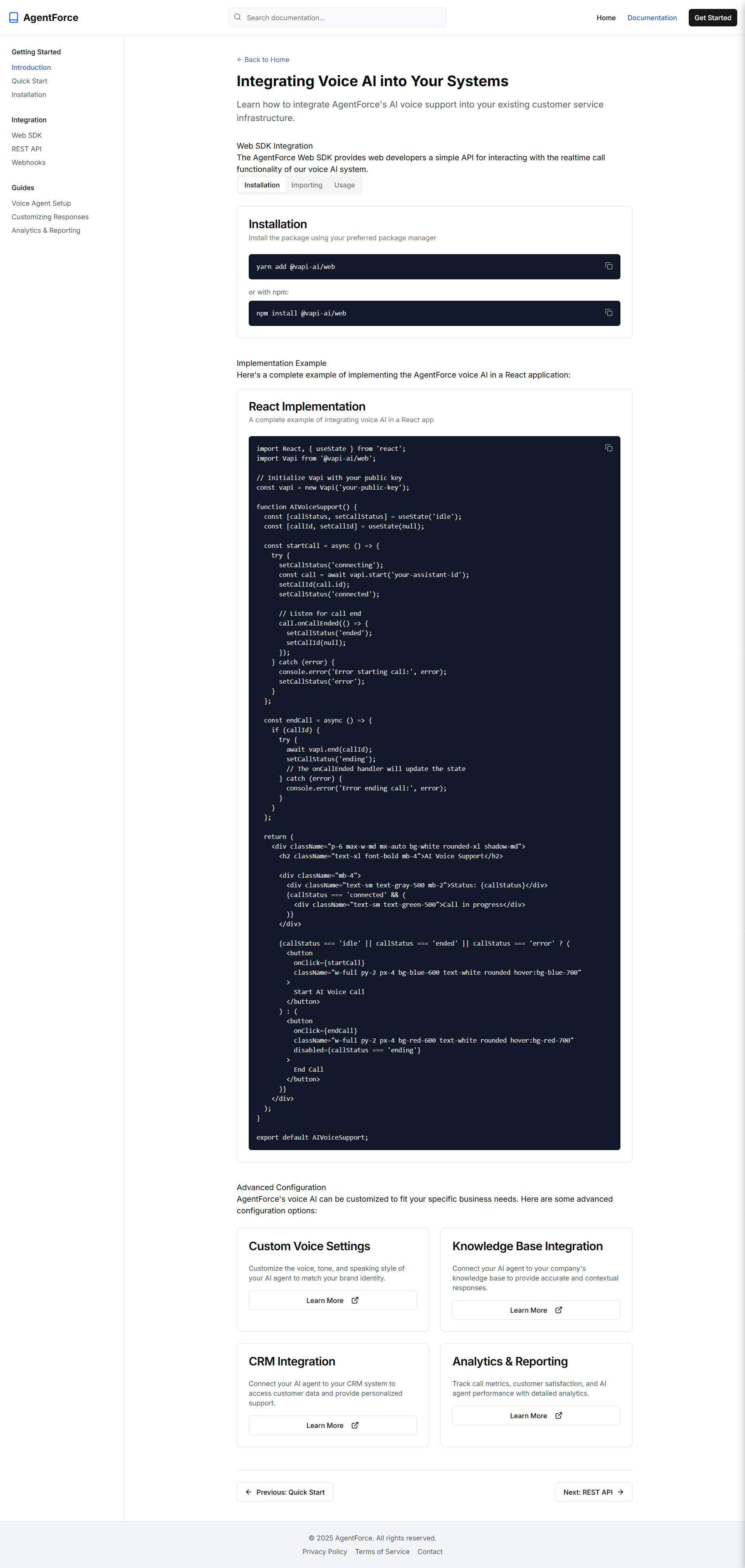
Doc Page
Inspiration
Our team was inspired by the growing gap between customer service expectations and the reality of support experiences. While customers increasingly demand 24/7, personalized support, businesses struggle with staffing, training, and scaling their customer service operations. We observed that voice remains the preferred channel for complex support issues, yet it's the most challenging to automate effectively. The Salesforce Agentforce Hackathon presented the perfect opportunity to address this challenge by combining advanced AI voice technology with the power of Salesforce's agent platform to create a solution that could transform customer service experiences.
What it does
AgentForce AI Voice Support is a comprehensive platform that enables businesses to deploy AI-powered voice agents that can understand, respond to, and solve customer problems in real-time. The platform features:
Natural, human-like voice conversations with contextual understanding 24/7 availability without staffing concerns Integration with existing customer service systems A testing framework for creating and evaluating different support scenarios Detailed analytics and reporting on call performance Customizable voice and personality settings to match brand identity Multi-language support for global businesses The solution seamlessly connects with knowledge bases and CRM systems, allowing the AI voice agents to access customer data and provide personalized support experiences that rival human agents.
How we built it
We built AgentForce AI Voice Support using a modern tech stack centered around Next.js for the frontend and backend functionality:
Frontend: We used Next.js with the App Router, React, and Tailwind CSS to create a responsive and intuitive user interface. Voice AI: We integrated with Vapi's AI voice technology to handle speech recognition, natural language understanding, and text-to-speech capabilities. Testing Framework: We developed a comprehensive testing framework that allows businesses to create, manage, and evaluate different support scenarios. Analytics: We implemented detailed analytics tracking to measure call performance, customer satisfaction, and AI agent effectiveness. Documentation: We created extensive documentation to help developers integrate the platform into their existing systems. Integration Layer: We built a flexible integration layer that can connect with various CRM systems, knowledge bases, and other business tools. The architecture was designed to be modular and extensible, making it easy to add new features and integrations in the future.
Challenges we ran into
Building AgentForce AI Voice Support presented several significant challenges:
Natural Conversation Flow: Creating truly natural conversation flows that could handle interruptions, clarifications, and context switching was technically challenging. Voice Quality: Ensuring high-quality voice output that sounds natural and engaging across different scenarios required extensive testing and refinement. Latency Management: Minimizing latency in voice processing to create a responsive experience that feels like talking to a human agent was a significant technical hurdle. Context Retention: Developing systems that could maintain context throughout a conversation, especially for complex support scenarios, required sophisticated state management. Integration Complexity: Creating a flexible integration layer that could work with various CRM systems and knowledge bases while maintaining performance was challenging. Testing Methodology: Designing an effective testing framework that could evaluate both technical performance and customer experience required innovative approaches.
Accomplishments that we're proud of
Despite the challenges, our team achieved several significant accomplishments:
Human-like Interaction: We created an AI voice agent that can engage in conversations that are remarkably natural and human-like, passing informal Turing tests with many users. Seamless Integration: We developed a platform that can easily integrate with existing customer service infrastructure, including CRM systems and knowledge bases. Comprehensive Testing: Our testing framework allows businesses to thoroughly evaluate and improve their AI voice agents across various scenarios. Performance Metrics: We implemented detailed analytics that provide actionable insights into call performance and customer satisfaction. Scalable Architecture: The platform's architecture can scale to handle thousands of simultaneous calls without degradation in performance or quality. Developer Experience: We created comprehensive documentation and examples that make it easy for developers to integrate and extend the platform.
What we learned
The development process provided valuable insights and learning opportunities:
AI Voice Complexity: We gained a deeper understanding of the complexities involved in creating natural voice interactions, including the importance of prosody, timing, and contextual understanding. User Experience Design: We learned that effective voice interfaces require a different approach to UX design, focusing on conversation flows rather than visual interfaces. Testing Methodologies: We developed new methodologies for testing voice interactions that combine technical metrics with subjective quality assessments. Integration Strategies: We learned effective strategies for integrating AI systems with existing business tools and data sources. Performance Optimization: We gained insights into optimizing performance for real-time voice processing, balancing quality with responsiveness. Customer Expectations: Through user testing, we developed a better understanding of customer expectations for AI voice interactions and how to meet them.
What's next for AgentForce With AI Call Customer Support
Our vision for the future of AgentForce AI Voice Support includes several exciting enhancements:
Salesforce Integration: Developing deep integration with Salesforce Agentforce to create a unified agent platform that spans all customer interaction channels. Emotion Detection: Implementing advanced emotion detection to allow AI agents to respond appropriately to customer sentiment. Multi-agent Collaboration: Enabling multiple AI agents to collaborate on complex issues, each with specialized knowledge and capabilities. Proactive Support: Moving beyond reactive support to proactive outreach based on predictive analytics. Voice Authentication: Implementing secure customer identification through voice biometrics. Industry-specific Solutions: Developing specialized versions of the platform for industries with unique support requirements, such as healthcare, finance, and retail. Global Expansion: Enhancing multi-language support and cultural adaptation for global businesses. By integrating with Salesforce Agentforce, we believe this solution can revolutionize customer service, enabling businesses to provide exceptional support experiences at scale while reducing costs and improving customer satisfaction.
Built With
- nextjs
- react
- typescript
- vapi


Log in or sign up for Devpost to join the conversation.