Inspiration
Building autonomous AI solutions often comes with a steep trade-off: either accept locked-in, rigid pipeline templates or deal with fragmented, hard-to-debug multi-agent orchestrations. We wanted to bridge this gap. Inspired by the need for flexible, production-ready AI workflows, we created Agentflow AI—a framework that empowers developers to seamlessly coordinate autonomous agents, execute complex multi-step reasoning, and handle dynamic tasks with precision.
What it does
Agentflow AI is an intelligent orchestration ecosystem that transforms static tasks into active, collaborative agent workflows.
Multi-Agent Collaboration: Enables specialized agents to share context, divide tasks, and execute sequential or parallel workflows.
Dynamic Execution: Adapts execution paths in real-time based on environmental feedback and dynamic inputs.
Developer-Friendly Controls: Offers fine-grained management over state, tool execution, and decision boundaries.
Production Ready: Built with observability and fallback mechanics to ensure reliable execution in real-world scenarios.
How we built it
Core Framework: Built using Python and modern asynchronous architectures to ensure fast, scalable agent state orchestration.
Model Integration: Leveraged LLM APIs with custom tool-use protocols to enable precise function calling and dynamic reasoning.
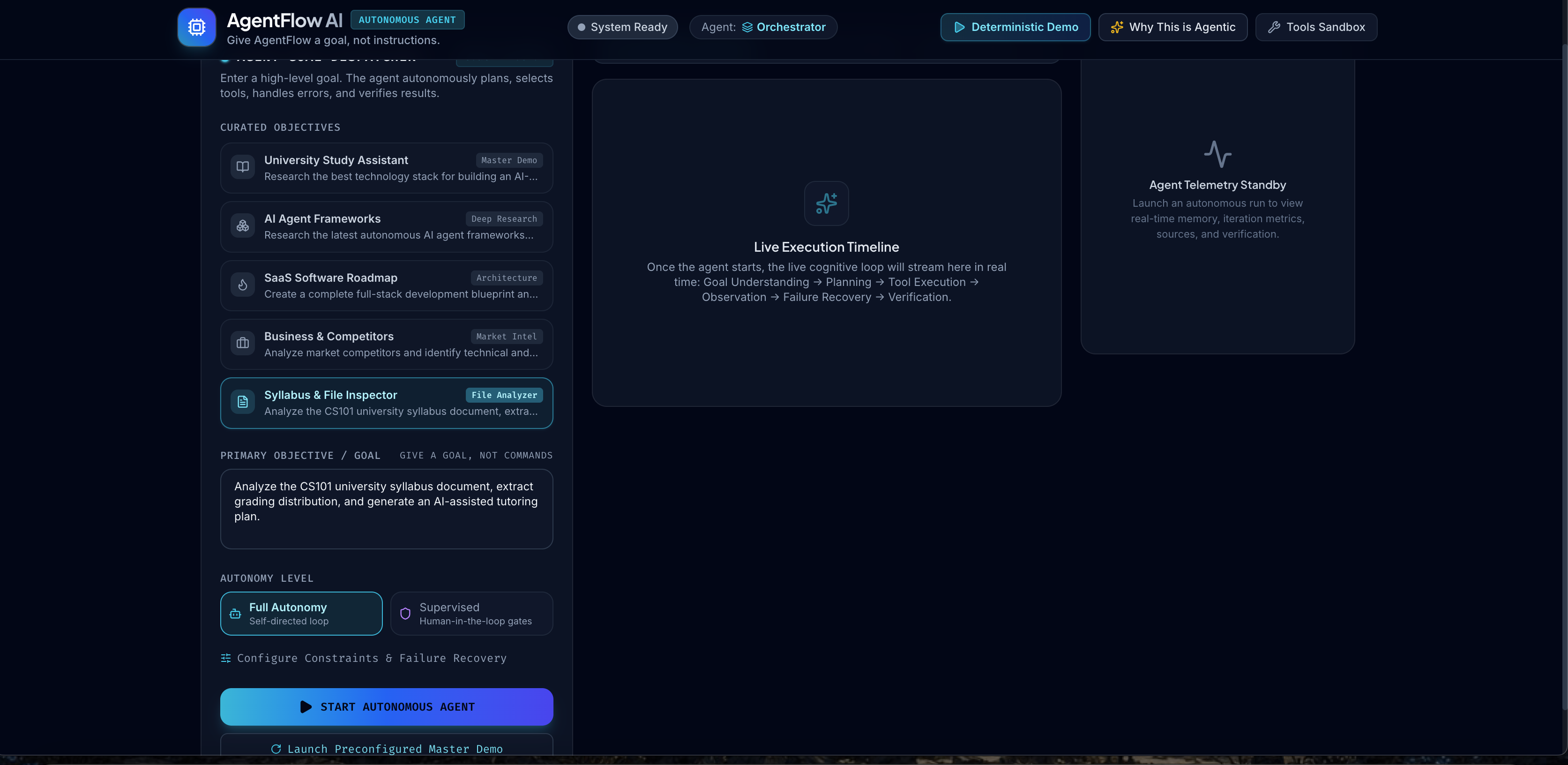
UI & Interaction: Developed an intuitive interface to visualize execution flows, inspect step-by-step reasoning, and monitor agent communications in real-time
Challenges we ran into
State Management & Context Drift: Ensuring agents retain long-term execution context without overloading memory windows required designing structured state-tracking mechanisms.
Agent Coordination: Preventing loops and conflicting decisions between autonomous agents required developing clear hand-off rules and delegation protocols.
Latency & Execution Speed: Balancing asynchronous tool execution with real-time UI updates to keep the workflow responsive.
Accomplishments that we're proud of
Successfully designed a resilient orchestration system capable of running multi-step, complex workflows without human intervention.
Built dynamic error-handling and fallback paths into agent execution chains.
Created a clean, actionable user view that clearly visualizes agent decisions step-by-step.
What we learned
Multi-agent architectures thrive on explicit responsibility boundaries rather than broad prompts.
Robust logging and intermediate state tracking are critical for debugging non-deterministic agent workflows.
What's next for Agentflow Ai
Visual Workflow Builder: Introducing a drag-and-drop interface for non-technical users to design agent chains visually.
Expanded Tooling Ecosystem: Adding pre-built integrations for enterprise databases, APIs, and third-party SaaS platforms.
Advanced Memory Layers: Implementing vector-backed persistent memory for long-running agent interactions.

Log in or sign up for Devpost to join the conversation.