Inspiration
AI agents are becoming increasingly capable, but the web is still difficult for them to interact with reliably.
We wanted to explore a simple question:
What if a web application could expose its own capabilities directly to AI agents?
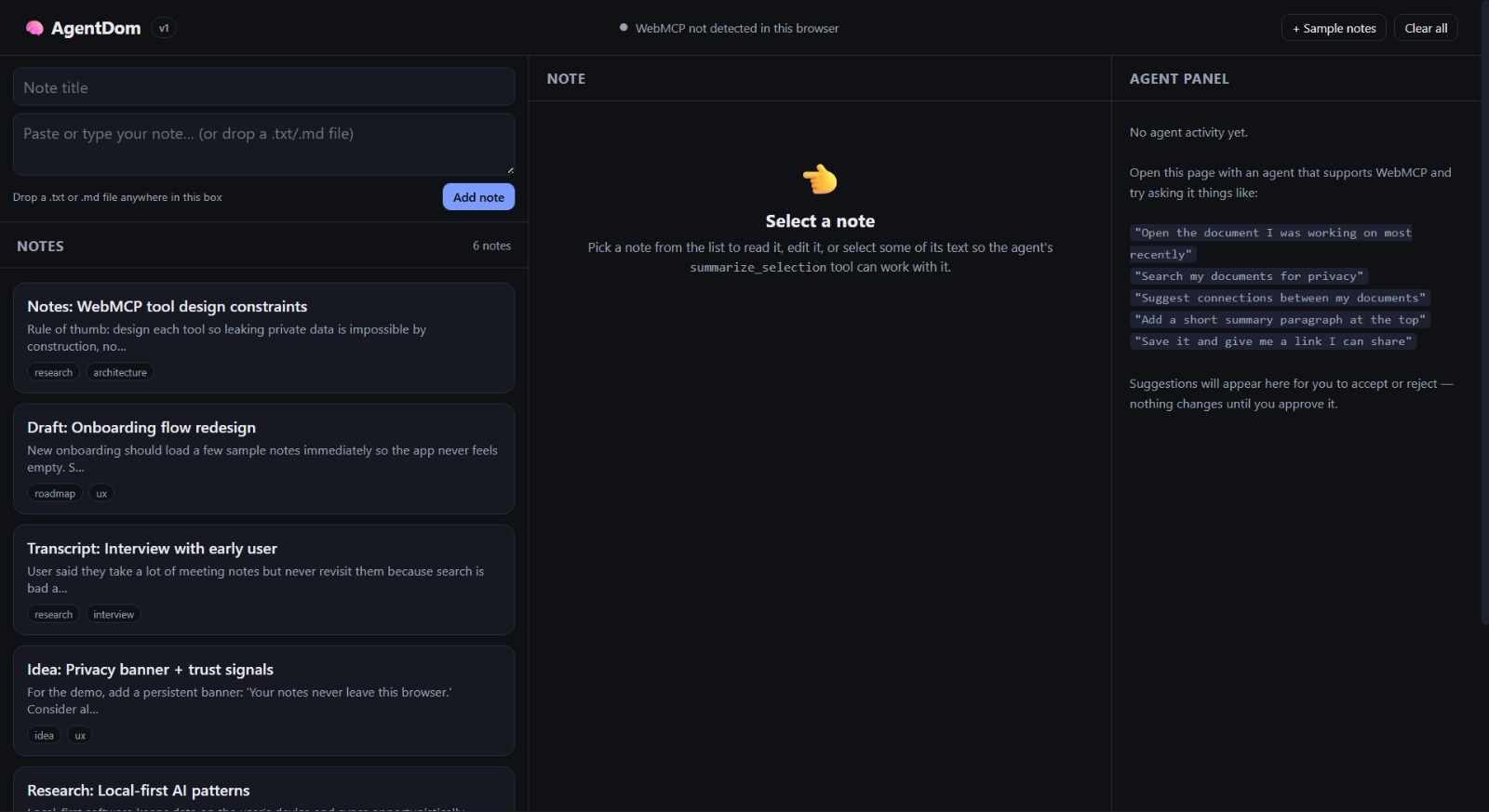
That led us to build AgentDOM — a privacy-first knowledge workspace where the application itself exposes useful actions to agents through WebMCP.
Instead of forcing an agent to scrape the UI, guess what buttons do, or rely entirely on external APIs, AgentDOM gives agents structured tools for working with the user's knowledge.
What we built
AgentDOM is a browser-based workspace for creating and managing notes and knowledge.
The key difference is that the application is agent-ready.
Through WebMCP, AgentDOM exposes capabilities that an AI agent can discover and use directly from the web application. An agent can work with the user's knowledge through structured tools rather than treating the page like an opaque visual interface.
The project is designed around privacy as well: knowledge can remain within the user's browser instead of requiring a traditional backend to store everything.
This creates a different model for AI + web applications:
Web App → exposes capabilities → AI Agent → performs useful work
rather than:
AI Agent → scrapes/interprets UI → tries to control Web App
How we built it
AgentDOM was built as a modern web application with a local-first architecture.
We created the knowledge workspace and then integrated WebMCP so that the application could expose agent-facing tools alongside its normal human-facing interface.
The agent interaction layer allows compatible AI agents to discover the available capabilities and invoke them using structured inputs and outputs.
We also kept the architecture lightweight and browser-focused so that the project could demonstrate that an application does not necessarily need a large backend or complex agent infrastructure to become agent-ready.
Why WebMCP matters
WebMCP changes the relationship between websites and AI agents.
Instead of every agent having to independently figure out how a website works, the website can explicitly describe the actions it supports.
For AgentDOM, this means the application can provide tools specifically designed for working with knowledge.
This makes agent interaction more predictable, easier to reason about, and potentially much more reliable than UI automation.
What we learned
Building AgentDOM taught us that making an application agent-friendly is not simply about adding an AI chatbot.
The more interesting part is designing the interface between the application and the agent.
We learned to think about:
- What capabilities should an application expose to an agent?
- What should the tool inputs and outputs look like?
- How can agents interact with structured application state?
- How can we keep the human experience simple while making the application machine-readable?
- How can local-first applications participate in the emerging agentic web?
WebMCP also made us think differently about the web itself: websites can become active participants in agent workflows rather than simply being pages that agents navigate.
Challenges
One of our biggest challenges was figuring out how to bridge the gap between a normal web application and an agent-facing tool interface.
We had to think carefully about which application capabilities should become tools and how an agent should interact with them.
Another challenge was keeping the experience useful for both humans and agents. We didn't want to build something that was only impressive in an agent demo; the application still needed to work naturally as a normal web workspace.
We also had to work within the limitations and emerging nature of WebMCP while building a practical demonstration around it.
What's next
AgentDOM is an experiment in what an agent-ready web could look like.
We want to explore more sophisticated tools, richer agent workflows, and ways for more web applications to expose their capabilities directly to agents.
Our goal is simple:
Make the web easier for agents to understand and safer for users to control.
Built With
- typescript
- vite
- webmcp

Log in or sign up for Devpost to join the conversation.