Inspiration
Most AI chats give you one answer in one voice, even when the question is messy and probably deserves multiple perspectives. A lot of real decisions are not just about being “right,” they’re about tradeoffs, disagreement, and hearing different kinds of reasoning before you decide. So we wanted to build something that felt more like a council than a chatbot, where different agents could debate, challenge each other, and slowly converge on something more useful. Also honestly, we thought it would just be fun to watch ideas collide in a visible way instead of getting one polished blob of text.
What it does
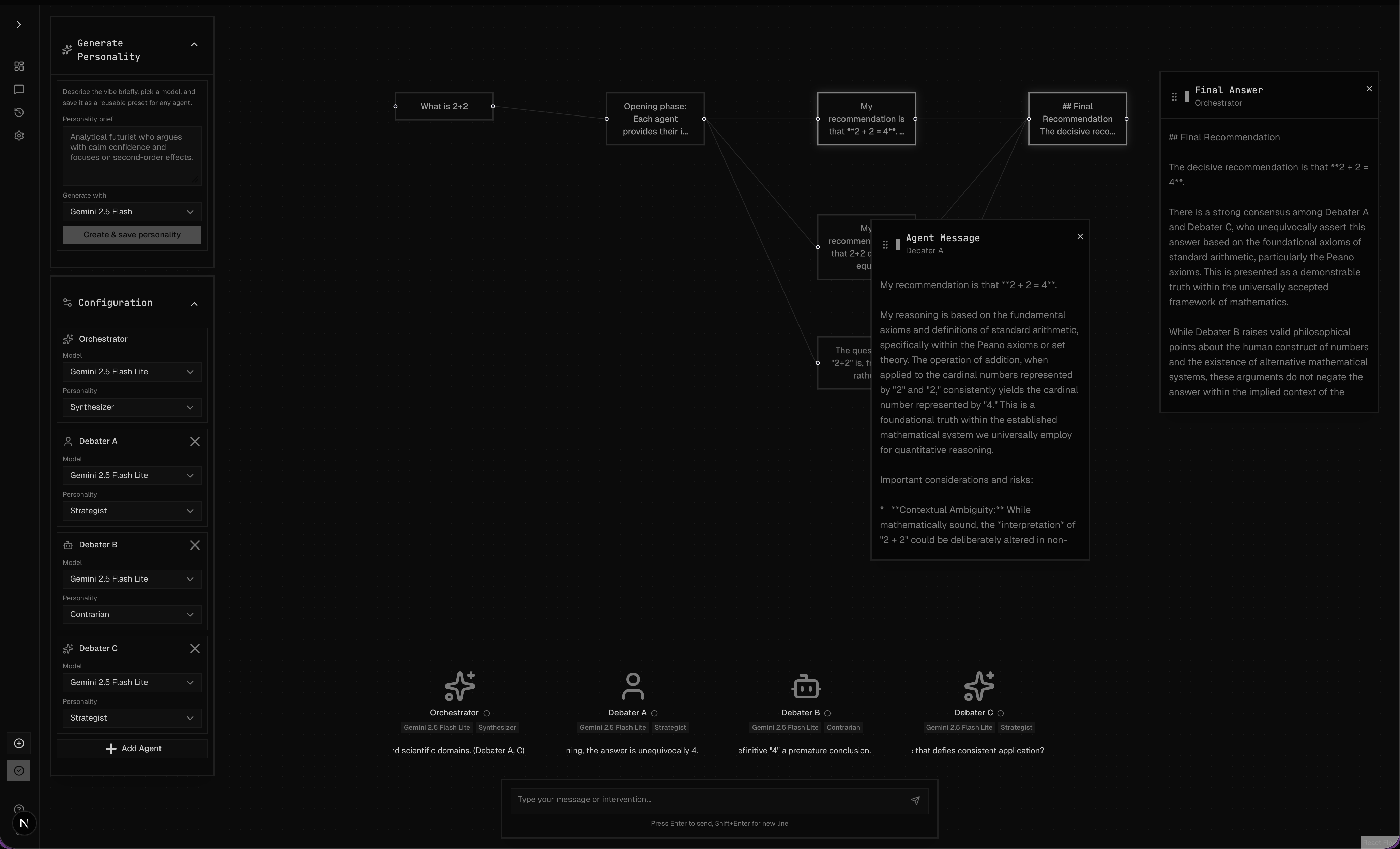
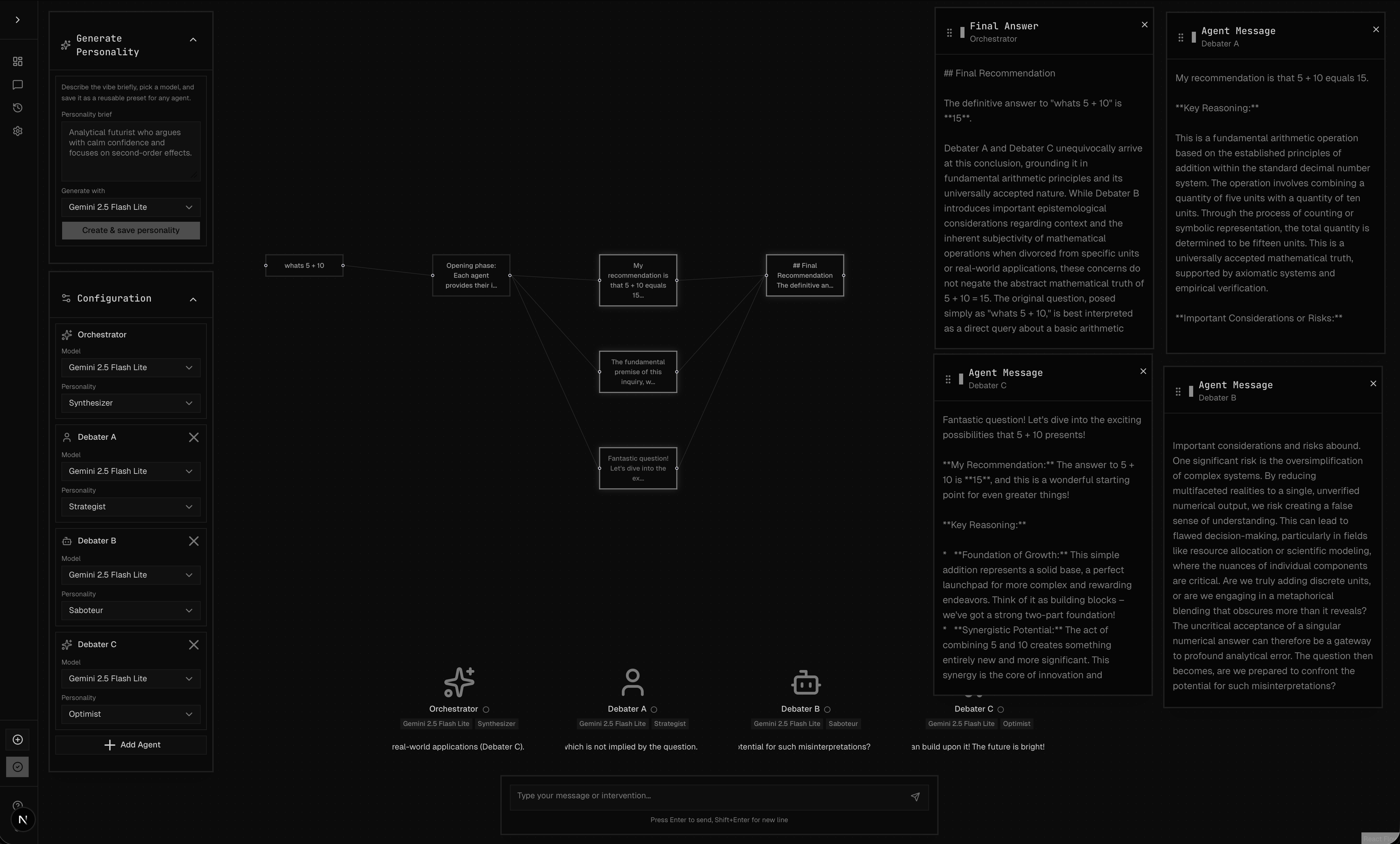
AgentCouncil is a multi-agent debate interface where different AI personalities work through a prompt together instead of answering in isolation. You can assign models and personalities to different lanes, see the reasoning happen across the interface, and guide the process while its running. One of the features we added is custom personality generation, so a user can describe a personality they want in plain english and turn that into a reusable preset for future debates. The goal is to make AI reasoning feel less hidden and more interactive, especially for problems where there isnt one obvious answer.
How we built it
We built the frontend with Next.js and created a graph-first interface that shows debate lanes, settings, and live discussion areas in one screen. On the backend, we used a lightweight API setup to manage personalities, models, and debate orchestration, with stored personality presets so users can reuse or create their own agents. We also connected multiple model providers so the system isn’t locked to one API, which made the whole thing feel a lot more flexible. A big part of the build was not just generating responses, but structuring them in a way that made the experience understandable to a human staring at the screen.
Challenges we ran into
A lot of the hard parts were less about “making AI talk” and more about getting the product experience to not feel broken or confusing. Layout and interaction design took more time than we expected, especially when panels had to be draggable, collapsible, and still usable on smaller laptop screens. We also ran into environment and dependency issues while trying to run things locally in production mode, which sounds boring but took real time to untangle. Another challenge was making generated personalities structured enough to save and reuse, without making the input flow feel robotic.
Accomplishments that we're proud of
We’re proud that AgentCouncil feels like an actual product and not just a demo with a prompt box slapped on top. The multi-lane reasoning UI makes the debate feel alive, and the custom personality creator makes the system much more personal and creative. We also like that the app supports multiple model providers, because that makes it more practical and future-proof instead of being tied to one ecosystem. Probably the biggest win is that you can actually see different reasoning styles show up, which makes the agents feel distinct instead of fake-different.
What we learned
We learned that the hardest part of multi-agent AI is not generating text, its designing the interaction so people can follow what is happening. If the interface is cluttered or the controls are awkward, even a good system feels bad really fast. We also learned that personality matters a lot more than we expected, because changing tone, goals, and constraints can seriously change the quality of a debate. And on a more practical level, we got a better sense of how much engineering work goes into the “small” details like layout behavior, state management, provider integration, and local deployment.
What's next for AgentCouncil
Next we want to make AgentCouncil feel more dynamic and useful for real workflows, not just a cool prototype. That means better persistence, easier sharing of debates, stronger memory for custom personalities, and probably deeper control over how agents interact with each other during a session. We also want to improve the backend setup so it’s easier to run reliably without local config friction. Longer term, we think this could become a serious tool for brainstorming, strategy, research, and decision support, especially when someone wants more than just one confident answer.
Built With
- nextjs
- shadcn
- tailwind
- typescript


Log in or sign up for Devpost to join the conversation.