-
-
Agentic AI Architecture
Inspiration
City services are hard to allocate fairly at scale. Without the right signals, even well-designed systems can drift — and the MyLA311 data shows exactly that: residents in Boyle Heights wait nearly twice as long for repairs as those in Bel Air, and anonymous filing rates in Watts run 3× higher than in Westwood. That anonymity gap points to something the data alone can't fix: communities where institutional trust has to be rebuilt, one interaction at a time.
Traditional routing algorithms ignore these signals entirely. Dashboards visualize the disparity beautifully and do nothing about it. We came to LA Hacks 2026 to build something that acts.
What it does
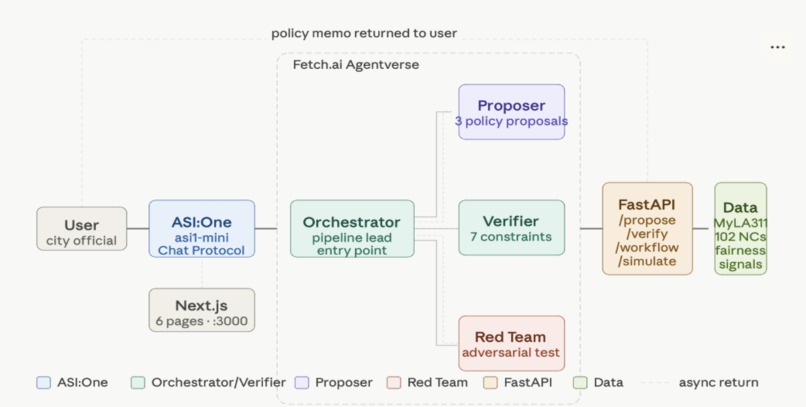
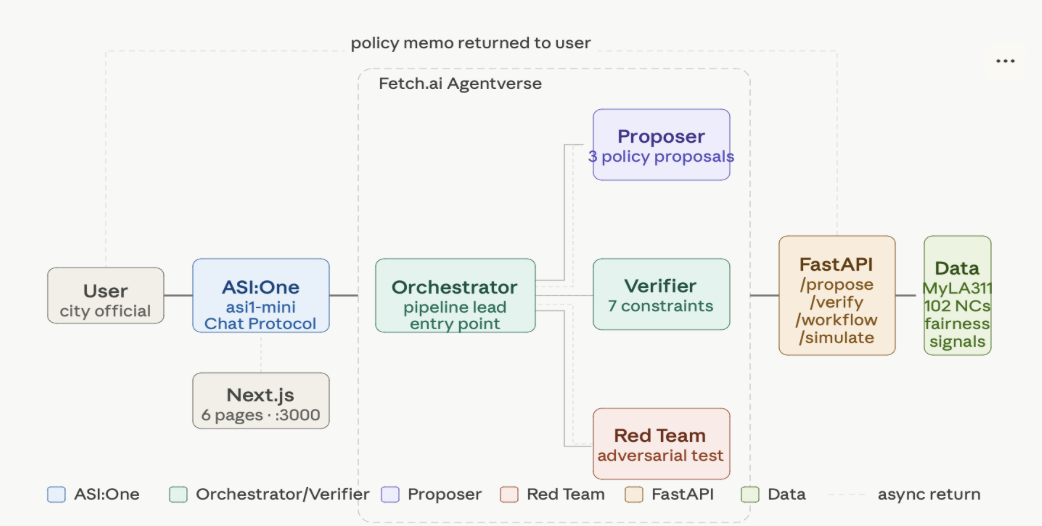
AgentCivic is a multi-agent constitutional AI system that transforms raw MyLA311 complaint data into audited, fairness-verified policy recommendations. A pipeline of four specialized uAgents handles the full workflow:
| Agent | Role |
|---|---|
| Orchestrator | Coordinates the pipeline and manages state across agents |
| Proposer | Identifies service gaps in historical MyLA311 data |
| Verifier | Enforces 7 constitutional fairness constraints per recommendation |
| RedTeam | Adversarially stress-tests every proposal before it surfaces |
City officials can query the entire network through ASI:One in plain English and receive a complete, audited policy memo — not a static chart.
Unlike standard dashboards, our system treats policy allocation as a dynamic search space that must be balanced against historical bias and digital divide signals like RequestSource and MobileOS.
How we built it
We started by profiling the MyLA311 dataset for equity signals: response time by council district, request channel distribution, anonymity rates by neighborhood, and mobile vs. desktop submission ratios as a proxy for the digital divide.
From there we designed a constitutional constraint set — seven rules the Verifier agent enforces on every proposal generated by the Proposer. Constraints include geographic response-time parity, anonymous filing rate weighting, and digital access correction. The math behind the equity score draws on a weighted fairness metric:
$$E = \sum_{i=1}^{n} w_i \cdot \left(1 - \frac{|s_i - \bar{s}|}{s_{\max}}\right)$$
where $s_i$ is the service rate for neighborhood $i$, $\bar{s}$ is the citywide mean, and $w_i$ reflects historical deprivation weighting.
The four agents were built on Fetch.ai's uAgents framework and integrated with ASI:One for natural language querying. The RedTeam agent runs adversarial prompts against each proposal to surface edge cases the Verifier might miss.
Challenges we faced
Data quality. The MyLA311 dataset has significant missingness in fields like MobileOS and RequestSource for older records, which are exactly the signals we needed most. We built imputation heuristics based on council district demographics, but this introduced its own assumptions we had to document carefully.
Defining fairness. There is no single agreed-upon definition of algorithmic fairness, and several of our seven constraints are in tension with each other. Equalizing response times across districts can conflict with efficiency-maximizing allocations. We resolved this by making the constraint weights configurable — surfacing the tradeoff to the human decision-maker rather than hiding it.
Agent coordination latency. Running four agents in sequence introduced latency that made real-time querying feel slow. We parallelized the Verifier and RedTeam passes where possible and cached Proposer outputs for repeated queries on the same dataset.
What we learned
- Institutional distrust is quantifiable and should be a first-class input to any civic AI system, not an afterthought.
- Constitutional AI is a powerful pattern beyond chatbot safety — it works well as a policy audit layer whenever you need structured, inspectable enforcement of constraints.
- The hardest part of equity work isn't the model. It's agreeing on what fairness means and being honest when constraints conflict.
What's next
We plan to connect AgentCivic to a live 311 data stream for continuous auditing, expand the constitutional library with community-defined constraints, and open-source the framework so other cities can deploy equity-first policy pipelines on their own municipal data.
Built With
- fetchai
- nextjs
- python

Log in or sign up for Devpost to join the conversation.