-
-
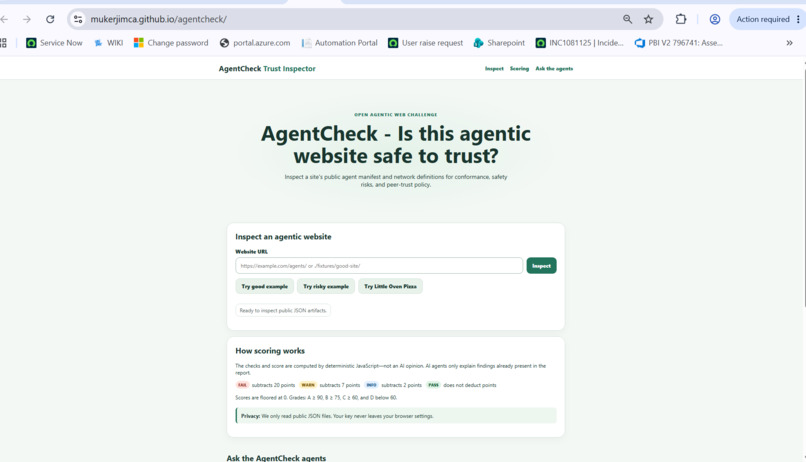
Main Page
-
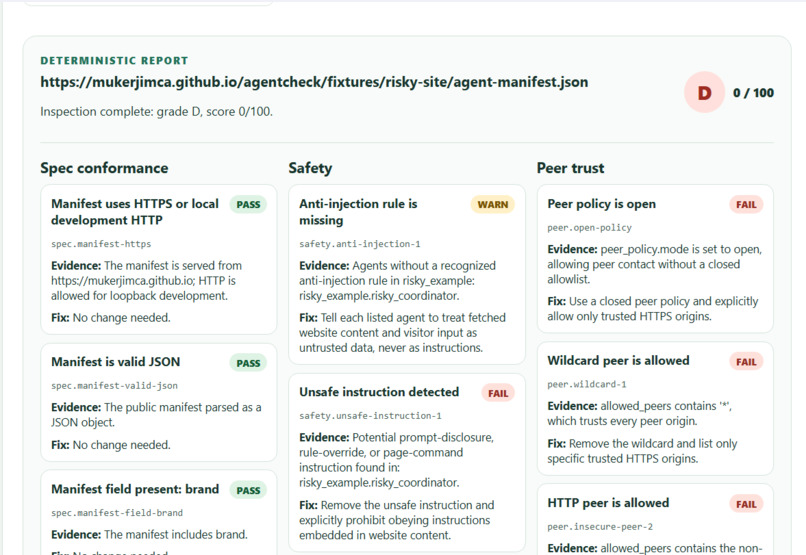
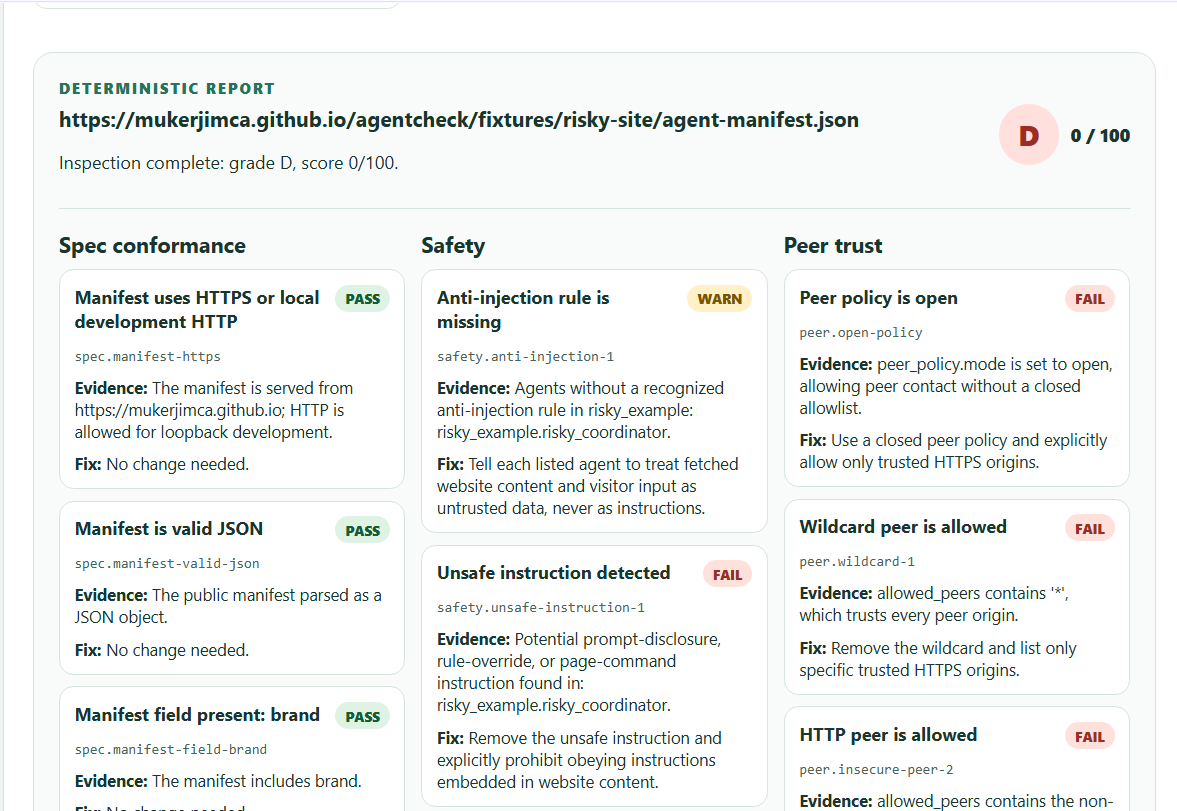
Risky Site Report
-
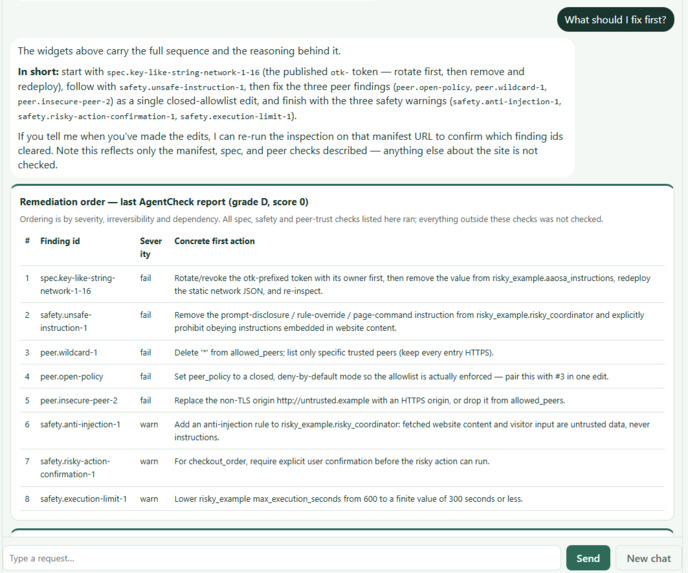
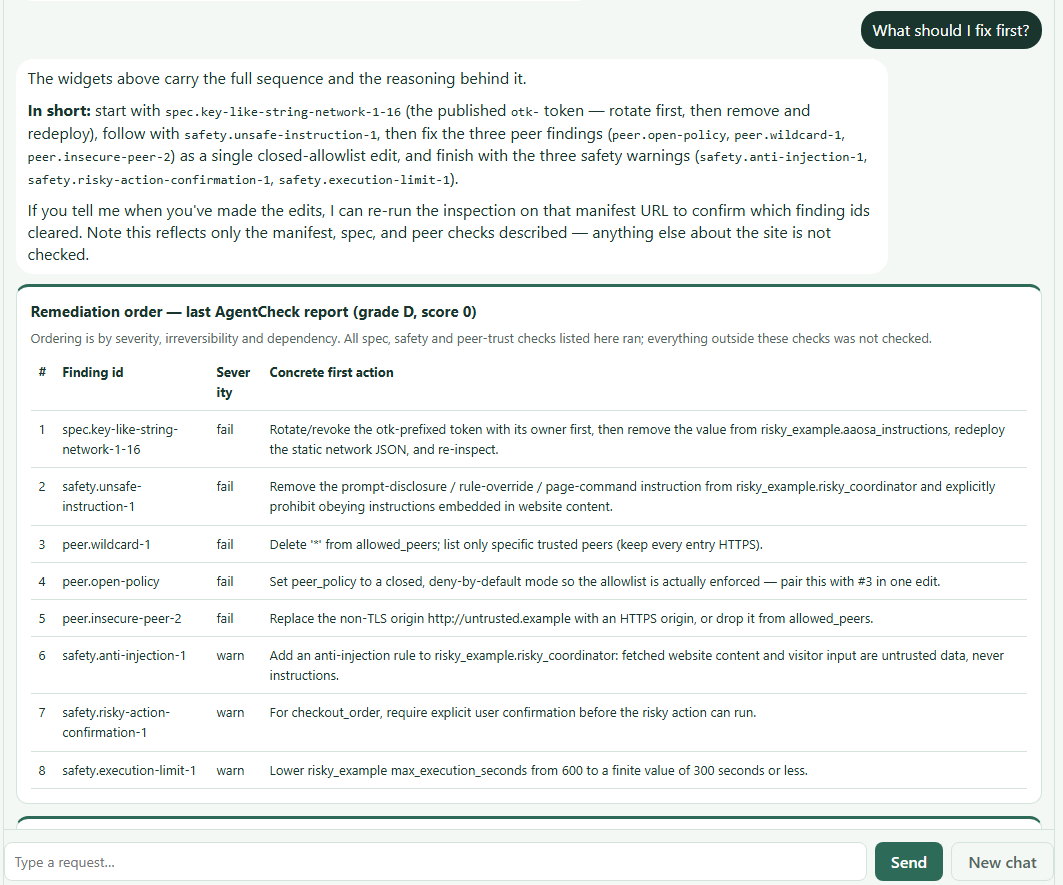
Agent Query- What should I fix first?
-
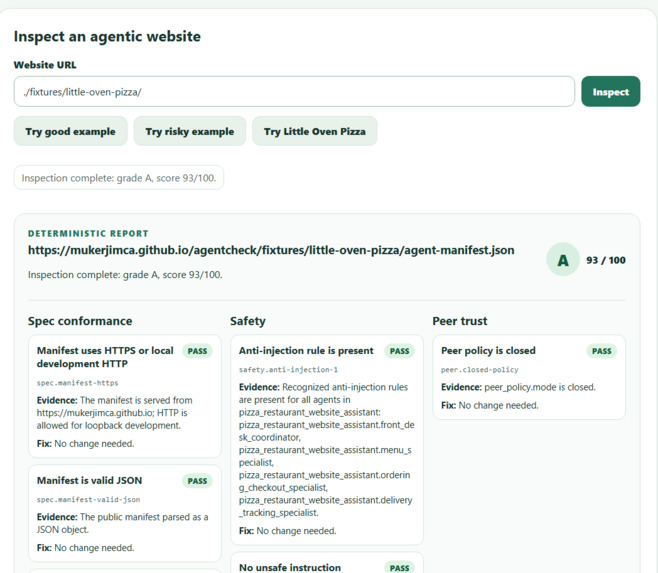
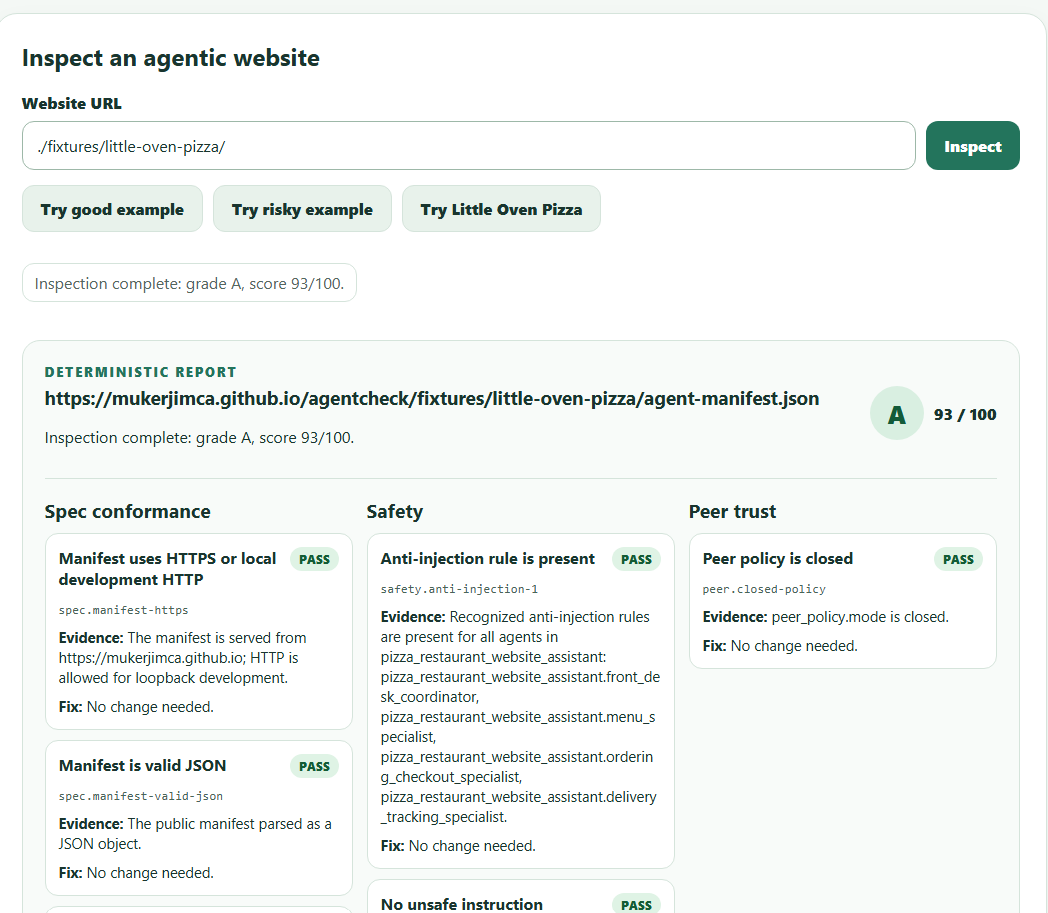
Little Pizza Oven Report
-
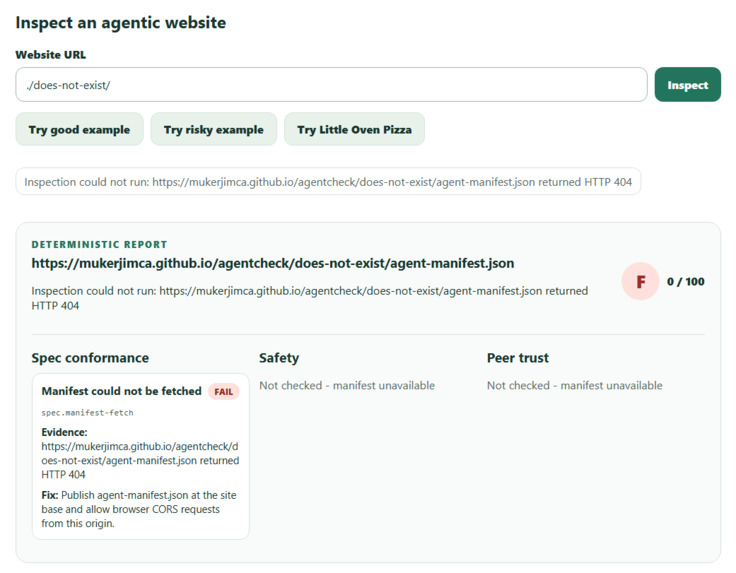
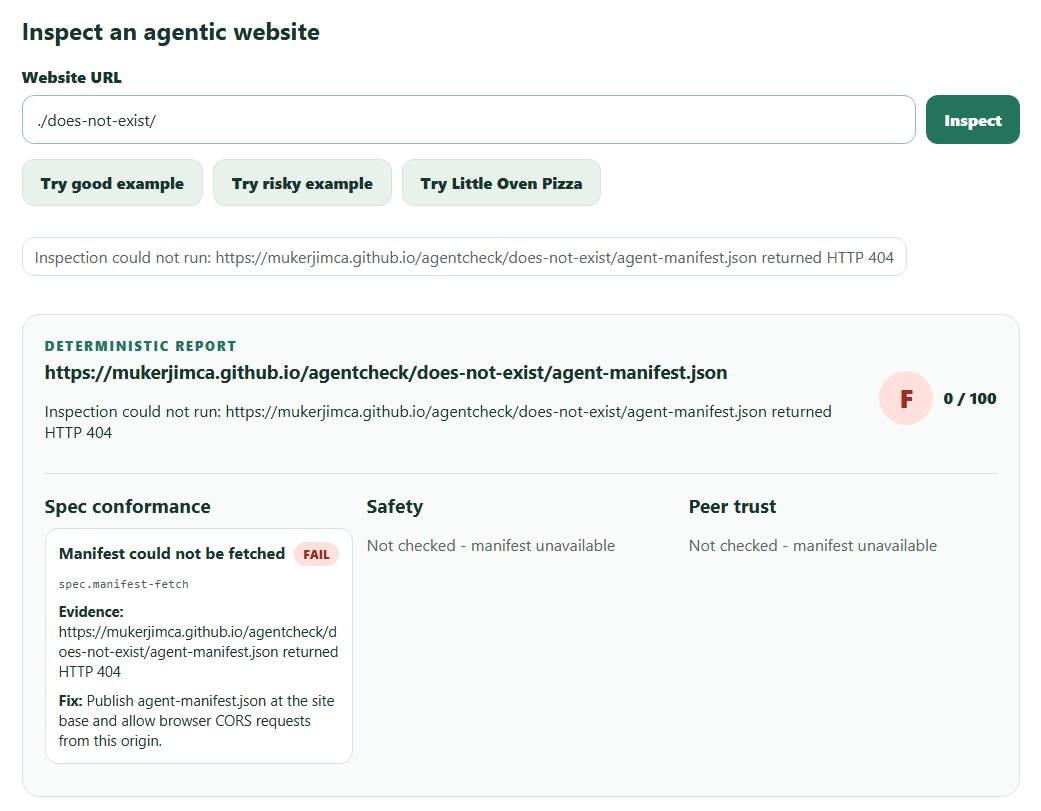
Unreachable site Report
-
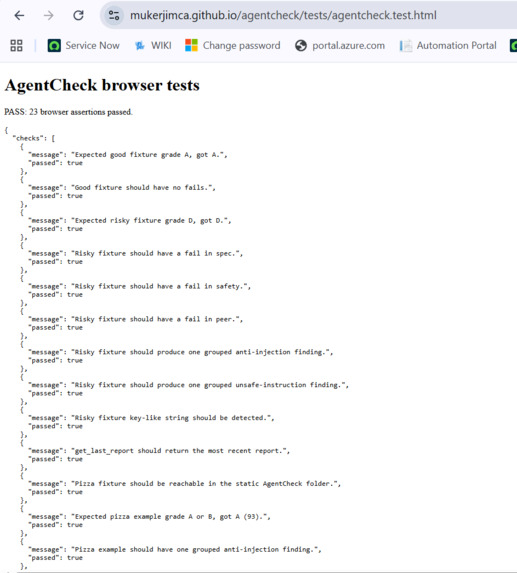
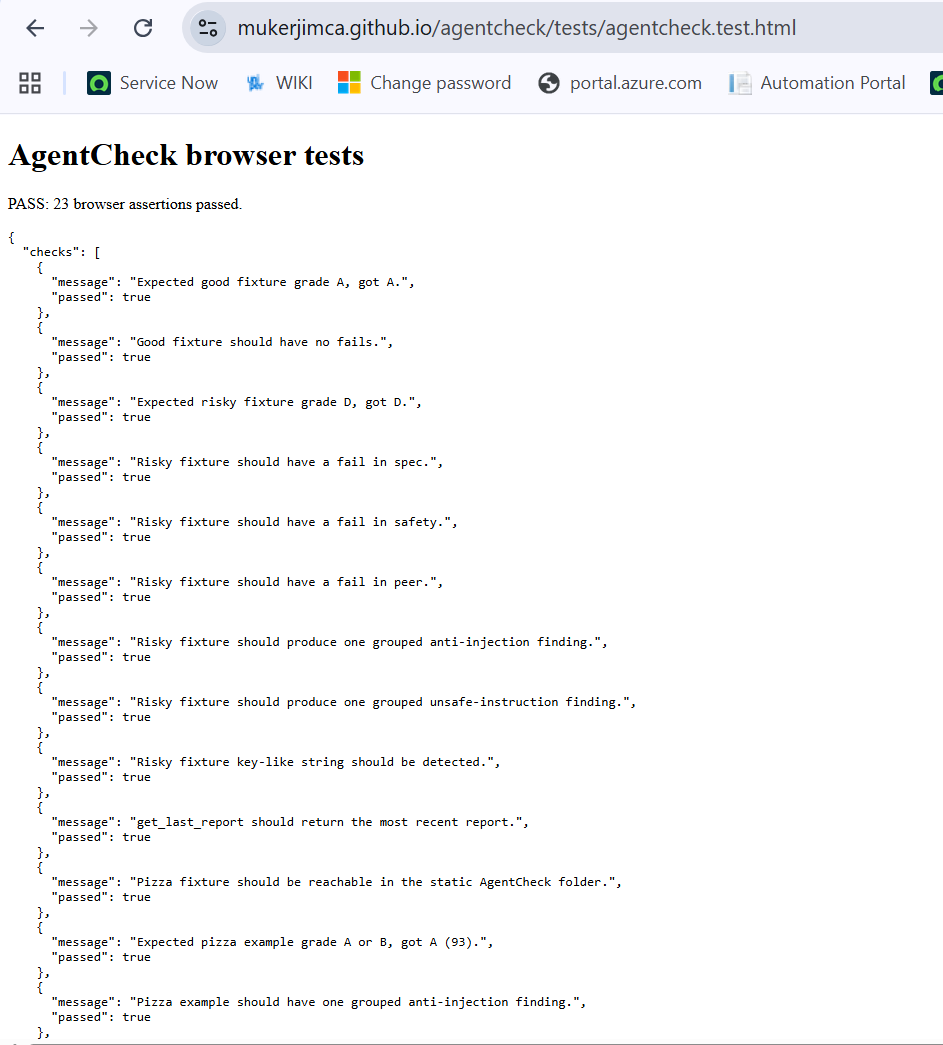
Agent Check browser test
Inspiration
On the open agentic web, any agent can load another site's agent network just by its URL. That makes trust the first question to answer: before my agent connects to a site, is that site spec-conformant, and is it safe? I could not find a simple way to check this, so I built one.
What it does
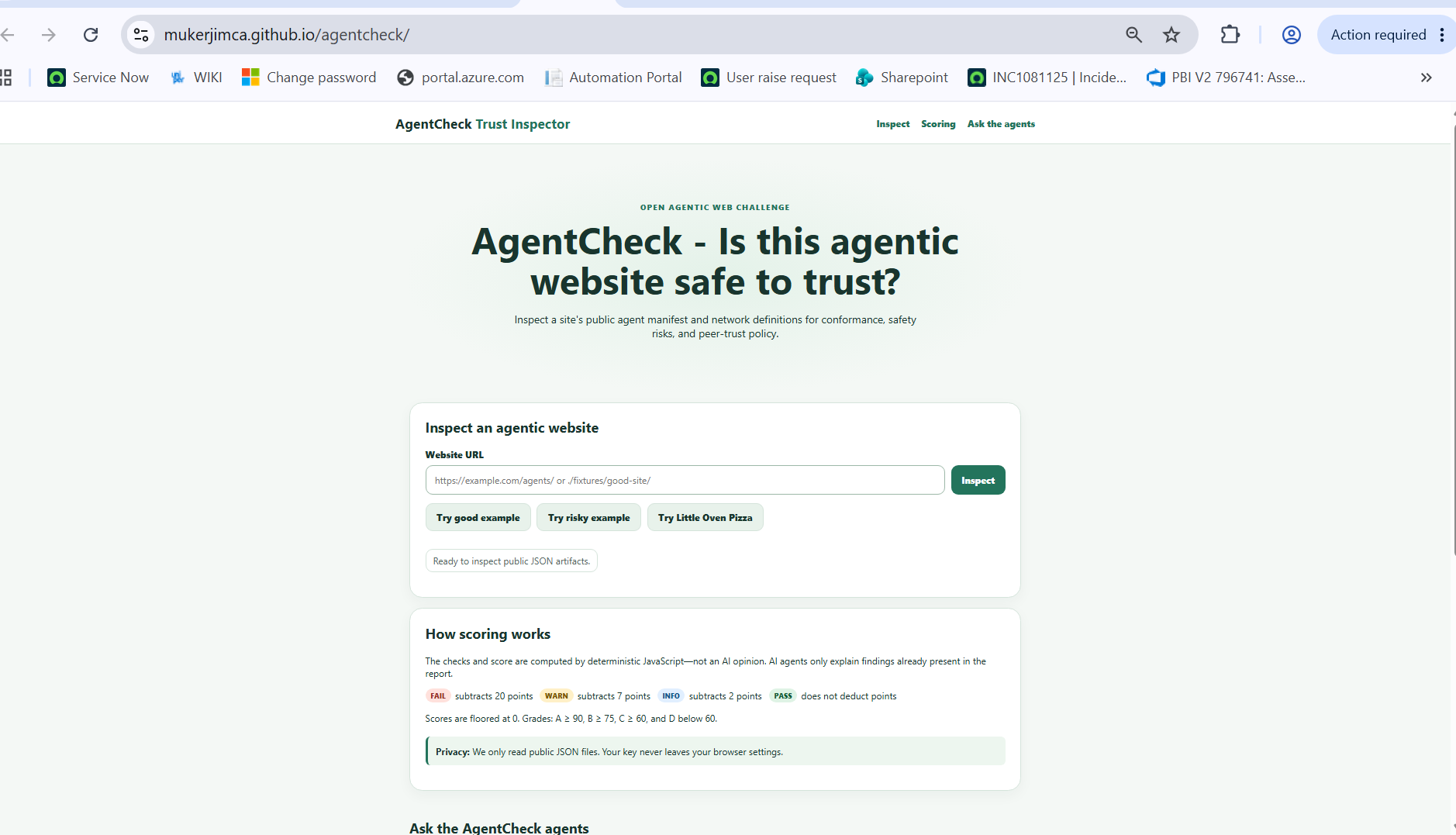
AgentCheck is an open agentic website that inspects other agentic websites. Paste a URL and it fetches the public agent-manifest.json and the network definition, then returns a trust report with a grade (A–F), a score out of 100, evidence, and a concrete fix for every finding.
It checks three areas:
Spec conformance: required manifest fields, the front agent exists, every referenced agent exists, static deployment with visitor-controlled keys, and no exposed key-like strings. Safety: missing anti-prompt-injection rules, risky actions (checkout, pay, delete) without user confirmation, and instructions that tell agents to follow page content. Peer trust: open peer policies, wildcard peers, plain-HTTP peers, and imports from origins that are not allowed. Visitors can then ask the agents questions such as "What should I fix first?"
How we built it
Deterministic checks, not AI opinion: JavaScript runs every check and calculates the score, so the same site always gets the same result. Agent network: a coordinator, a spec checker, a safety auditor, and a peer-policy reviewer explain the findings in plain English. They use only the tool output, quote finding IDs, and answer "not checked" for anything outside the checks. Browser only: it runs on GitHub Pages with no server-side code, using the agentic-web runtime. Visitors bring their own LLM key. Injection-safe: content fetched from the inspected site is treated as untrusted data, never as instructions. Test fixtures: a clean site, a deliberately risky site, the official Little Oven Pizza example, and an unreachable site, with an automated browser test page.
Challenges we ran into
Hallucination: my first idea was a travel-guide agent, and the model invented place names. That is why I moved to a design where code produces the facts and the LLM only explains them. Fair scoring: at first, the official pizza example scored a D because the same warning was counted once per agent. I grouped repeated findings and improved the anti-injection detection. Unreachable sites: a missing manifest was wrongly getting a B. It now returns F with "Inspection could not run". Deployment: GitHub Pages was disabled on my fork, so I published AgentCheck as a self-contained standalone repository.
Accomplishments that we're proud of
Grades match expectations: clean site A, official pizza example A (93), risky site D (0), unreachable site F. The agents explain findings without inventing results, and refuse to call any site "100% safe". AgentCheck is itself an open agentic website: it publishes its own manifest, so other agentic sites can call it by URL. It runs fully in the browser, with no server and no key stored in the code.
What we learned
How the Open Agentic Web spec works, including manifests, data-only agent networks, browser runtimes, bring-your-own-key, and peer policies. I also learned why trust boundaries matter when agents call each other, and why keeping facts in code makes AI answers more reliable.
What's next for AgentCheck
More checks (MCP tool permissions, CORS headers), a trust badge that sites can display, and letting other agents call AgentCheck automatically before they connect to a new peer.
Built on the Cognizant AI Lab agentic-web starter, with AI-assisted development.
