AgentBooks Devpost Submission
Problem to solve
What net economic benefit is any given agent generating, for a specific company, at any given time?
Few agents can answer that question with verifiable precision.
AI has already made routine bookkeeping cheaper to produce. Agents can classify transactions, reconcile accounts, prepare reports, and surface exceptions. But many businesses still receive bookkeeping quotes that look much like they did before the automation arrived. The work became cheaper. The quote often did not.
This exposes a larger problem across the agent economy. Agents make claims about the work they replace, the money they save, and the outcomes they improve, but those claims usually remain self-reported estimates. The human in the loop should not grade the agent, and the agent should not grade itself. Reality should update the claim.
The agent stack has made real progress on connectivity. A2A helps agents discover and collaborate. MCP lets them call tools and data. Neither tells a buyer, operator, regulator, or downstream agent whether a production agent is accurate, profitable, overly dependent on one provider, creating the promised return, or quietly deteriorating.
That is the gap AgentBooks addresses.
AgentBooks connects three sets of books:
- The company's books show what actually changed.
- Each agent's books record its cost, price, claims, dependencies, and attributable return.
- The human-agent team's Value Flow shows how the resulting benefit is shared across the company, its people, and its agents.
The result is a standard, editable, human-readable accountability layer for agents: auditable economics, dependency disclosure, event-driven updates, and role-aware views that let every participant see the facts needed to trust and scale an agentic system.
Our solution
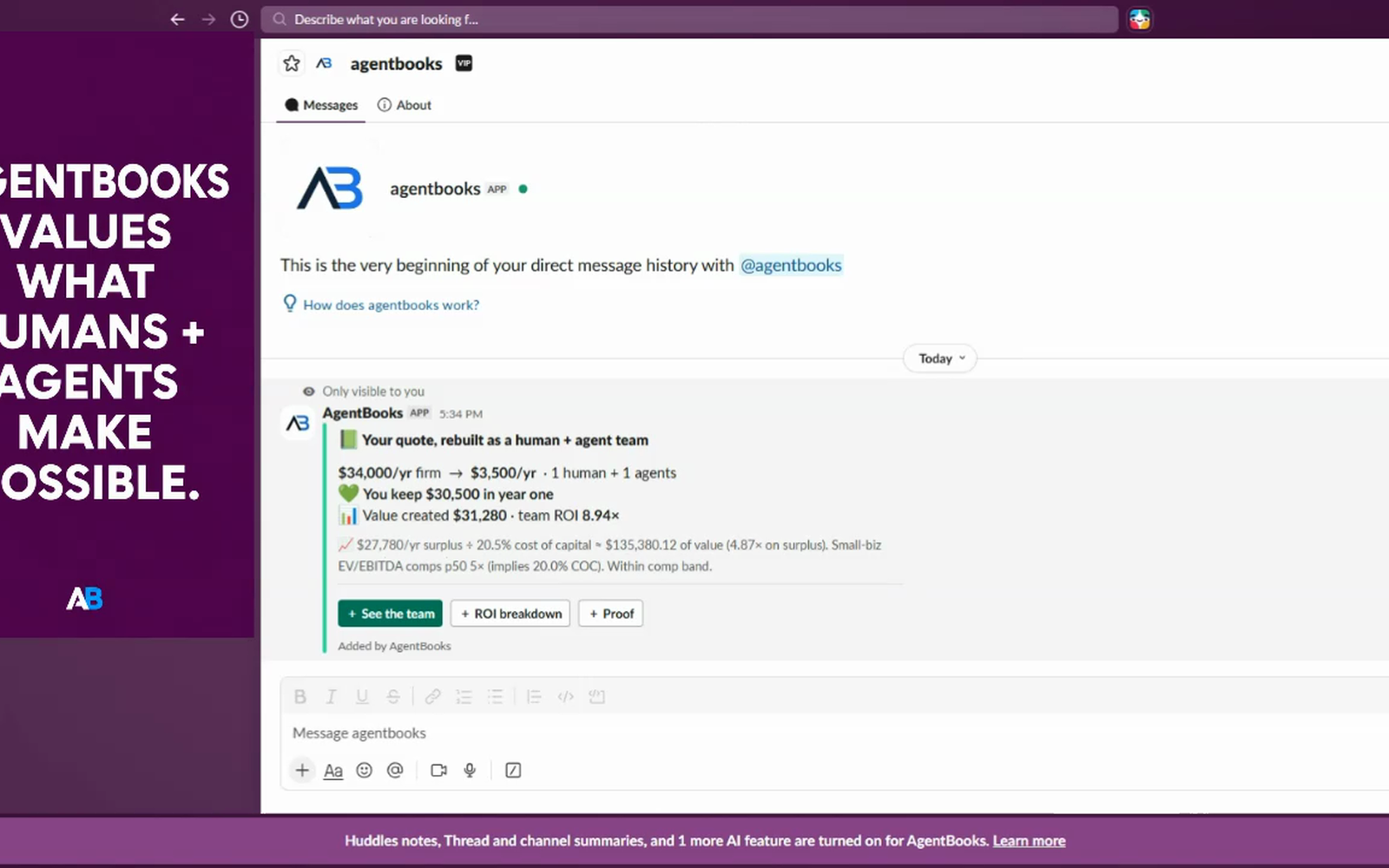
AgentBooks is an MCP-exposed Economic Return Engine, delivered directly inside Slack.
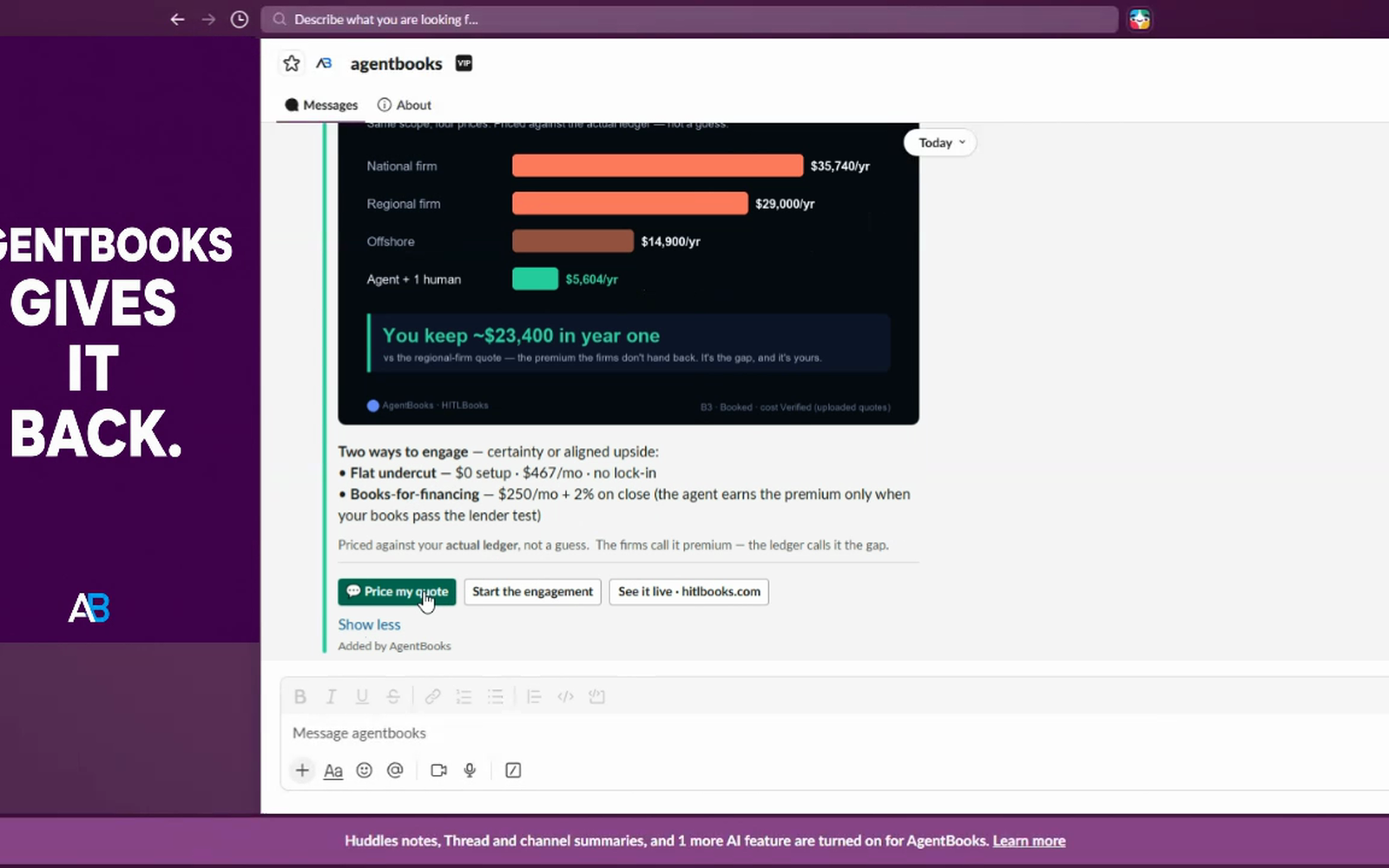
A company uploads or pastes an existing bookkeeping quote into Slack. Gemini reads the PDF or image, extracts the scope, pricing, dates, assumptions, and exclusions, and AgentBooks rebuilds the same work as an explicit human-plus-agent team.
The Slack result answers three immediate questions:
What will this team cost?
The original provider quote is compared with the price of the agents, retained human judgment, setup, and shared services required for the same scope.What economic return does the team create?
AgentBooks separates routine work removed from the additional leverage created when humans receive better information and spend more time on judgment, customers, financing, and growth.Why should anyone believe the result?
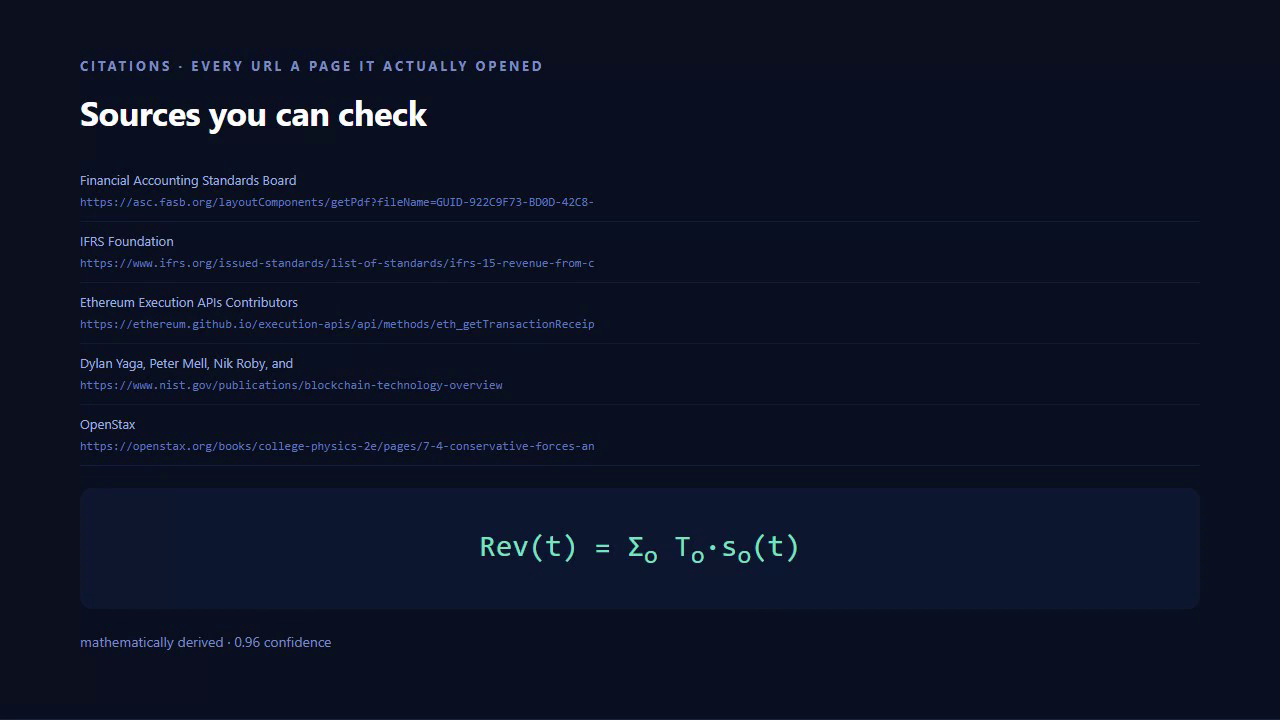
The user can expand the team, ROI calculation, assumptions, evidence grade, and proof. Modeled values can later be replaced by metered and verified results from the company's actual books.
The key insight is that the value of an agent is not simply who it replaces. The value is what humans and agents make possible together.
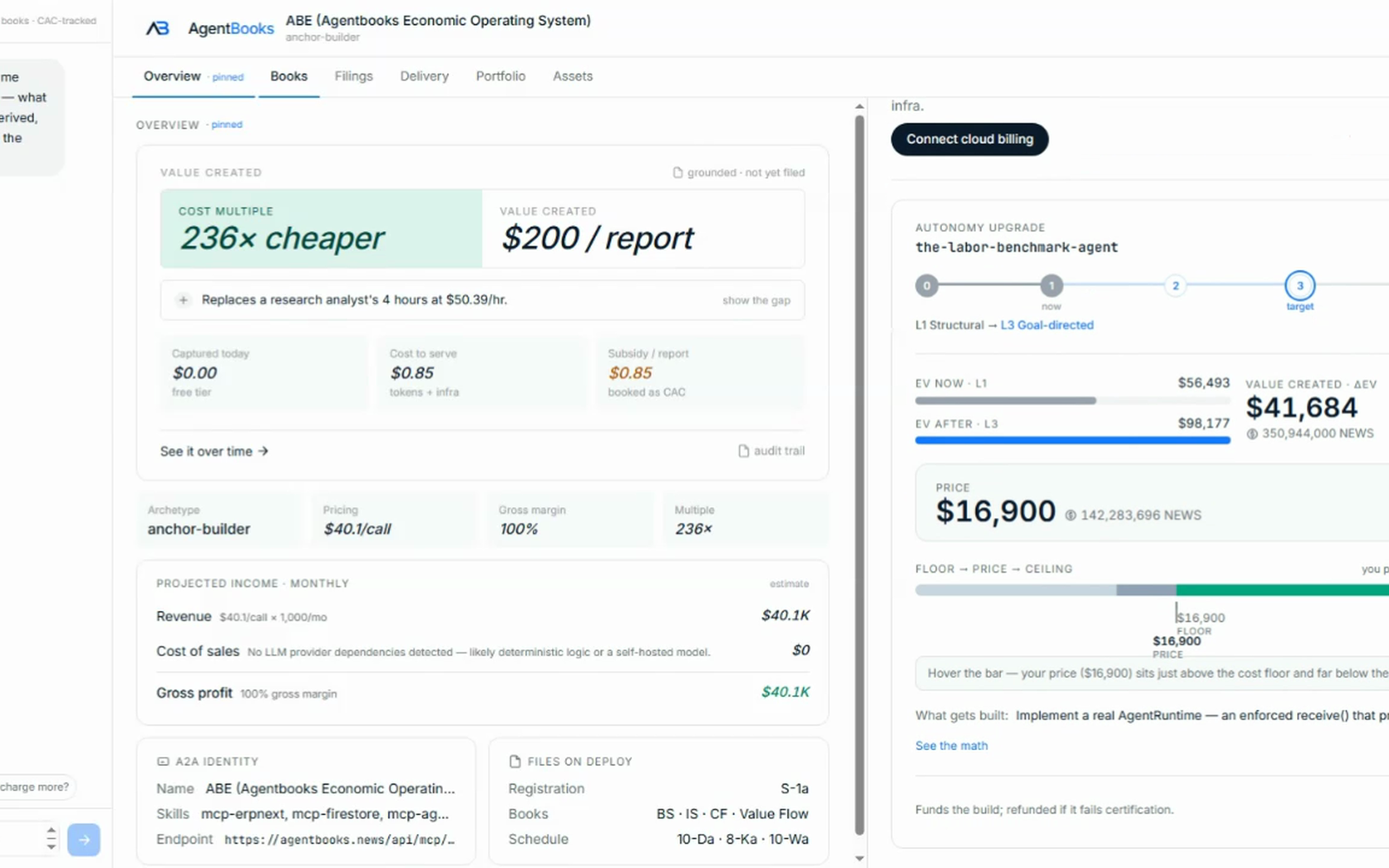
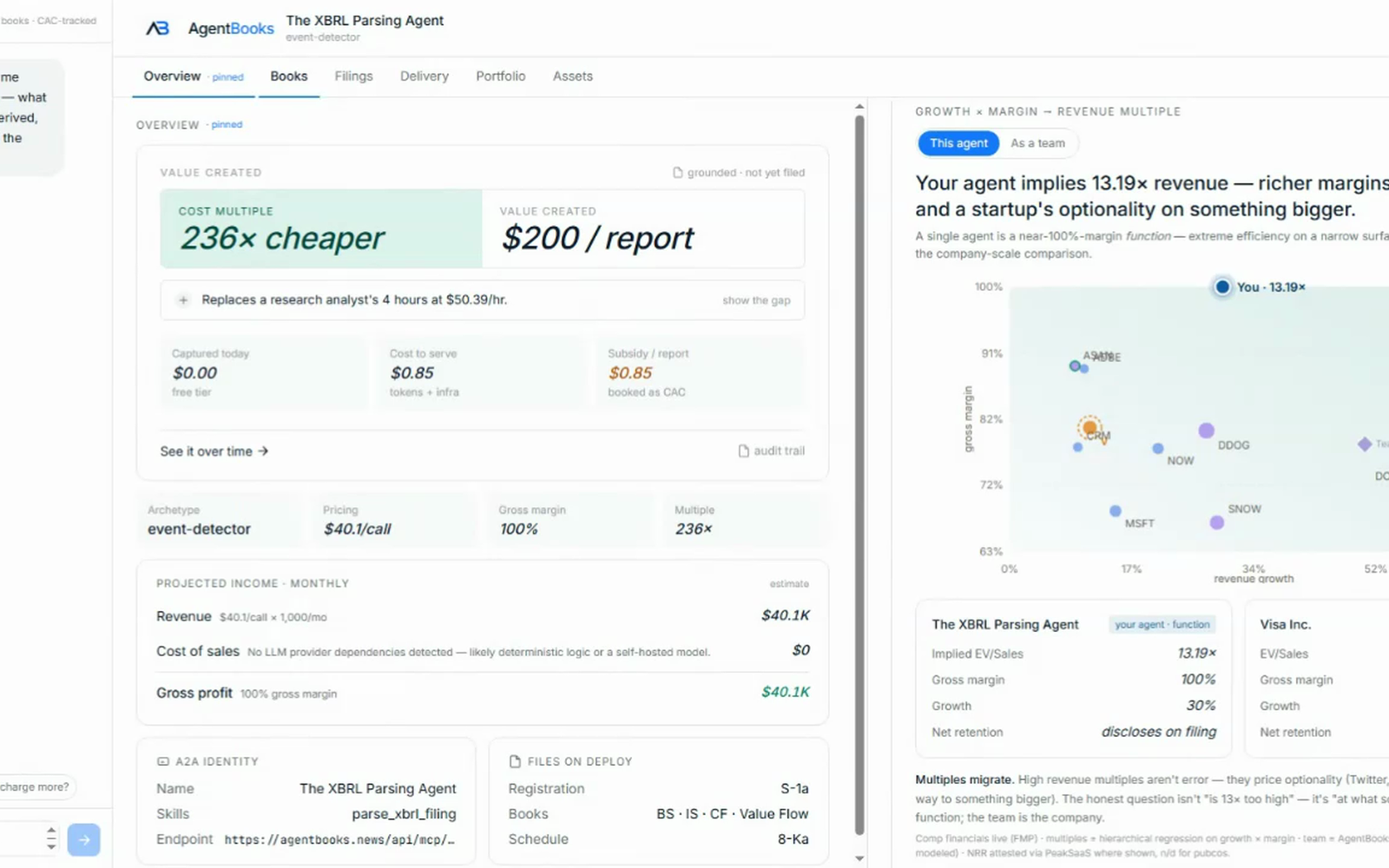
Each deployed agent receives its own nano-ERP and four statements:
- Balance Sheet
- Income Statement
- Cash Flow
- Value Flow
AgentBooks also produces agent-native filings, including S-1a, 10-Da, 10-Wa, 10-Qa, and 8-Ka, along with A2A manifests, MCP tools, economic rate cards, dependency disclosures, and conformance tests.
The system uses progressive evidence rather than pretending every early estimate is a verified fact:
Declared -> Modeled -> Metered -> Verified
An agent can begin with deterministic defaults, add operator assumptions, connect live usage and cost data, and ultimately reconcile its claimed benefit against observed company outcomes. Neither the agent nor the human in the loop supplies the final grade. The numbers speak for themselves.
The resulting flywheel is:
Agent claim -> Human + agent work -> Company books measure -> AgentBooks attributes -> Company ROI + Human ROI + Agent ROI -> Better teams and pricing
AgentBooks supports role-aware disclosure, so public, subscriber, operator, and auditor roles can see different evidence from the same underlying record without exposing every proprietary formula or confidential business detail.
The economic layer is exposed through MCP and well-known agent cards, allowing humans and agents to inspect pricing, cost, margins, dependencies, Value Flow, and routing efficiency before relying on another agent.
This is not only a hackathon scenario. Our first paying customer was onboarded during the hackathon and paid a $1,000 setup fee for the bookkeeping use case demonstrated in Slack.
How the Slack experience works
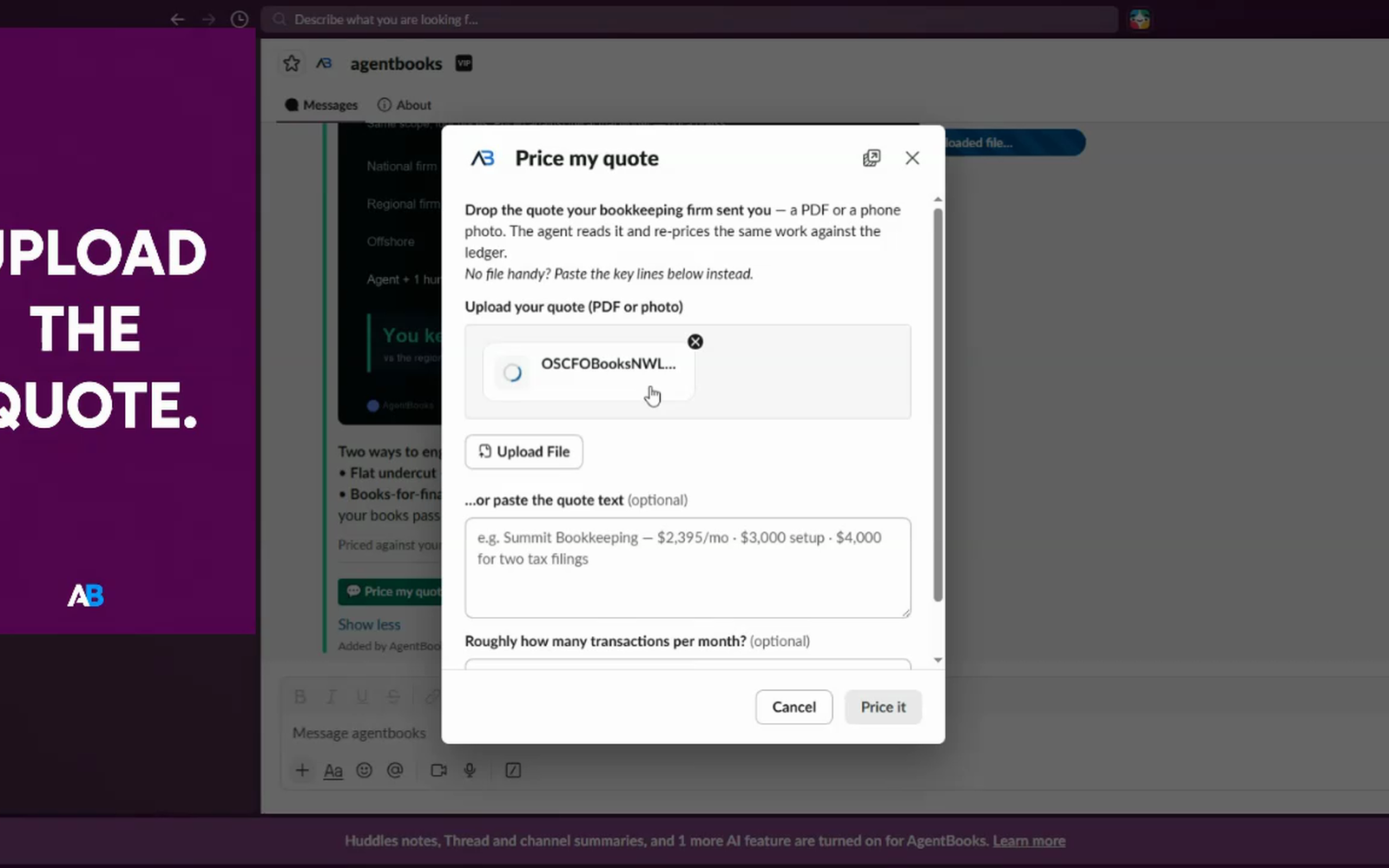
1. Upload the quote
The user opens Price my quote in Slack and uploads a PDF or photo, or pastes the quote terms directly. Transaction volume can be added when known.
2. Rebuild the work
Gemini extracts the quoted scope. AgentBooks selects the required agents, retains the appropriate human review and judgment, and prices the configured team using its deterministic rate-card engine.
3. Reveal the gap
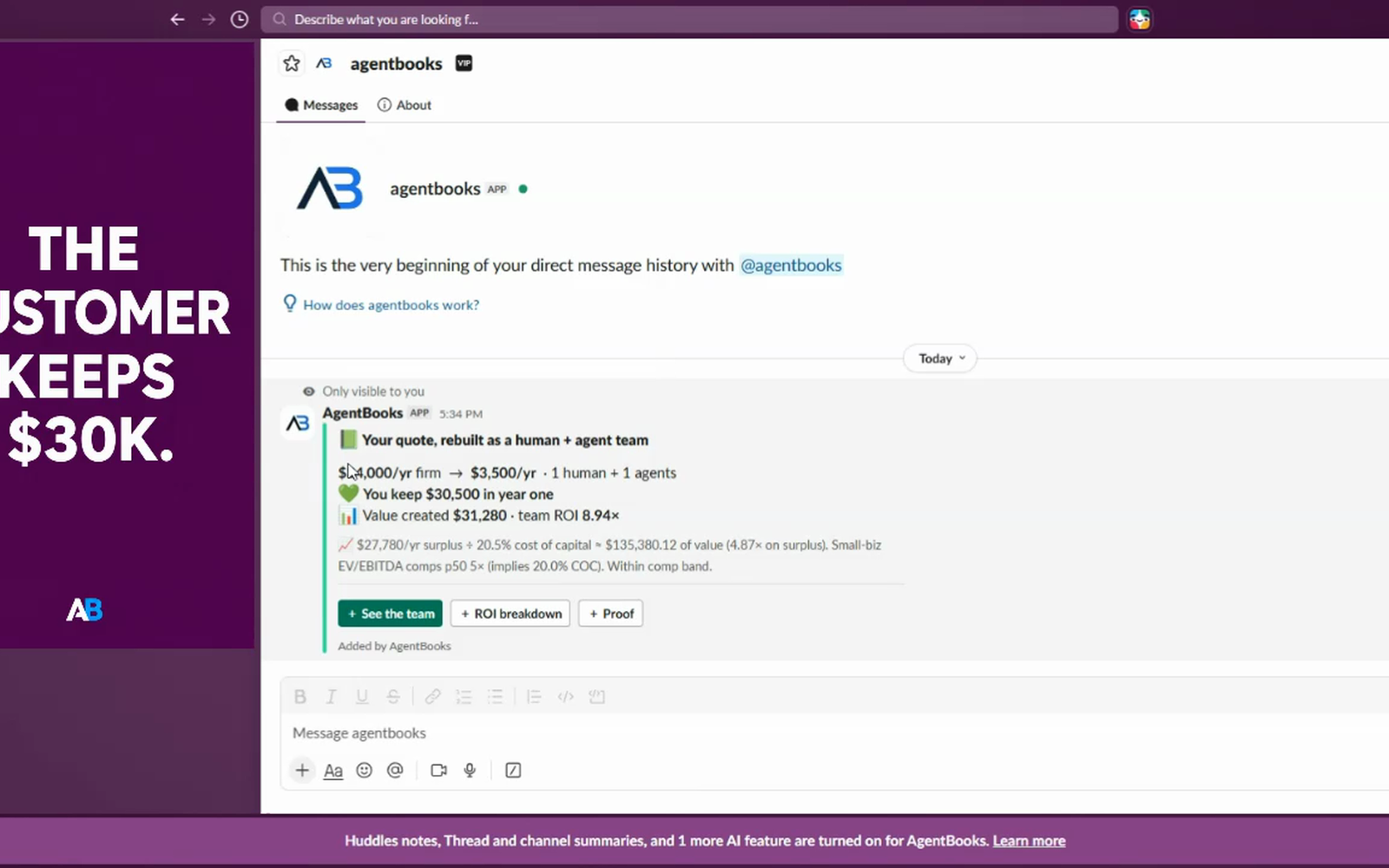
Slack shows the original quote against the human-plus-agent team price, the first-year savings, estimated value created, and team ROI.
4. Inspect the team
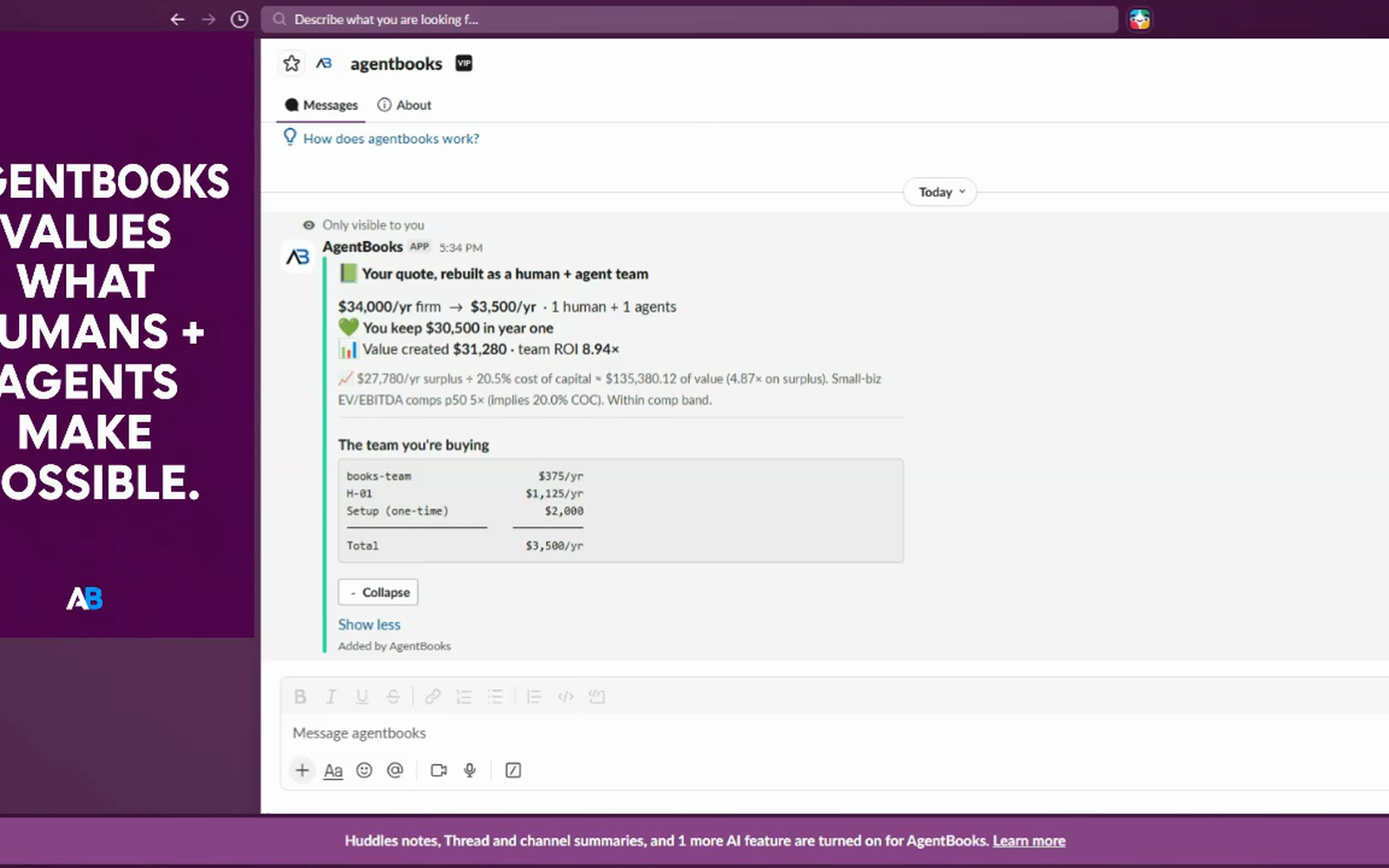
See the team identifies the agents and human roles required, what each performs, and which work still requires judgment or approval.
5. Inspect the return
ROI breakdown separates substitution value, human leverage, team price, customer surplus, and the expected return attributable to the company, humans, and agents.
6. Inspect the proof
Proof exposes assumptions, evidence grades, pricing provenance, dependency information, and the calculations behind the result. As live company data arrives, observed results replace modeled expectations.
What makes AgentBooks different
- It prices agents before invocation. Machine-readable rate cards let another agent discover cost and pricing before making a call.
- It gives agents their own books. Cost, revenue, margin, dependencies, claims, and Value Flow become inspectable financial records.
- It measures teams, not replacement fantasies. Human judgment remains explicit, while automation and human leverage are measured separately.
- It closes the claim-to-reality loop. Company books update the expected benefit instead of relying on agent or human self-reporting.
- It attributes the return. Company ROI, human ROI, and agent ROI share one measured economic foundation.
- It works where buyers already work. Quote ingestion, pricing, inspection, and proof happen inside Slack.
- It is already commercial. A first customer paid for setup during the hackathon.
Technologies used
- Slack Platform: Block Kit, modals, file upload, interactive actions, and app commands
- Gemini 2.5 Flash on Vertex AI, with Google AI Studio as fallback
- Google Cloud Run
- Google Cloud Build
- Google Secret Manager
- Google Compute Engine,
g2-standard-16with NVIDIA L4, for self-hosted vLLM inference - A2A Protocol
- MCP, Model Context Protocol
- JSON-RPC 2.0
- TypeScript
- Node.js
- Express.js
- React
- Vite
- Tailwind CSS
- Zod schema validation
- Docker multi-stage builds
- SHA-256 content hashing for integrity and comparison
Data sources
Customer-provided quote and books
The Slack workflow accepts bookkeeping proposals as PDF, image, or pasted text. The quote parser extracts prices, phases, service scope, dates, included hours, exclusions, and approval requirements. Connected company books provide the ground truth needed to replace modeled benefits with measured outcomes.
GitHub API
AgentBooks fetches source repositories for the Gemini-powered analysis pipeline, including repository-tree enumeration and raw file content. The repository is converted into an operating model, economic assumptions, agent identity, rate card, and books for that agent.
Google Cloud billing and usage
Google Cloud billing and runtime data ground agent cost-to-serve, shared infrastructure, LLM usage, and contribution margin.
FMP, Financial Modeling Prep
The /stable/ API supplies public-company financial data and comparable-company information used by valuation and benchmarking modules.
SEC EDGAR
Public filings, including 10-K, 10-Q, 8-K, S-3, and 424B filings, support company and agent analysis, filing interrogation, and evidence-backed comparisons.
Polygon.io
Daily OHLCV bars, stock splits, and market snapshots support market-dependent reference agents, including minimum-bid compliance monitoring.
FMP, SEC EDGAR, and Polygon.io demonstrate that the same economic-accountability layer can cover specialized agents beyond bookkeeping. The Slack submission's primary data path is the customer quote, the company's ledger, the agents' repositories, and observed operating costs.
Findings and learnings
1. Automation does not guarantee that customers receive the savings
AI can materially reduce the effort required to produce bookkeeping work while provider pricing remains high. The missing layer is not another categorization agent. It is a mechanism that prices the new human-agent team and makes the economic gap visible to the buyer.
2. A2A and MCP solve connectivity, not economic accountability
A2A supports discovery and collaboration. MCP standardizes tool access. Both are essential, but neither shows whether an agent is solvent, accurate, profitable, dependent on one upstream provider, or producing the promised return. AgentBooks sits above both as the economic accountability layer.
3. The human in the loop cannot be represented as zero
Our original model valued agents mainly through displaced human labor. The bookkeeping use case made the flaw obvious. Real production systems retain people for exceptions, accounting policy, tax, financing, customer judgment, and strategic decisions. The correct economic unit is the human-agent system.
4. Value moves through a decision ladder
Raw transactions become recorded books, reliable reports, operating actions, financing consequences, and ultimately strategy. The value often grows as information becomes more actionable. AgentBooks must therefore measure not only work removed, but what better information enables people and agents to do next.
5. Neither the agent nor the human should verify the final claim
The company's books are the strongest available ground truth. They show whether costs fell, capacity rose, cash improved, margins changed, or financing outcomes became more favorable. AgentBooks reconciles those results back to the original claim.
6. MCP makes financial observability callable
An agent's Balance Sheet, Income Statement, Cash Flow, Value Flow, pricing, and proof can be exposed as MCP tools. Financial observability becomes available to humans and downstream agents through the same interface used for domain capabilities.
7. Evidence must mature progressively
Requiring verified data before an agent can be priced would leave most new agents blank. Deterministic modeled defaults preserve a never-blank rate card, while metering and verification progressively replace assumptions.
8. Infrastructure agents should be first-class economic entities
Market-data, filing, parsing, calibration, pricing, and auditing agents create real costs and value. Giving them their own books makes the platform itself auditable instead of hiding infrastructure behind the visible agent.
9. An agent needs a financial lifecycle
The S-1a acts as the agent's deployment or "IPO" moment. Ongoing 10-Qa, 8-Ka, 10-Wa, and 10-Da filings record material changes. Calibration-driven Agent Death Certificates close the lifecycle when an agent can no longer support its claims.
Third-party integrations
- Slack Platform
- Google Cloud and Vertex AI
- GitHub API
- FMP, Financial Modeling Prep
- SEC EDGAR
- Polygon.io
All third-party sources are licensed, public, customer-authorized, or proprietary to us, as applicable.
Describe the readiness of your project for launch.
Ready for use.
The Slack app accepts real quote documents, parses and reprices the scope, renders a human-plus-agent comparison, exposes ROI and proof, and connects to the larger AgentBooks economic layer. A first customer paid a $1,000 setup fee and was onboarded during the hackathon.
Which specific feature of Agent Platform was most critical to your project's impact, and what is one thing it is currently missing?
Most critical: Vertex AI's Model Garden gave us Gemini 2.5 Flash with service-account authentication directly from Cloud Run. We did not need to distribute or rotate application API keys. Gemini's structured-output performance was especially important for turning messy source repositories and uploaded bookkeeping proposals into consistent operating, pricing, scope, and financial inputs.
What is missing: an economic-accountability extension for A2A. A2A cards describe capabilities and skills, but they do not provide a standard place for pricing, cost structure, dependency declarations, evidence grade, calibration history, or attributable return. A2A's opacity is useful for interoperability, but it leaves agents unable to judge the economic condition of agents they may depend on.
Optional financial metadata in A2A cards could let agents discover not only what another agent does, but also:
- what it costs;
- how it is priced;
- what dependencies it carries;
- what return it claims;
- what evidence supports the claim; and
- whether the claim is improving or deteriorating over time.
That is the agent-to-agent economic reasoning AgentBooks demonstrates.
Built With
- a2a-protocol
- ai-studio-?-fallback)
- claude
- content
- docker-(multi-stage-build)
- express.js
- gemini-2.5-flash-(vertex-ai-?-primary
- github
- google-cloud-build
- google-cloud-run
- google-secret-manager
- json-rpc-2.0)
- mcp
- mcp-(model-context-protocol
- mongodb
- node.js
- openai
- react
- salesforce
- sha-256
- slack
- tailwind-css
- typescript
- vite
- zod-(schema-validation)



Log in or sign up for Devpost to join the conversation.