-
-
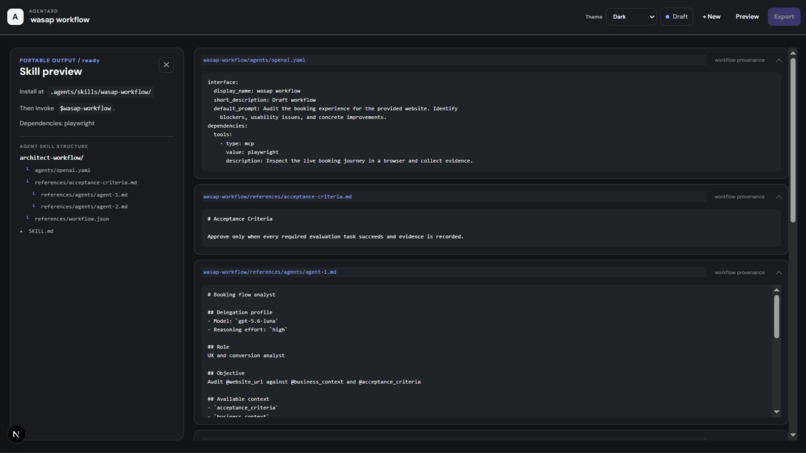
Preview export
-
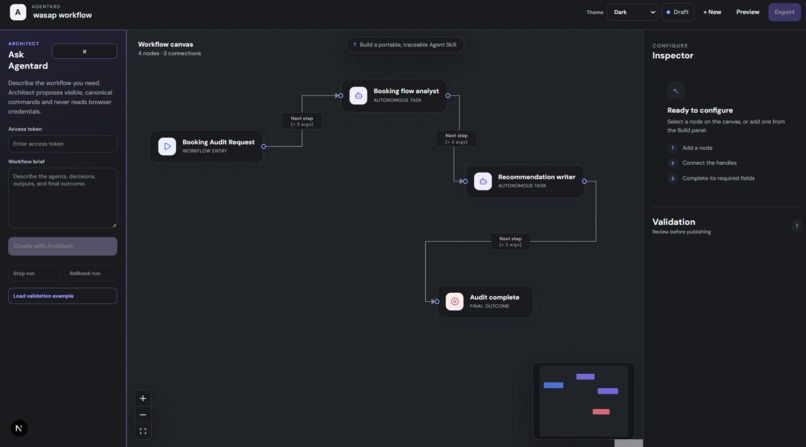
IA builder mode
-
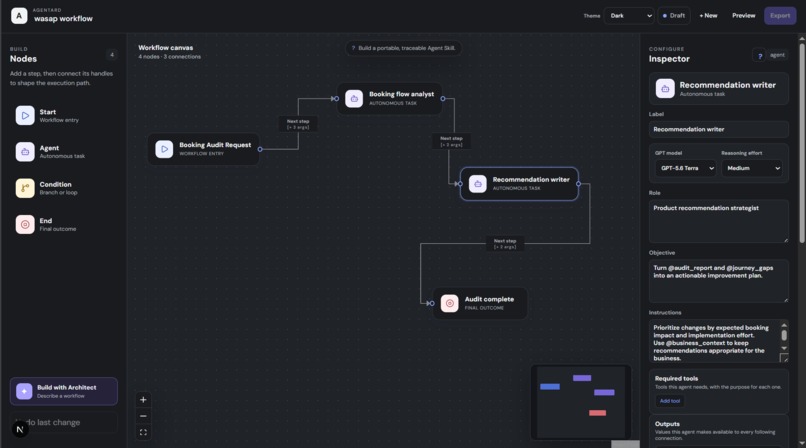
Manual mode
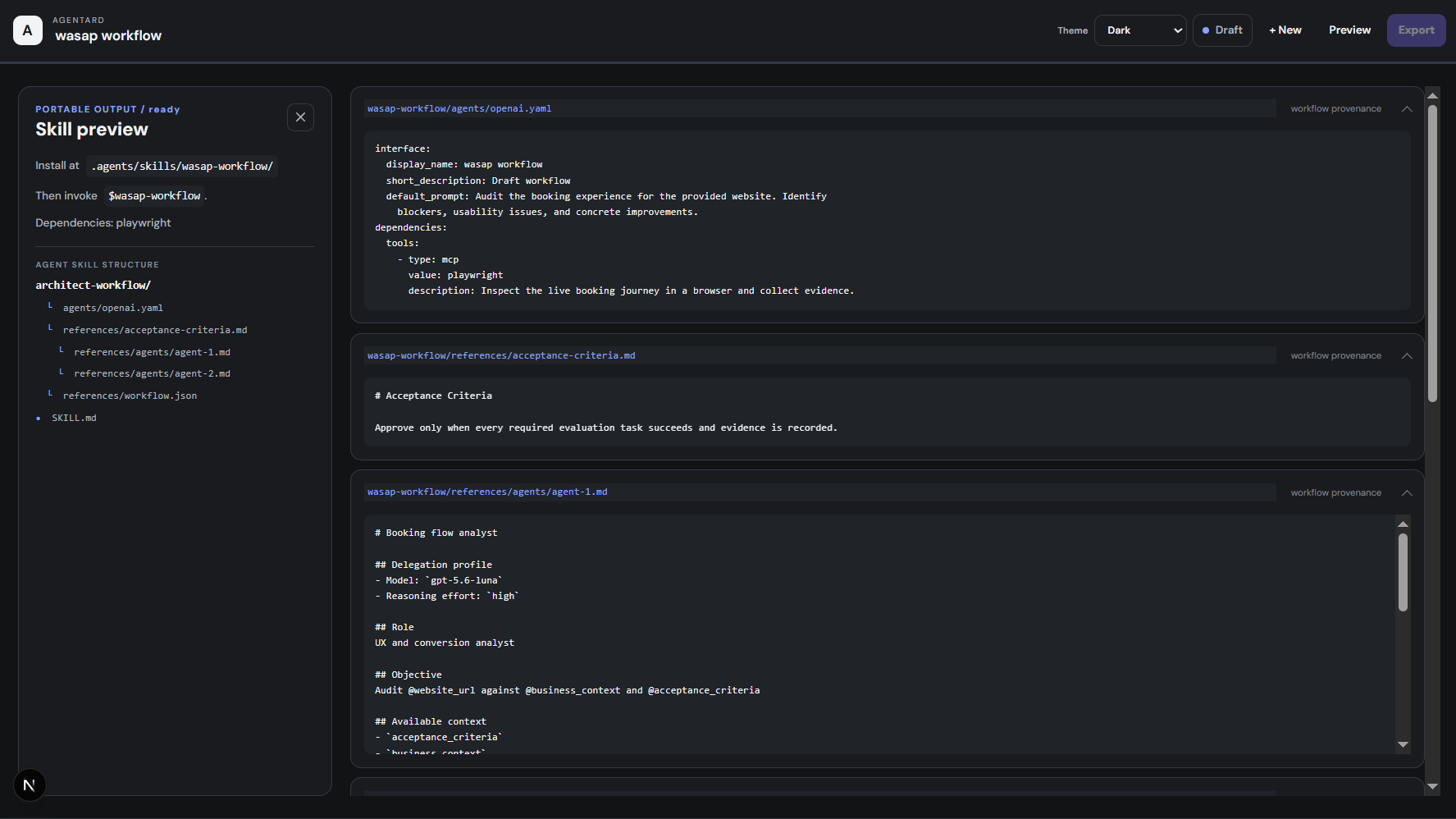
Inspiration
What it does
How we built it
Inspiration
Most AI development tools focus on making a single agent more capable. However, real development tasks often require multiple specialized roles, clear handoffs, validation steps, conditions, and iteration loops.
We imagined a visual workspace where developers could design these systems as easily as building a workflow—then package the result into something Codex can understand and execute inside a real project.
That idea became Agentard.
What it does
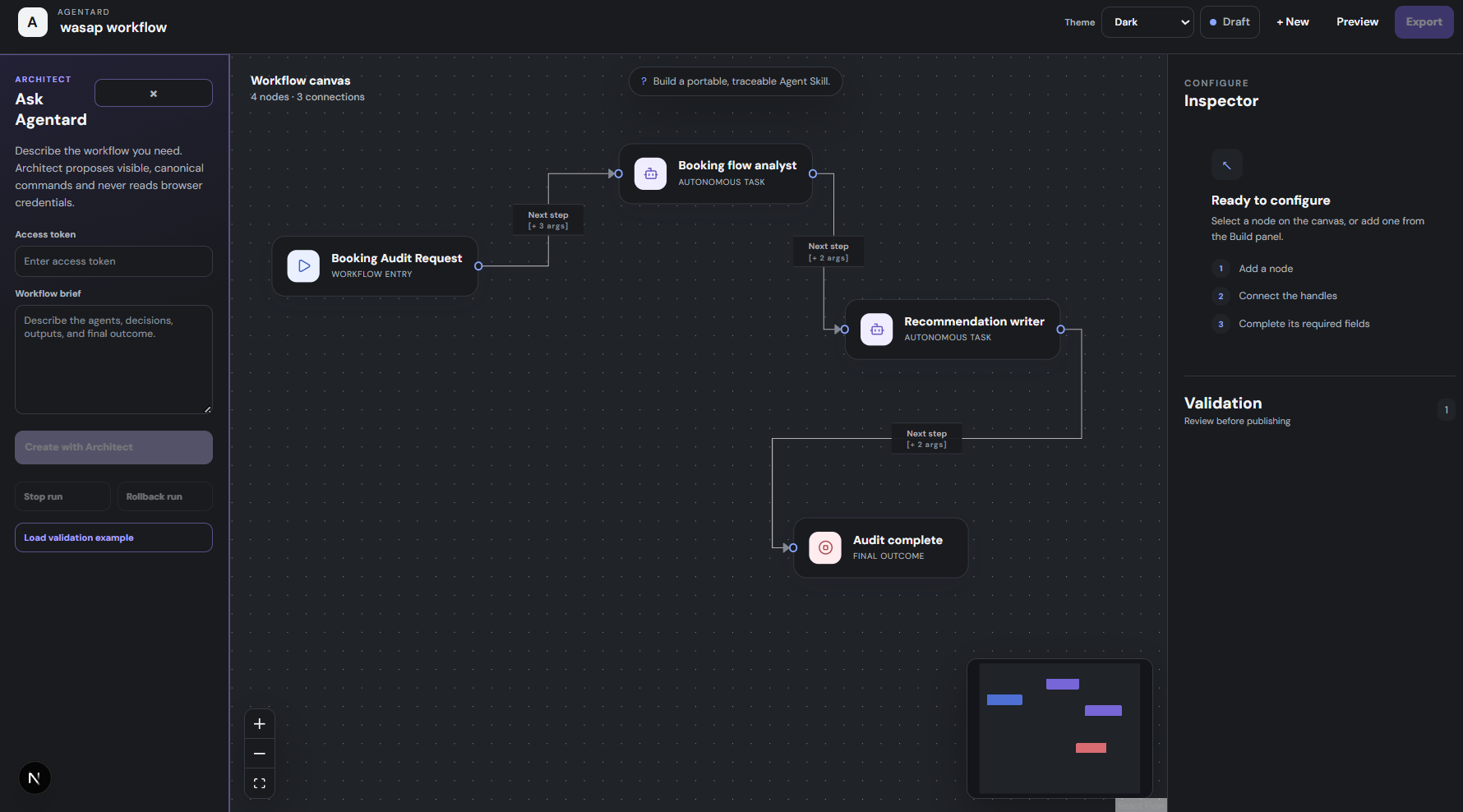
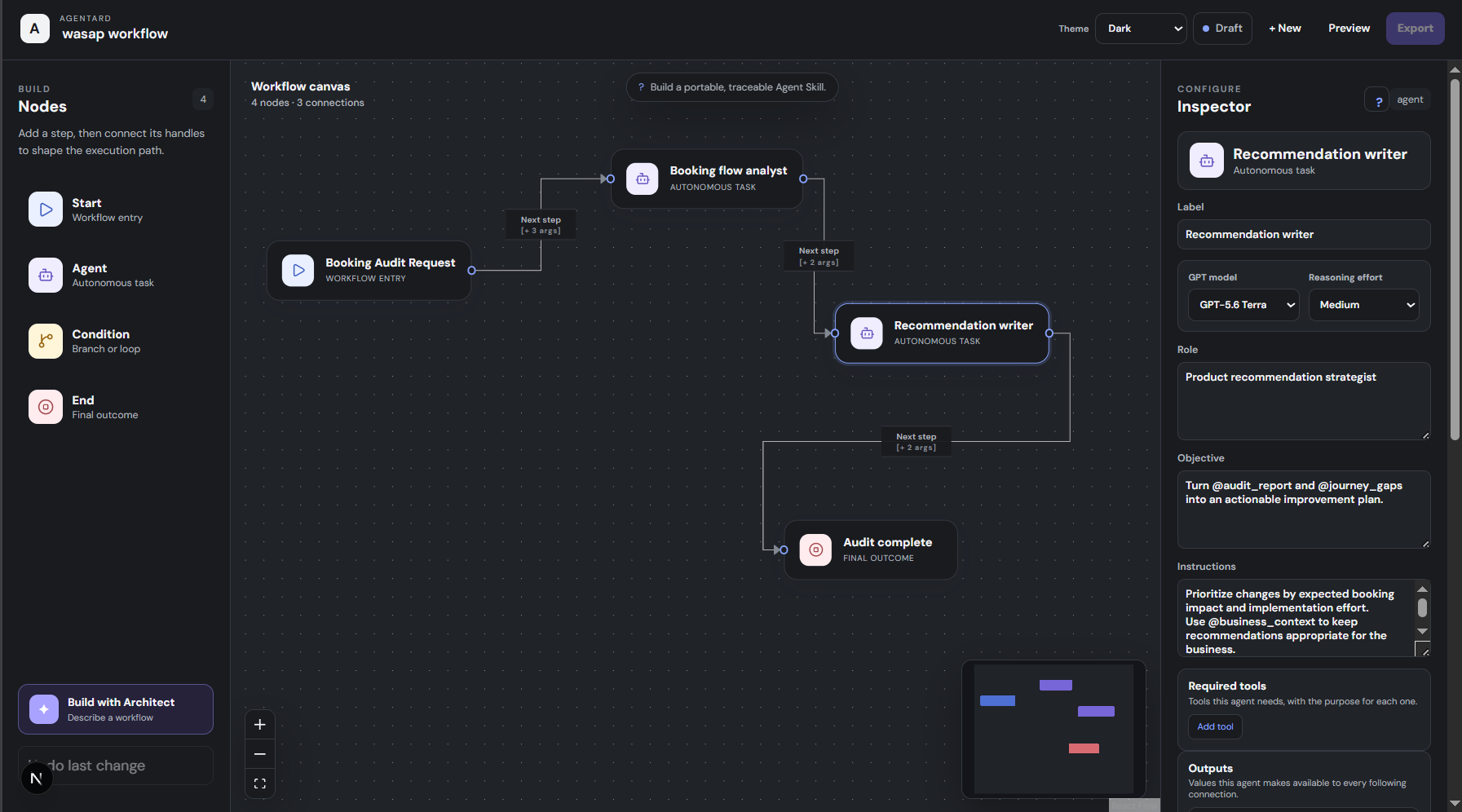
Agentard is a visual editor for designing specialized multi-agent workflows and exporting them as Codex-ready Agent Skills.
Users can create workflows manually with nodes or describe what they need in natural language. Agentard Architect, powered by GPT-5.6, converts that request into an editable workflow containing:
- Specialized agents and personas
- Instructions and responsibilities
- Connections and handoffs
- Conditions and approval gates
- Controlled iteration loops
- MCP and tool requirements
- Acceptance criteria
Before exporting, Agentard validates the workflow for missing connections, invalid configurations, unsafe loops, and incomplete agent definitions.
The final result is packaged as a project-scoped Agent Skill. Once added to a repository, Codex can interpret the workflow, work with the project files, use the declared tools, and coordinate the specialized roles.
Agentard designs the workflow. Codex brings it to life.
Example workflow
Our demo creates a product-development workflow for a barbershop application:
- A Product Designer proposes the experience.
- A Frontend Developer implements it.
- A Barber Persona evaluates the result as the target user.
- Playwright is used to inspect and interact with the application.
- An approval condition either completes the task or sends feedback back to the designer.
- The workflow can iterate up to a predefined limit.
This turns a generic coding agent into a repeatable development and validation process designed for a specific use case.
How we built it
Agentard consists of four main layers:
- A node-based web editor for creating and editing workflows.
- A structured workflow schema representing agents, connections, conditions, tools, and iteration policies.
- A deterministic validation and compilation layer.
- Agentard Architect, powered by GPT-5.6 through the OpenAI API.
Instead of allowing the model to modify the interface directly, GPT-5.6 works through a controlled set of tools such as creating agents, connecting nodes, assigning MCP requirements, defining conditions, and configuring loop limits. Every generated change must pass the same deterministic validation rules as a manually created workflow.
The compiler transforms the validated graph into a Codex-compatible Agent Skill containing a SKILL.md, agent metadata, workflow definitions, role instructions, acceptance criteria, and tool requirements.
Codex was our primary development environment during the hackathon. We used it to plan the architecture, implement and debug the product, refine the workflow schema, create validation rules, and test the exported Agent Skill inside a real project.
Challenges we ran into
The hardest challenge was translating a visual graph into instructions that an autonomous coding agent could follow reliably.
We also had to separate two different responsibilities: Agentard should design and validate workflows, while Codex should execute them. Keeping this boundary clear made the product safer, more portable, and easier to understand.
Other challenges included preventing infinite feedback loops, representing conditional paths, keeping generated workflows editable, declaring external tool requirements, and ensuring that AI-generated changes never bypass deterministic validation.
Accomplishments that we're proud of
We created a workflow format that can represent specialized agents, personas, conditional decisions, tool requirements, and bounded feedback loops.
We are especially proud that Agentard does not lock workflows inside its own runtime. It exports them as portable Agent Skills that can live alongside the user's code and be interpreted by Codex within the actual project context.
We also designed GPT-5.6 as an accessibility layer rather than a replacement for the visual editor. Technical users retain detailed control, while less-experienced developers can generate a strong starting point using natural language.
What we learned
We learned that effective agentic systems are not only about selecting a powerful model. Their quality also depends on role definition, context boundaries, validation criteria, tool access, handoff structure, and stopping conditions.
We also learned that generated workflows need deterministic guardrails. GPT-5.6 provides planning and reasoning, but the product still needs conventional validation to guarantee that the exported workflow is structurally complete and safe to execute.
What's next for Agentard
Next, we want to add reusable workflow templates, collaborative editing, workflow versioning, richer validation, and a community marketplace for sharing Agent Skills.
We also want to expand the visual language with human-approval nodes, parallel execution, reusable subflows, observability, and evaluation reports.
Our long-term vision is to make specialized multi-agent workflows as easy to design, understand, and share as modern automation workflows—while keeping Codex as the environment where those workflows become real software.
Built With
- next.js

Log in or sign up for Devpost to join the conversation.