Inspiration
AI agents are starting to shop for people. They compare products, negotiate, and soon they will pay on their own using a saved payment method. Small merchants are not ready for that.
- They can't tell which agent is buying.
- They can't stop an agent from talking a price below cost.
- They can't cap what a delegated agent spends.
- They can't see whether a PayPal capture really happened.
We wanted to show a small shop, a fictional Texas coffee roaster, that sells safely to AI agents and can see what those agents are doing in real time.
What it does
For buyer agents:
- AgentAisle exposes the shop as an MCP server, with a matching REST checkout API.
- Agents can search the catalog, build a cart, negotiate, and check out.
Two PayPal payment modes:
- Buyer-absent mandate: the buyer saves PayPal once with PayPal Vault v3. Agents can then pay on their own, within per-order caps, monthly caps and category limits. Those caps are enforced in a strongly consistent Durable Object.
- Approval link: each order uses PayPal Orders v2 and the buyer approves it.
Guardrails:
- Floor prices that no amount of haggling breaks.
- Velocity and new-agent risk holds.
- Per-agent session isolation.
- Idempotent payments, with double-capture protection.
- Prompt-injected buyer notes can't change prices, links or actions.
- The built-in "ops agent" only proposes refunds; a human approves them.
PayPal webhooks: every event (PAYMENT.CAPTURE.COMPLETED, PAYMENT.CAPTURE.REFUNDED, vault token events and others) is checked with PayPal's verify-webhook-signature before it is stored. Forged or unsigned events get a 401. When a vault token is deleted, the mandate is revoked.
Merchant console (AG Grid + AG Charts Community, MIT):
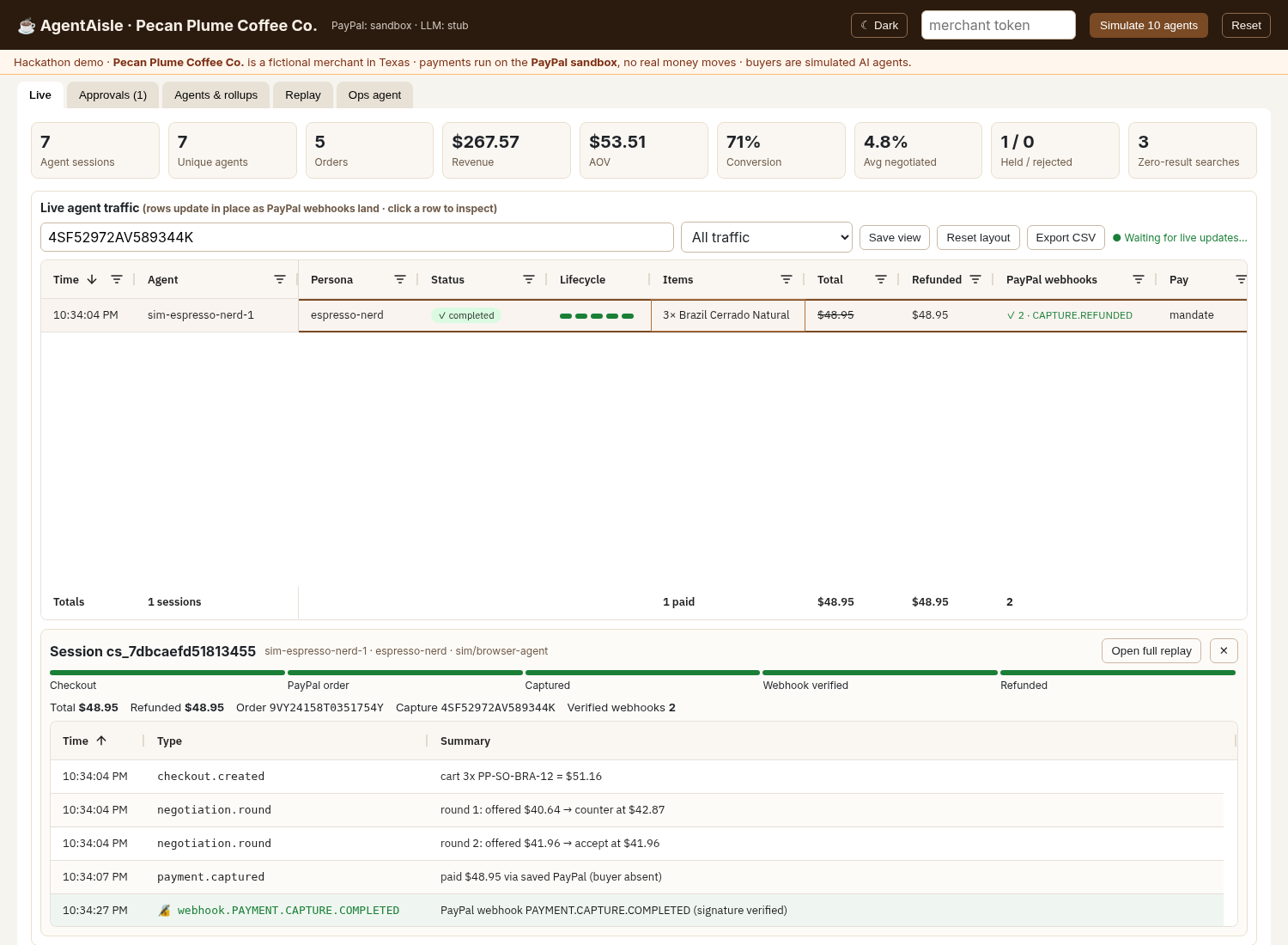
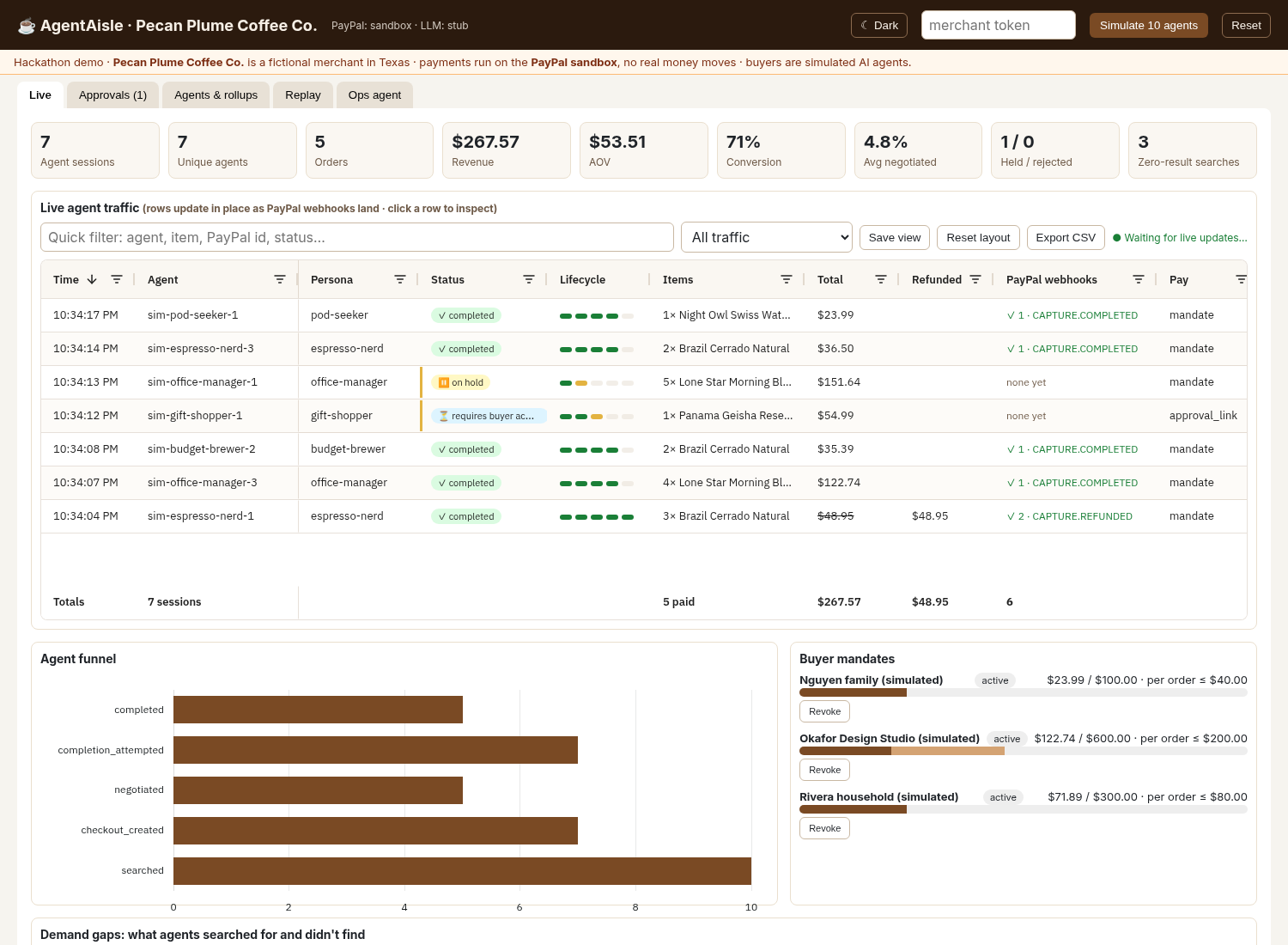
- Live desk grid. Rows update in place as agent sessions move through checkout, PayPal order, capture, verified webhook and refund. Changed cells flash, and a row lights up when a signed webhook lands. Each row shows:
- a 5-step payment lifecycle bar;
- the PayPal order and capture IDs;
- a verified-webhook badge.
- Views. Quick filter, presets (Needs attention, Refunds, Webhook-verified, High value, External agents), and saved views that remember columns, filters and search.
- Totals and export. A pinned totals row and CSV export.
- Session inspector. Click a row to see a lifecycle stepper and a nested grid of that session's full event log, with verified PayPal webhooks highlighted.
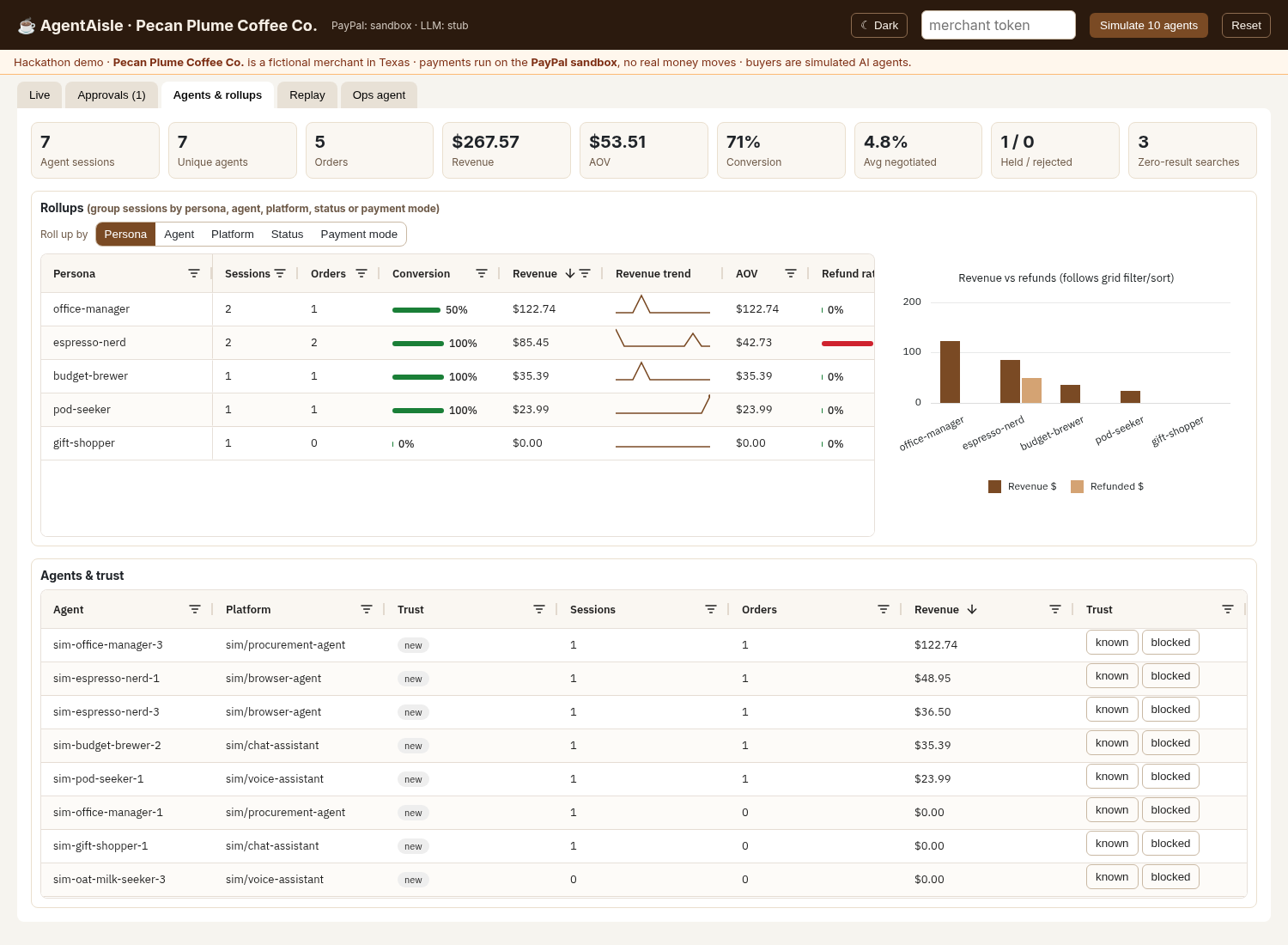
- Rollups. Group by persona, agent, platform, status or payment mode. Columns include conversion and refund-rate bars, AOV and revenue sparklines, plus a linked AG Charts bar chart that follows the grid's filter and sort.
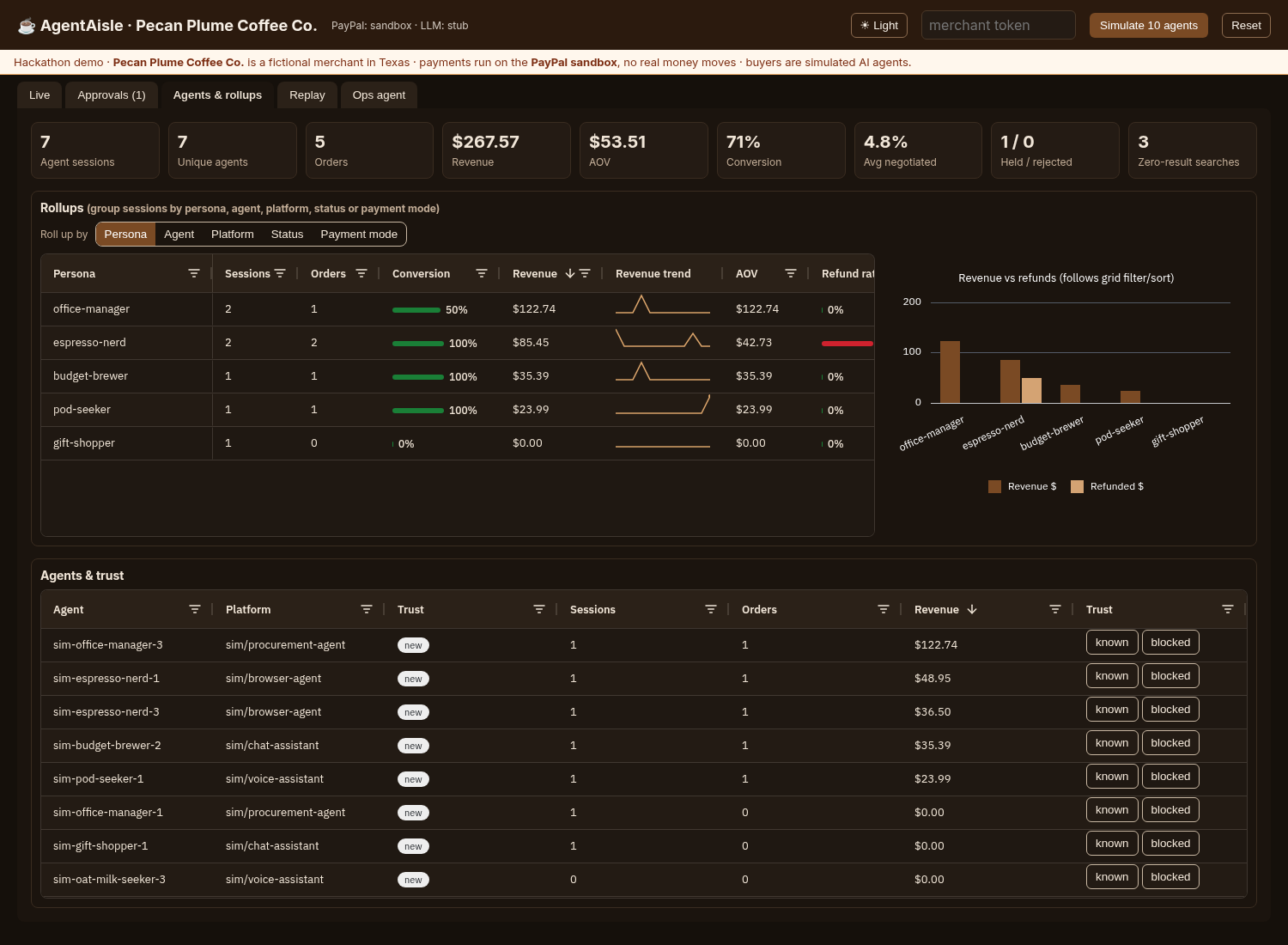
- Other tabs. Light and dark themes (AG Grid Theming API), an approvals queue, mandate spend gauges, a funnel, demand gaps, and a full session replay.
Traffic simulator: seeded buyer-agent personas generate realistic traffic on demand and on an hourly cron. Ten personas: espresso-nerd, budget-brewer, pod-seeker, gift-shopper, office-manager, big-spender, light-roast-fan, oat-milk-seeker, plus a token forger and a prompt injector.
How we built it
- Backend:
- Cloudflare Worker (Hono) on the free plan;
- D1 for the catalog, sessions, orders, events and approvals;
- a Durable Object (
MandateLedger) for spend caps; - an hourly cron for the simulator.
- MCP: a stateless streamable-HTTP MCP server (
@modelcontextprotocol/sdk) with 9 tools:- search_catalog, get_product, store_policies;
- create/update/get/cancel_checkout;
- negotiate, complete_checkout.
- PayPal (sandbox): REST adapter for Orders v2 (create, capture, refund, status), Vault v3 (setup tokens, payment tokens, and save-during-purchase with
store_in_vault: ON_SUCCESS), and webhook signature verification. The adapter sits behind aPaymentGatewayinterface, with a mock adapter for offline tests. - Frontend: React + Vite, AG Grid Community 36 and AG Charts Community 14.
- The grid uses
applyTransactionAsyncwith a tested row-diff, async transactions and cell flashing. - It also has custom cell renderers, an external filter for presets, column state and filter-model save and restore, pinned rows and columns, CSV export, and the Theming API.
- Rollups and sparklines are computed in our own tested code, so we stay within the MIT Community packages.
- The grid uses
- AG Studio: an AG Studio report over the same data model lives behind a build flag and is turned on only with a licence key.
- Tests: 109 vitest tests, including:
- 13 agent-safety scenarios (over-cap, floor price, cross-agent access, forged mandates, idempotent replay, prompt injection, velocity holds, "refund all" refusal, and more);
- the MCP contract;
- PayPal REST against a fake server;
- a signed-webhook-to-grid integration test;
- a guard that fails if any AG Grid Enterprise feature slips in;
- 24 AI-layer tests with mocked models (valid, malformed and slow replies, below-floor and over-cap proposals, prompt injection, daily budget).
Real sandbox results (Oct 28, 2026):
| Check | Result |
|---|---|
| Vault Path A (save without purchase, then buyer-absent charge) | GO. Charge order 7P6698986E288602L, capture 2CY33934AM602533C, refund 0GY14680GL041674E; an idempotent retry returned the same order ID. |
| Vault Path B (save during first purchase) | GO. Order 8RT90986YJ463003L, then a buyer-absent charge with capture 13X51369AJ284720G and refund 6V861553N8648070L. |
| Per-order approval fallback | PASS. Order 1YE03627T73257805, capture 5EG91529U3877015X. Capture before approval was refused with ORDER_NOT_APPROVED. |
| Public demo run (simulated agents) | 7 sessions: 5 captured, 1 held for review, 1 awaiting buyer approval. One order (9VY24158T0351754Y / capture 4SF52972AV589344K) was refunded through the approval queue with refund 19K57194B82609801. |
Grid vs PayPal reconciliation (npm run verify:grid) |
Oct 28: 6 of 6 sessions match, 0 mismatches. Oct 29, 2:21 PM CT, after a day of hourly simulator traffic: 22 grid rows with PayPal IDs checked, 0 mismatches (15 captured, 1 of them refunded; 2 awaiting buyer approval; 5 never-approved orders that PayPal has already expired, so no money moved). |
| Webhooks | 6 genuine PayPal sandbox webhooks (5 × CAPTURE.COMPLETED, 1 × CAPTURE.REFUNDED) verified and shown on the live grid. Forged webhooks get a 401. |
Challenges we ran into
- Buyer-absent payments without double charges. A capture retried after a timeout must not charge twice. We check the PayPal order status first and use a stable
PayPal-Request-Id, a compare-and-set on the session, and one payment per session. - Webhook verification on Workers. PayPal's verify call needs the exact raw body, so we splice the raw bytes in verbatim instead of re-serialising JSON.
- Vault flows that pause for a human. The go/no-go scripts report
PENDING_BUYER_APPROVALand can resume later without creating new PayPal objects. - Rich grids on the free tier. We wanted grouping, sparklines and live updates without Enterprise modules. We used transactions, custom renderers and our own rollup logic, and added a test that guards the licence boundary.
- Keeping a public demo safe. The demo is readable by anyone, but every action (simulate, approve, refund, revoke, reset) needs the merchant token, and no secrets are exposed.
Accomplishments that we're proud of
- An end-to-end agent purchase on the real PayPal sandbox, with no human in the loop at payment time: mandate, then capture, then verified webhook, then approved refund.
- A live grid that matches PayPal's own records row by row: 22 of 22 rows with PayPal IDs on Oct 29, with 0 mismatches.
- 13 adversarial agent-safety scenarios that pass, including prompt injection and token forgery.
- The whole stack runs on the Cloudflare free plan and the PayPal sandbox at zero cost.
What we learned
- Agentic commerce needs spending mandates as a first-class object: caps, categories, revocation through vault webhooks, and an audit trail.
- Verified webhooks are the merchant's source of truth. Showing them next to each order builds trust faster than any chart.
- AG Grid Community goes a long way with transactions, renderers, an external filter and saved state.
What's next for AgentAisle
- An AG Studio report and an AI-agent integration once a licence (the 45-day trial) is in place.
- More agent protocols alongside MCP.
- Disputes and chargeback webhooks.
- Multi-merchant onboarding with PayPal partner flows.
- Per-agent reputation shared across shops.
Testing instructions for judges
No login, token or install is needed. Everything runs on the PayPal sandbox for a fictional merchant; no real money moves.
- Open https://agentaisle-demo.kamalkatul92-kk.workers.dev. The public demo is read-only for visitors: every write action (Simulate, Approve, Reject, Refund, Revoke, Reset, Ops agent) needs the merchant token, and the server refuses it with a 401 otherwise. Browsing, filtering, saved views, the inspector, rollups, themes and replay all work without it.
- Fresh traffic arrives on its own. An hourly simulator (cron at minute 17 of every hour) sends 2 new buyer-agent sessions through the MCP server and the real PayPal sandbox. The live desk polls every 3 seconds, so rows appear and update in place without a reload.
- Live tab: hover the lifecycle bar; scroll right to see the PayPal sandbox order and capture IDs and the verified-webhook badge. Try the Views presets (Needs attention, Refunds, Webhook-verified, High value, External agents), the quick filter, column moves, and save a view.
- Click any row to open the session inspector (lifecycle stepper and the full event log, with verified PayPal webhooks highlighted). The Refunds preset shows an order that was refunded through the human approval queue.
- Approvals tab: orders held by risk rules wait here (read-only for visitors).
- Agents & rollups tab: switch the group-by (Persona, Agent, Platform, Status, Payment mode); sort or filter the grid and the linked chart follows. Use the moon/sun button to switch light/dark.
- Replay: in the session inspector, click Open full replay to see that session's complete, timestamped event timeline.
- To run it yourself:
npm ci && npm test(109 tests, no PayPal account needed) and the README Quick start for a local Worker with mock payments.
AI tools used (required by the rules)
- In the product: Cloudflare Workers AI, model
@cf/meta/llama-3.3-70b-instruct-fp8-fast, through the Worker'sAIbinding (no API key).- Buyer agents: the simulated shopping agents use the model to choose products and quantities for each persona's goal and budget, and to decide each haggling offer and what they say.
- Merchant replies: the model rewords the shop's negotiation replies. The price itself is never the model's.
- Ops agent: the merchant's chat assistant uses the model to pick read-only tools, rate refund risk with a short rationale, and advise on held orders. It can only propose actions; a human approves them.
- Deterministic, in code: prices, floor prices, discounts, mandate caps, category limits, risk holds, approvals, refund amounts, PayPal calls and webhook checks. Every model reply is validated (JSON schema, timeout, code guards); on any failure the app uses the rule-based version, and the console shows a model or fallback badge on each decision.
- Prompt injection: buyer notes reach the model only as quoted data. Tests show an injected note cannot change a price, a cap or an approval.
- In development:
- An AI coding assistant (Grok Bot) helped write and test code, run the PayPal sandbox checks, draft this write-up and the docs, and record the demo video.
- The video narration is synthetic speech generated with xAI Grok Text to Speech (voice "Ara"). It does not imitate any real person.
- Every number, ID and screenshot in this submission comes from real runs against the PayPal sandbox; the architecture card and the terminal clip in the video replay real captured output rather than being live screen captures, and the video says so on screen.
Disclaimer for judges
This is a hackathon sandbox demo. Pecan Plume Coffee Co. is a fictional merchant in Texas, all products and buyers are simulated, and payments run only on the PayPal sandbox. No real money moves.
Built With
- ag-charts
- ag-grid
- cloudflare-d1
- cloudflare-workers
- cloudflare-workers-ai
- durable-objects
- hono
- llama
- model-context-protocol
- paypal
- paypal-orders-v2
- paypal-vault
- paypal-webhooks
- react
- typescript
- vite
- vitest
- zod
