-
-
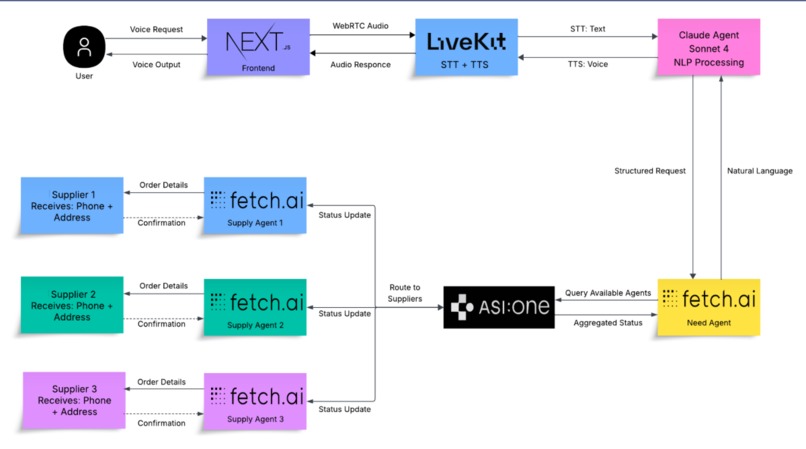
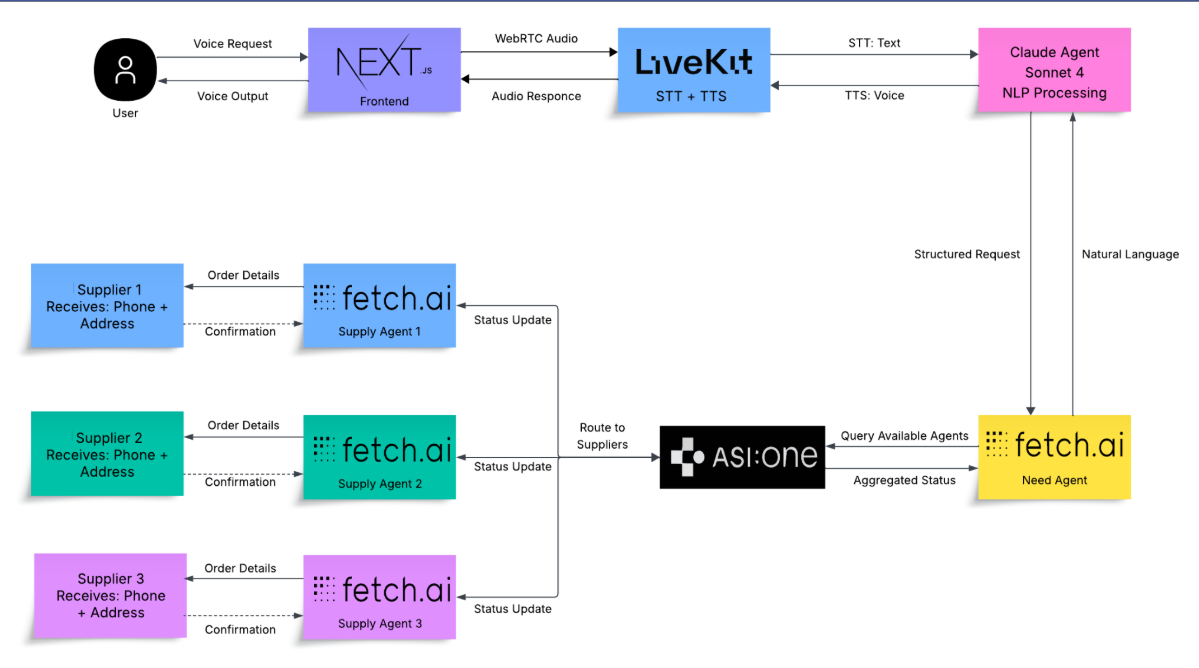
Architecture
Inspiration During the 2023 California wildfires, we watched news footage of hundreds of families stranded in evacuation centers waiting hours for basic supplies like water, insulin, and baby food. A mother with a diabetic child desperately needed medication, but coordination between aid organizations was so chaotic that by the time help arrived, it had been over 4 hours. We realized that in 2025, with AI agents, autonomous systems, and real-time communication, there's no reason anyone should wait hours for life-saving aid during a disaster. The inspiration struck: What if we could build an "Uber for disaster relief"—where victims simply describe what they need, and AI instantly connects them with the nearest available supplier? What if autonomous agents could handle coordination, leaving humans to focus on what matters: saving lives? That's how AgentAid was born. We set out to build the AI-powered nervous system for disaster response.
What it does
What it does AgentAid is a real-time disaster response coordination platform that uses AI to instantly connect victims with nearby suppliers through three core components: 🤖 AI-Powered Request Processing
Victims submit requests via chat interface (future: voice input) Claude Sonnet 4 extracts structured data from natural language:
Items needed (rice, insulin, asthma pump, etc.) Priority level (critical, high, medium) Location (automatically geocoded to coordinates) Estimated number of people affected
🔗 Autonomous Agent Matching
Fetch.ai agents represent supply organizations (Red Cross, food banks, medical coalitions) Agents autonomously negotiate and match requests with available supplies Distance optimization using real-time geocoding (OpenStreetMap Nominatim) Intelligent routing: prioritizes critical requests, optimizes for proximity
📊 Real-Time Dashboard & Tracking
Victims see: Chat-based interface with live status updates
"Request received" → "In progress" → "On the way" → "Delivered"
Coordinators see: Dashboard with all requests, priorities, and ETA Suppliers see: Optimized delivery routes and inventory management Everyone sees: Live disaster news feed for situational awareness
🌍 Geocoding & Distance Intelligence
Automatic location extraction from text ("Mission District Shelter") Converts to precise coordinates using Python geocoding agent Calculates distances to find nearest suppliers Route optimization for fastest delivery
How we built it
🏗️ Architecture ┌─────────────┐ ┌──────────────┐ ┌─────────────┐ │ React │ ────▶ │ Node.js │ ────▶ │ Claude │ │ Frontend │ │ Backend │ │ Sonnet 4 │ └─────────────┘ └──────────────┘ └─────────────┘ │ ├────────▶ Python Geocoding Agent │ └────────▶ Fetch.ai Agents
🔧 Tech Stack Frontend:
React with hooks (useState, useEffect) Lucide React icons Tailwind CSS for styling Persistent storage via Claude.ai storage API
Backend (Node.js):
Express.js REST API Anthropic SDK for Claude integration Axios for API calls CORS for cross-origin requests
AI & Agents:
Claude Sonnet 4 - Natural language understanding and structured data extraction Fetch.ai uAgents - Autonomous supply matching and coordination Python Geocoding Agent - Location intelligence using OpenStreetMap Nominatim
Testing & Automation:
Postman - Complete API collection with automated tests Collection Runner for workflow automation Mock servers for development
Additional Tools:
OpenStreetMap Nominatim API (free, no key required!) Haversine formula for distance calculations JSON storage for MVP (would use PostgreSQL in production)
Challenges we ran into
Accomplishments that we're proud of
What we learned
What's next for AgentAid
Built With
- agentverse
- brightdata
- claude
- elasticsearch
- fetchai
- livekit


Log in or sign up for Devpost to join the conversation.