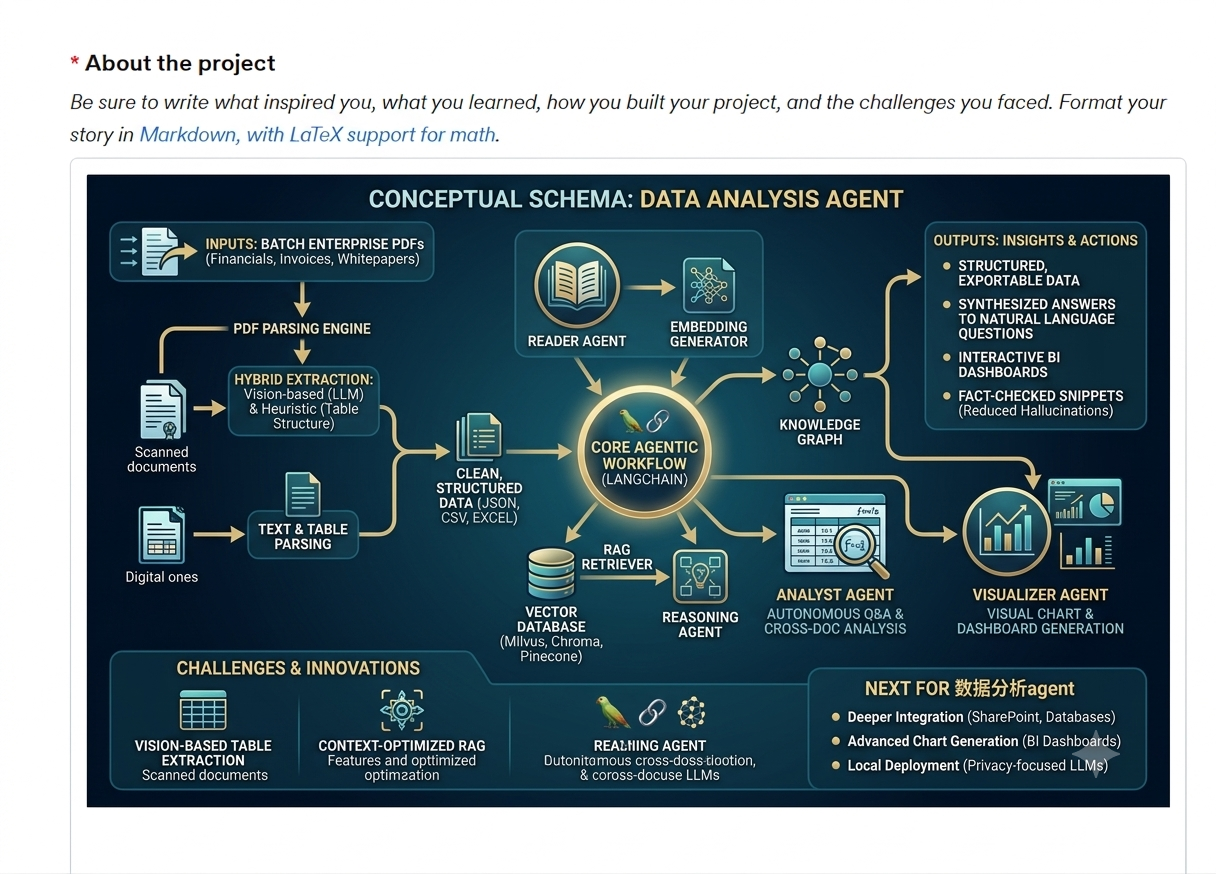
In modern enterprises, vast amounts of critical business data (such as financial reports, invoices, and industry whitepapers) are locked away in unstructured PDF files. Manually reading, extracting, and analyzing this data is incredibly tedious, error-prone, and slow. We wanted to build 数据分析agent to act as an intelligent, autonomous analyst—instantly processing thousands of PDFs, understanding their semantic context, and turning raw documents into structured, actionable insights automatically.
数据分析agent is an autonomous AI agent designed for high-throughput enterprise document intelligence.
Batch Processing: Users can upload hundreds of complex PDFs (even with varied layouts, scanned pages, or multi-column formats) simultaneously.
Semantic Extraction: Utilizing advanced LLMs, it parses and transforms unstructured text and complex tables into clean, structured JSON/CSV data.
Autonomous Q&A & Analysis: Users can ask complex cross-document questions in natural language (e.g., "Compare the Q3 revenue growth across all uploaded PDF reports"), and the agent will synthesize answers and generate visual charts.
AI & Agentic Framework: We utilized LangChain / LlamaIndex (根据你实际用的修改,比如 AutoGen/Dify) to build the multi-agent workflow, coordinating specialized agents for reading, parsing, and reasoning.
PDF Parsing Pipeline: We integrated robust PDF tools like LlamaParse / PyMuPDF / OCR engines to extract both text and complex table structures accurately.
Vector DB & RAG: We used Milvus / Chroma / Pinecone to store document embeddings, allowing the agent to retrieve precise context instantly.
Frontend: Built a clean and intuitive user interface using Streamlit / React for seamless file uploading and interactive chat.
The PDF Table Nightmare: Extracting nested tables and multi-page tables from scanned PDFs with 100% accuracy was a huge challenge. We overcame this by building a hybrid extraction pipeline combining vision-based LLM parsing with heuristic table structure recognition.
Context Limit & Hallucinations: Large batches of PDFs quickly exceed LLM context windows. We carefully optimized our chunking strategy and RAG retriever to ensure the agent only feeds highly relevant, fact-checked snippets into the model, drastically reducing hallucinations.
Successfully built an end-to-end pipeline that can process a massive batch of complex enterprise PDFs in minutes instead of days.
Achieved high-fidelity table extraction that seamlessly converts messy PDF tables into exportable Excel sheets.
Designed a smooth, non-technical user experience where anyone can perform complex data analysis just by chatting with their documents.
Data Prep is 80% of the Battle: We realized that in LLM applications, especially with PDFs, document preprocessing (cleaning, OCR, and chunking) matters just as much as, if not more than, the choice of the LLM itself.
The Power of Agentic Workflows: We learned how breaking down a complex analytical task into smaller, specialized agents (e.g., a "Parser Agent", an "SQL/Analyst Agent", and a "Writer Agent") yields far better results than a single prompt.
Deeper Enterprise Integration: Connect directly to enterprise cloud storage (SharePoint, Google Drive) and databases to automate the workflow directly from the source.
Advanced Chart Generation: Enhance the agent's ability to not just output tables, but automatically render interactive, presentation-ready BI dashboards (using Plotly/Echarts).
Local Deployment & Privacy: Implement support for local open-source LLMs (like Llama 3 / Qwen) to ensure strict data privacy for sensitive enterprise financial records.
Built With
- gpt
- langchain
- langgraph
- openai

Log in or sign up for Devpost to join the conversation.