-
-
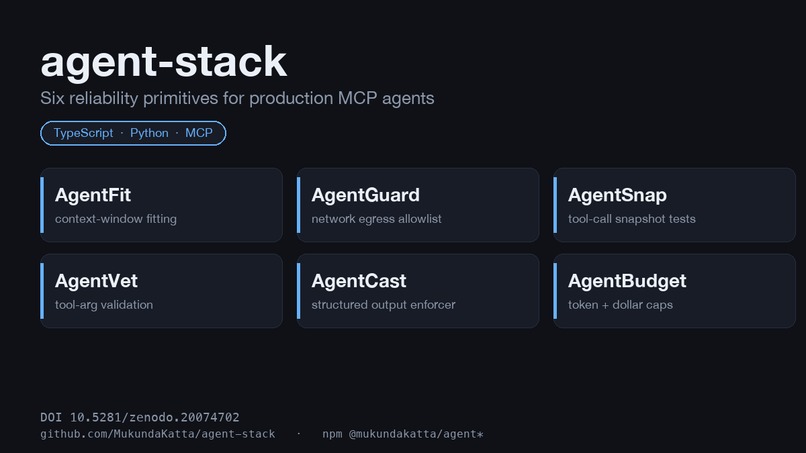
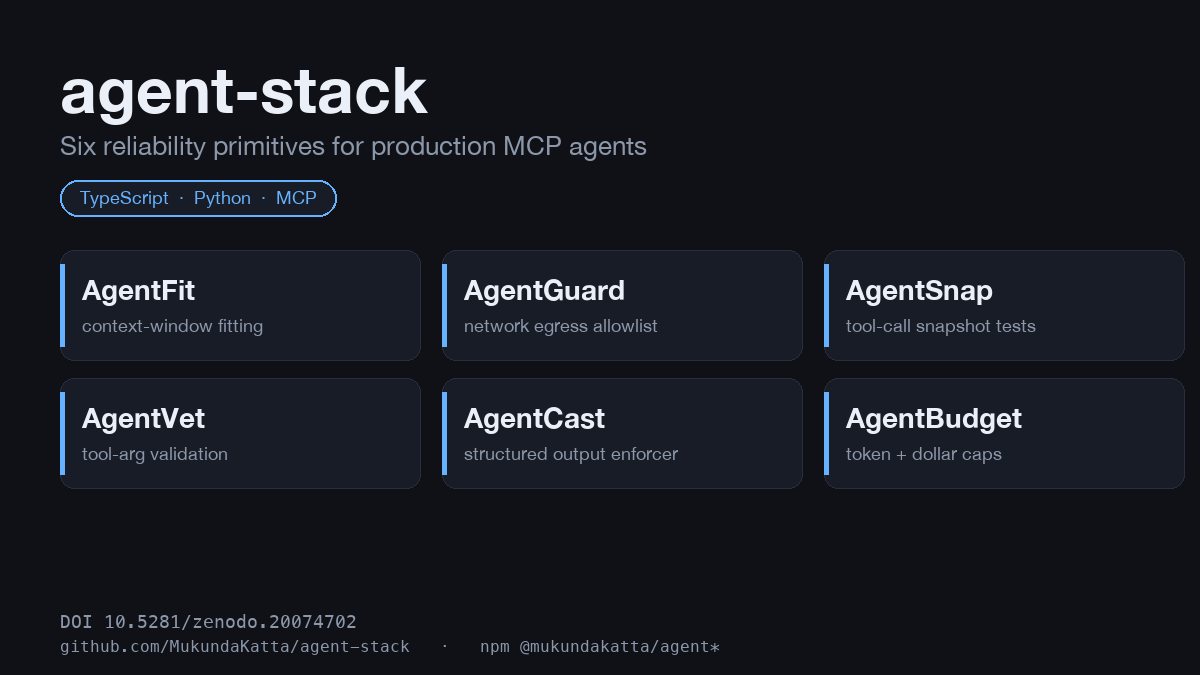
Six libraries (TS + Python + MCP) covering agent reliability concerns: fit, guard, snap, vet, cast, budget.
Inspiration
Reliability concerns for LLM agents are usually bundled into one heavy framework. Production teams building healthcare agents do not want to buy into a full framework just to get an egress allowlist or a tool-argument validator. They want à la carte primitives they can drop into existing code without adopting a new programming model.
Healthcare amplifies this. A FHIR-querying agent has to be defensive about: only calling sanctioned endpoints, never leaking PHI in logs, abstaining when the right tool is not on the list, validating that a patient_id looks like a real FHIR id before it hits the tool, never exceeding a token or dollar budget on a single patient query, and producing structured outputs the downstream system can actually parse. Existing agent frameworks address one or two of these. None give you all six in libraries you can adopt independently.
What it does
agent-stack is six independently published libraries, each handling exactly one reliability concern. Every library ships in three forms: TypeScript on npm, Python on PyPI, and an MCP-server variant that exposes the primitive as a tool to any MCP client.
- AgentFit — token-aware context-window fitting with multiple truncation strategies.
- AgentGuard — declarative network egress allowlist. Throws on violation.
- AgentSnap — snapshot tests for tool-call traces.
- AgentVet — wraps tool functions with argument validation; throws
ToolArgErrorwith an LLM-friendly retry hint. - AgentCast — structured-output validate-and-retry loop for LLM JSON.
- AgentBudget — per-run token + dollar caps with a hook for early termination.
How we built it
TypeScript for the canonical implementation, Python port matching the surface 1:1, MCP server variants on @modelcontextprotocol/sdk. Healthcare demo: a minimal Express + TypeScript service that calls a public FHIR sandbox (HAPI FHIR R4) and threads all six primitives around the tool calls. Reproducibility: CI on GitHub Actions, snapshot tests, CITATION.cff, Software Heritage archival, DataCite DOI on Zenodo.
Challenges we ran into
- Cross-runtime parity. Keeping the TypeScript and Python surfaces 1:1 meant deferring some idiomatic choices on each side.
- MCP server packaging. Primitives are stateless functions, MCP servers are typically stateful. We designed a "primitive-as-tool" wrapper.
- PHI redaction in
AgentGuardlogs. Added a hook so the consuming app supplies a redactor. - Budget bookkeeping under streamed token usage.
AgentBudgetnormalizes across providers.
Accomplishments
Six libraries, all published, all zero-dependency, all under 500 LOC. Three runtime surfaces (npm + PyPI + MCP). Working healthcare-FHIR demo. Zenodo DOI: 10.5281/zenodo.20074702.
What's next
- Healthcare-aware AgentGuard preset
- AgentTrace as a seventh primitive
- A combined
@mukundakatta/agent-stackmeta-package
Try it
Repo: github.com/MukundaKatta/agent-stack Zenodo DOI: https://doi.org/10.5281/zenodo.20074702 License: Apache 2.0

Log in or sign up for Devpost to join the conversation.