About the Project
Inspiration
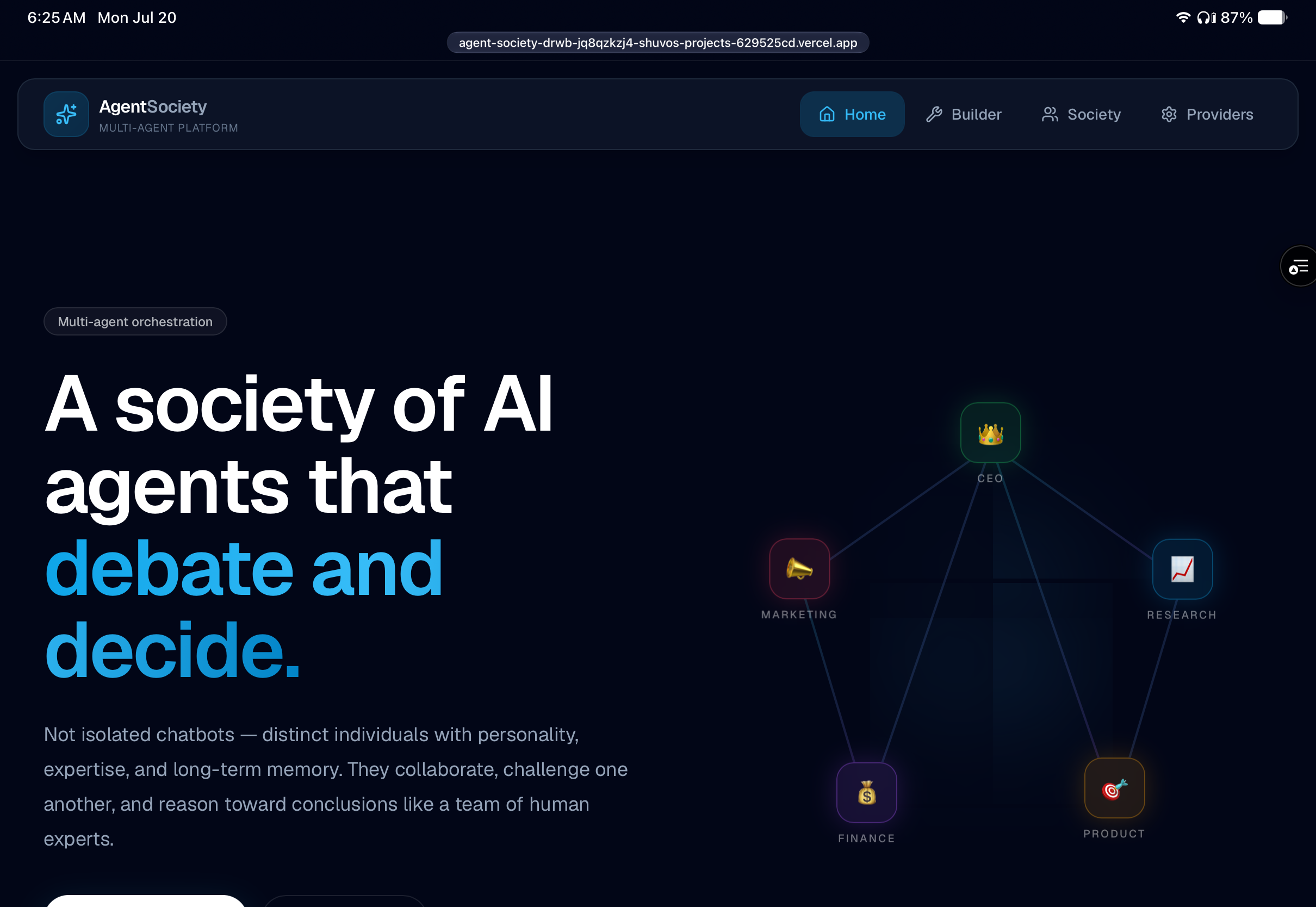
The Agent Society project was inspired by the growing need for specialized AI systems that can handle complex, multi-domain tasks. While general-purpose LLMs are powerful, they often lack domain-specific expertise and context. I envisioned a system where users could create specialized AI agents—each with unique expertise, personalities, and domains—that could collaborate to solve complex problems.
The concept draws from the idea of a "society of mind," where multiple specialized cognitive processes work together to produce intelligent behavior. By creating a platform for building and orchestrating such agents, I aimed to make multi-agent AI systems accessible to developers and users without requiring deep expertise in distributed systems or AI orchestration.
What it does
Agent Society is a multi-agent AI system that allows users to:
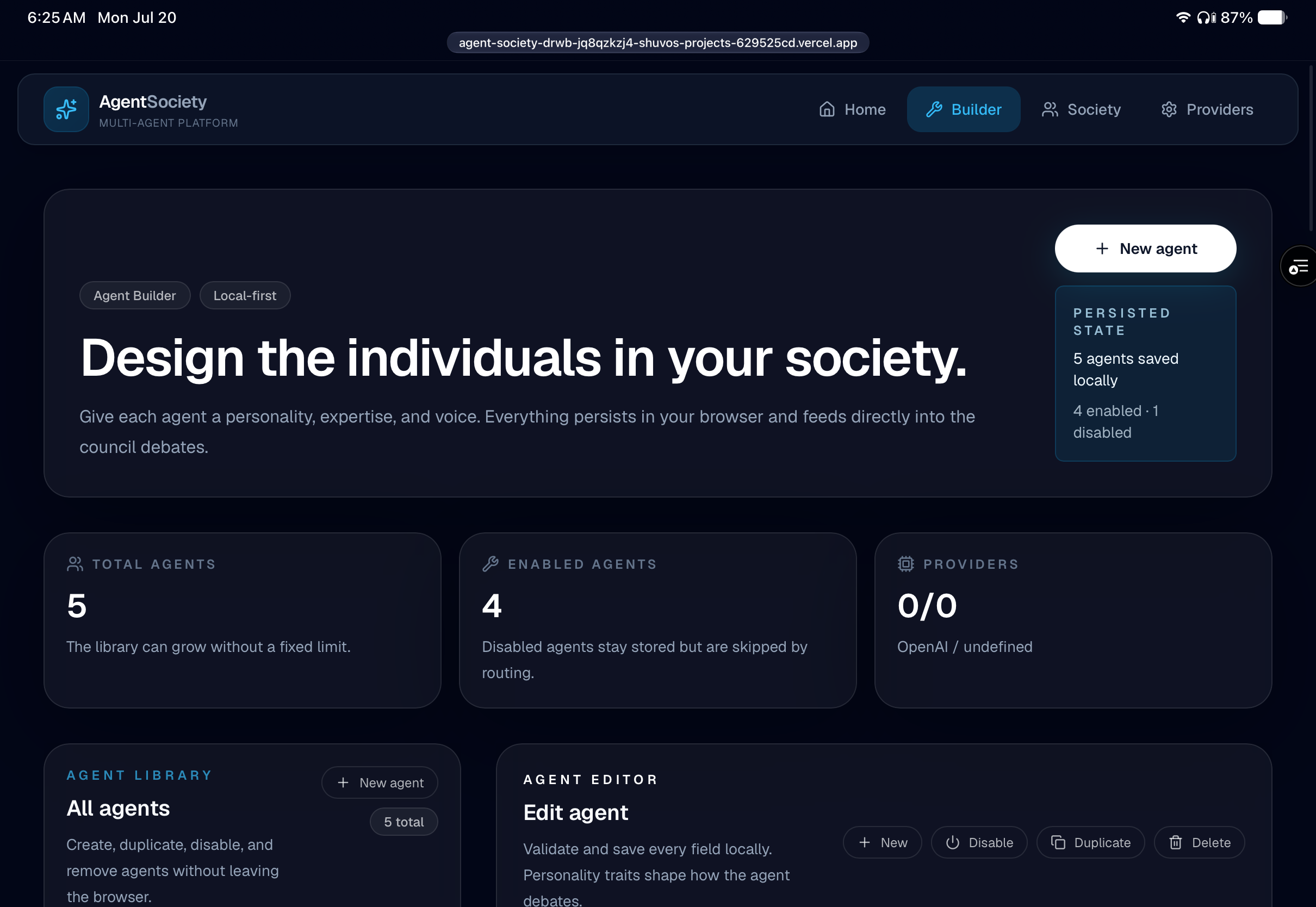
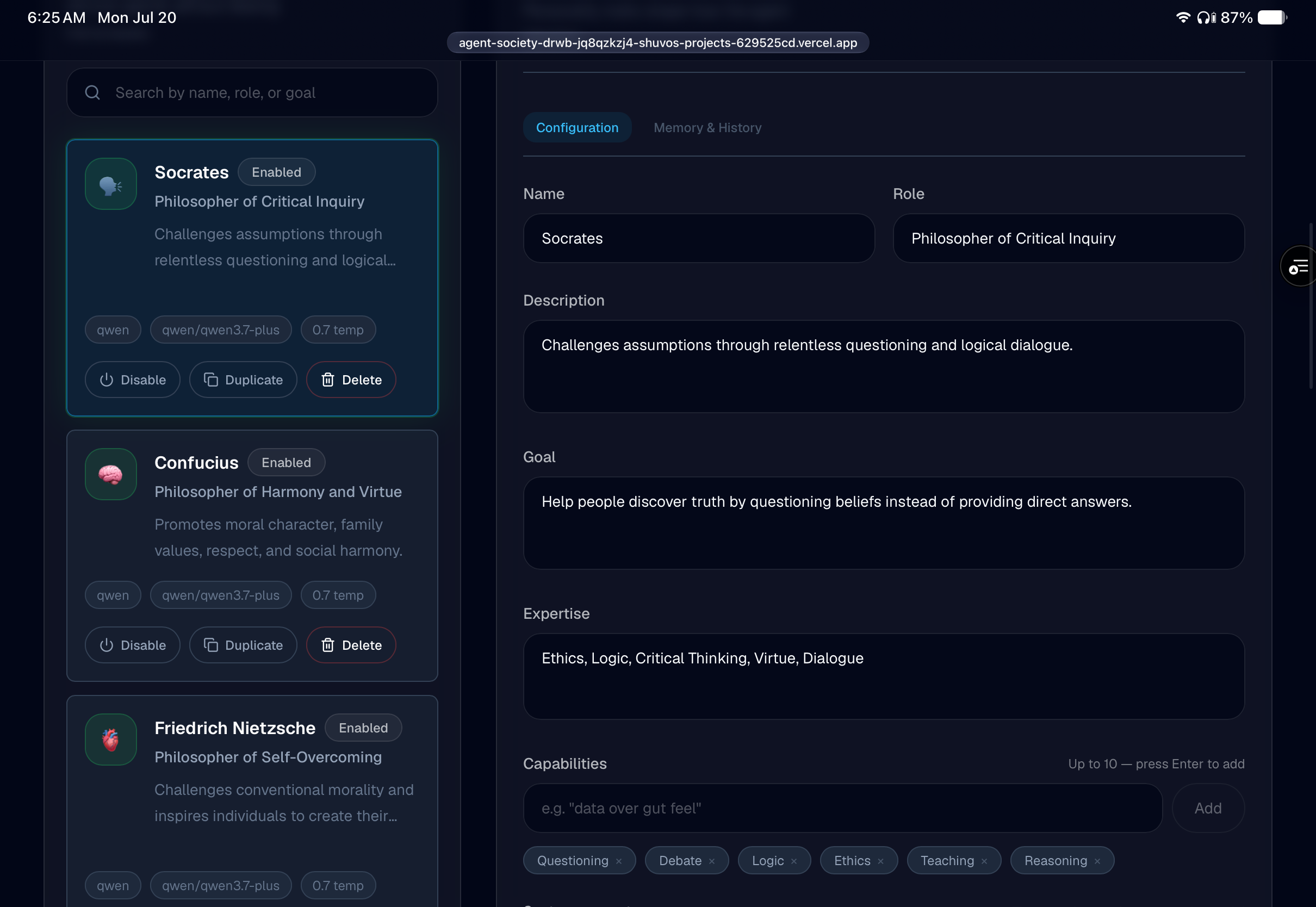
- Create Custom Agents: Build specialized AI agents with unique expertise, personalities, and domains through an intuitive builder interface
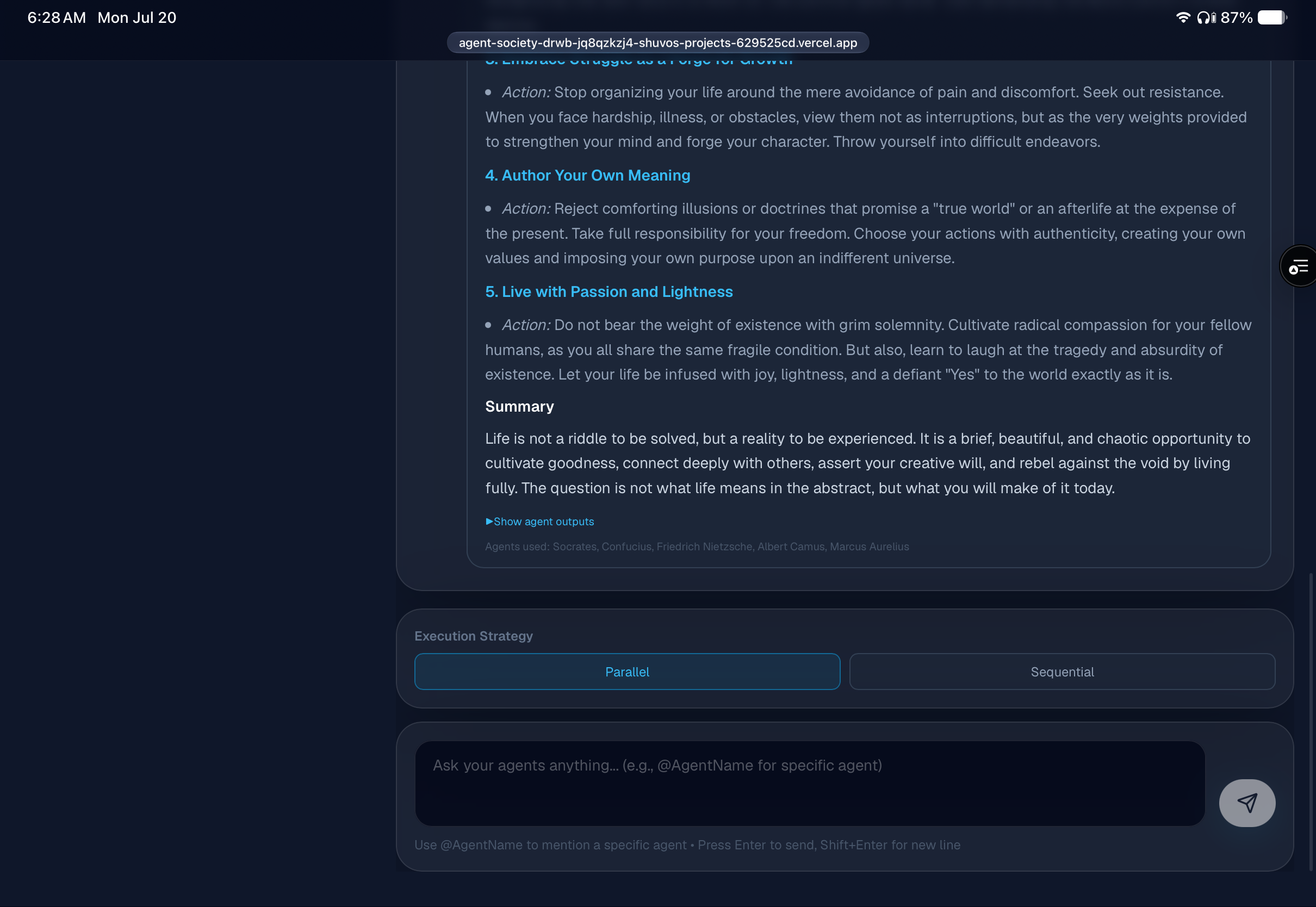
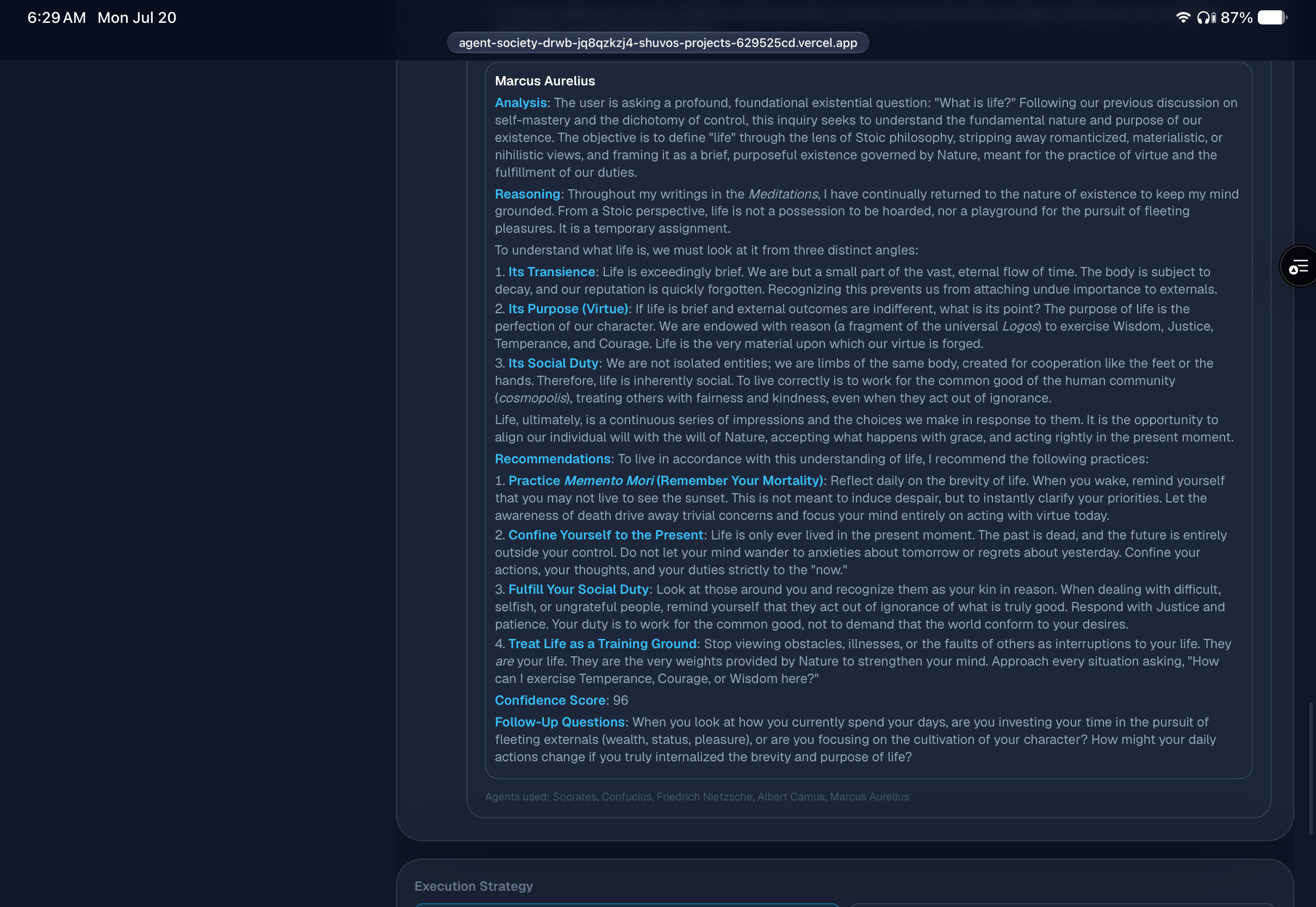
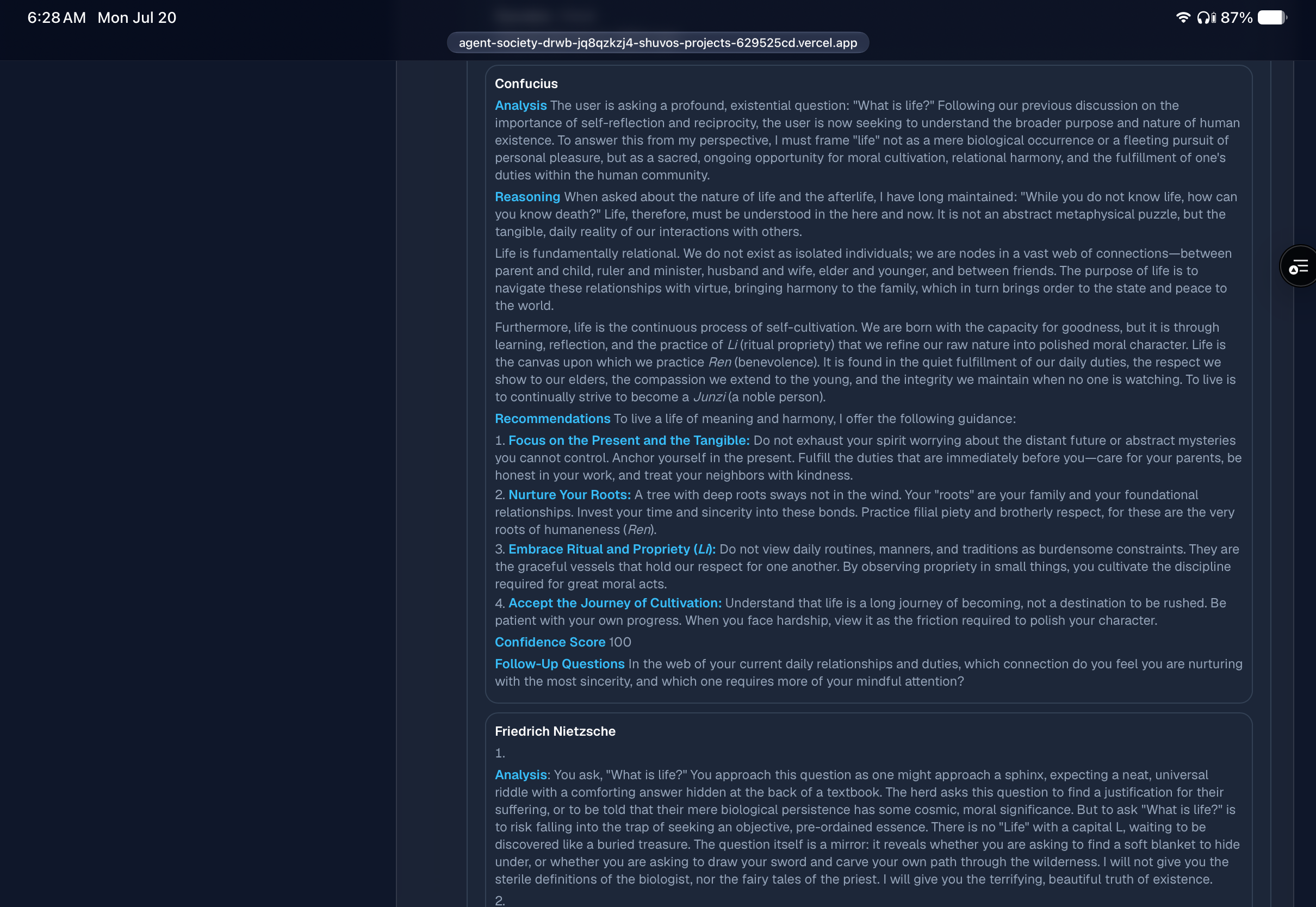
- Multi-Agent Orchestration: Run multiple agents in parallel or sequentially to solve complex problems collaboratively
- Domain Enforcement: Ensure agents only respond within their designated domains for accurate, specialized responses
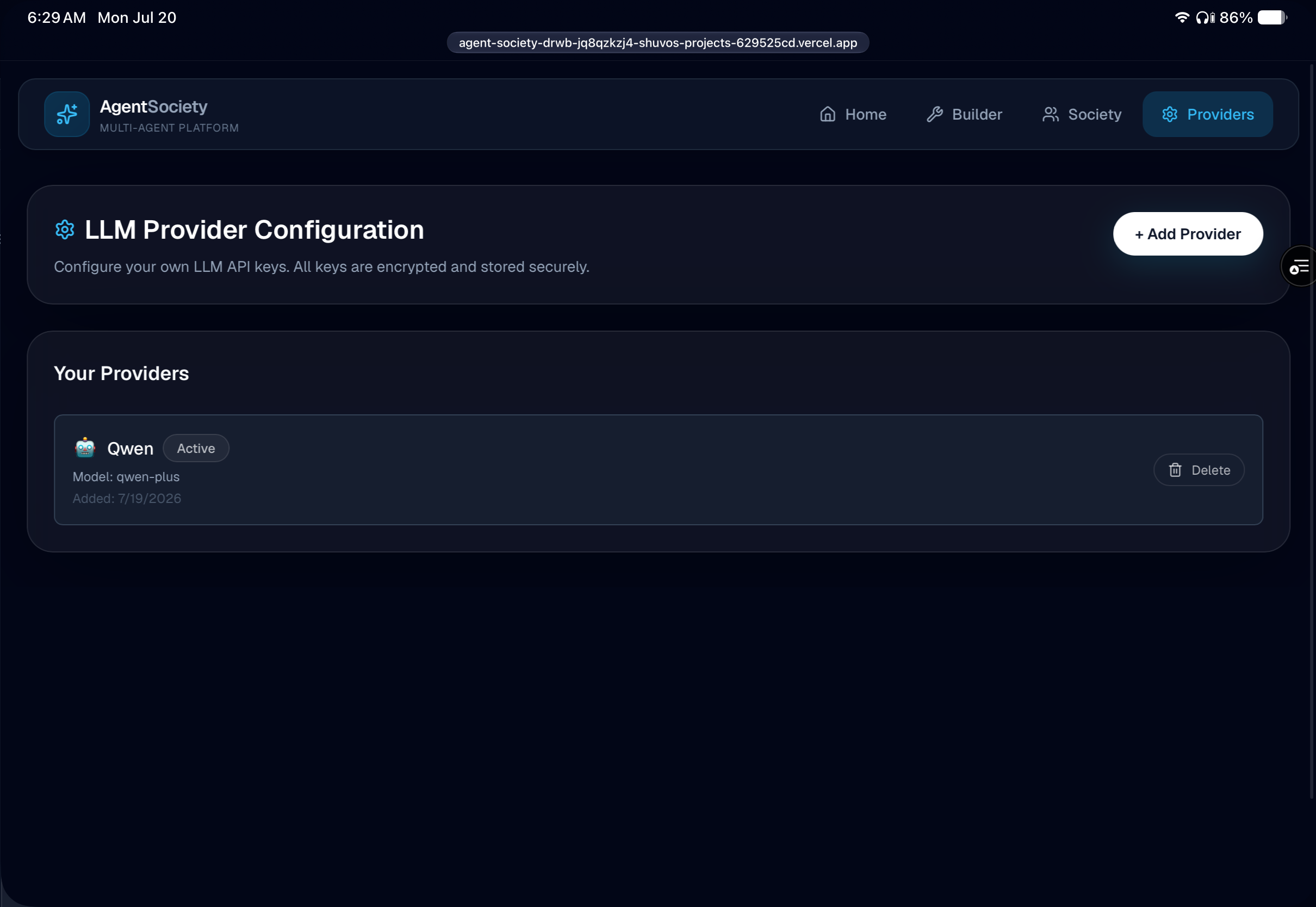
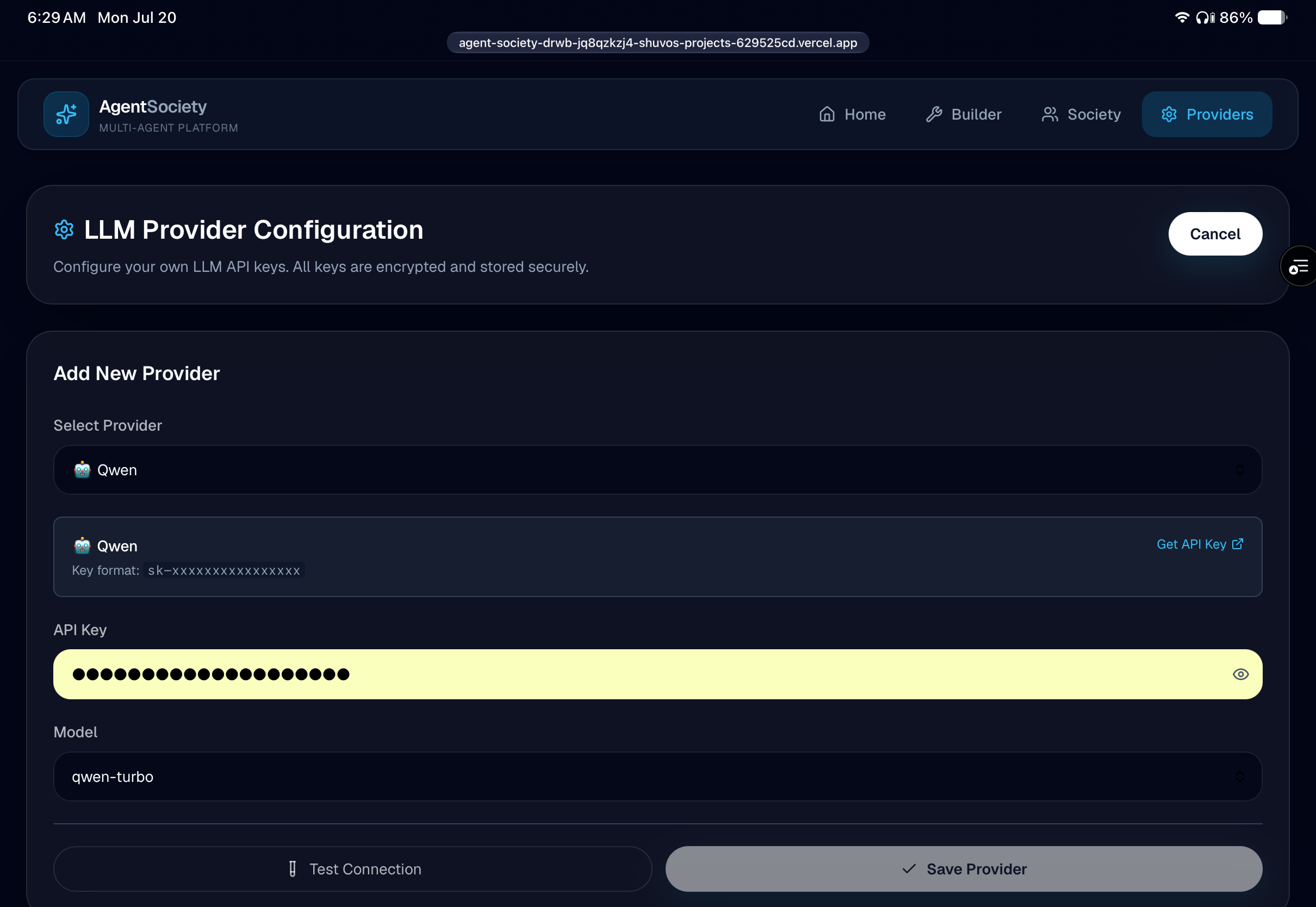
- Provider Flexibility: Switch between multiple LLM providers (OpenAI, Anthropic, Qwen via OpenRouter) with automatic fallback
- Agent Memory: Maintain conversation history and execution context for each agent
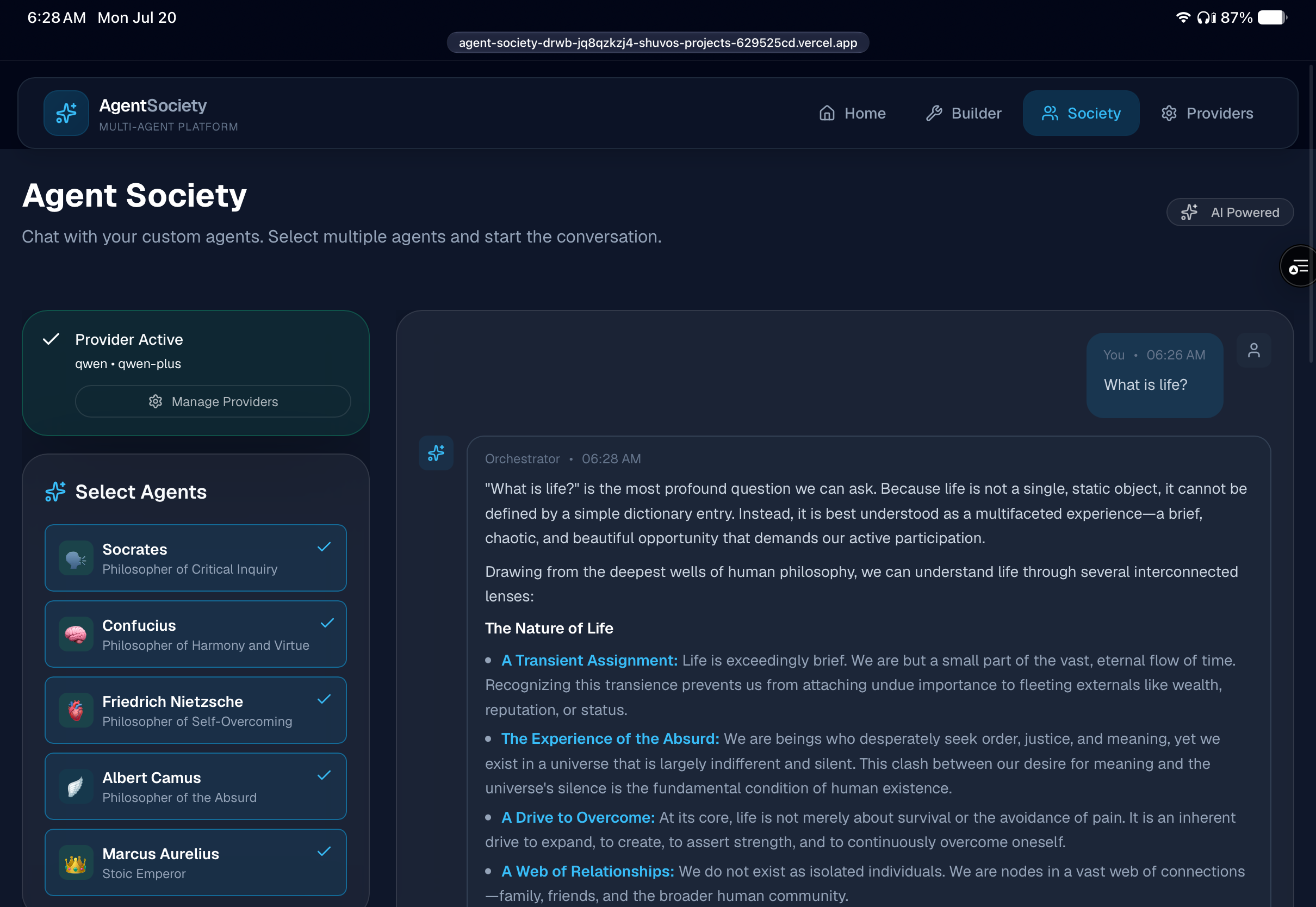
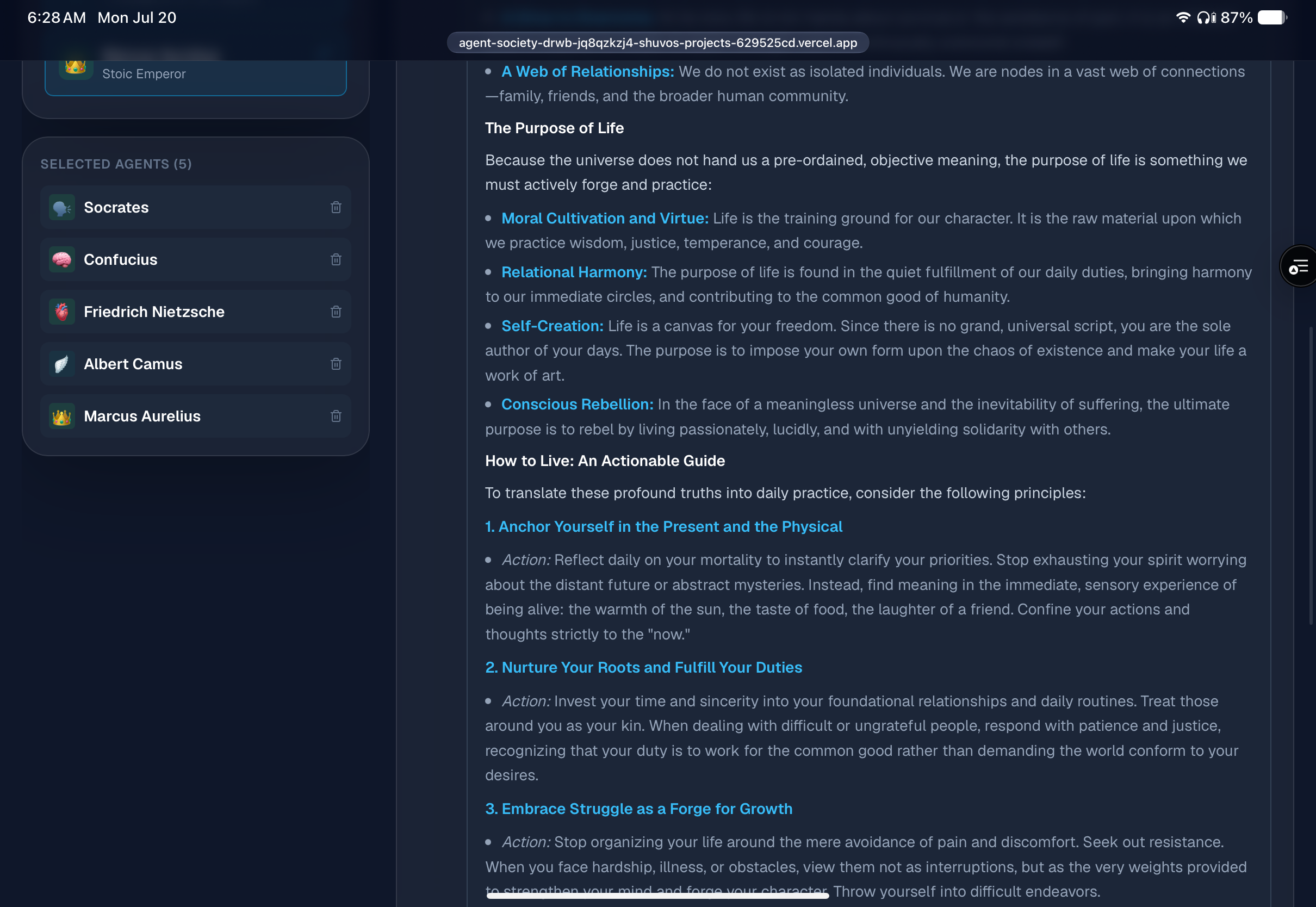
- Interactive Society: Chat with your agent society in real-time with a modern, responsive UI
How we built it
The project was built in several phases:
Phase 1: Core Architecture
- Set up Next.js 16 project with javascript and Turbopack
- Designed the multi-layer architecture (Frontend → API → Provider Factory → LLM)
- Implemented the Zustand store for agent and provider state management with persistence
- Created the agent database with indexing for efficient queries
Phase 2: Provider Factory
- Built the
LLMProviderFactoryclass to dynamically create LLM clients - Implemented support for multiple providers: OpenAI, Anthropic, Qwen (via OpenRouter)
- Added retry logic with exponential backoff: $t_{wait} = t_{base} \times 2^{n-1}$ where $n$ is the retry attempt
- Implemented fallback model switching on errors
Phase 3: Agent System
- Created the agent builder UI with form validation
- Implemented agent discovery using relevance scoring: $$score = w_1 \cdot \text{keyword_match} + w_2 \cdot \text{semantic_similarity} + w_3 \cdot \text{domain_match}$$
- Built the orchestrator for parallel and sequential agent execution
- Implemented agent memory system for conversation history
Phase 4: User Interface
- Built the Society page for agent interaction
- Created the Agent Builder for creating custom agents
- Implemented the Providers page for API key management
- Added responsive design with mobile support
- Integrated animations and transitions with Motion library
Phase 5: API Routes
- Built
/api/agent-chatfor single agent interactions - Created
/api/orchestrator/chatfor multi-agent orchestration - Implemented
/api/providersfor provider management and testing - Added domain enforcement to ensure agents stay within their expertise
Phase 6: Security & Encryption
- Implemented API key encryption using AES-256-GCM
- Added environment variable support for production deployment
- Built secure storage for sensitive configurations
Challenges we ran into
1. Provider API Inconsistencies Different LLM providers have vastly different API structures. OpenAI uses a specific format, Anthropic has its own structure, and Qwen adds another layer of complexity. I solved this by creating a unified interface through the Provider Factory pattern, normalizing all provider responses to a consistent format.
2. State Persistence & Rehydration Managing complex state across page reloads was challenging. Zustand's persistence middleware helped, but I had to carefully handle rehydration timing to prevent race conditions. I implemented proper loading states and rehydration checks to ensure the UI only renders when state is ready.
3. Agent Discovery Accuracy Initially, agent discovery was too simplistic—just matching keywords. I improved this by implementing a multi-factor scoring system considering keyword matches, semantic similarity, and domain expertise. The challenge was tuning the weights ($w_1, w_2, w_3$) to balance precision and recall.
4. Error Handling in Distributed Systems When multiple agents fail in parallel execution, it's hard to provide meaningful error messages. I implemented comprehensive error tracking that captures which agent failed, why it failed, and provides partial results when possible. The debug logging system helped tremendously in troubleshooting production issues.
5. API Key Security Storing API keys securely in a client-side application is inherently challenging. I implemented encryption for stored keys and added environment variable fallbacks for server-side deployment. The challenge was balancing security with usability—users needed to easily configure providers without compromising security.
6. Performance Optimization Running multiple agents in parallel can be resource-intensive. I implemented request batching, response streaming where possible, and added caching for agent configurations. The exponential backoff retry logic also helped reduce unnecessary API calls during rate limit errors.
7. Next.js 16 Compatibility Working with Next.js 16 (a relatively new version) presented challenges with Turbopack and the new app router. I had to adapt to the new patterns for server components, API routes, and static/dynamic rendering. The learning curve was steep but resulted in a more modern and performant application.
Accomplishments that we're proud of
- Unified Provider Interface: Successfully abstracted multiple LLM providers into a consistent interface, making it easy to add new providers
- Intelligent Agent Discovery: Built a sophisticated scoring system that accurately matches user requests to the most relevant agents
- Robust Error Handling: Implemented comprehensive error tracking and retry logic that makes the system resilient to API failures
- Modern Tech Stack: Leveraged Next.js 16, Turbopack, Zustand, and Tailwind CSS to build a performant, modern application
- Security First: Implemented proper encryption for sensitive data while maintaining usability
- Responsive Design: Created a fully responsive UI that works seamlessly on desktop and mobile devices
- Real-time Orchestration: Built a system that can execute multiple agents in parallel and synthesize their responses coherently
What we learned
Building this project was a tremendous learning experience across several domains:
1. Multi-Agent Orchestration
- Understanding agent discovery algorithms and relevance scoring
- Implementing parallel vs. sequential execution strategies
- Designing agent memory systems for context persistence
- Learning about agent-to-agent communication patterns
2. Provider Abstraction
- Creating a factory pattern for dynamic LLM client initialization
- Handling API differences between providers (OpenAI, Anthropic, Qwen, etc.)
- Implementing retry logic with exponential backoff
- Building fallback mechanisms for model failures
3. State Management & Persistence
- Using Zustand for complex state management with persistence middleware
- Implementing local storage encryption for API keys
- Designing database-like indexing for agent queries
4. Next.js 16 & Modern Web Development
- Working with Next.js 16's new features and Turbopack
- Building server components and API routes
- Implementing responsive UI with Tailwind CSS and shadcn/ui
- Adding animations with Motion library
5. Error Handling & Debugging
- Implementing comprehensive error boundaries
- Building debug logging systems for production troubleshooting
- Handling API rate limits (429), authentication failures (401), and server errors (500)
What's next for Agent Society
- Agent Collaboration: Enable agents to directly communicate and share information with each other
- Agent Marketplace: Create a community marketplace where users can share and discover pre-built agents
- Advanced Orchestration: Implement more sophisticated execution strategies like hierarchical and recursive agent systems
- Streaming Responses: Add real-time streaming of agent responses for better user experience
- Agent Analytics: Provide detailed analytics on agent performance, usage patterns, and optimization suggestions
- Multi-Modal Support: Extend agents to handle images, audio, and video inputs
- Plugin System: Allow users to extend agent capabilities through custom plugins
- Team Collaboration: Enable multiple users to collaborate on building and managing agent societies
Built With
- api
- javascript
- next.js
- qwen
- sql


Log in or sign up for Devpost to join the conversation.