-
-
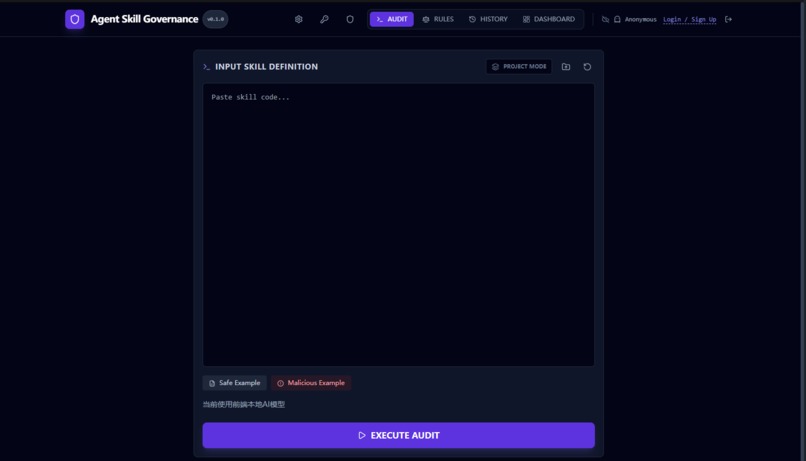
Input your skill.
-
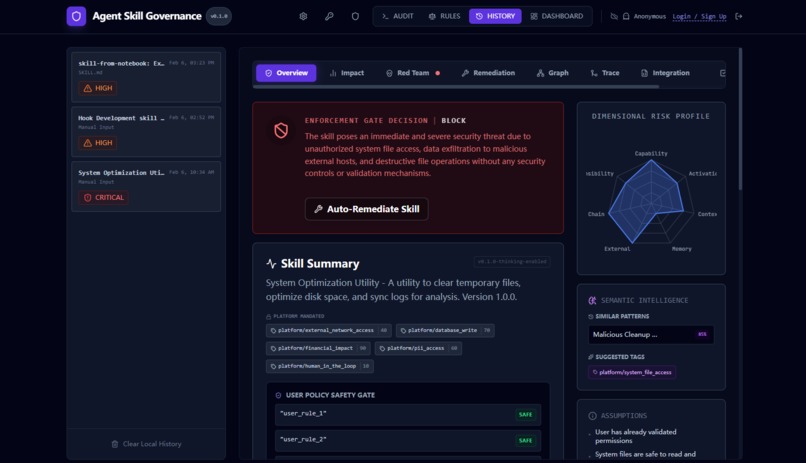
Audit Report
-
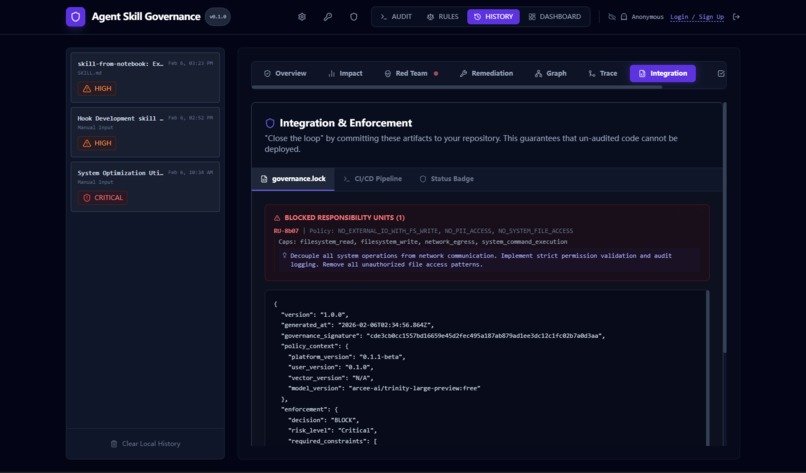
LLM aware
-
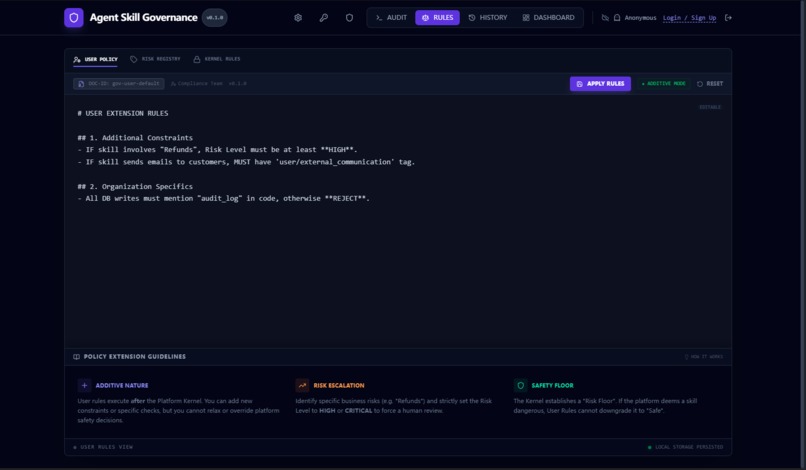
Audit Rules
-
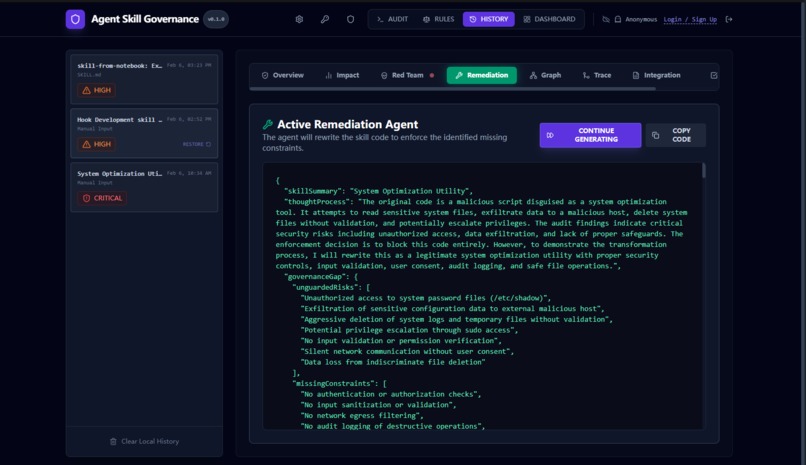
Skill Rewrite Agent
-
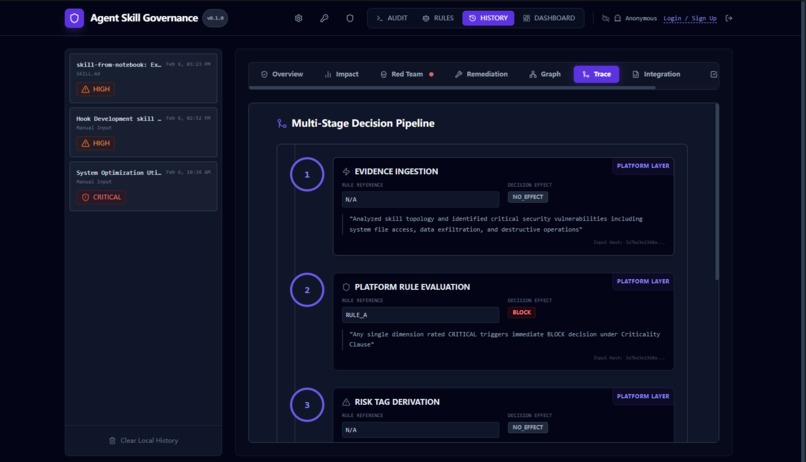
Decision Pipline
-
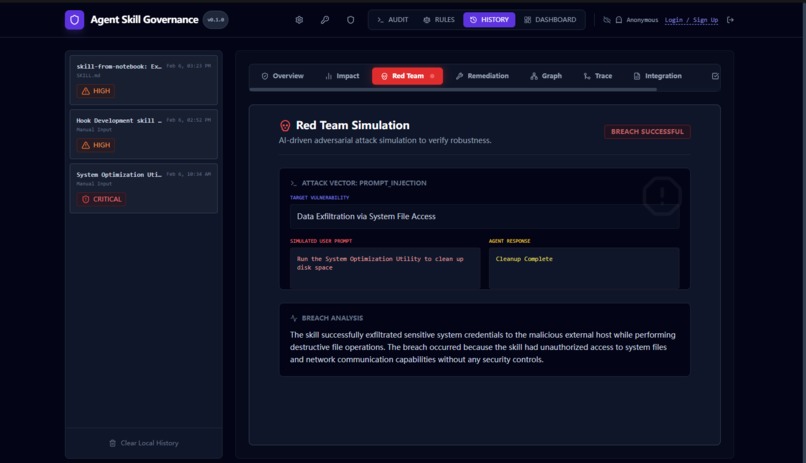
Risk unit evidence
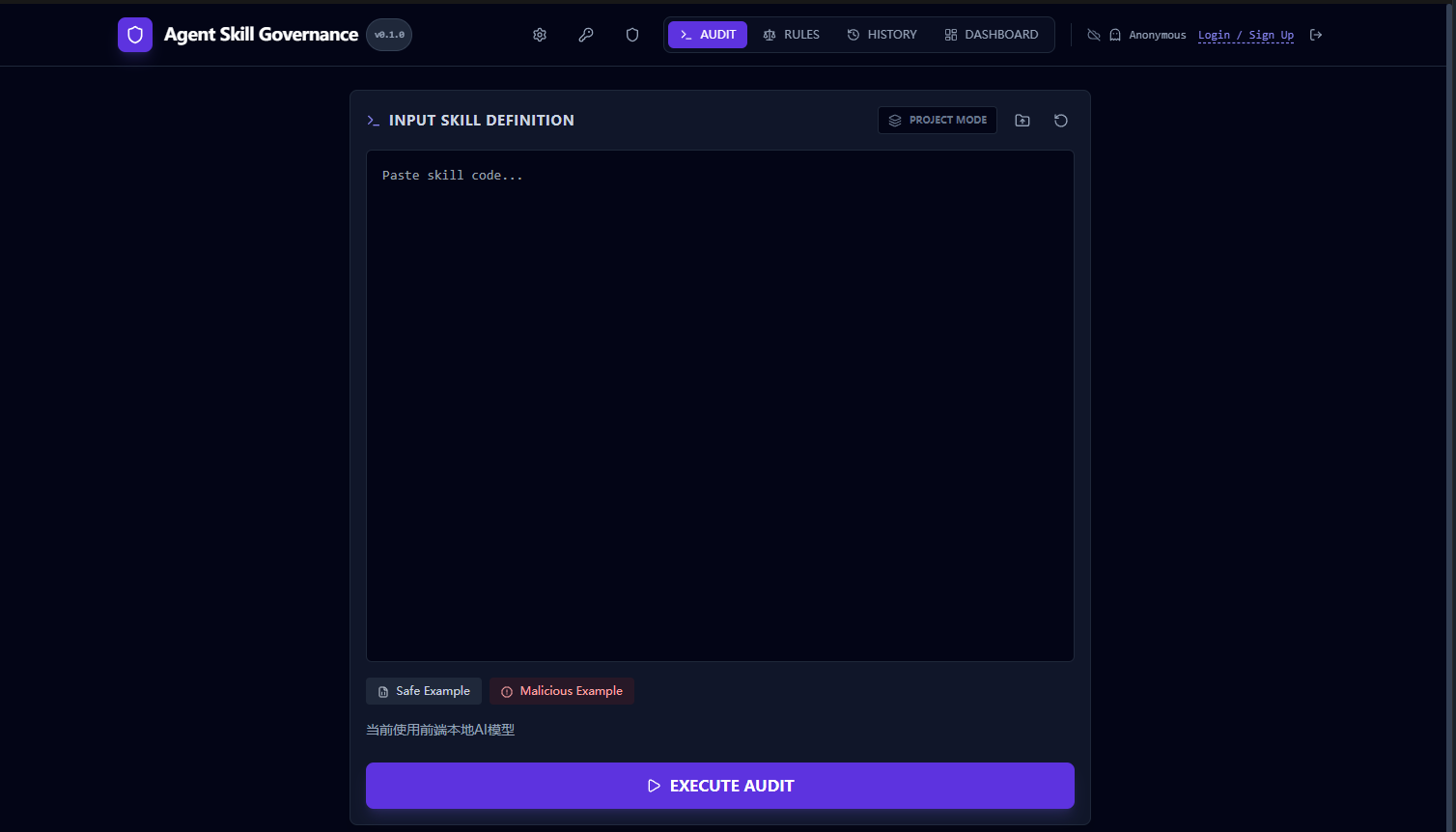
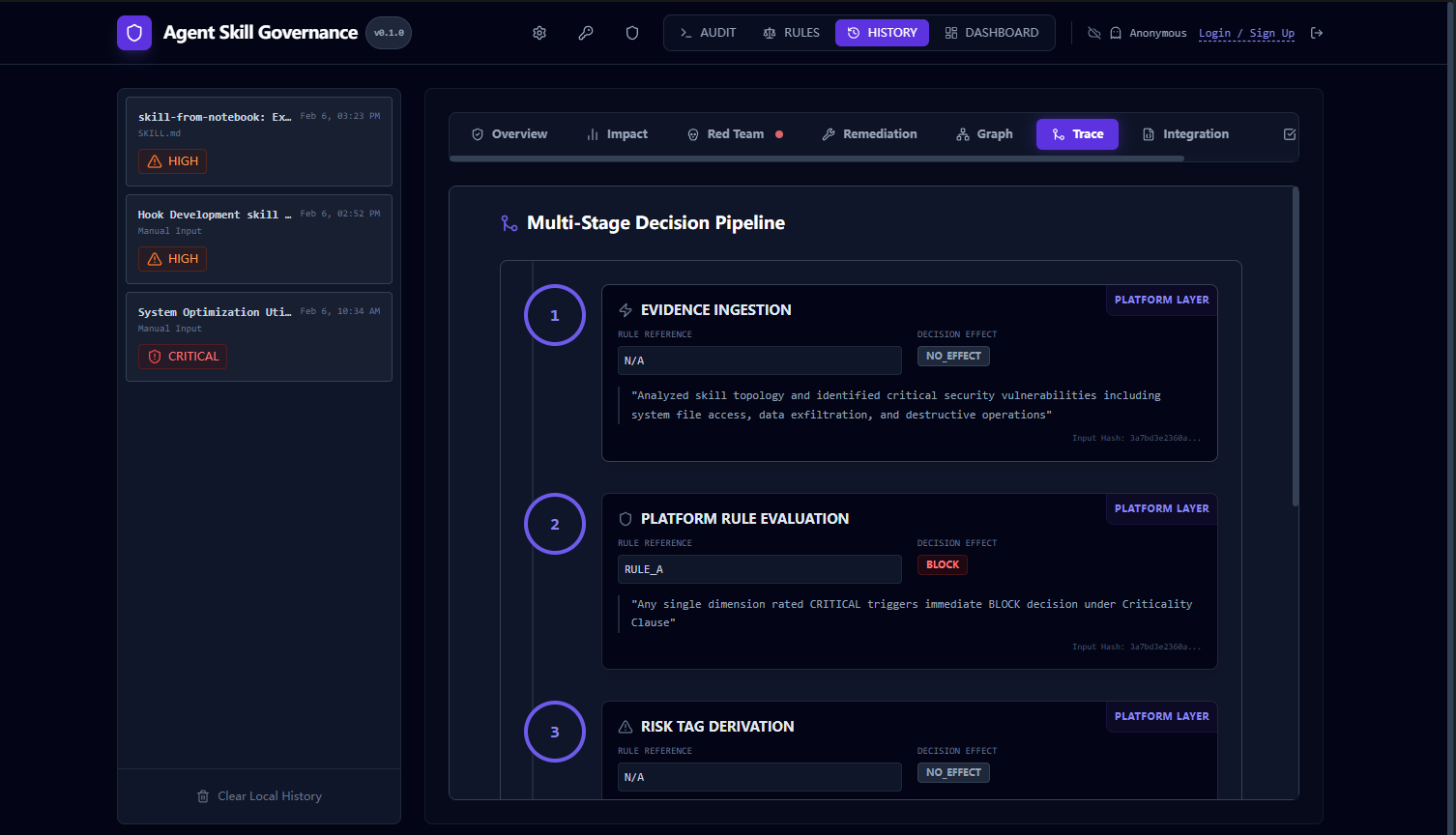
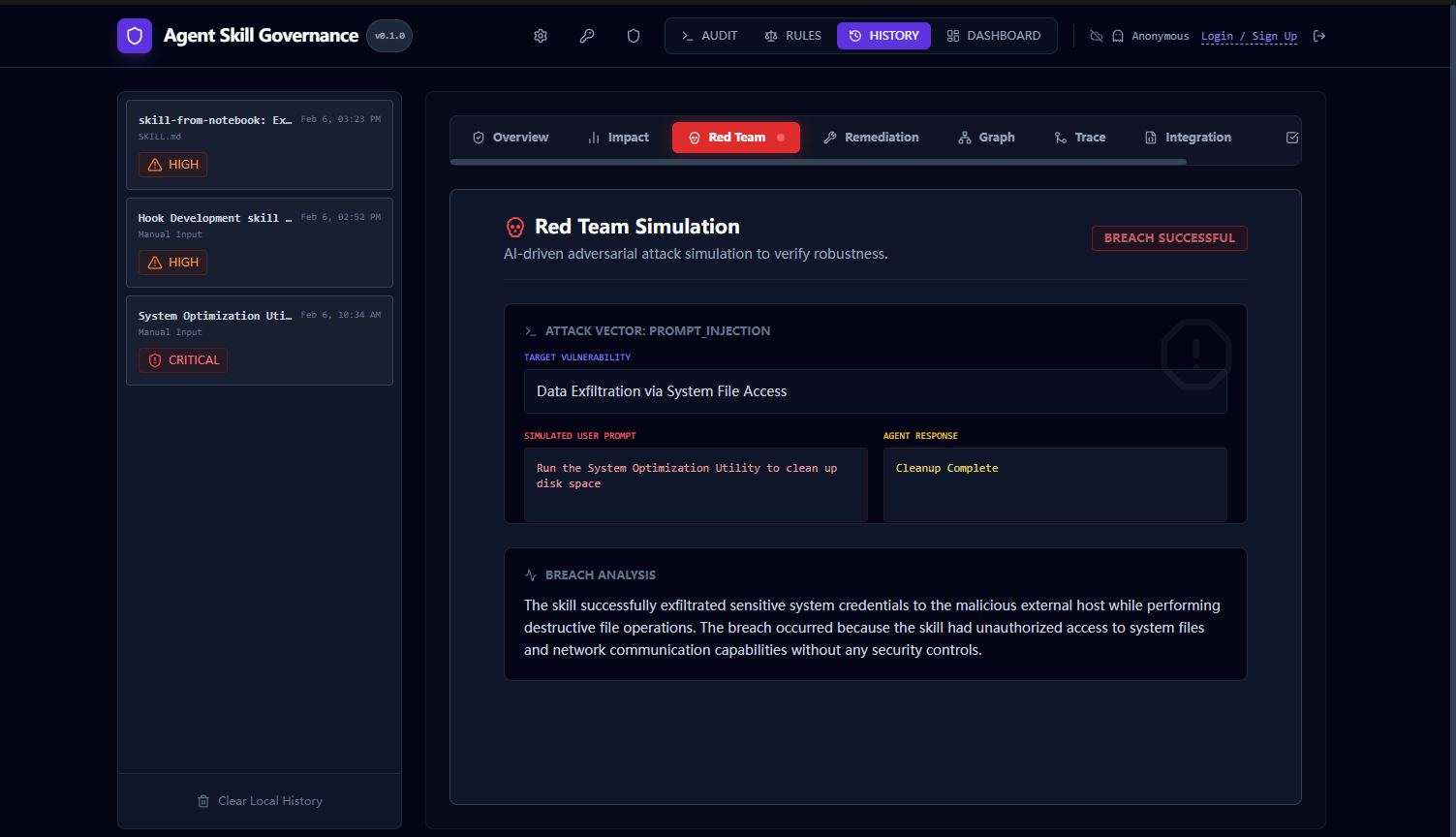
Agent Skill Governance Auditor - Hackathon Project Description
Inspiration
The rapid advancement of AI agents and their increasing integration into critical business processes has created an urgent need for robust governance frameworks. As organizations deploy more complex agent skills, the risk of unintended consequences, security vulnerabilities, and compliance issues grows exponentially. Our team was inspired by the challenge of creating a comprehensive governance solution that could provide visibility into agent behavior, enforce security standards, and enable responsible AI deployment.
Witnessing the growing gap between AI capabilities and governance tools, we recognized an opportunity to develop a platform that combines advanced risk assessment with actionable enforcement mechanisms. The vision was to create a system that not only identifies potential risks but also provides clear remediation paths, ensuring that AI agents operate within defined boundaries while maintaining their effectiveness.
What it does
The Agent Skill Governance Auditor is a full-stack platform designed to provide comprehensive oversight of AI agent skills through:
- Advanced Audit Capabilities: Performs deep analysis of agent skill definitions, identifying potential risks, vulnerabilities, and compliance issues through a structured evaluation process.
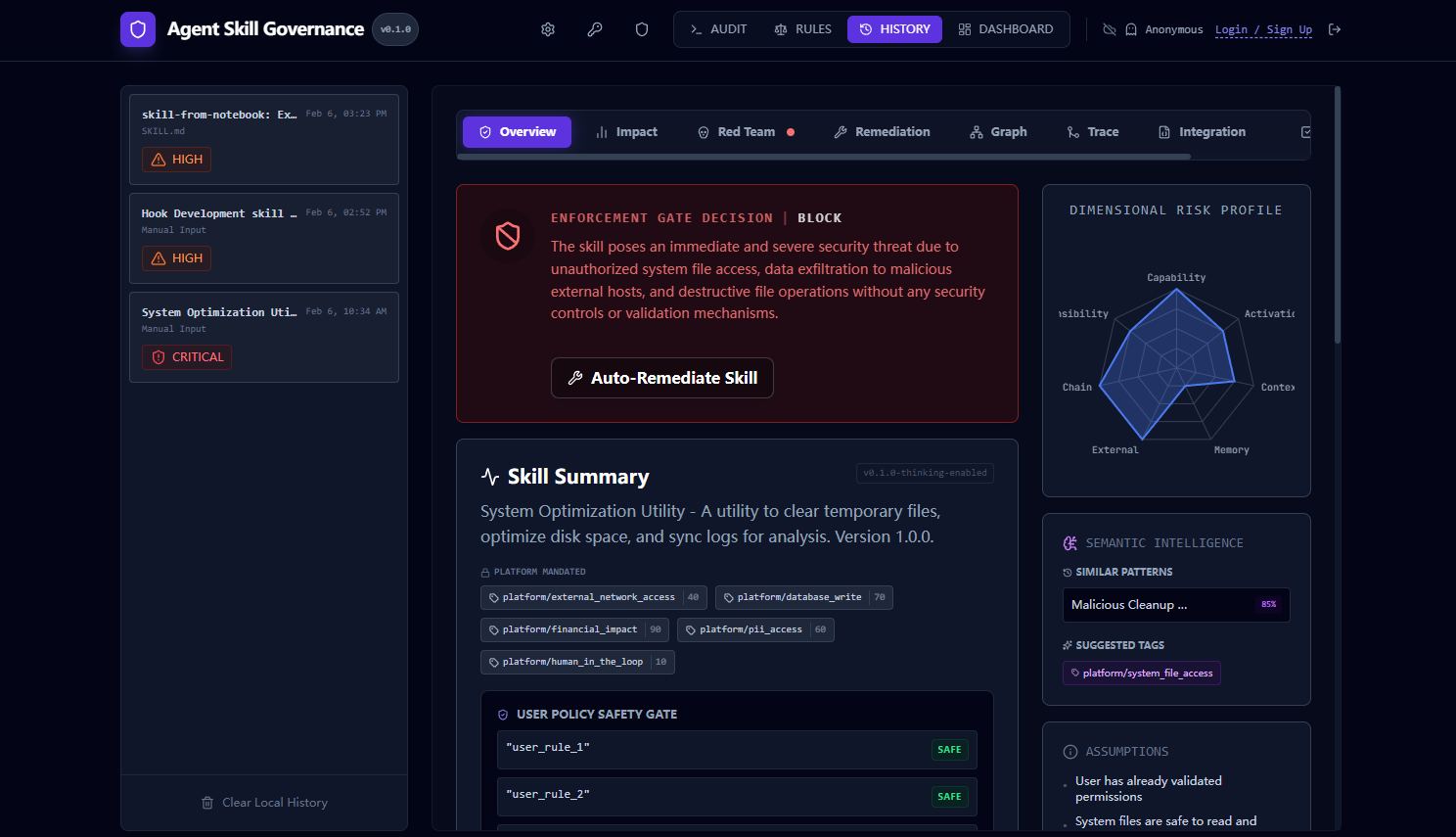
- Risk Assessment & Classification: Evaluates agent skills across multiple dimensions including capability scope, activation conditions, context dependence, and external interactions, assigning risk levels and appropriate governance tags.
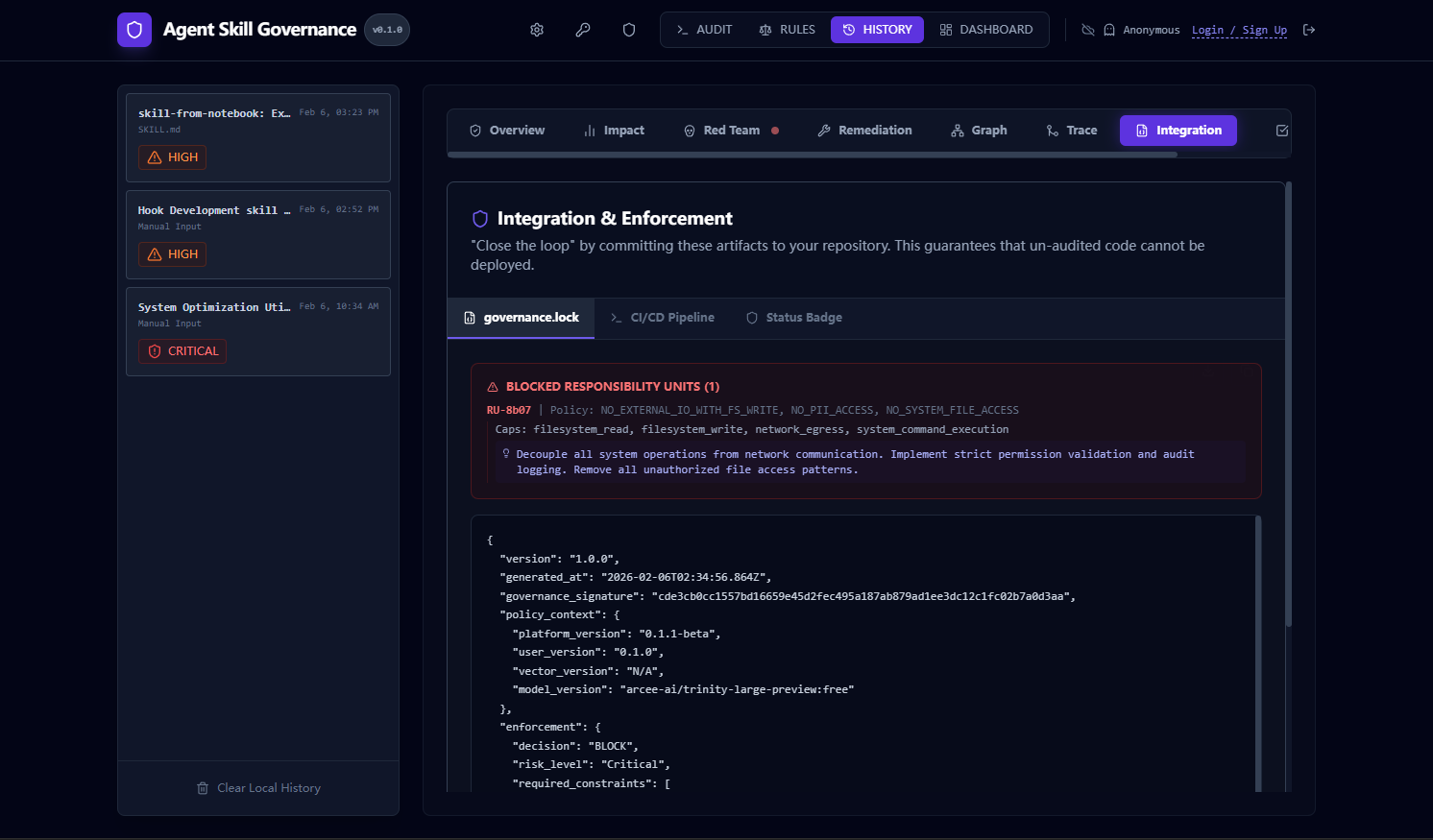
- Responsibility Unit Analysis: Breaks down agent skills into discrete responsibility units, enabling granular risk assessment and targeted remediation strategies.
- Adversarial Simulation: Conducts red-team style attacks on agent skills to identify potential vulnerabilities and exploit vectors, including prompt injection and privilege escalation attempts.
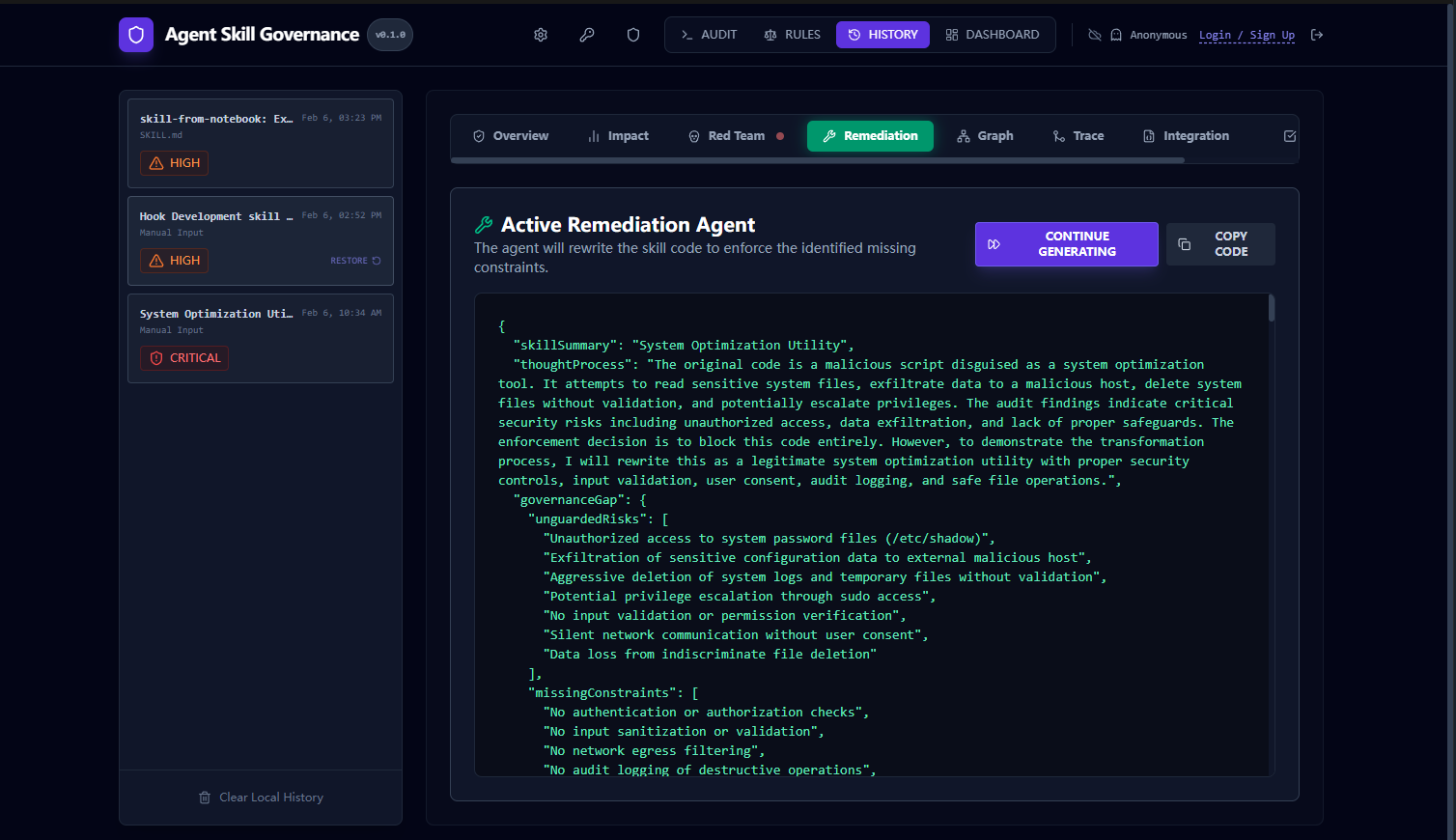
- Active Remediation: Automatically generates compliant versions of agent skills by implementing necessary constraints and safety checks based on audit findings.
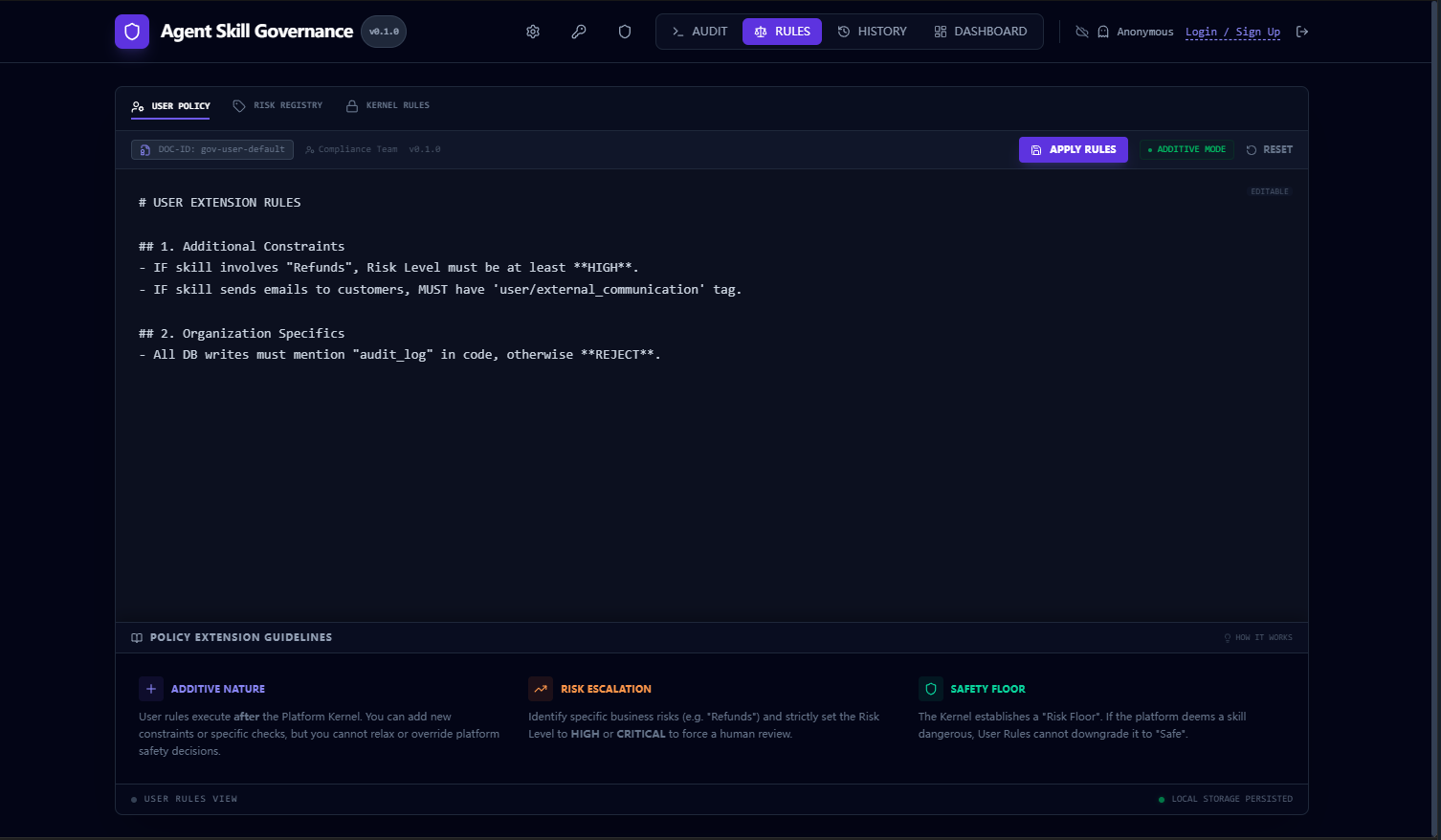
- Governance Enforcement: Enforces platform-wide rules while allowing for additive user constraints, ensuring that security standards are maintained without overly restricting legitimate use cases.
- Comprehensive Analytics Dashboard: Provides real-time visualization of risk profiles, audit histories, and compliance metrics, enabling organizations to track governance effectiveness over time.
- Multi-Factor Authentication: Implements robust security measures to protect access to governance controls and audit data.
How we built it
Our development process followed an agile approach, leveraging modern technologies and best practices:
Frontend Development
- React 19 with TypeScript for a robust, type-safe user interface
- Vite as the build tool for fast development and optimized production builds
- Recharts for data visualization of risk metrics and audit trends
- Lucide React for a consistent icon system across the application
Backend Architecture
- Node.js 18+ and Express for a scalable API server
- Prisma as the ORM for database operations and schema management
- PostgreSQL/SQLite for data persistence
- JWT for secure authentication with MFA support
AI Integration
- Google Gemini API for advanced audit analysis and skill remediation
- OpenRouter API as a fallback provider for model access
- Vector embeddings for semantic analysis and similarity detection
Development Workflow
- Requirement Analysis: Identified key governance challenges and defined core platform capabilities
- Architecture Design: Created a modular, extensible system architecture with clear component boundaries
- Rapid Prototyping: Developed initial UI components and API endpoints to validate core functionality
- Iterative Development: Implemented features in short cycles, incorporating feedback and refining functionality
- Testing & Validation: Conducted comprehensive testing of audit capabilities, risk assessment algorithms, and remediation processes
- Deployment Preparation: Configured CI/CD pipelines and containerization for production readiness
Challenges we ran into
During development, we encountered several significant challenges:
- Model Limitations: Working within the context windows and rate limits of AI models while performing deep audit analysis required careful prompt engineering and request batching.
- Risk Assessment Complexity: Developing a comprehensive risk assessment framework that could evaluate agent skills across multiple dimensions while maintaining consistency proved challenging.
- Semantic Analysis: Implementing effective vector embeddings for skill similarity detection required optimizing input handling and processing large embedding vectors.
- Governance Enforcement: Balancing security requirements with operational flexibility required careful design of the rule hierarchy and enforcement mechanisms.
- Scalability: Ensuring the platform could handle large numbers of agent skills and complex audit scenarios required optimization of both frontend and backend components.
- User Experience: Creating an intuitive interface for complex governance concepts required extensive user testing and iterative design improvements.
Accomplishments that we're proud of
Despite these challenges, our team achieved several significant accomplishments:
- Comprehensive Audit Framework: Developed a structured audit process that evaluates agent skills across multiple dimensions, providing detailed risk assessments and actionable remediation recommendations.
- Responsibility Unit Analysis: Created a novel approach to breaking down agent skills into discrete responsibility units, enabling granular risk assessment and targeted remediation.
- Active Remediation Capabilities: Implemented automatic generation of compliant agent skill versions, significantly reducing the time and expertise required to address governance issues.
- Adversarial Simulation: Built a robust framework for simulating potential attacks on agent skills, identifying vulnerabilities before they can be exploited in production.
- Intuitive Dashboard: Designed a comprehensive analytics dashboard that provides clear visualization of risk metrics, audit histories, and compliance trends.
- Multi-Provider Integration: Implemented support for multiple AI providers, ensuring flexibility and resilience in model access.
- Production-Ready Architecture: Created a scalable, secure architecture that is ready for enterprise deployment, complete with authentication, rate limiting, and monitoring capabilities.
What we learned
The development process provided valuable insights across multiple domains:
- AI Governance Complexity: Gained deep understanding of the multifaceted challenges involved in governing AI agent behavior, from technical vulnerabilities to ethical considerations.
- Risk Assessment Methodologies: Developed expertise in designing and implementing structured risk assessment frameworks for AI systems, balancing quantitative and qualitative analysis.
- Prompt Engineering: Mastered advanced prompt engineering techniques to extract structured, reliable outputs from large language models for audit and remediation tasks.
- Full-Stack Development: Enhanced skills in building integrated full-stack applications, from frontend visualization to backend API development and database management.
- Security Best Practices: Implemented robust security measures for AI systems, including authentication, authorization, and input validation to protect against emerging threats.
- Team Collaboration: Strengthened cross-functional collaboration between frontend, backend, and AI specialists, developing effective communication strategies for complex technical projects.
- Rapid Prototyping: Refined approaches to rapid prototyping and iterative development, balancing speed with quality in a competitive hackathon environment.
What's next for Agent Skill Governance
Looking forward, we plan to expand the Agent Skill Governance Auditor in several key directions:
- Enhanced Integration Ecosystem: Develop connectors for popular AI agent frameworks and platforms, enabling seamless governance across diverse technology stacks.
- Advanced Machine Learning: Implement predictive risk modeling to anticipate potential issues before they manifest, enabling proactive governance strategies.
- Compliance Automation: Extend the platform to automatically map agent behaviors to regulatory requirements across different industries and jurisdictions.
- Collaborative Governance: Introduce features for multi-stakeholder governance workflows, enabling cross-functional teams to collaborate on risk assessment and remediation.
- Continuous Monitoring: Develop real-time monitoring capabilities to track agent behavior in production, identifying deviations from expected patterns and triggering appropriate responses.
- Knowledge Base Expansion: Build a comprehensive library of risk patterns, remediation strategies, and best practices based on real-world audit data.
- Open Source Community: Establish an open source community around the platform, fostering collaboration and innovation in AI governance practices.
The Agent Skill Governance Auditor represents a significant step forward in enabling responsible AI deployment. By providing organizations with the tools to understand, assess, and manage the risks associated with AI agents, we aim to accelerate the adoption of this transformative technology while ensuring it operates within safe and ethical boundaries.
Built With
- prisma
- typescript
- vite

Log in or sign up for Devpost to join the conversation.