-
-
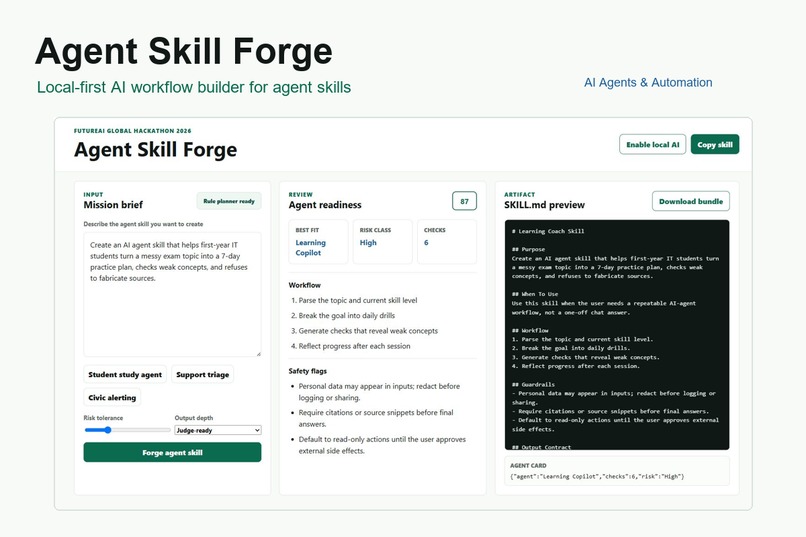
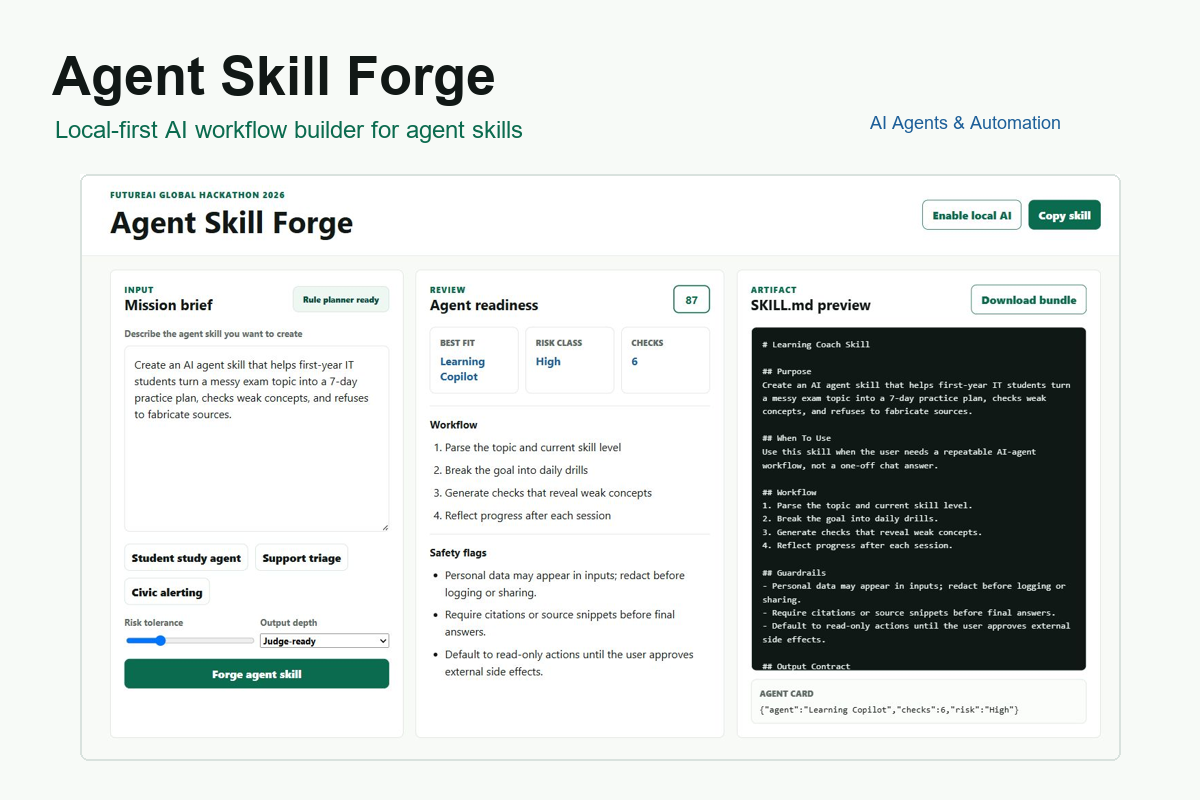
Agent Skill Forge turns a rough task brief into a safer, testable SKILL.md-style agent workflow.
Inspiration
Most AI-agent ideas begin as a vague prompt: "make me an agent for studying", "triage support tickets", or "coordinate field reports". Agent Skill Forge turns that messy idea into a structured skill spec that another agent or human builder can actually run and test.
What it does
Agent Skill Forge is a local-first web tool for creating SKILL.md-style agent workflows. A user writes a mission brief, chooses risk tolerance and output depth, then the app produces:
- the best-fit agent archetype
- a step-by-step workflow
- safety flags for privacy, sources, and high-impact decisions
- acceptance checks
- a portable Markdown skill and JSON agent card
How I built it
The project is a static web app built with HTML, CSS, and JavaScript. It runs immediately with a deterministic rule planner so the demo works offline. When the user clicks "Enable local AI", the app loads Transformers.js with Xenova/all-MiniLM-L6-v2 in the browser and uses embeddings to semantically rerank agent archetypes.
Clear use of AI
AI is used in the optional local embedding layer: the browser compares the user's brief against agent archetype descriptions and chooses the closest workflow. The app also keeps a rule-based fallback so it remains usable without an API key, server, or network model download.
Challenges
The hardest part was keeping the tool practical instead of turning it into a generic prompt generator. I focused on output contracts, guardrails, and acceptance checks so the result is closer to an implementation-ready agent skill.
What I learned
I learned how to design a small AI workflow where the deterministic layer and AI layer support each other. The fallback gives reliability; embeddings add better matching when available.
What's next
Next I would add import/export for real Codex skill folders, more archetypes, and a test runner that checks generated skills against sample user scenarios.
Links
- Live demo: https://cecon123.github.io/agent-skill-forge-futureai/
- Source code: https://github.com/cecon123/agent-skill-forge-futureai
- Demo video: https://youtu.be/EwpisJ_RIDo
Built With
- agent-tooling
- ai-agents
- css
- github
- html
- javascript
- local-first-ai
- transformers.js

Log in or sign up for Devpost to join the conversation.