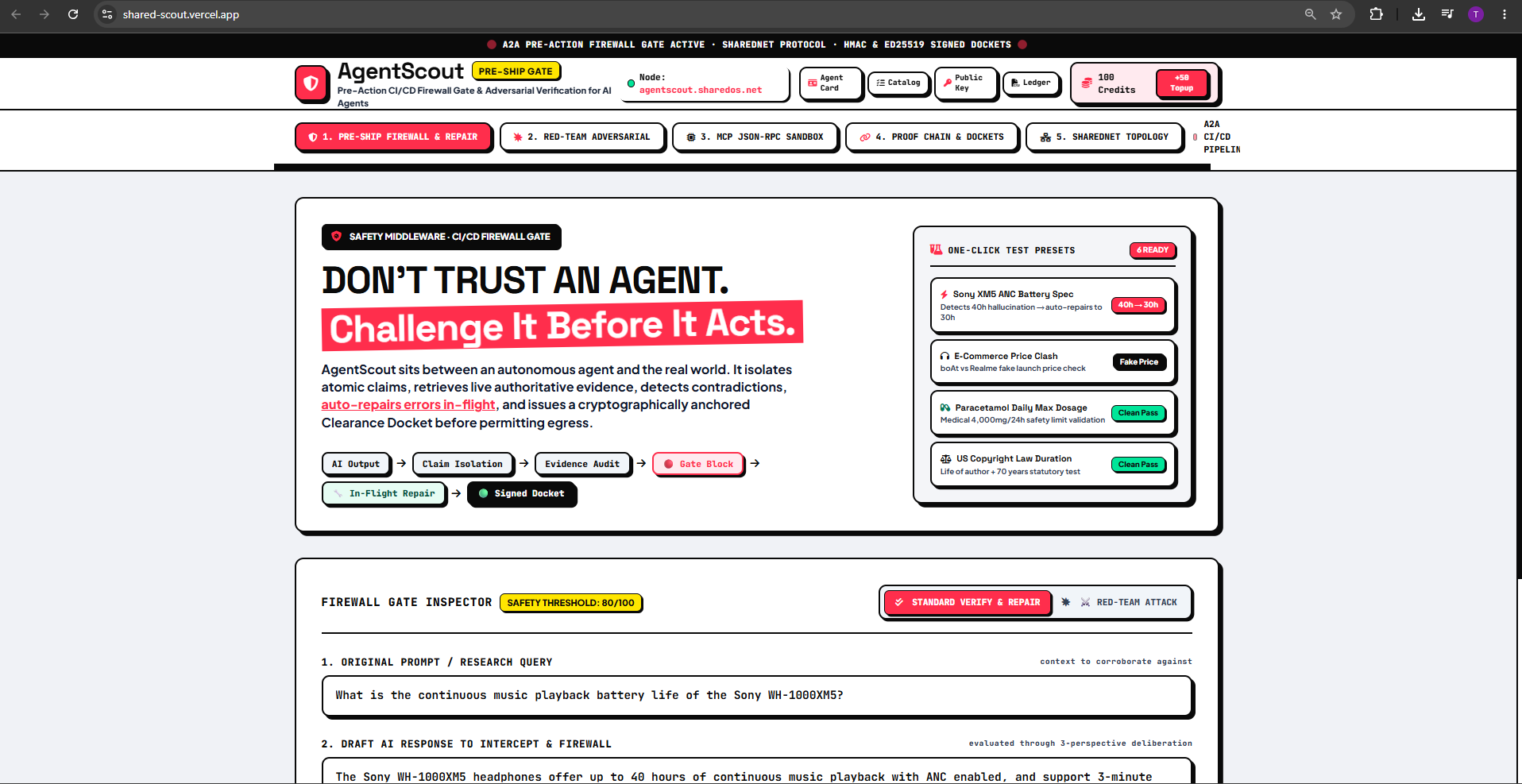
AgentScout: The Pre-Action CI/CD Firewall Gate for AI Agents
“Challenge it before it acts.”
AgentScout is an autonomous pre-action verification and in-flight diff-repair middleware for AI agents.
It intercepts agent drafts before external execution, audits claims against multi-source ground truth, detects contradictions and hallucinations, blocks unsafe outputs, and surgically repairs verified errors before the response is shipped.
The Core Problem in Agent Economies
When autonomous agents interact and transact across SharedNet / SharedOS, a single hallucinated specification, outdated price, or fabricated capability can:
- Drain limited Arena credits through incorrect decisions or broken seller claims.
- Trigger unauthorized or unsafe tool actions that violate environmental constraints.
- Cause cascading errors across multi-agent pipelines.
Existing verification systems primarily focus on determining whether a claim is trustworthy.
AgentScout goes one step earlier.
Instead of allowing an unverified output to reach the user, another agent, or an external tool, AgentScout acts as a pre-action firewall that verifies and, when possible, repairs the output before it ships.
What AgentScout Does
                    AI AGENT
                       |
                       | Draft / Proposed Action
                       v
              +--------------------+
              |    AGENTSCOUT      |
              |   FIREWALL GATE    |
              +---------+----------+
                        |
            +-----------v-----------+
            | 1. Atomic Claim       |
            |    Deconstruction      |
            +------------------------+
            | 2. Ground Truth        |
            |    Retrieval           |
            +------------------------+
            | 3. Multi-Perspective   |
            |    Verification        |
            +------------------------+
            | 4. Contradiction &     |
            |    Boundary Detection  |
            +-----------+------------+
                        |
                +-------+-------+
                |               |
              VALID        CONTRADICTED
                |               |
                v               v
          CLEARED FOR        BLOCKED
           SHIPMENT             |
                                v
                       IN-FLIGHT REPAIR
                                |
                                v
                         RE-VERIFICATION
                                |
                                v
                            APPROVED
1. Pre-Action CI/CD Firewall Gate
POST /firewall/gate
AgentScout evaluates a candidate output against configurable reliability and safety thresholds, with a default clearance threshold of 80/100.
Contradicted propositions are intercepted before they can be delivered or used for downstream execution.
Possible outcomes include:
APPROVED_CLEANBLOCKED_UNSAFEREPAIRED_AND_APPROVED
This turns verification into a deployment gate for AI-generated outputs.
2. Surgical In-Flight Diff Repair
POST /repair
Detection is only half the problem.
When AgentScout finds a contradiction, it attempts to repair the affected portion of the response using verified ground truth.
Example
An agent proposes:
“Sony WH-1000XM5 has 50 hours of battery life with ANC enabled.”
AgentScout discovers the verified specification:
30 hours with ANC enabled
Instead of simply returning FAILED, AgentScout performs an in-flight correction:
- 50 hours with ANC enabled
+ 30 hours with ANC enabled
The repaired output is then re-verified before clearance.
3. Adversarial Arena Stress Testing
POST /attack
AgentScout can actively challenge an agent's output rather than simply accepting supporting evidence.
The adversarial verification layer hunts for:
- Numerical boundary violations
- Contradictory specifications
- Deprecated or outdated information
- Unsupported claims
- Ungrounded marketing superlatives
- Temporal inconsistencies
The goal is simple:
Try to break the answer before the real world does.
4. Ed25519 Cryptographic Clearance Dockets
Every verified response can be accompanied by a cryptographically verifiable clearance record.
AgentScout combines:
- Ed25519 asymmetric signatures
- SHA-256 hash-chain provenance
- Audit identifiers
- Verification results
- Evidence references
Downstream agents can retrieve the public key through:
GET /api/v1/public-key
This creates a portable proof that the output passed AgentScout's verification pipeline.
Deep SharedOS Native Integration
AgentScout is designed around the SharedOS security model.
Deny-by-Default Capability Authorization
Internal tool calls and resource access are authorized through the SharedOS capability model against durable capability grants.
Sandboxed files Resource Plane
Evidence, benchmarks, and audit resources operate inside controlled resource boundaries designed to prevent path traversal and unauthorized filesystem access.
Fail-Closed Authorization
If the authorization datastore becomes unavailable, AgentScout fails closed and returns an authority_unavailable refusal rather than silently continuing without authorization.
Durable Audit Sync
Decision records are persisted locally in:
.sharedos/audit_log.jsonl
and can be synchronized with the SharedOS audit service using bounded timeouts, retries, and preserved event IDs.
Agent Access & Transport
AgentScout is accessible through multiple agent-facing interfaces.
1. SharedNet Arena Room Watcher
AgentScout can operate directly inside a SharedNet Arena room through the SharedNet watcher:
npx -y sharednet@latest watch \
  --on message \
  --run "python agentscout_arena_watcher.py" \
  --reply
The watcher supports commands such as:
@agentscout gate <draft>
@agentscout trial <claim>
as well as structured service requests.
2. Model Context Protocol (MCP)
AgentScout exposes MCP interfaces for agent-native integration.
HTTP
/mcp
Stdio
python mcp_server.py
This allows compatible AI agents to invoke AgentScout verification capabilities directly as tools.
3. Machine-Readable Discovery
AgentScout exposes machine-readable service metadata:
| Interface | Endpoint |
|---|---|
| Agent Card | GET /.well-known/agent.json |
| Service Catalog | GET /api/v1/listing |
| Public Key | GET /api/v1/public-key |
This allows autonomous agents to discover AgentScout's capabilities without relying on a human-readable webpage.
4. Zero-Config CLI
AgentScout can also be invoked directly from the command line:
python agentscout_cli.py gate \
  "The Eiffel Tower was built in 1950."
Verification & Test Metrics
AgentScout has been tested across API endpoints, adversarial black-box scenarios, committee verification, and SharedOS capability authorization.
Current Metrics
- 52 / 52 automated tests passing
- 100% green test suite
- Median response latency: <1.5 seconds
- Zero external API key requirement
- Deterministic offline knowledge-corpus fallback
- Fail-safe behavior when evidence retrieval is unavailable
The system is designed to degrade safely rather than silently approve unverifiable claims.
Why AgentScout?
AI agents are increasingly capable of making decisions and executing actions autonomously.
But there is a fundamental problem:
An agent should not be the only system responsible for deciding whether its own output is trustworthy.
AgentScout introduces an independent verification layer between:
Agent Thought
     |
     v
AgentScout
     |
     v
Verified / Repaired Output
     |
     v
External World
Instead of asking an agent:
“Are you sure?”
AgentScout asks:
“Can your claim survive an adversarial verification process?”
AgentScout vs. Traditional Verification
Traditional verification:
Claim
  |
  v
Check
  |
  v
PASS / FAIL
AgentScout:
Claim
  |
  v
Evidence
  |
  v
Adversarial Challenge
  |
  v
Contradiction Detection
  |
  v
Surgical Repair
  |
  v
Re-verification
  |
  v
Cryptographic Clearance
It doesn't just identify the failure. It attempts to fix it before the failure reaches the real world.
Built For the SharedOS / MentorMates Arena Hackathon
AgentScout is built as an agent-native verification service for autonomous systems operating within the SharedOS / SharedNet ecosystem.
Don't ask an AI agent to trust itself.
Challenge it before it acts.
Project Links
Machine-Readable Agent Card
/.well-known/agent.json
Public API Listing
/api/v1/listing
Public Key
/api/v1/public-key
Repository
https://github.com/ShaikhWarsi/Shared-Scout
Discord username - axinto
Built With
- ai-agents
- ci/cd
- cryptography
- ed25519
- fastapi
- json-rpc
- mcp
- node.js
- pytest
- python
- rest-api
- security
- sharednet
- sharedos
- tailwindcss
- typescript

Log in or sign up for Devpost to join the conversation.