-
-
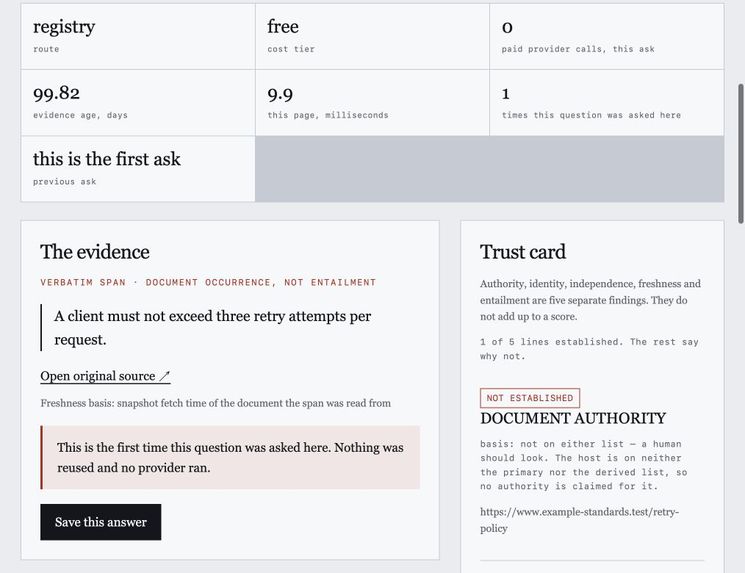
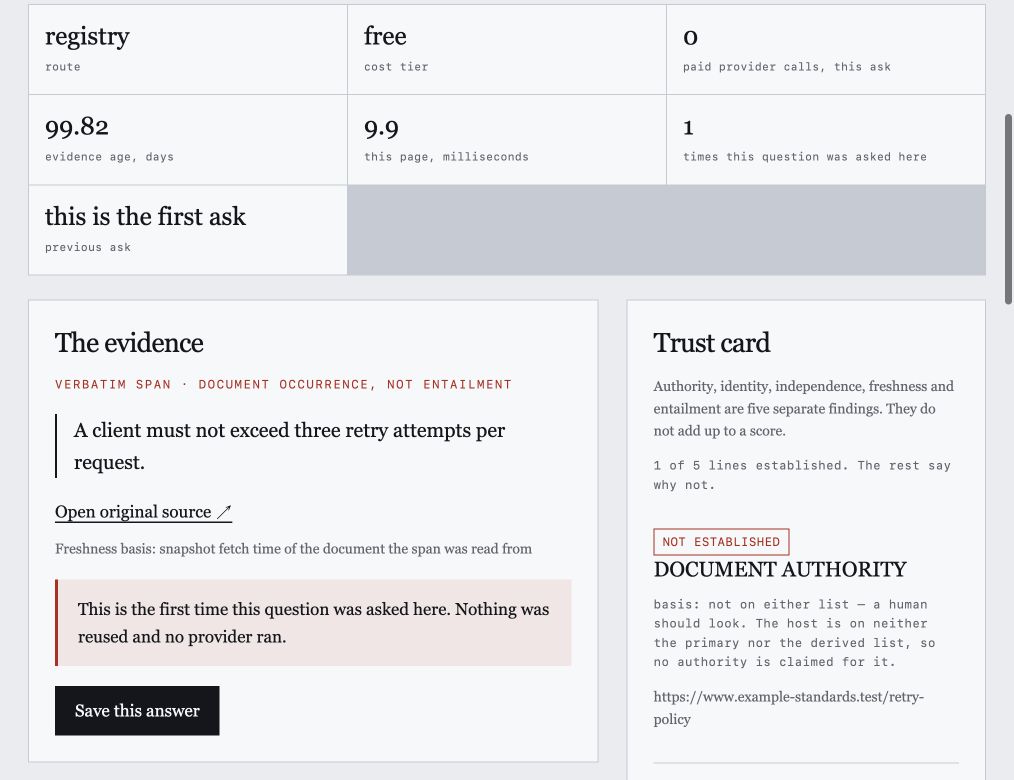
02 / The exact passage, its retrieval context and a trust card that shows what remains unknown.
-
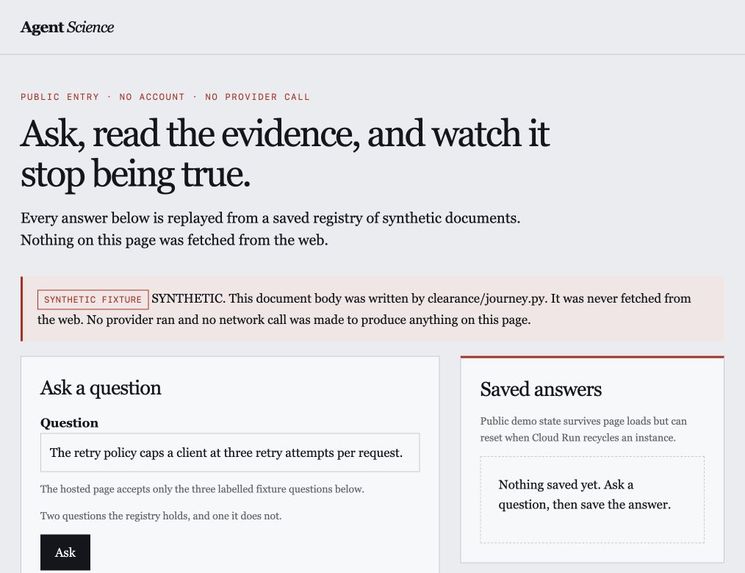
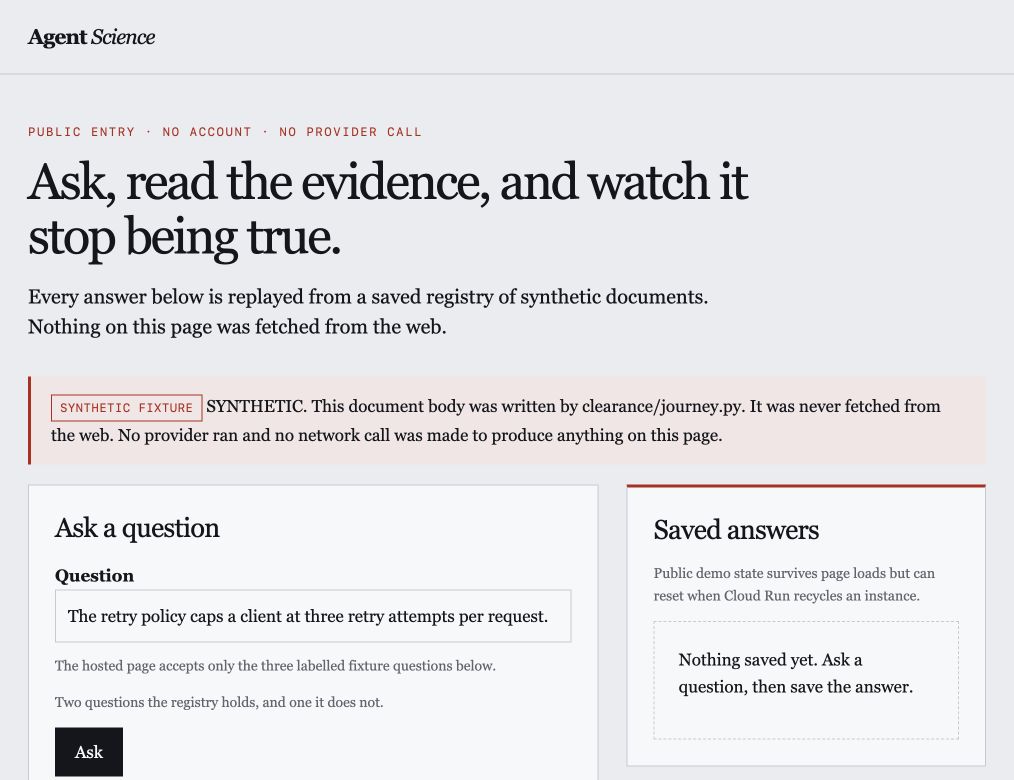
01 / Ask, inspect, save and revisit. Public demonstration with labelled synthetic documents.
-
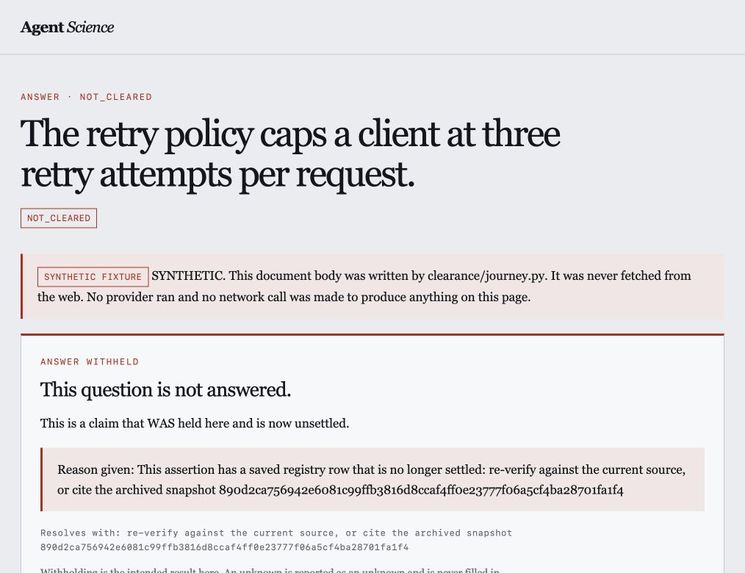
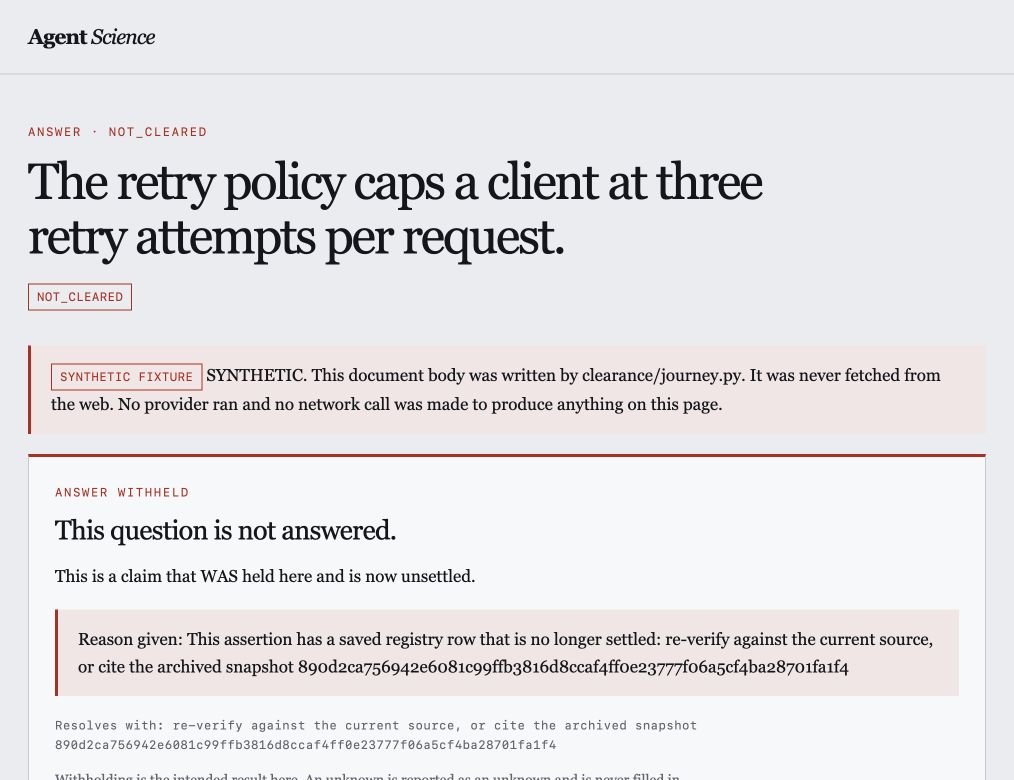
03 / The source changed. The saved answer is now unsettled and must be checked again.
-
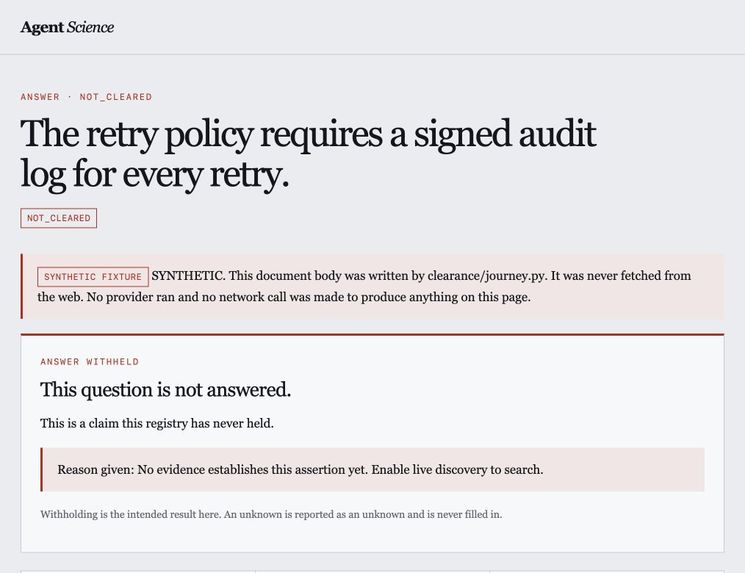
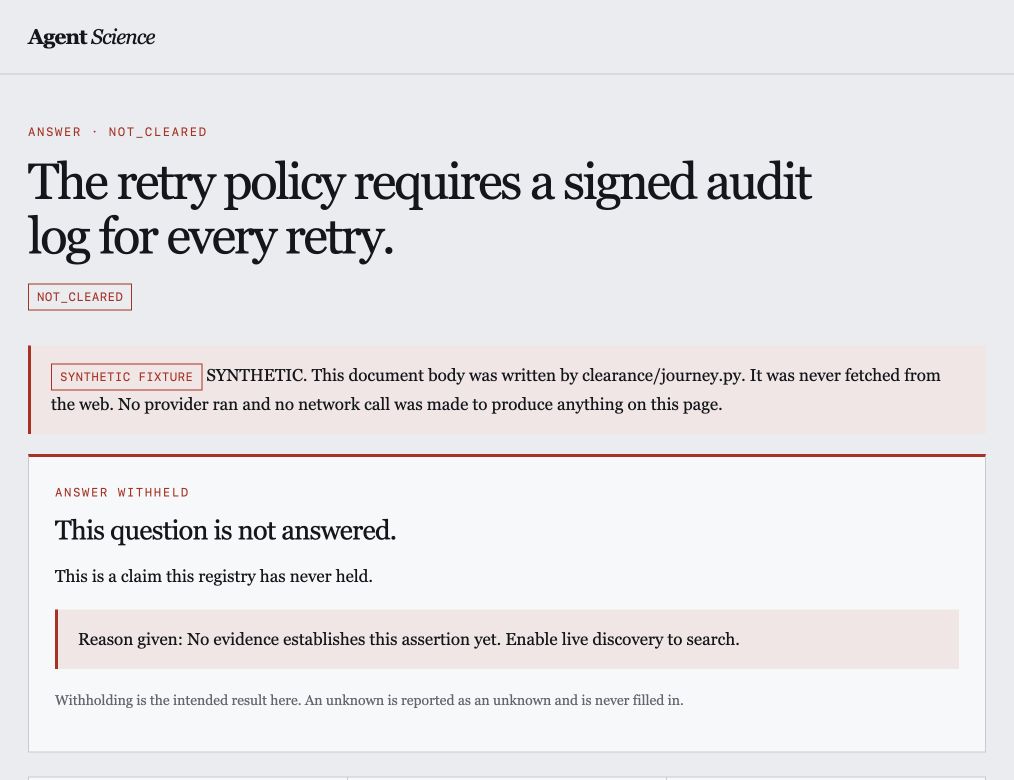
04 / No supporting evidence in the registry. The answer is withheld instead of invented.
Inspiration
I keep asking the internet questions I have already researched. New tab, new answer, another confident paragraph. The useful part disappears: which source actually said it, what it established, and what I still didn't know.
That gets expensive when the answer becomes a line in a documentary, a script or a published story. A citation travels with the sentence. The doubt usually doesn't.
Agent Science started with a question: what if the research survived the chat?
What it does
Agent Science is a websearch truth companion. Its core is a reusable record of a claim, the exact passage behind it, when that passage was retrieved, and the limits of what it establishes.
The interaction I care about is the second visit. Open a saved answer. Inspect its evidence. Change the source. Ask again.
The old answer should be allowed to stop being settled.
The public demonstration lets you:
- Ask one of the labelled example questions.
- Inspect the exact source passage and its trust card.
- Save the answer for another visit.
- Change a synthetic source, then recheck the saved claim.
- See an answer withheld when its supporting passage disappears, or when the registry never held evidence for it.
A document changing does not automatically make a claim false. It means the earlier basis needs another look.
Why it matters for media
Imagine a documentary researcher handing a script to an editor. Alongside the narration is a record of which statements have support, where that support came from, and what needs checking before publication.
That is the intended production workflow. A producer can review the unresolved questions. An editor can follow the passage. A later production can begin with the previous investigation instead of another blank search box.
The ambition is a shared research library that gets more useful with each investigation, while keeping uncertainty visible.
How we built it
The Python research pipeline connects Parallel Search to evidence retention. Parallel discovers candidate sources; its results do not automatically become verified claims. SQLite stores retained records. Document hashes and source excerpts support later rechecks.
A Google ADK wrapper uses Gemini through Vertex AI to call the script-clearance tool and return its structured report. Cloud Run hosts the application, and Cloud Storage backs the private workspace.
Partner track: Parallel. Source discovery is its role in the product. ClickHouse was an early design option and is not part of the implementation.
What the demo proves
The public journey and the 2:06 video show the evidence-retention and correction loop using labelled synthetic documents. They do not make live Gemini or Parallel calls. Demo state is shared and may reset when the hosting instance recycles.
The integrated research code and the public fixture journey are separate execution paths. Live partner operation on the submitted hosted journey, and reconciliation of the hosted revision with the public default branch, remain release gaps. This demonstration does not establish real-world accuracy or measured search savings.
Challenges and what I learned
The difficult part was deciding what a result is allowed to claim.
Finding a sentence proves that the sentence appeared in a document. A prestigious-looking hostname is not proof of authority. Several links can repeat one underlying source. We found and repaired a domain-classification defect during review, then tested the misleading hostname against the corrected behaviour.
The interface has to make those distinctions understandable. Otherwise a careful backend produces another confident-looking answer.
What's next
Start with a field, discover its recurring questions, and curate the strongest sources, useful methods and unresolved disagreements. For media teams, that means research which can travel from investigation to script to the next production.
For the wider product, it could mean reusable investigations into model routing, onboarding patterns or research methods. Popular questions tell us where to look. Evidence determines what we can say.
Keep the research. Keep its limits. Make the next question better.
Built With
- gemini
- google-adk
- google-cloud
- google-cloud-run
- parallel
- python
- sqlite

Log in or sign up for Devpost to join the conversation.