Inspiration
While reading about failures in autonomous AI systems, I came across several cases where agents made unauthorized API calls, hallucinated tool outputs, and quietly corrupted downstream workflows.
The second spark was more personal. While building with AI agents, I noticed something uncomfortable: I was constantly micromanaging the very systems that were supposed to save time. Every autonomous agent still required me to stay close, monitor its actions, and manually review decisions. The promise of autonomy felt incomplete.
That contradiction led to the central question behind this project:
What if agents had a master — not to control them, but to free humans from watching them constantly?
A system that observes, understands, and governs agent behavior in real time, allowing developers to trust their agents without constant supervision.
That idea became Agent S.H.I.E.L.D.
What it does
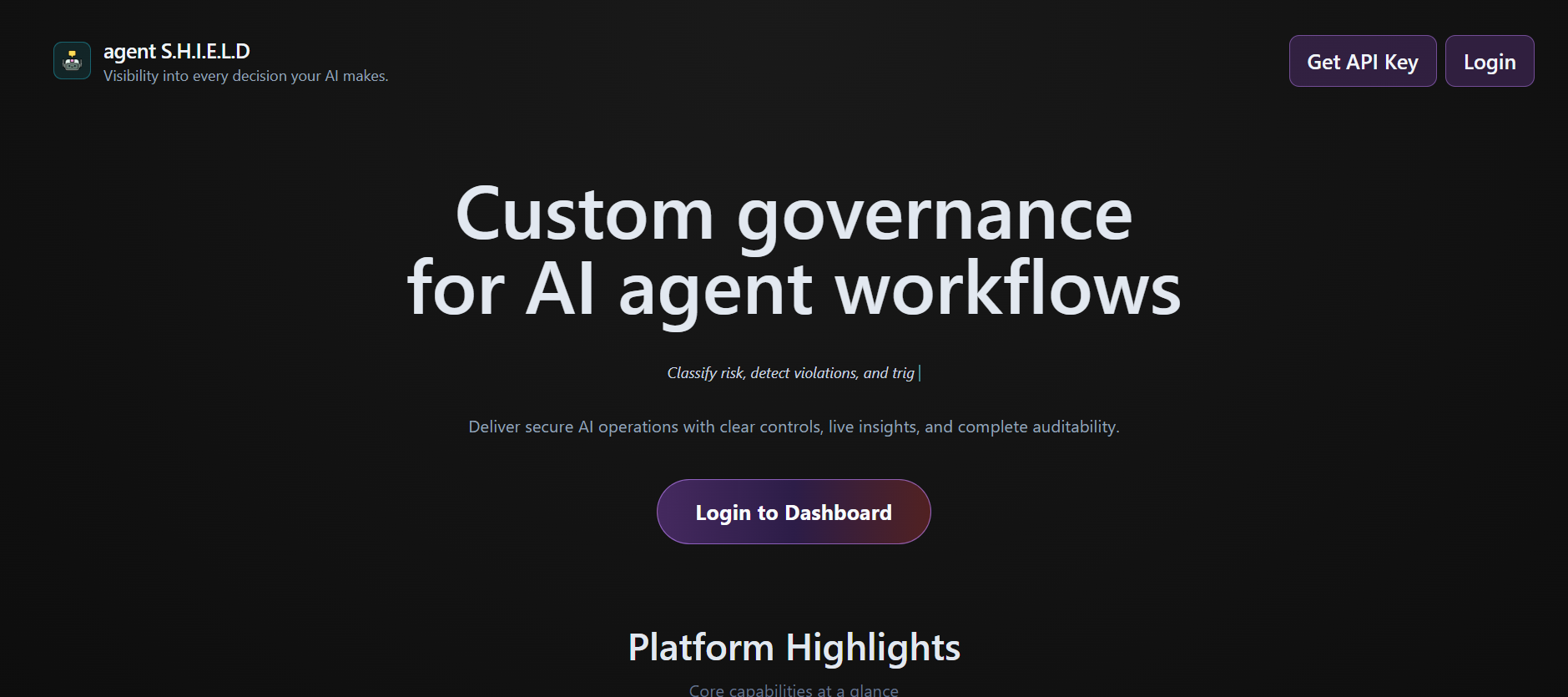
Agent S.H.I.E.L.D. is an enterprise-grade governance and monitoring layer for AI agents.
It sits above deployed agents and performs three core functions:
- Real-time violation detection – identifies anomalous or unsafe agent behavior as it happens.
- Risk scoring – evaluates every decision using a multi-factor risk engine.
- Explainable audit trails – provides full traceability so humans stay informed without constant intervention.
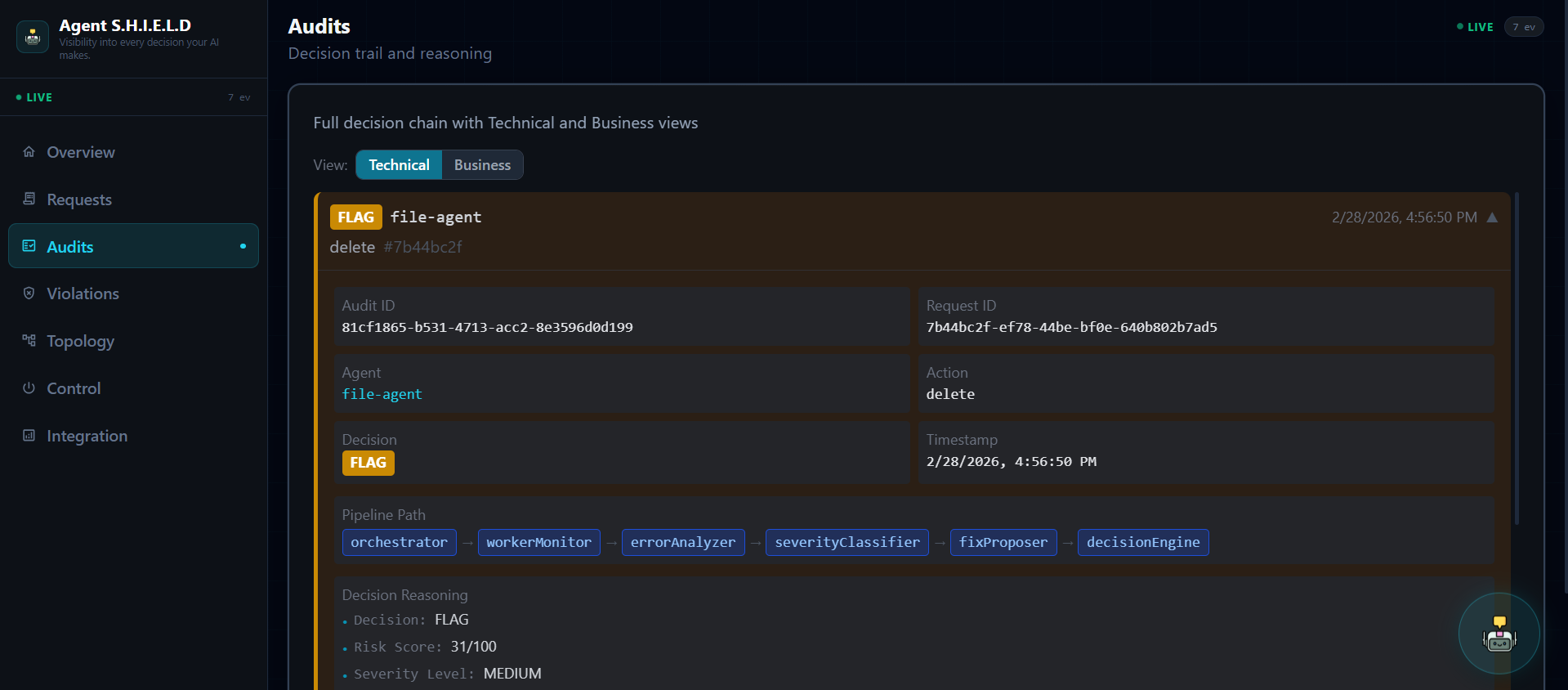
The system runs on a multi-agent LangGraph pipeline where an orchestrator coordinates several specialized agents:
- Worker Monitor
- Error Analyzer
- Severity Classifier
- Fix Proposer
- Decision Engine
Each layer contributes signal to the analysis. The result is not just an alert, but an explainable governance decision including triggered rules, risk factors, and recommended actions.
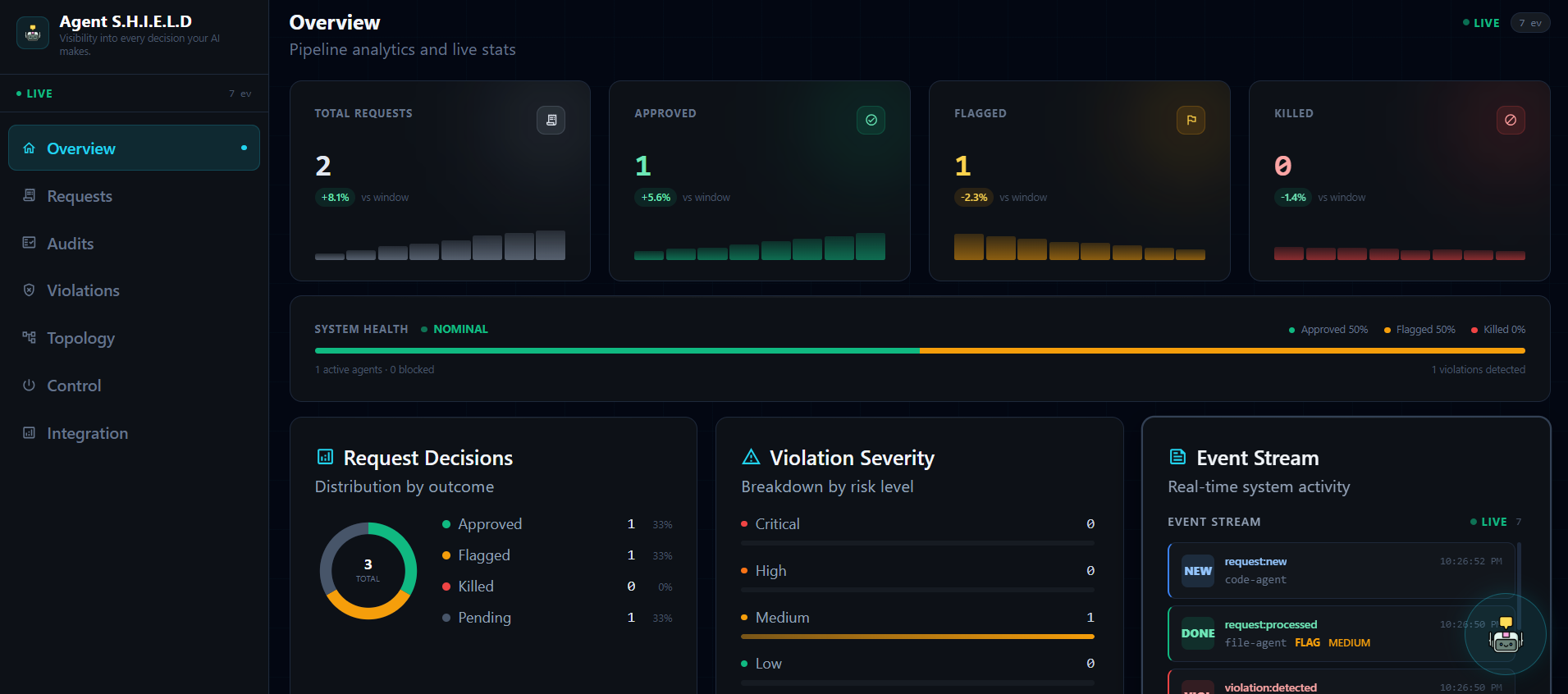
The dashboard provides:
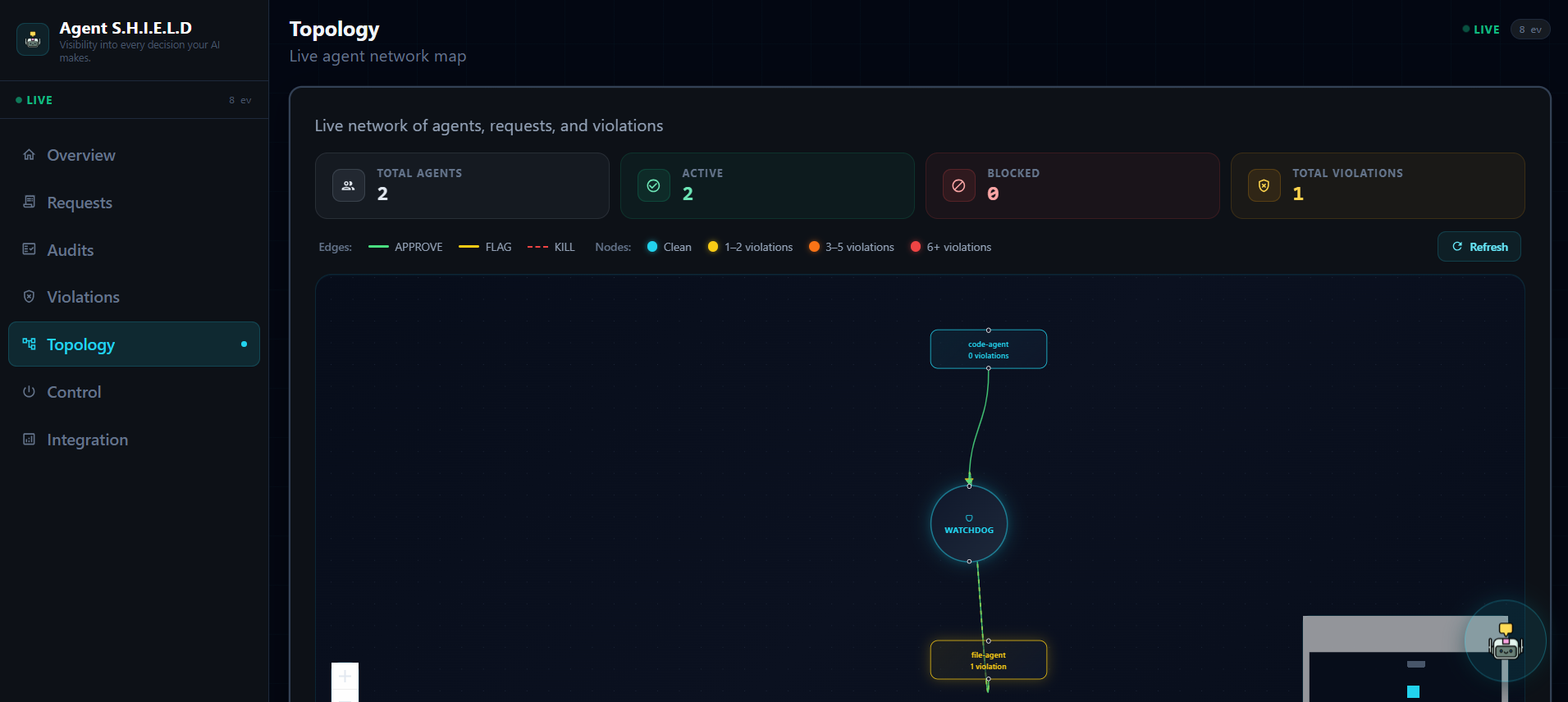
- Topology Maps – live visualization of agent interactions and violation heat zones
- Pipeline Traces – stage-by-stage breakdown of each violation
- Risk Score Cards – arc gauges with weighted factor explanations
- Dual Audit Views – technical insights for engineers and summarized reports for business stakeholders
- Behavioral Baselines – drift detection against historical agent behavior
How I built it
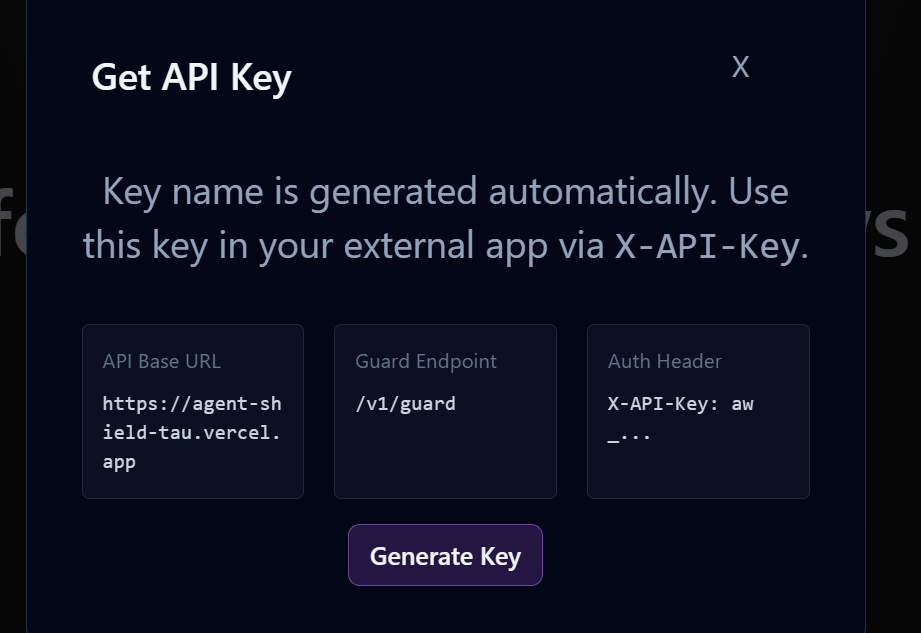
The system was designed as an agent-agnostic monitoring layer so it can observe and govern any AI agent architecture without modifying the agents themselves.
| Layer | Technology Stack |
|---|---|
| Backend | Node.js, TypeScript, Express, LangGraph, SQLite |
| AI Engine | Claude Sonnet via LangChain Anthropic |
| Real-time Layer | Socket.IO WebSockets |
| Frontend | React 18, Vite, Tailwind CSS, MUI, ReactFlow |
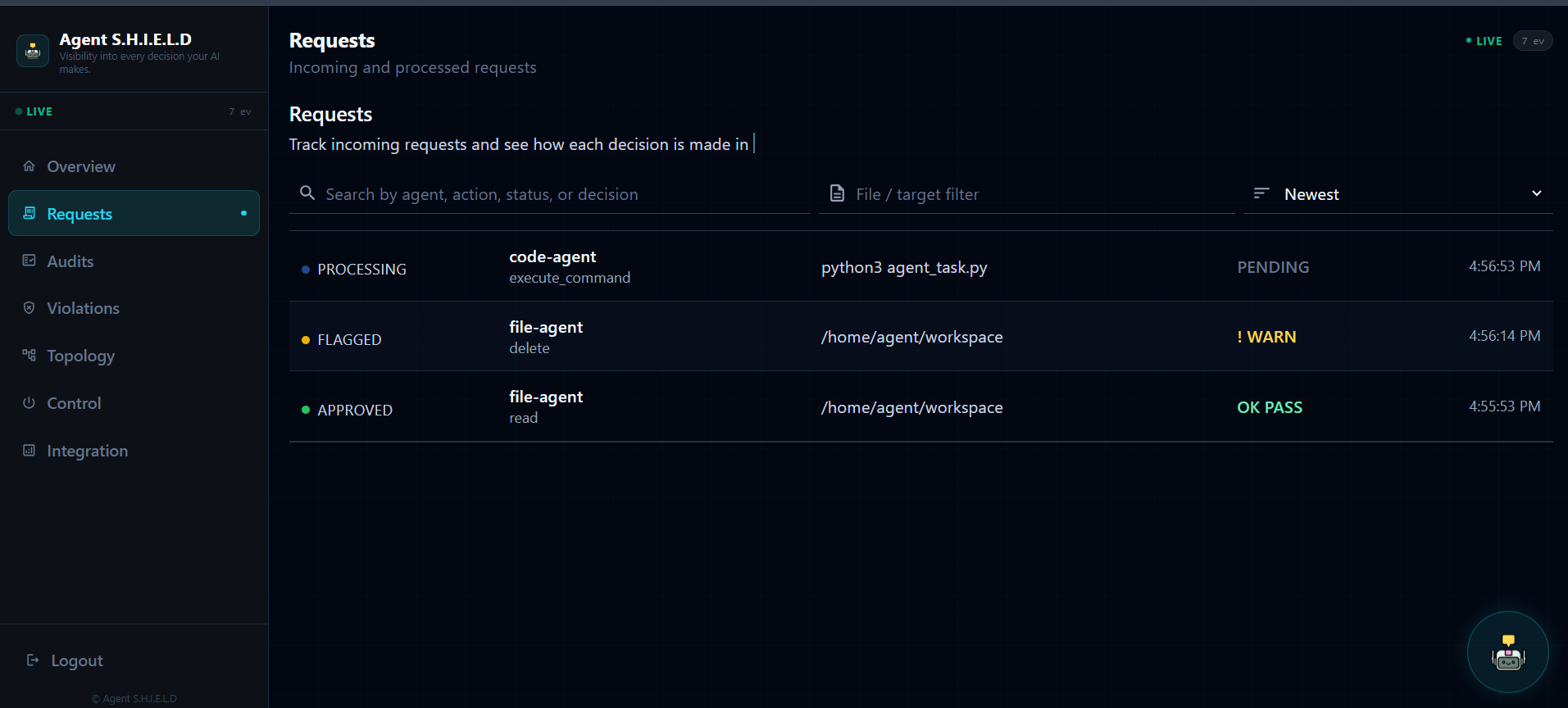
The backend processes incoming agent events and feeds them into the LangGraph pipeline. Each stage performs a specialized analysis and produces structured outputs. The frontend dashboard receives real-time updates through WebSockets and visualizes agent behavior and risk signals.
Architecture
Incoming Request
       │
       ▼
┌──────────────┐
│ Orchestrator │ ──▶ Initial assessment & routing
└──────────────┘
       │
       ▼
┌──────────────┐
│Worker Monitor│ ──▶ Deep inspection & intent analysis
└──────────────┘
       │
       ▼
┌──────────────┐
│Error Analyzer│ ──▶ Violation detection
└──────────────┘
       │
       ▼
┌────────────────┐
│Severity Classifier│ ──▶ Risk assessment
└────────────────┘
       │
       ▼
┌────────────────┐
│ Fix Proposer   │ ──▶ Remediation suggestions
└────────────────┘
       │
       ▼
┌────────────────┐
│Decision Engine │ ──▶ APPROVE / FLAG / KILL
└────────────────┘
Challenges I ran into
1. Making risk scoring explainable
A score of 87/100 means nothing without context. The real challenge was forcing the LLM to output why — which rules triggered, which factors contributed, and what action to take — in consistent, structured JSON every time.
Getting that reliability required significant prompt engineering and output validation.
2. Behavioral drift detection
Defining “normal” behavior for an AI agent is inherently difficult.
We approached this by building baseline profiles for each agent and monitoring deviations:
[ Drift = \left| Behavior_{current} - Behavior_{baseline} \right| ]
Calibrating sensitivity so that the system detects meaningful deviations without generating excessive alerts required iterative tuning.
3. Serving both technical and non-technical audiences
Engineers need stack traces, logs, and rule identifiers. Executives need risk summaries and impact explanations.
We addressed this with dual audit views:
- Technical View: rule triggers, pipeline traces, raw diagnostics
- Business View: simplified summaries explaining impact and recommended action
This allowed the same data to serve two very different audiences effectively.
Accomplishments that I'm proud of
- Building a fully functional governance layer for AI agents
- Designing a multi-agent analysis pipeline using LangGraph
- Delivering real-time monitoring with explainable risk scoring
- Creating a visual dashboard that makes agent behavior observable
- Demonstrating how AI governance can be implemented as infrastructure rather than an afterthought
What I learned
- AI governance is infrastructure, not a feature.
- Explainability matters more than raw accuracy when humans are involved.
- The best monitoring systems reduce noise and highlight only meaningful risks.
I also learned that observing agent behavior across time provides deeper insights than evaluating individual decisions in isolation.
What's next for Agent S.H.I.E.L.D
The current system demonstrates a strong foundation, but several improvements are planned:
- Automated remediation actions that can safely intervene when high-risk behavior is detected
- Policy engines allowing organizations to define custom governance rules
- Cross-agent correlation analysis to detect coordinated or cascading failures
- Integration with major agent frameworks and orchestration platforms
- Machine learning models for adaptive behavioral baselines
As organizations deploy increasing numbers of AI agents, governance will become essential.
Agent S.H.I.E.L.D. aims to become the support needed!!
Built With
- api
- claude
- express.js
- javascript
- langchain
- langgraph
- mui
- node.js
- react
- reactflow
- socket.io
- sql
- sqlite
- tailwind
- typescript
- vite
- websockets


Log in or sign up for Devpost to join the conversation.