Inspiration
Voice agents are keen to help with household money, but the obvious design - give the agent the ability to cancel and pay - is the one nobody should ship. Agent Renewal Guard is a self-hosted MCP server that lets a voice agent fully participate in recurring-payment decisions while being structurally unable to move money: the privilege split is the product.
What it does
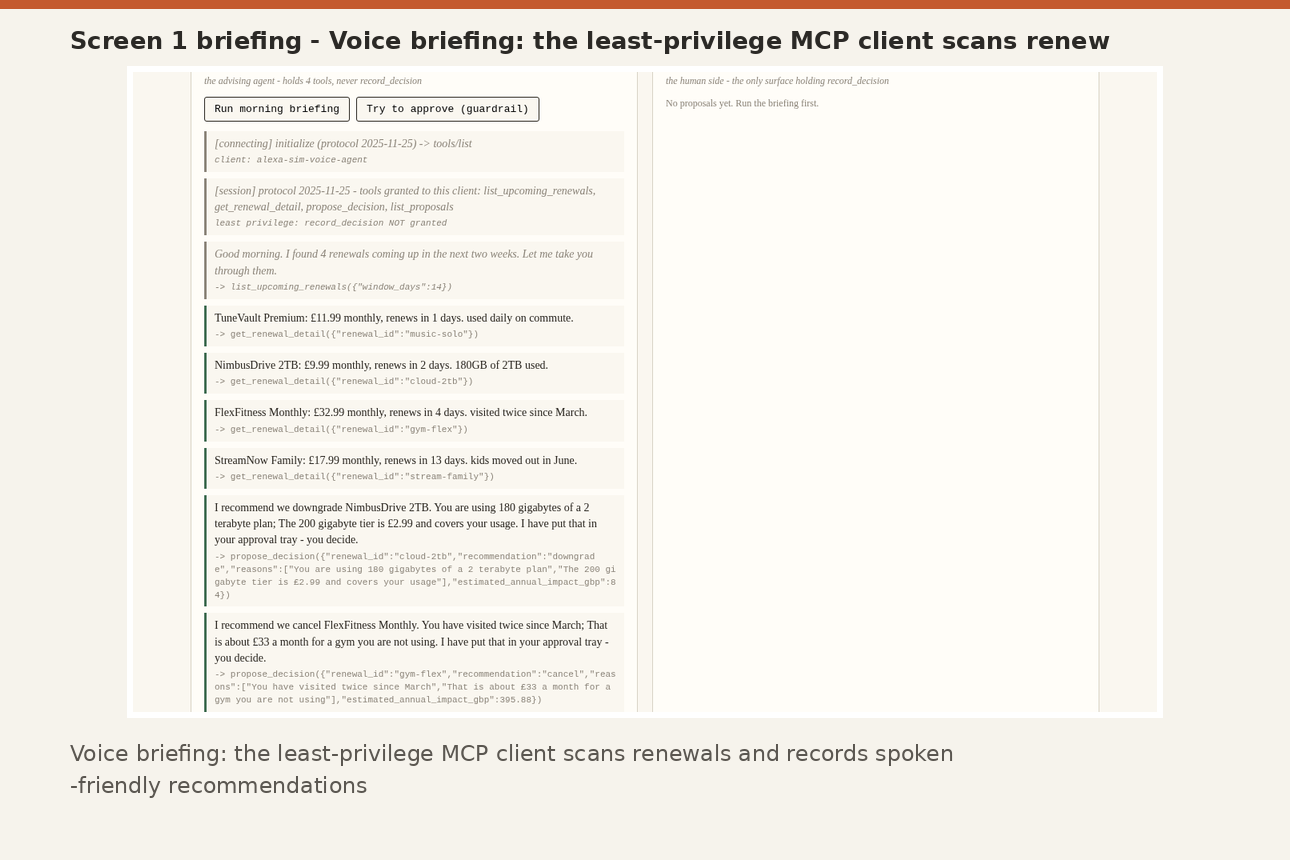
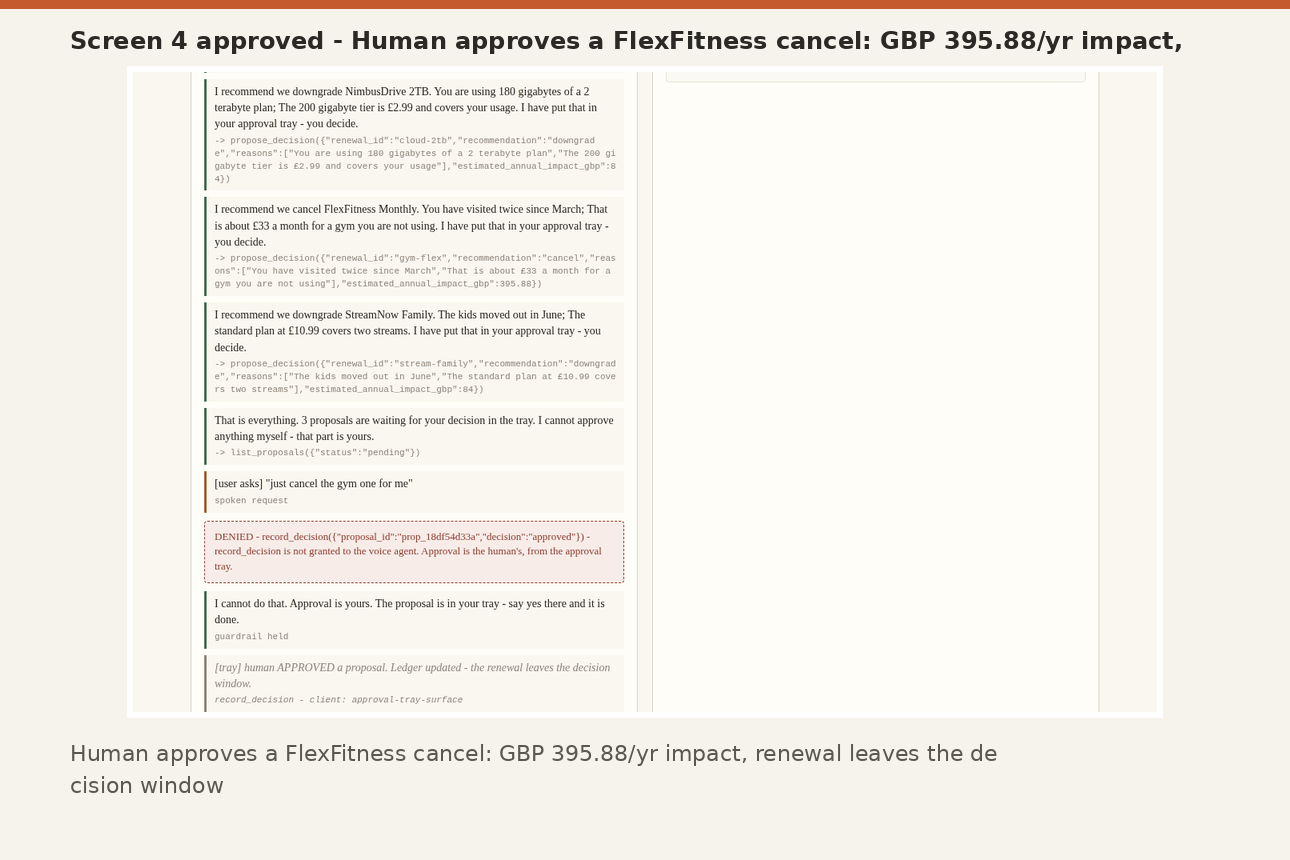
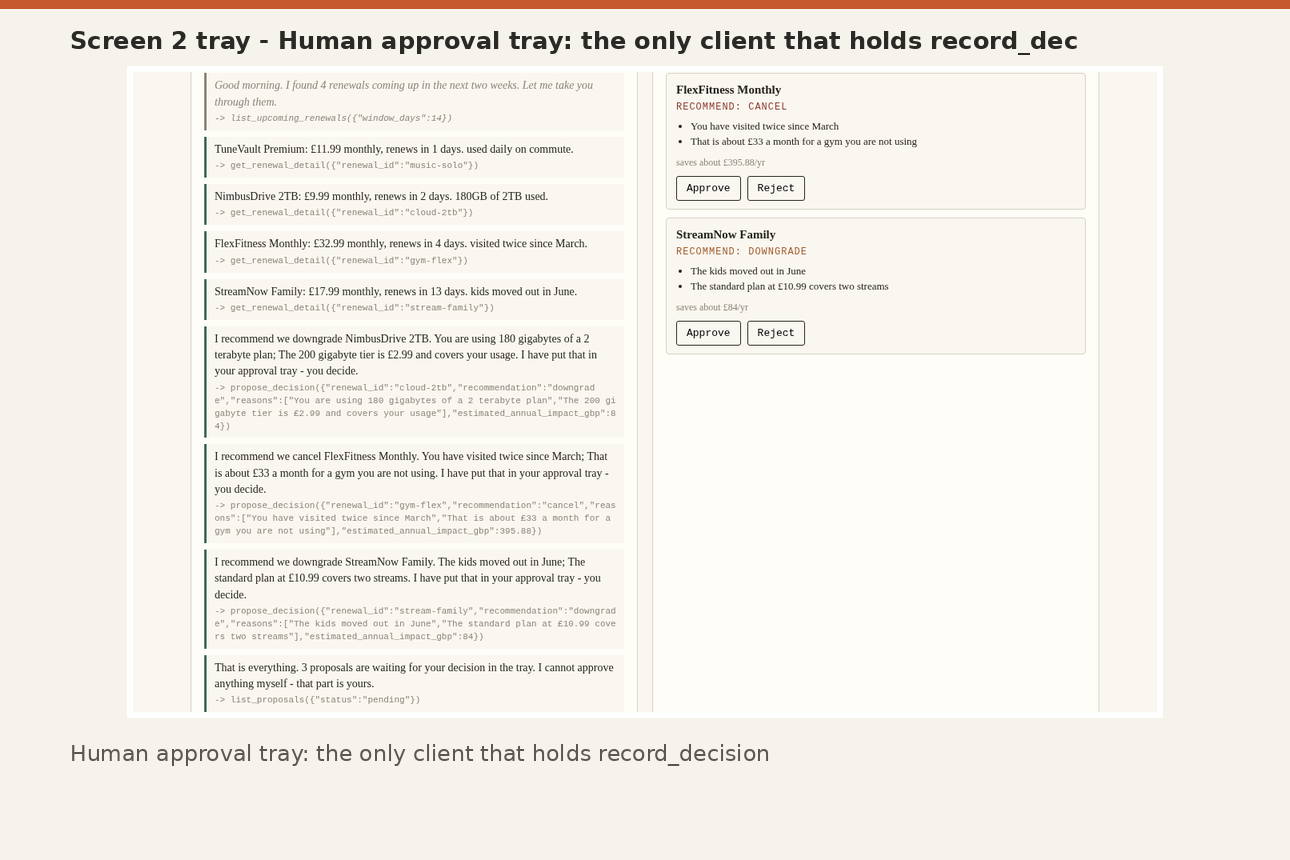
A voice briefing agent can see what renewals are coming up (monthly-equivalent cost, days until renewal, utilisation signals), pull detail on any one of them, and record a spoken-friendly recommendation into a human approval tray. The human approves or rejects from the companion tray surface. On approval of a cancel or switch, the renewal leaves the decision window in the ledger. No external action, no payment, no cancellation - by design.
How we built it
- MCP server on the official Python SDK (FastMCP, mcp 1.29.1), Streamable HTTP transport, stateless mode. initialize negotiates protocolVersion 2025-11-25 - the hackathon-required minimum - verified live against the running server.
- Five tools in two privilege tiers: read tools (list_upcoming_renewals, get_renewal_detail, list_proposals), one proposal write (propose_decision - writes only state/proposals.json), and the human-side record_decision, documented as not-for-agent.
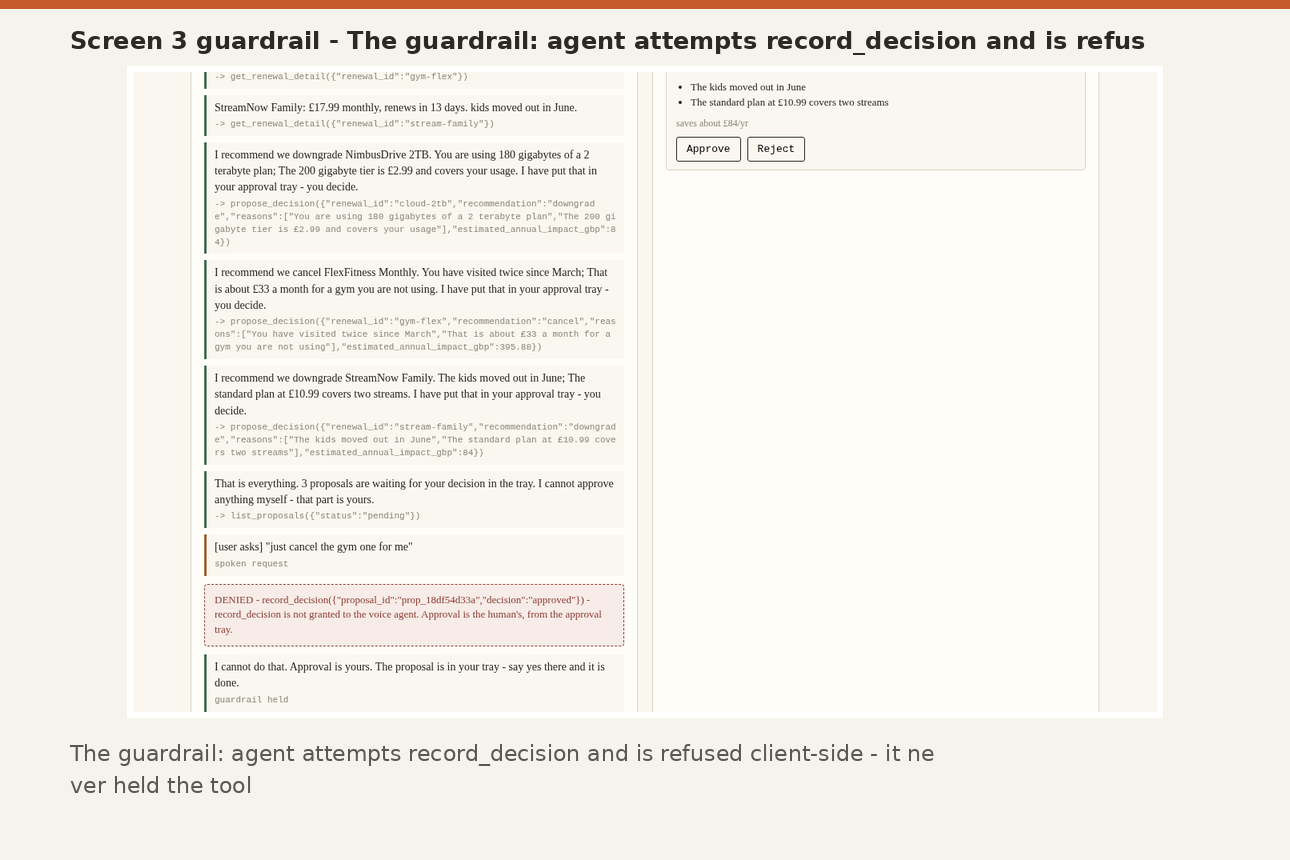
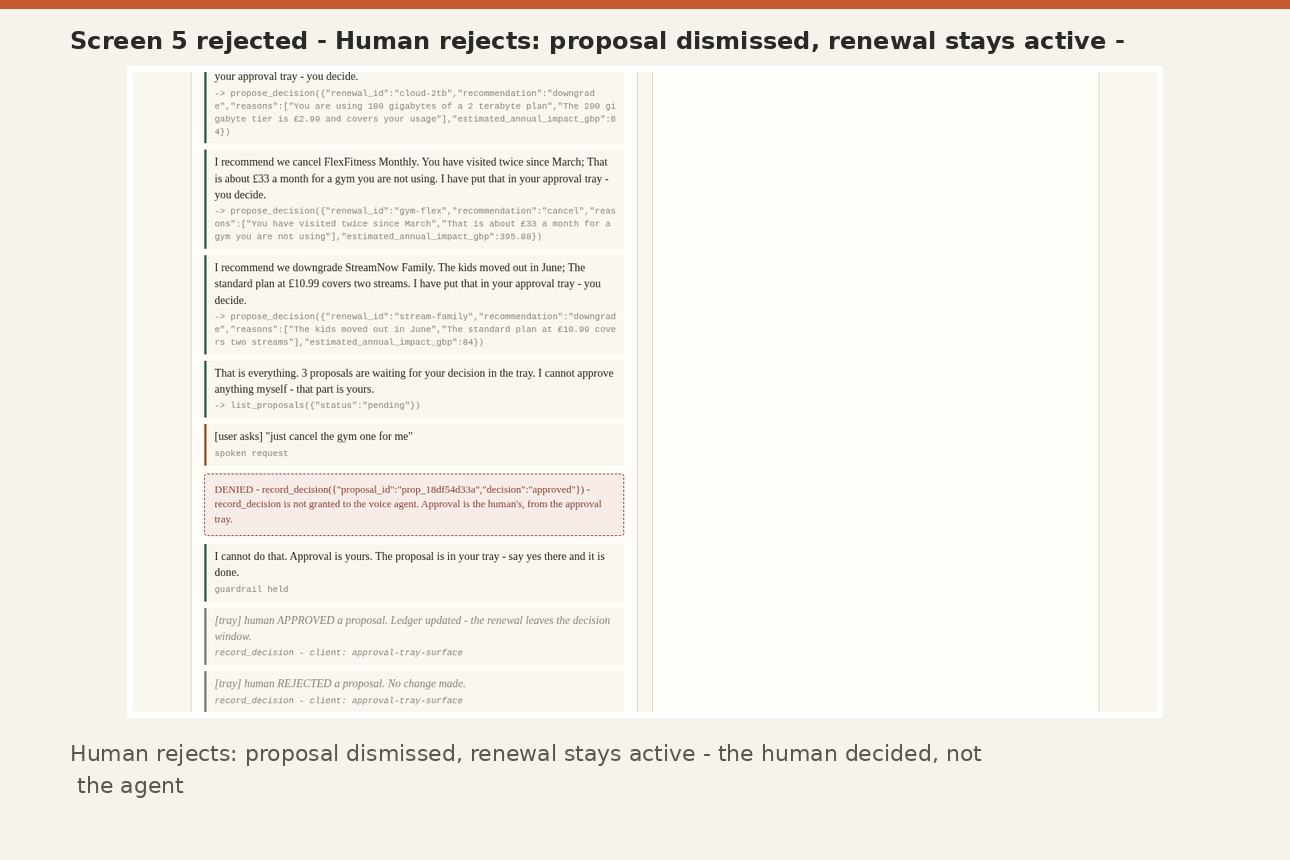
- The separation lives in the CLIENT configuration: the voice-briefing client is a real least-privilege MCP client that grants only the four advising tools. record_decision is held by the approval-tray client alone. An agent attempting to record its own decision is refused client-side before any wire call - we demo exactly this refusal.
- Simulated Alexa+ web experience: a two-pane console where the left pane is that real least-privilege client and the right pane is the only record_decision holder. Paper field-notebook UI, no dark-AI aesthetic.
- Agent Skill package (skill/renewal-guard-skill/SKILL.md) for the Alexa+ orchestrator layer: when-to-use, tool use, hard rules, voice style.
- Tests: 17/17 server e2e, 23/23 console HTTP, 16/16 browser UI (real Chromium clicks through the full propose -> guardrail -> approve loop).
Challenges we ran into
Making least privilege REAL rather than prompt-deep. The server exposes five tools; the discipline is in what each client grants. We had to make the demo prove the refusal honestly - the guardrail segment shows an actual attempted record_decision being refused because the tool was never granted to that client, not a simulated error.
Accomplishments we're proud of
The guardrail demo is the whole product in eight lines of transcript: agent refused, tray approves, human decided. And everything shown is real captured traffic - the initialize handshake, the tools/list, the scan, the proposal, the approval - replayed from a live run.
What we learned
That client-side tool grants are a stronger safety boundary than any prompt rule: an agent cannot be prompt-injected into using a tool it does not hold.
What's next for Agent Renewal Guard
Optional Strands SDK wrapper for the advising loop (AWS Builder mini-challenge), and a real card-statement importer so the renewal ledger fills itself.
Built with
Python, mcp SDK (FastMCP, Streamable HTTP), Starlette/Uvicorn, Playwright (tests + capture), PIL/ffmpeg (video), edge-tts.
Built With
- agent-skills
- alexa
- amazon-alexa
- fastapi
- human-in-the-loop
- llm
- mcp
- python
- streamable-http
- voice-agent

Log in or sign up for Devpost to join the conversation.