-
-
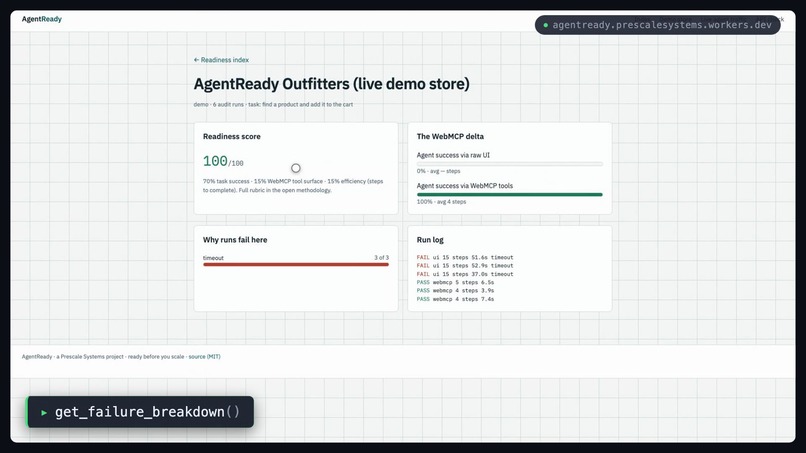
Benchmark Run Log
-
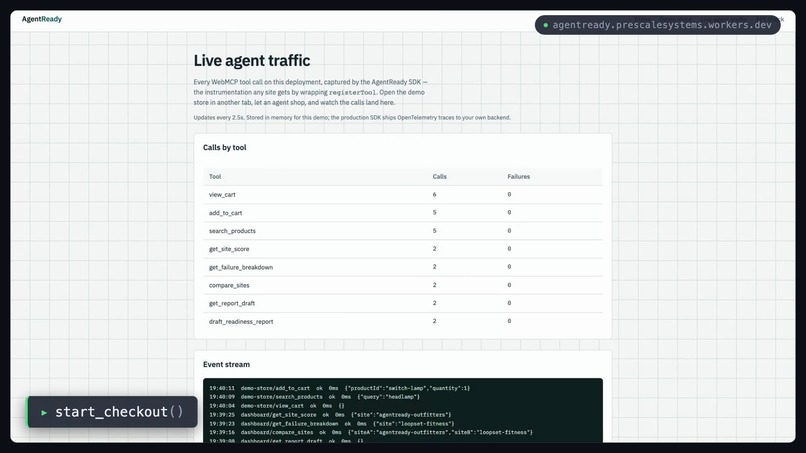
Live Agent Traffic
-
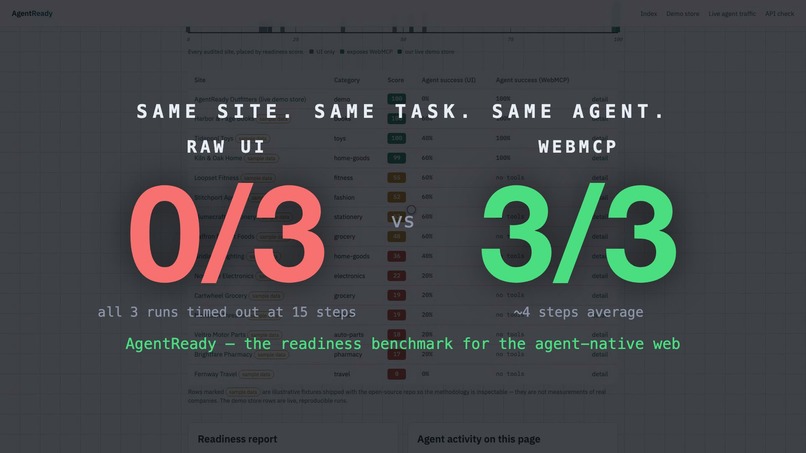
Scorecard
-
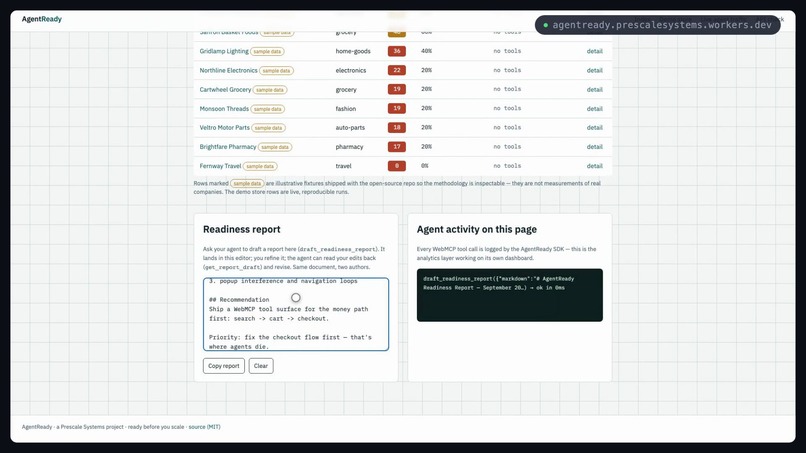
Human Agent Cowriting
-
Agent Ready
Inspiration
Everyone in the agent era repeats the same claim — "AI agents struggle to use websites" — and nobody measures it. Site owners have zero visibility into whether an agent can actually finish a checkout on their site, and WebMCP adopters have no way to prove the investment worked. We stopped arguing and built the measuring instrument.
What it does
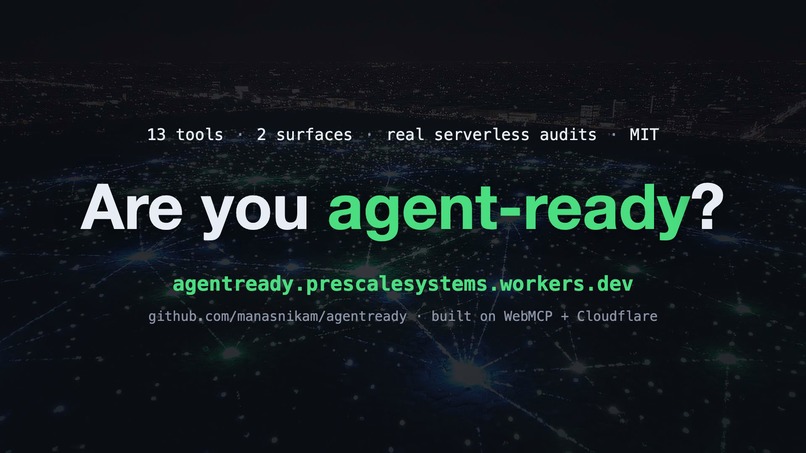
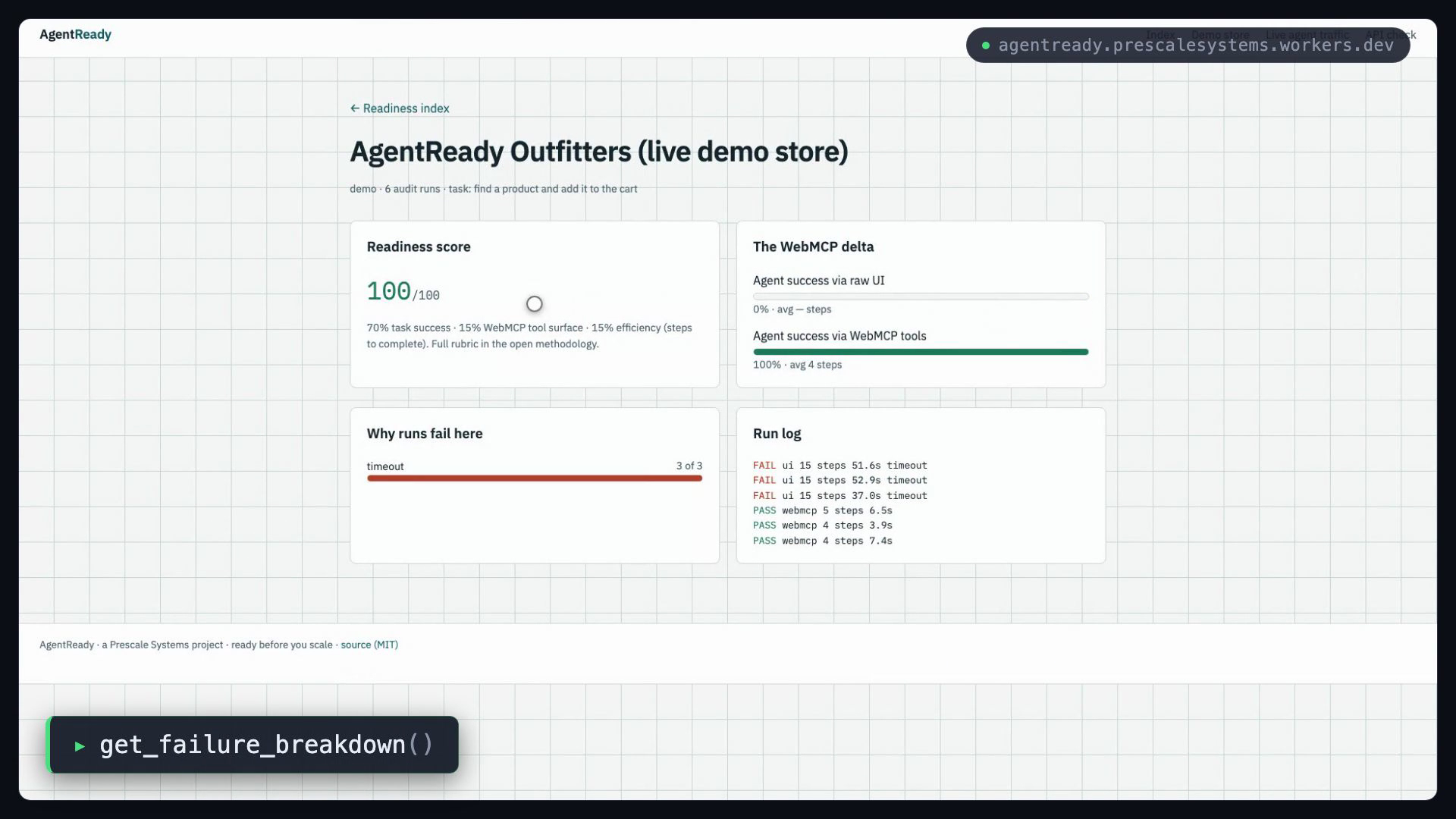
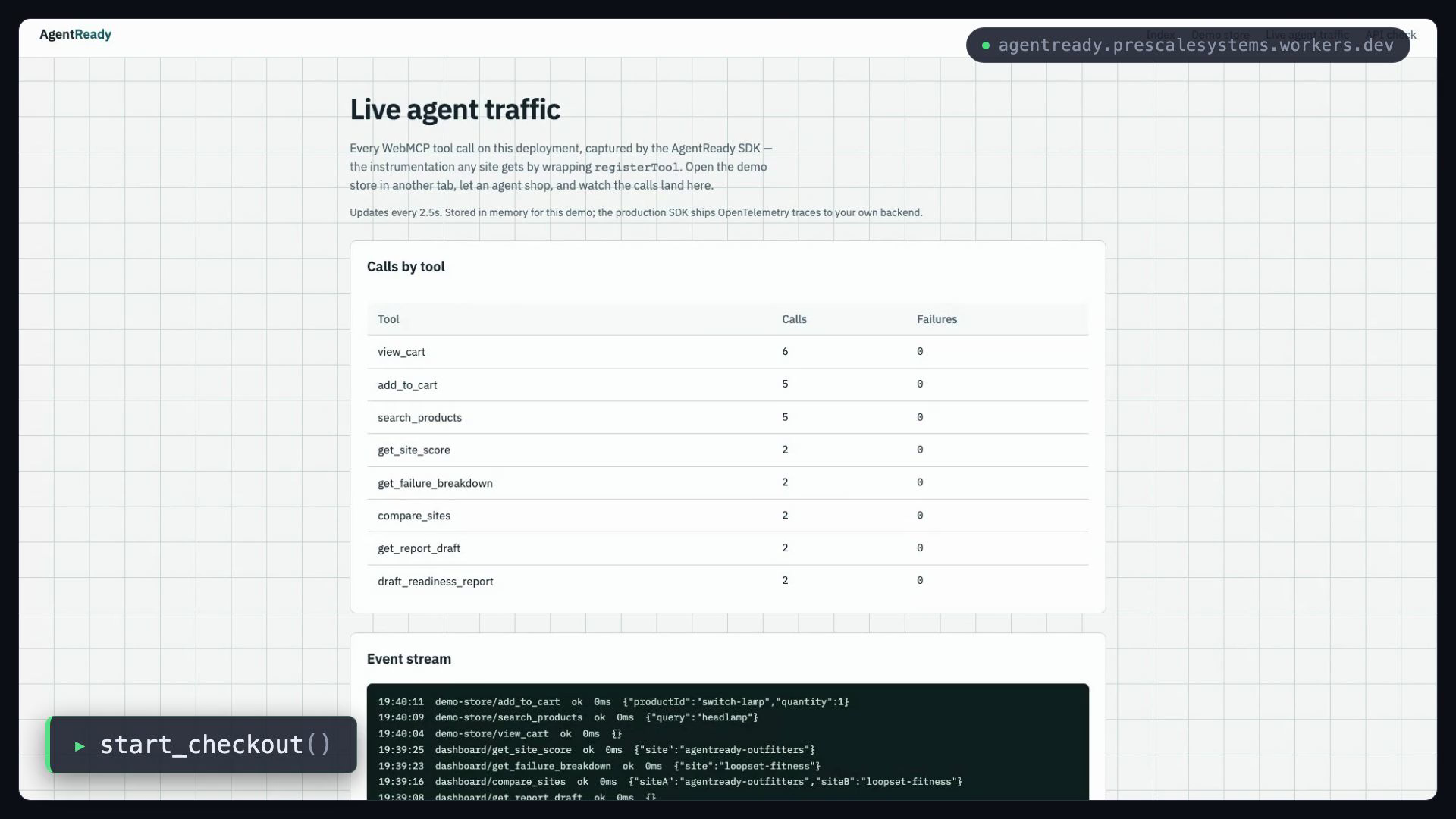
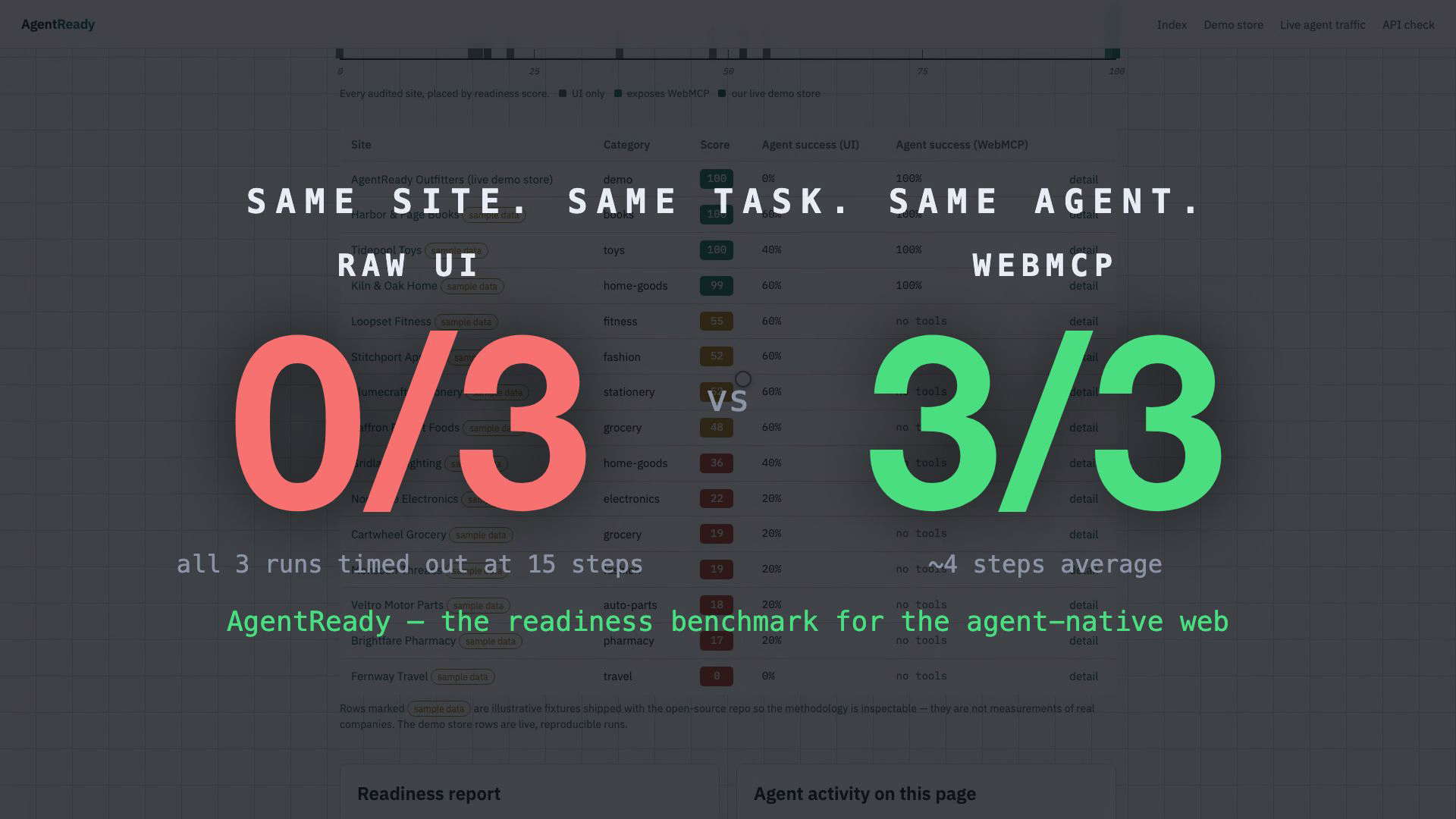
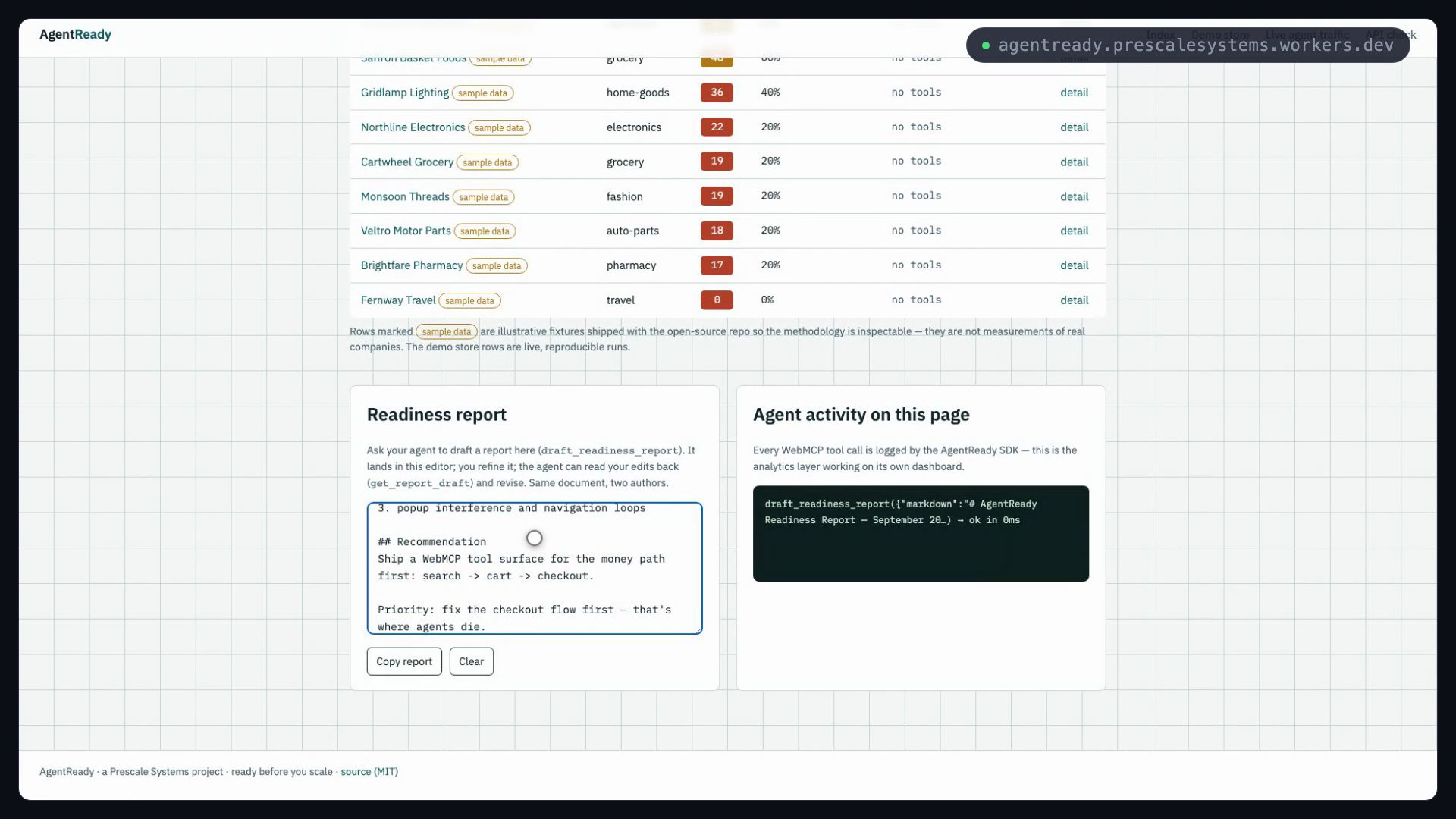
AgentReady is the readiness benchmark for the agent-native web. It runs real AI agents against real task flows on a site twice — once through the raw UI, once through the site's WebMCP tools — and scores the site 0–100 from success rate, tool surface, and steps-to-complete, with a failure taxonomy (auth walls, popups, navigation loops, timeouts) explaining every miss. The benchmark's own dashboard is agent-native: 8 WebMCP tools let your agent query scores, compare sites, and co-write a readiness report with you in a shared on-page editor — it drafts, you edit by hand, and it reads your edits back through a tool before revising. Its queue_live_audit tool triggers a real serverless audit — headless browser, LLM agent, results into the database — that your agent then reads back. A demo store with 5 more tools (one cart shared between human and agent) is the reference implementation, and every tool call on the deployment streams to a live analytics view. Measured result on our own store: raw UI 0/3 (all timed out at 15 steps), WebMCP 3/3 in ~4 steps.
How we built it
Entirely on Cloudflare: the app runs on vinext (the Vite-based Next.js reimplementation) on Workers, D1 stores telemetry and audit results, Queues orchestrates audit jobs, Browser Run provides headless Chrome at the edge, and Workers AI (Llama 3.3 70B) is the audit agent. A small shim (lib/webmcp.ts) registers WebMCP tools via document.modelContext with a navigator fallback, instruments every execution for the live analytics view, and mirrors tools onto a page registry so headless auditors can drive the exact same tool functions. A local Playwright runner audits external sites with confidence intervals; a queue-consumer Worker runs the serverless audits. The demo video was produced by a multi-agent pipeline too: strategy, script, Playwright screen-capture of the live site, Kyutai pocket-tts narration, Veo b-roll, and a Remotion composition.
Challenges we ran into
vinext is explicitly experimental — our first deploys shipped an assets-only Worker (no server code) until we discovered the config needed an explicit main: "vinext/server/fetch-handler". UI-mode audit runs take 12+ minutes, which blew past queue consumer wall-clocks when we batched runs into one message — the fix was one message per run. Workers AI sometimes returns parsed JSON objects where we expected strings, which silently killed our first serverless audits. Browser launch failures burned queue retries without recording anything until we made every failure write a result row. And securing an intentionally unauthenticated API (judges' agents must call it) meant same-origin audit restriction, a daily run budget, and payload caps instead of auth.
Accomplishments that we're proud of
The headline number is measured, not claimed: same site, same task, same agent — 0/3 through the UI, 3/3 through WebMCP. The bidirectional co-writing loop (draft_readiness_report → human edits → get_report_draft reads them back) treats the page as a two-way channel between human and agent, not a tool facade. The benchmark audits its own demo store with one tool call, on camera, in production. And we kept the methodology honest: sample rows are clearly badged as synthetic, the real runs are labeled with their n, and the whole thing is MIT-licensed and reproducible.
What we learned
Agent-readiness is measurable, and the gap is bigger than the discourse suggests — our agent burned 15 steps and still failed on a UI it could clear in 4 steps with tools. A tool surface beats heroic UI parsing every time, and the score gap is the business case in one number. Architecturally: mirroring tools onto a page registry made the site testable by any headless browser, serverless constraints (queue wall-clocks, browser session limits) should shape job design from day one, and honest small-n data presented plainly is more credible than inflated claims.
What's next for Agent Ready
Audit real production sites (with permission) to grow the index into an industry readiness leaderboard. An embeddable "agent-ready score" badge and a CI check so a site's score updates on every deploy. Richer task suites beyond add-to-cart — search, auth flows, form completion, multi-step journeys. Durable Object browser-session pooling to parallelize serverless audits. And opening the instrumentation SDK so any site gets /live-style agent analytics by wrapping registerTool in one line.
Built With
- cloudflare-browser-run
- cloudflare-d1
- cloudflare-queues
- cloudflare-workers
- javascript
- llama-3.3
- node.js
- playwright
- pocket-tts
- react
- remotion
- sqlite
- typescript
- veo
- vinext
- vite
- webmcp
- workers-ai

Log in or sign up for Devpost to join the conversation.