-
-
MongoDB MCP
Inspiration
A2A made agents discoverable. MCP made them operational. Neither gives an agent a price. The A2A spec carries capabilities, skills, and signed identity — but no price field exists anywhere in the agent stack. Marketplaces configure pricing out-of-band, at listing time, in consoles. A consuming agent literally cannot find out what a call costs before making it.
We've spent two weeks building AgentBooks — financial statements, SEC-style filings, and valuations for AI agents. The missing primitive kept being the same one: pricing power. AI compressed product creation from months to days, but capturing value still runs on guesswork. So we built the layer that manufactures it.
What it does
ratecard.dev — paste a repo (GitHub or GitLab, public or OAuth-private) and in ~30 seconds our agent extracts a complete, machine-readable Agent Rate Card: launch price, floor (2x cost), ceiling (value created), and a constant-elasticity demand curve. Every field is always populated — the card is never blank by construction. Point it at a mono-repo and it finds the nested agents and re-prices each one instantly per click (our own monorepo surfaces 40).
The card is a status, not a static file:
- $5, one coffee — a one-off Stripe payment (signature-verified webhook) flips the card from
generatedtoattestedunder a GitHub-verified identity - Proof-of-revenue renewals — show your agent earned for a business this month, next month is free. No proof yet? Another $5 covers the month
- Listing decay — attestation freshness is recomputed at serve time; abandoned cards visibly go
stale. Trust is a mechanism, not a policy - Pre-call discovery — every card serves at
/.well-known/agent-rate-card.jsonas an A2A extension, so any consuming agent can price a call before making it
How we built it (the Google Cloud + MongoDB part)
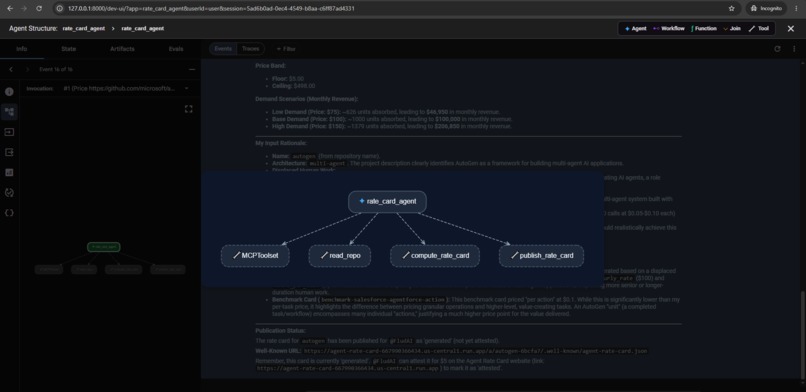
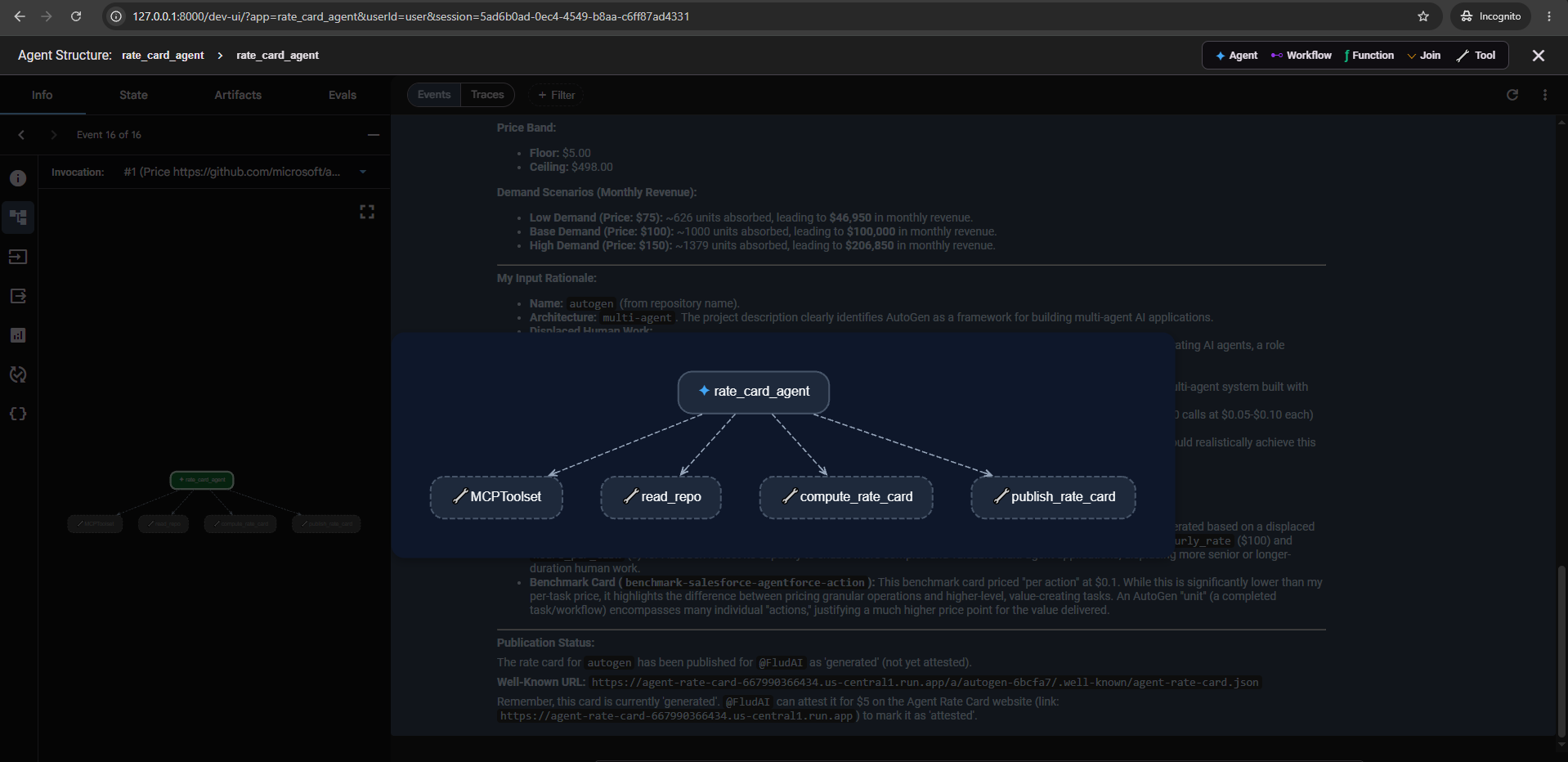
The Rate Card Agent is a Gemini 2.5 Flash agent on Vertex AI, built with ADK 2.2. Its division of labor is the design principle: Gemini reasons - MongoDB grounds - arithmetic prices - Stripe attests.
read_reporeads the target repo's signals- Gemini maps them to economic inputs — and grounds them in a comps corpus queried over MongoDB's MCP server (MongoDB Atlas holding attested cards + citable public benchmarks: Intercom Fin's $0.99/resolution, Salesforce Agentforce's $0.10/action, Sierra's outcome-based pricing)
- The deterministic pricing engine (Cloud Run, 22 conformance tests) computes the card — the LLM never computes a price
- The registry (Firestore) persists attestations; Stripe's webhook confirms payments server-side
Live architecture: https://ratecard.dev/architecture.html
Challenges
- GitLab's MCP server (beta) 404'd trial accounts despite every documented toggle — we pivoted to MongoDB MCP at midnight, which turned out to be the better story: comps grounding was already in our spec. The GitLab toolset ships in the code, env-gated, ready for when their flag opens.
- MCP latency reality: the full reasoning loop takes minutes; our deterministic path answers in milliseconds. We treat the agent as concierge and the API as product — which is why the math was never delegated to the model.
- The one-off vs. subscription trap: a $5 one-time payment risks "I own this forever." We solved it with mechanism, not legal copy — the listing decays without proof. (Patent pending.)
What we learned
Deterministic-first is what makes an economic primitive trustworthy: an LLM that intermittently invents prices would poison the registry. And public pricing without freshness invites adverse selection — the eBay lemons problem — so staleness had to be visible to every consumer by construction.
What's next for Agent Rate Card
The corpus flywheel: every attested card improves the comps grounding for the next agent priced. Card-first, auctions later — the rate card is the reserve-price layer programmatic agent commerce will clear against. Goal: 1M developers monetizing agents for 1M businesses in 12 months.
(c) 2026 Lorenzo Carver All Rights Reserved. Patent Pending.

Log in or sign up for Devpost to join the conversation.