-
-

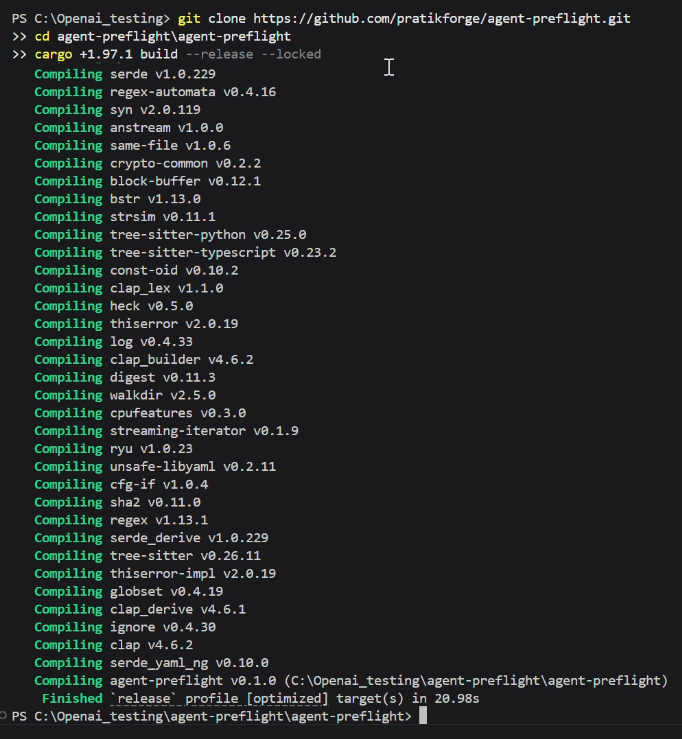
One command installs Agent Preflight. Zero runtime dependencies.
-
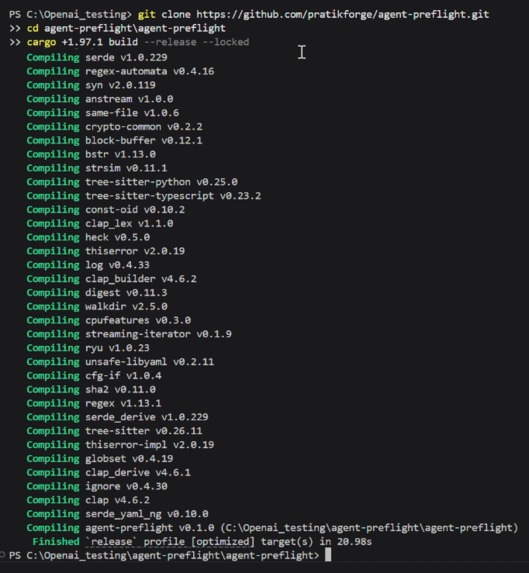
Compiled in Rust — single static binary, every platform.
-

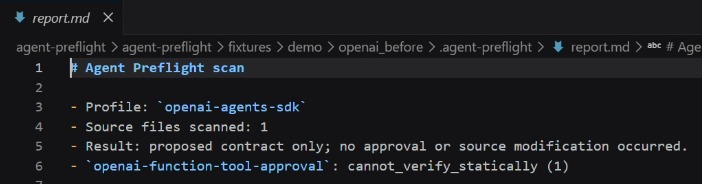
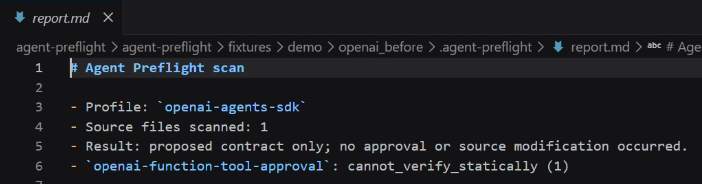
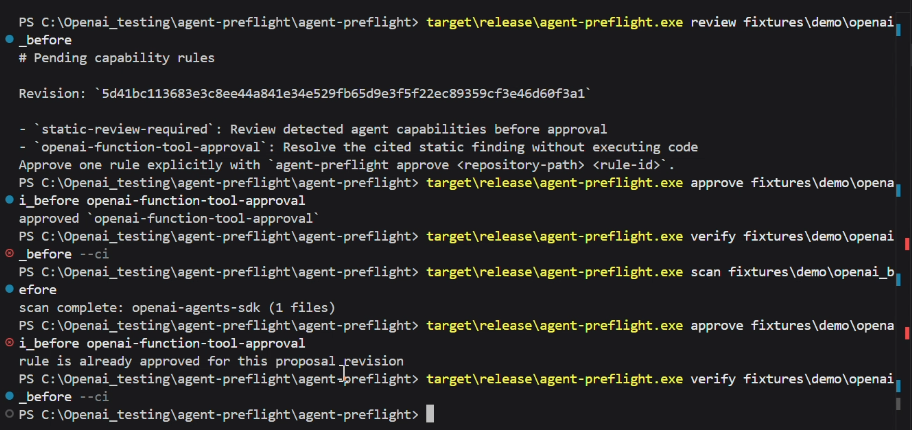
Scan silently parses every tool decorator without executing code.
-
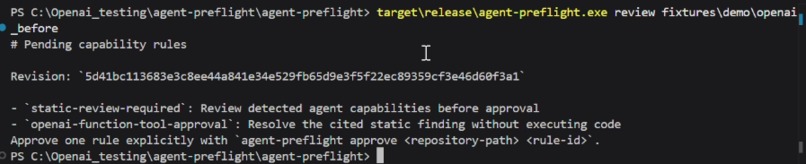
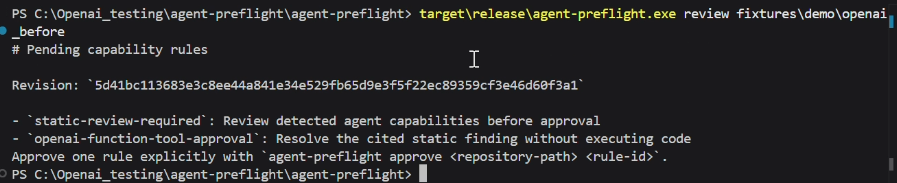
Review surfaces every pending capability rule that needs approval.
-
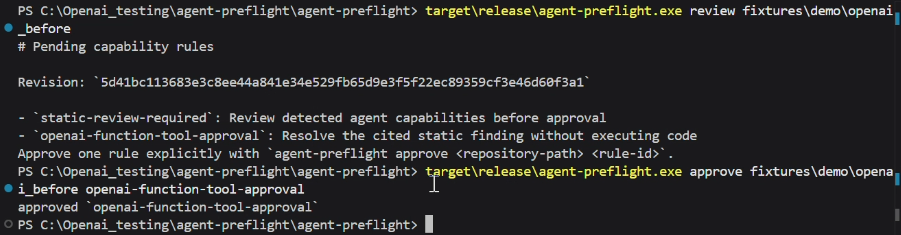
Approve signs the capability contract into the repository.
-
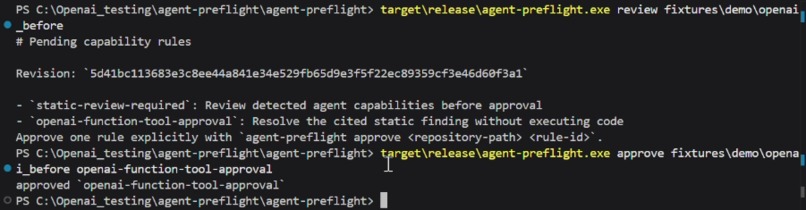
Contract locked. The approved rules are now version-controlled.
-
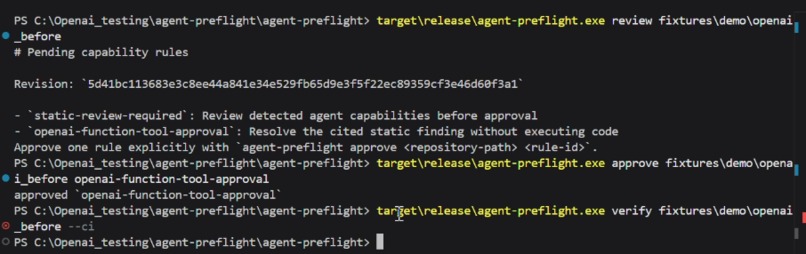
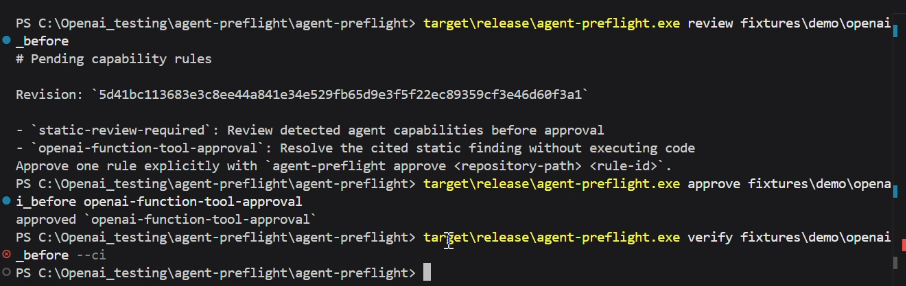
Source drifted from contract. CI exits 1. Pipeline blocked.
-
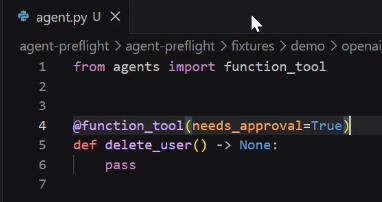
The full scan → approve → verify lifecycle in one terminal.
-
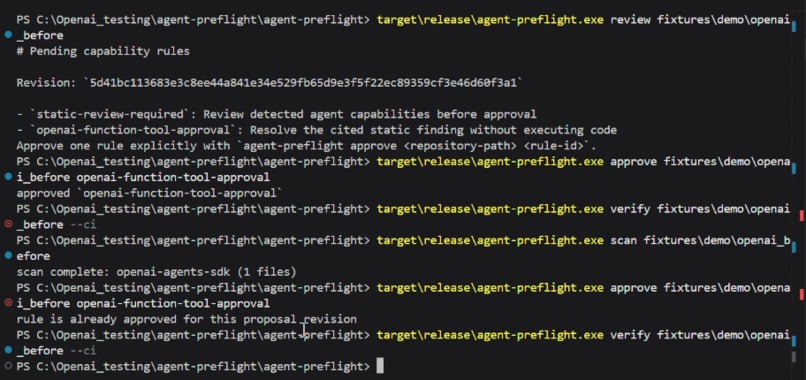
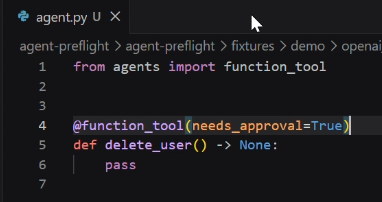
One line added. needs_approval=True. The fix is in source.


Inspiration
No agent framework proves, before deployment, that every high-stakes tool has the safety control its owner intended. Agents ship to production with @function_tool and no human-approval gate. The gap isn't tooling — it's evidence.
What it does
A static-analysis CLI that scans agent codebases and verifies every tool decorator has the approval control its owner approved — without ever executing code.
Scan → Approve → Verify. Three commands. If source code drifts from the approved contract, CI fails. Uncertainty never becomes a green result. Supports OpenAI Agents SDK, Google ADK, and Anthropic Claude.
How we built it
- Rust — zero-dependency, single static binary, cross-platform.
- Tree-sitter — parses Python ASTs directly from source text. No imports, no execution.
- YAML contracts — human-readable, diffable, version-controlled.
- GitHub Actions — 15 test suites across Windows, macOS, and Linux.
- Codex (GPT-5.6) — architecture partner for designing the scan/approve/verify lifecycle.
Challenges we ran into
Making the analyzer deliberately conservative. If it can't prove a control exists, it fails — never guesses. Cross-SDK support was equally hard: OpenAI, Google ADK, and Anthropic each express approval controls in completely different idioms.
Accomplishments that we're proud of
Zero false positives. Sub-second scans. One binary, every platform. 15 CI suites on 3 operating systems — we practiced what we preach.
What we learned
The hardest part of AI safety tooling isn't detection — it's deciding what to do when you're uncertain. We chose to fail loudly. That one decision shaped the entire architecture.
What's next for Agent Preflight
MCP server support, pre-commit hooks, a VS Code extension, and TypeScript/Go framework adapters.


Log in or sign up for Devpost to join the conversation.