-
-
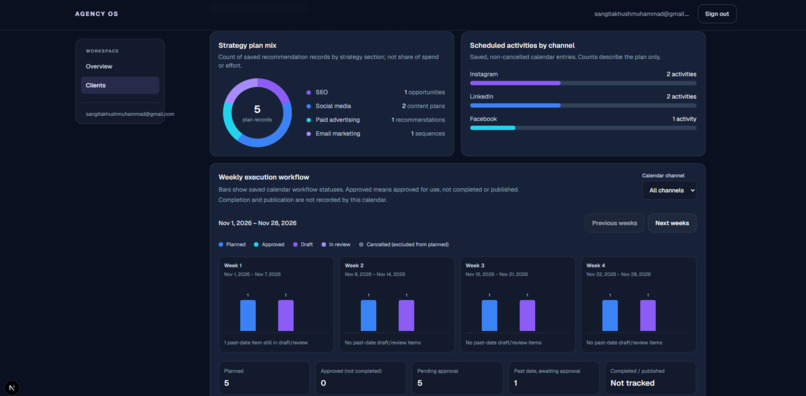
Analysis page
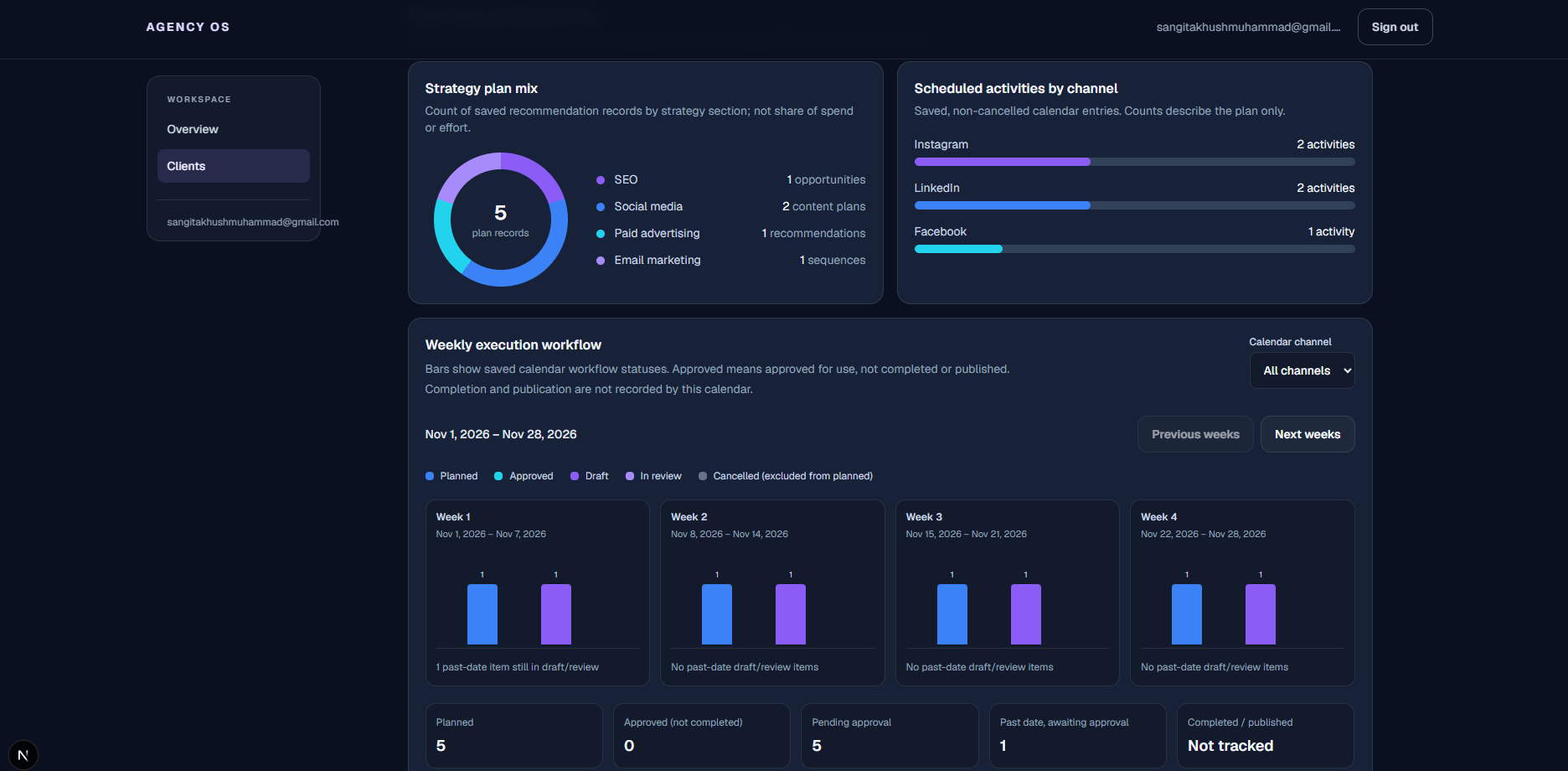
About Agent OS
Inspiration
The inspiration behind Agent OS came from my experience working with web development and digital marketing projects. I noticed that managing multiple clients, understanding their business requirements, developing marketing strategies, planning content, and organizing marketing activities often involves several disconnected tools and a lot of manual work.
Digital marketing agencies need more than just AI-generated captions or content ideas. They need a structured system that understands a client's business, identifies marketing opportunities, and turns business goals into actionable marketing plans.
I wanted to build something that could bring these processes together in one place. That idea became Agent OS — an AI-powered operating system for digital marketing agencies.
What It Does
Agent OS helps marketing agencies transform client requirements into structured marketing strategies and actionable plans.
Users can onboard clients by providing their business information, industry, target audience, competitors, products or services, and marketing objectives.
Based on these details, the platform helps generate:
- Customized digital marketing strategies.
- Structured marketing funnels with stages, objectives, and recommended actions.
- Content calendars with planned topics, platforms, and publishing schedules.
- Multi-channel marketing recommendations.
- Marketing roadmaps and measurable objectives.
- Organized strategy reports and planning analytics.
One important part of Agent OS is that marketers remain in control. They can review, edit, refine, manage strategy versions, and approve AI-generated plans before using them in their actual marketing workflows.
How I Built It
I built Agent OS using a modern full-stack web development architecture.
The frontend is developed with Next.js 16, React, TypeScript, and Tailwind CSS, providing a responsive and organized user experience.
For the backend and data management, I integrated Supabase with PostgreSQL. Supabase Auth handles authentication, while Row Level Security (RLS) helps protect workspace and client data.
I structured the application around agency workspaces, client management, and marketing strategies. I also implemented a strategy workflow that supports creating drafts, managing versions, reviewing generated plans, and recording approvals.
For AI-powered functionality, I integrated an AI strategy-generation workflow that uses client business information to help produce relevant marketing plans rather than generic outputs.
I focused on building the platform in separate modules so that client management, strategy generation, content planning, and analytics could work together as parts of one system.
Challenges I Faced
Building Agent OS was not just about creating an attractive dashboard. One of the biggest challenges was designing a workflow that could turn unstructured client information into useful and organized marketing strategies.
Some of the main challenges included:
1. Structuring Client Information
Every business has different requirements, audiences, competitors, and objectives. I needed to design a flexible client onboarding system that could capture relevant information and provide a useful foundation for strategy generation.
2. AI Strategy Generation
Generating meaningful marketing strategies requires more than sending a simple prompt to an AI model. I had to consider how client information should be organized and how generated results could be structured into funnels, marketing channels, roadmaps, and content plans.
3. Database Architecture and Security
Designing relationships between workspaces, clients, and marketing strategies required careful database planning. Implementing Supabase Row Level Security and handling authenticated user ownership also required additional testing and debugging.
4. Strategy Versioning and Approval
I wanted marketers to have control over AI-generated content. Building a workflow for saving drafts, managing strategy versions, and recording approvals introduced additional complexity.
5. AI Service Reliability
During development, I encountered AI service rate-limit issues and configuration problems. These challenges taught me the importance of handling external service failures and building more reliable application workflows.
What I Learned
Building Agent OS has been a valuable learning experience for me.
I improved my understanding of full-stack SaaS architecture, Next.js App Router, Supabase authentication, PostgreSQL database relationships, Row Level Security, and structured AI integration.
I also learned that building a useful AI product is not simply about connecting an AI API. The real challenge is designing the right workflow around AI, organizing its outputs, allowing human review, and making the results practical for real users.
Most importantly, I learned how to approach a real-world business problem as a product developer: identifying a problem, designing a solution, building its architecture, testing workflows, and improving the user experience.
Future Vision
Agent OS is an evolving project, and my long-term vision is to make it a complete operating system for digital marketing agencies.
Future improvements may include deeper AI-assisted campaign workflows, email marketing management, lead management, team collaboration, performance tracking, and integrations with social media and other marketing platforms.
My goal is to help agencies spend less time managing disconnected marketing tasks and more time creating meaningful growth for their clients.
Agent OS — One Workspace. Smarter Marketing. Better Growth.
Built With
- app-router
- cursor
- git
- github
- google-gemini
- next.js
- postgresql
- react
- supabase
- supabasesql
- tailwind
- typescript
- vs-code

Log in or sign up for Devpost to join the conversation.