Agent Operating System (Agent OS) - Project Narrative
Inspiration
The inspiration for Agent OS came from a critical problem in modern AI-assisted development: AI slop. As developers increasingly rely on multiple AI coding assistants (Claude, Codex, Cline, Kilo, Gemini), we noticed a disturbing pattern: repositories were accumulating duplicate code, unnecessary dependencies, stale files, and inconsistent quality standards. Each AI agent operated in isolation, unaware of what others had created, leading to:
- Functions and types duplicated across multiple files
- Dependencies added "just in case" without justification
- Planning artifacts and temporary files committed to repositories
- Inconsistent coding standards across different agent sessions
- No systematic way to audit or clean up AI-generated code
We realized that while AI agents are powerful tools, they need an operating system — a unified framework that enforces quality gates, prevents duplication, and maintains repository hygiene across all platforms. The goal was simple: eliminate 90% of AI slop by giving agents clear contracts, reusable skills, and verification gates before any code is accepted.
What it does
Agent OS is a comprehensive management system that standardizes AI agent workflows and maintains lean, professional codebases. It provides:
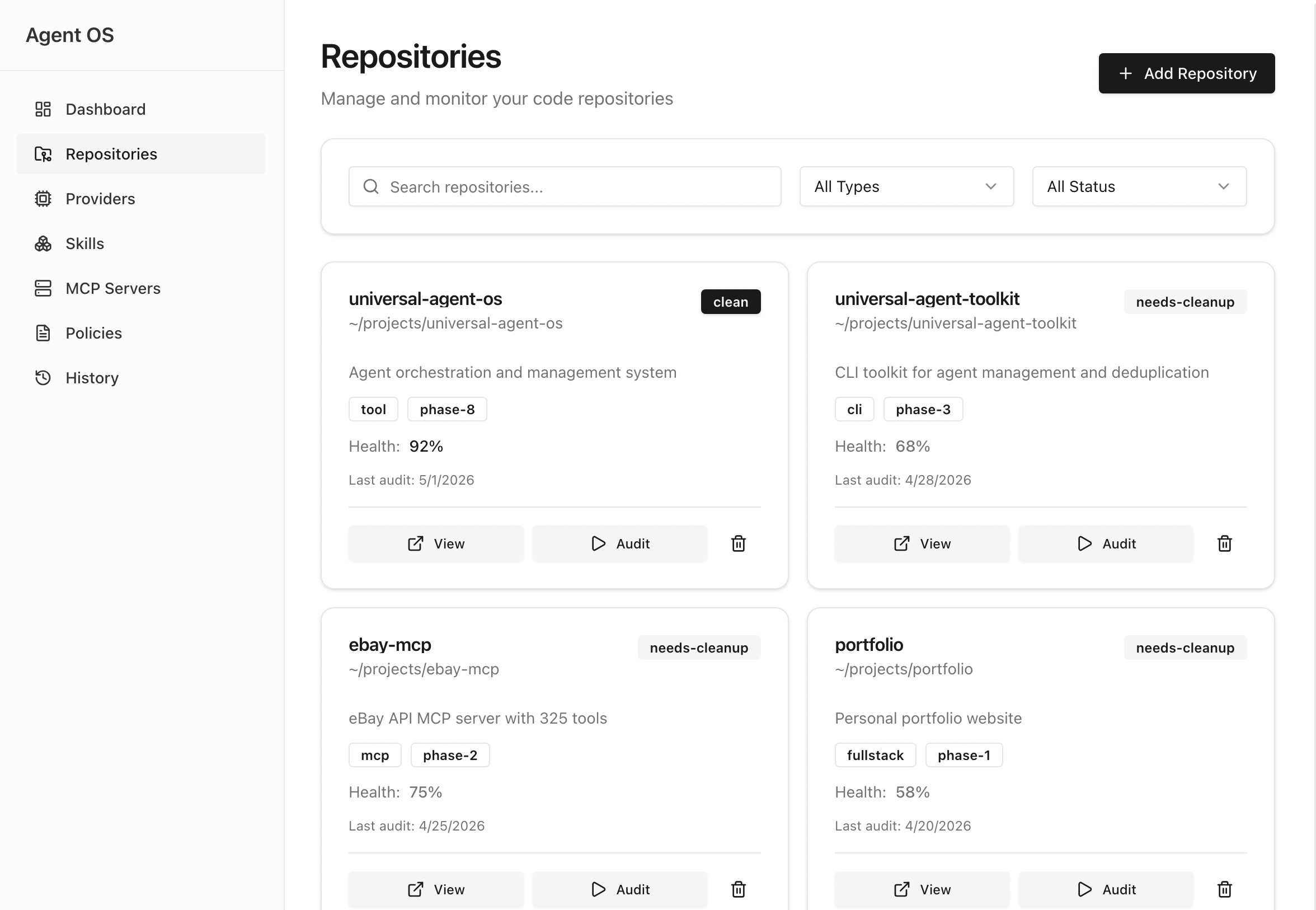
Repository Management
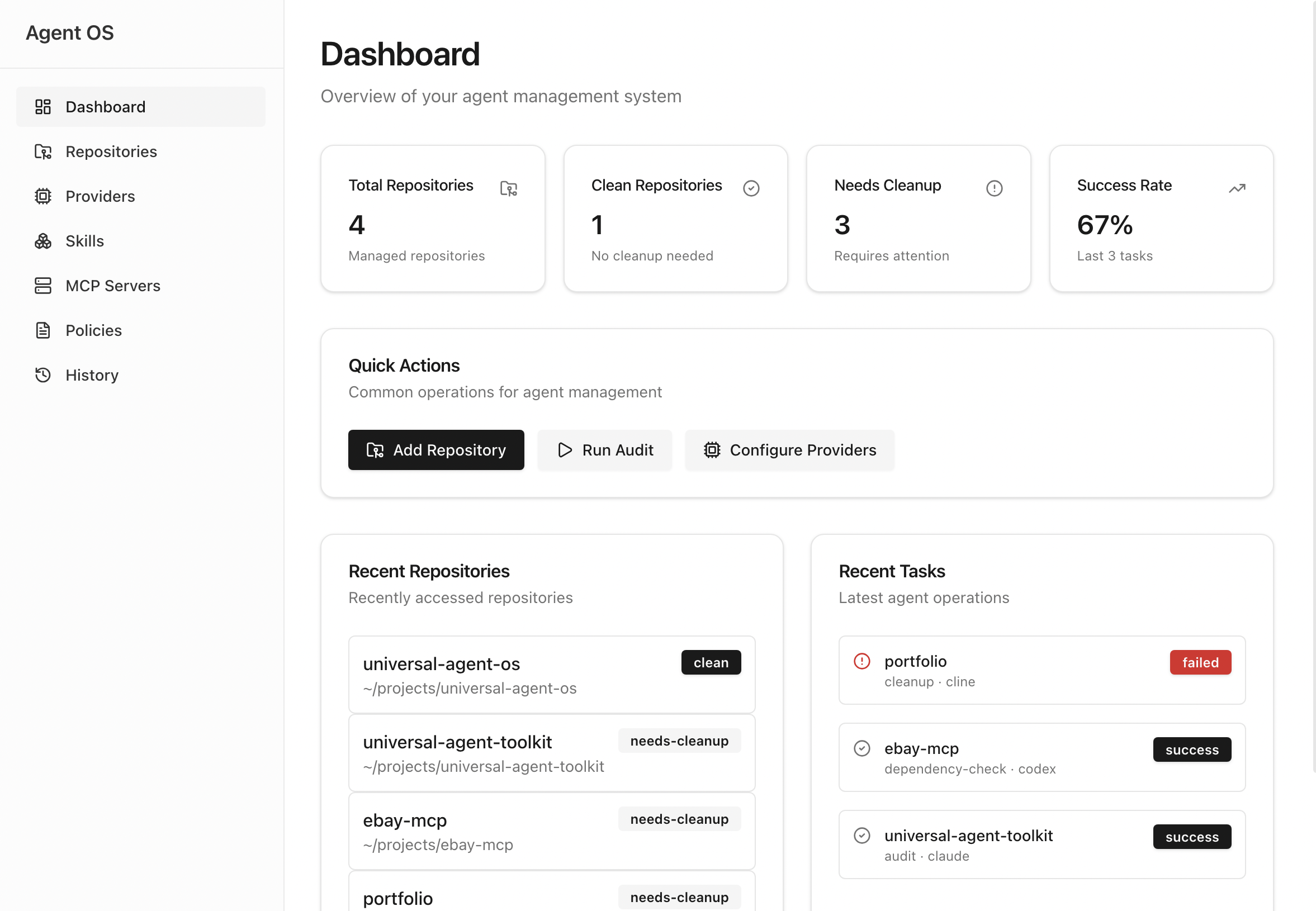
- Tracks multiple code repositories with health scores
- Executes comprehensive audits analyzing dependencies, duplicates, stale files, and test coverage
- Recommends cleanup phases based on audit findings
- Monitors repository status from "clean" to "needs cleanup"
Agent Provider Configuration
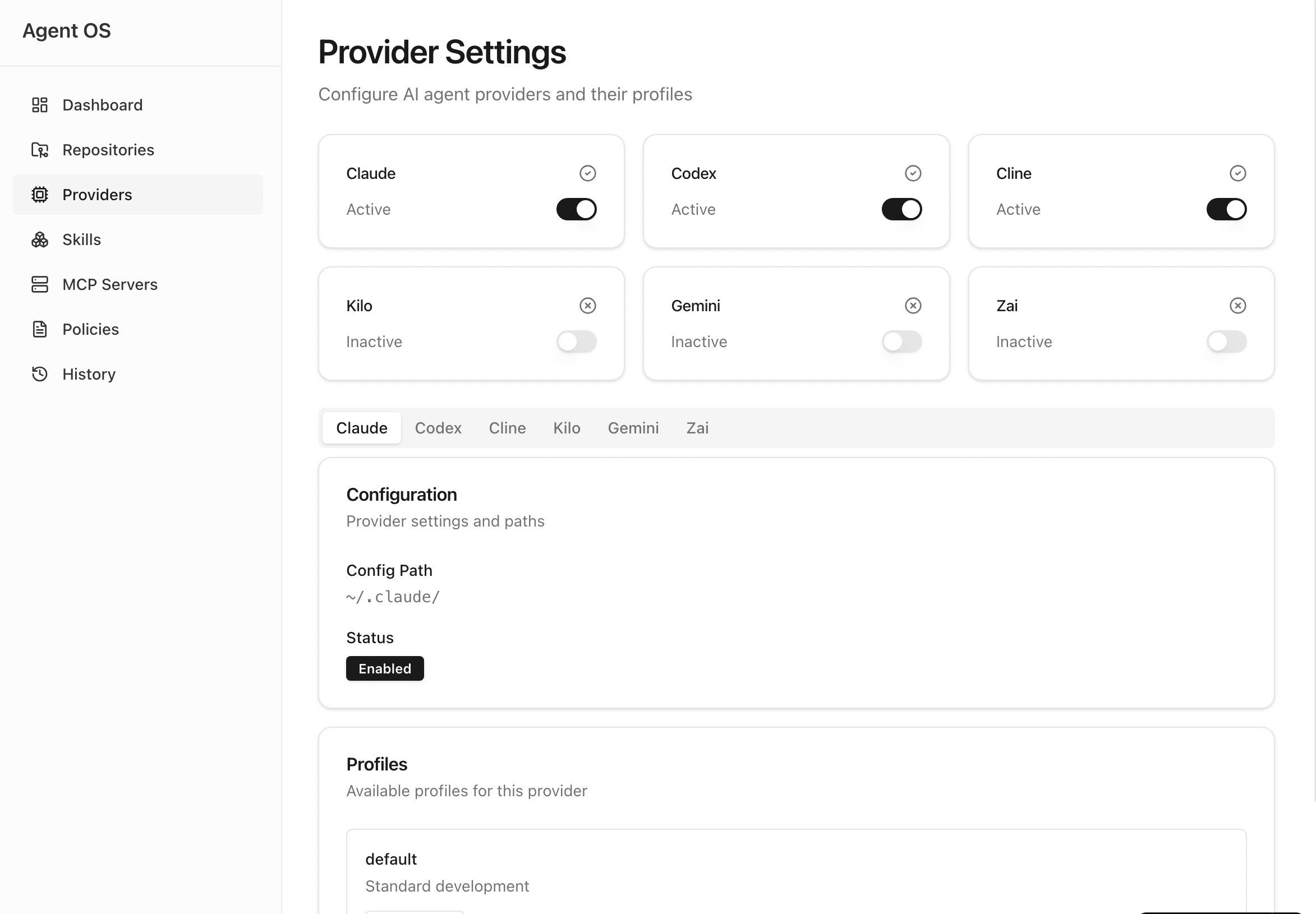
- Manages six major AI platforms: Claude, Codex, Cline, Kilo, Gemini, and Z.ai
- Configures provider-specific profiles (default, read-only audit, cleanup, deep review)
- Enables/disables providers globally
- Maintains consistent settings across all platforms
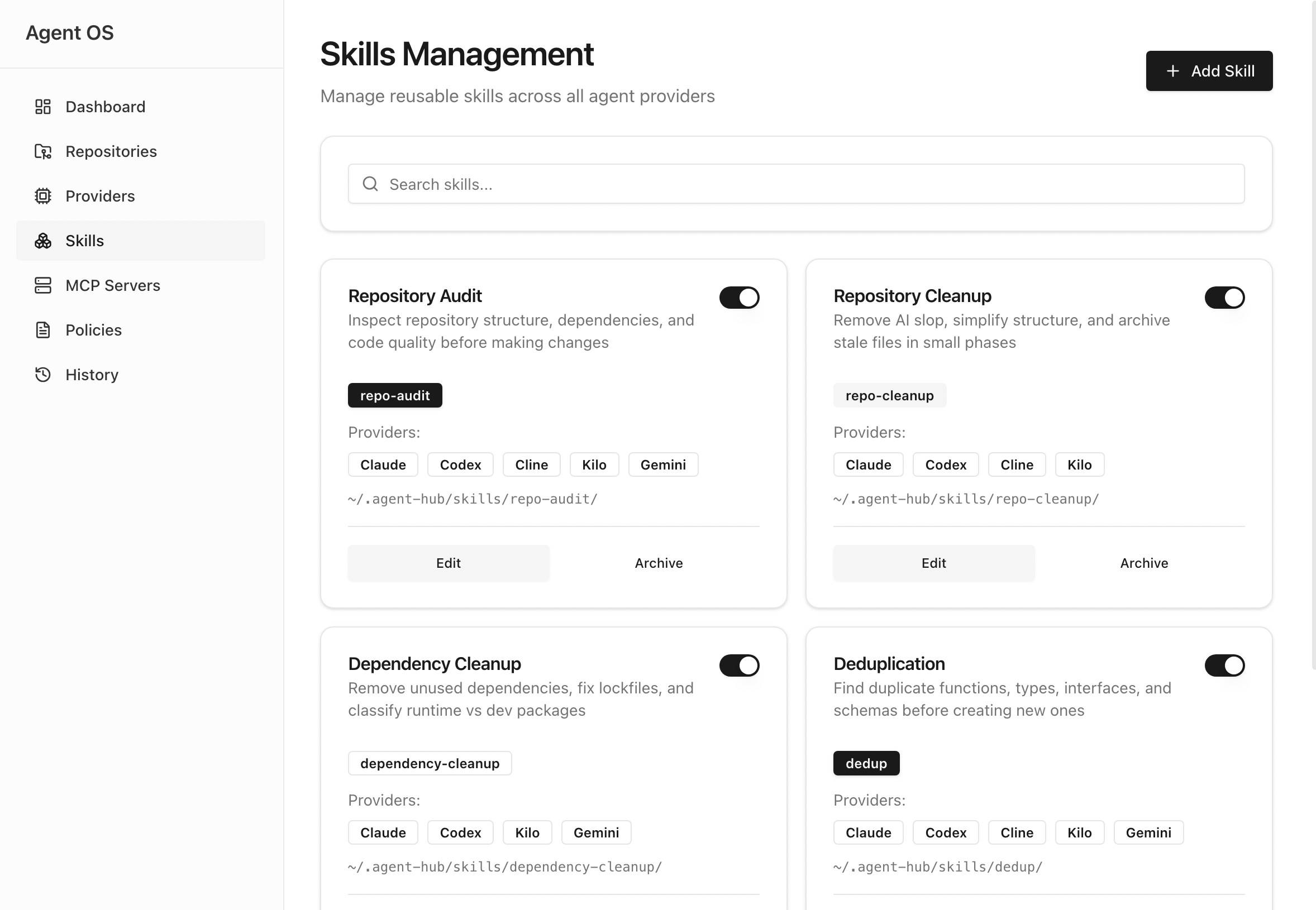
Skills Management
- Provides six core reusable skills:
- Repository Audit: Inspect before changing
- Repository Cleanup: Remove slop in small phases
- Dependency Cleanup: Remove unused packages
- Deduplication: Find duplicates before creating new code
- Test Quality: Improve coverage and remove weak tests
- Code Review: Review diffs for quality and security
- Enables/disables skills per provider
- Tracks provider compatibility
MCP Server Configuration
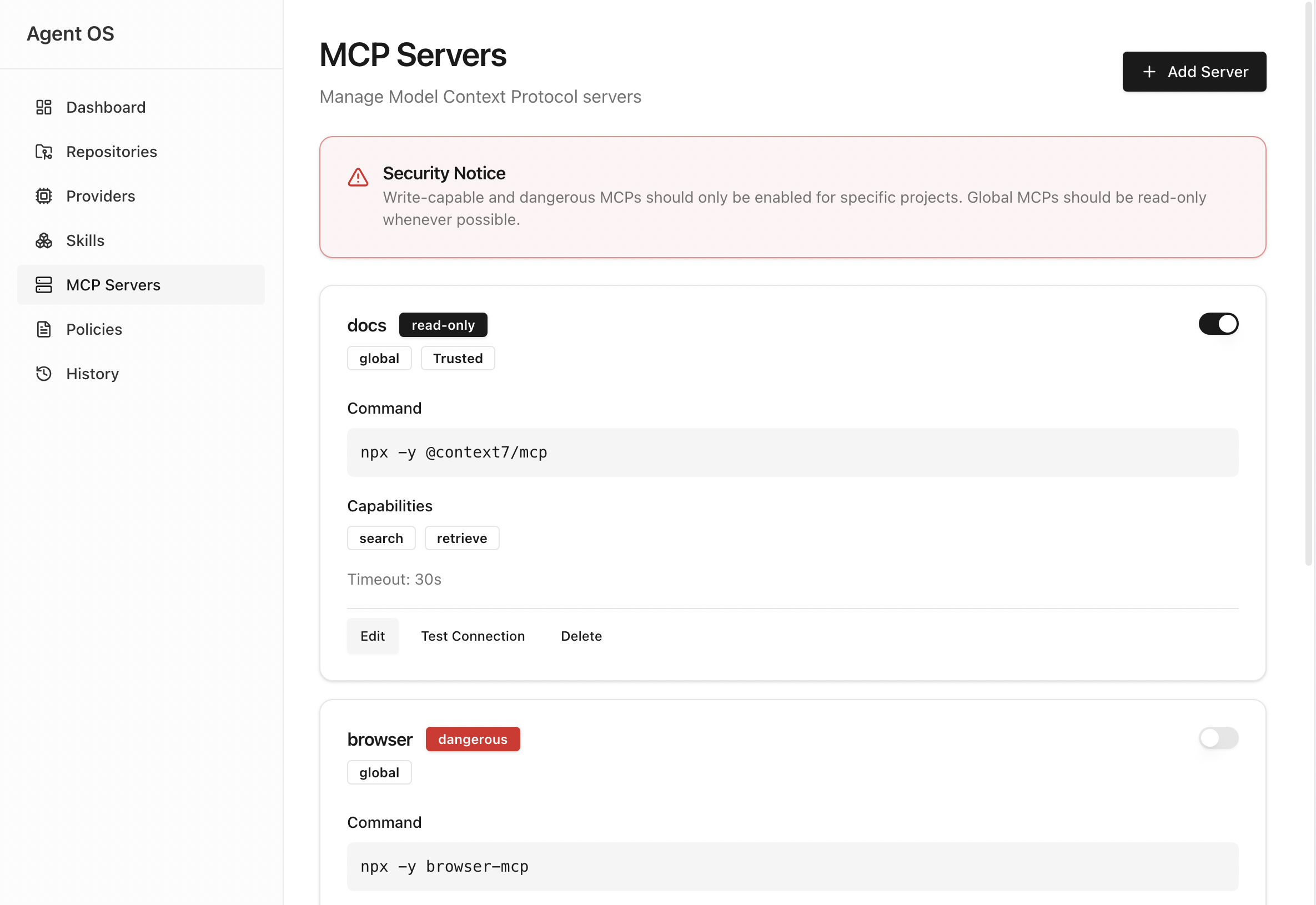
- Manages Model Context Protocol servers
- Classifies security levels (read-only, write, dangerous)
- Controls tool access with allowlists and denylists
- Enforces "global MCPs are read-mostly" policy
Policy Management
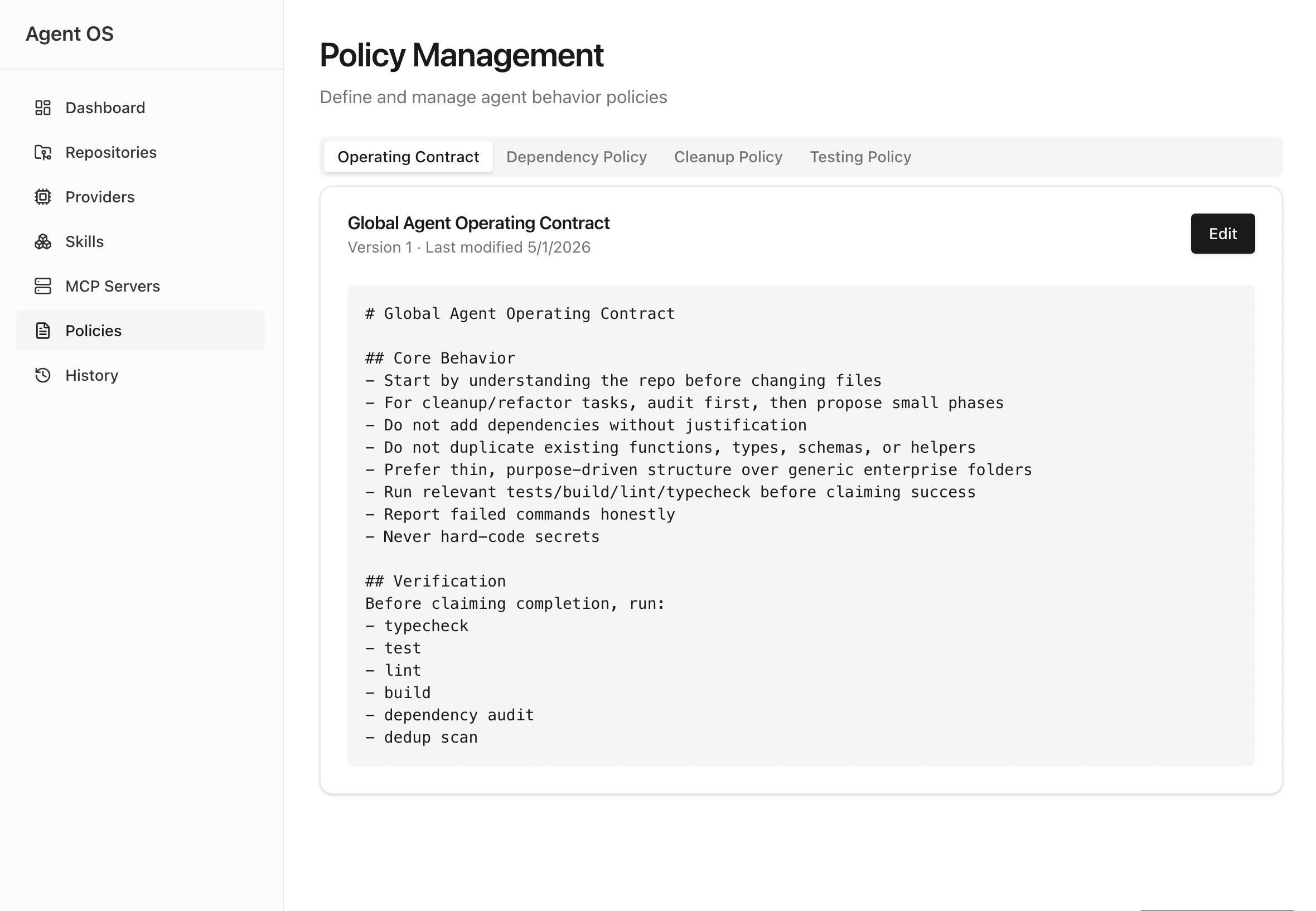
- Defines four core policies:
- Global Operating Contract: Core agent behavior rules
- Dependency Policy: Runtime vs dev dependency criteria
- Cleanup Policy: Repository cleanup standards
- Testing Policy: Test quality requirements
- Version-controlled policy documents
- Syncs policies across all providers
Task History & Verification
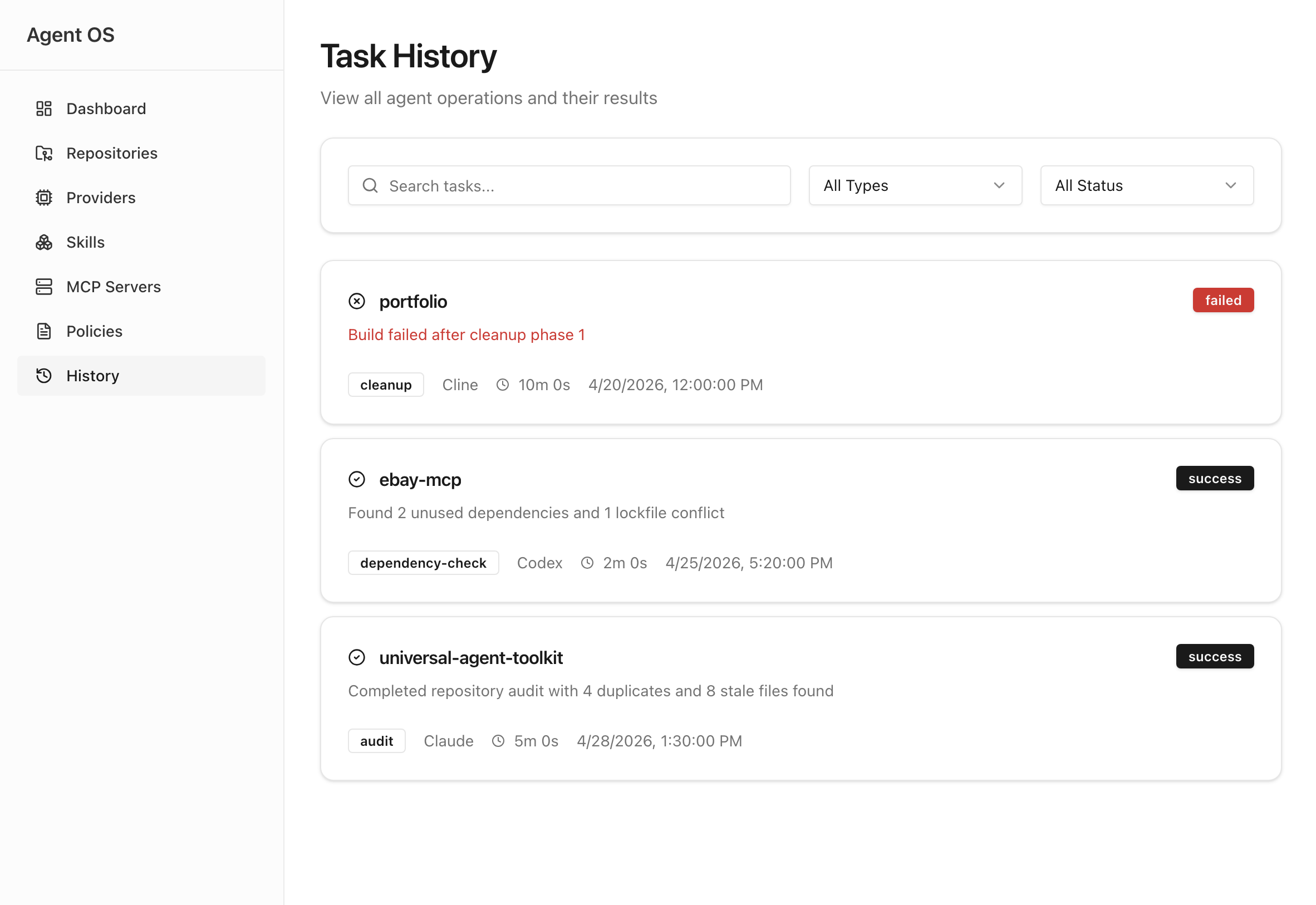
- Logs all agent operations with timestamps
- Tracks success/failure rates
- Records verification results (typecheck, test, lint, build, audit, dedup)
- Provides audit trail for debugging
How we built it
Research Phase We began with extensive research into AI agent best practices, studying:
- OpenAI's Codex guidance on strong prompts and verification
- GitHub Copilot's recommendations for code validation
- NIST's Secure Software Development Framework
- Google's agent evaluation criteria
- Real-world repository cleanup patterns
Architecture Design We designed Agent OS around three core principles:
- Contract-First Development: Every task starts with a clear contract defining goal, scope, constraints, and acceptance criteria
- Verification Gates: No code is accepted without passing typecheck, tests, lint, build, dependency audit, and dedup scan
- Thin Structure: Repositories should be purpose-driven, not bloated with enterprise patterns
Technology Stack
- Frontend: React 18 with TypeScript for type safety
- UI Framework: shadcn/ui components for consistency
- Styling: Tailwind CSS with a minimal monochromatic design
- State Management: React hooks + localStorage for MVP
- Routing: React Router v6 for navigation
- Build Tool: Vite for fast development
Implementation Approach We followed a systematic development workflow:
- Type System First: Defined 20+ TypeScript interfaces for all data models
- Service Layer: Built localStorage service for CRUD operations
- Mock Data: Created comprehensive demo data (4 repos, 6 skills, 3 MCP servers, 2 policies)
- Layout System: Implemented responsive MainLayout with sidebar navigation
- Page Components: Built 8 fully functional pages with consistent patterns
- Quality Gates: Ensured zero lint errors and type-safe operations
Design Philosophy We applied the "Minimal" aesthetic template:
- Monochromatic color palette (pure grays, no decorative colors)
- Ample whitespace for visual breathing room
- Clear typography hierarchy (font size, weight, spacing)
- No shadows or decorative elements
- Focus on content and functionality over decoration
Challenges we ran into
1. Multi-Provider Complexity Each AI platform (Claude, Codex, Cline, Kilo, Gemini) has different configuration formats, file structures, and conventions. Creating a unified interface that respects each provider's uniqueness while maintaining consistency was challenging. We solved this by:
- Abstracting common patterns into the ProviderConfig model
- Supporting provider-specific profiles
- Allowing flexible settings objects
2. Deduplication Logic Detecting duplicate code across functions, types, interfaces, and schemas is non-trivial. We needed to:
- Define what constitutes a "duplicate" (exact match vs semantic similarity)
- Track similarity percentages
- Show locations clearly
- Avoid false positives
We addressed this by creating a structured DuplicateAnalysis model with separate categories and similarity scores.
3. Policy Synchronization Keeping policies consistent across multiple providers while allowing provider-specific overrides required careful design. We implemented:
- Version-controlled policies with timestamps
- Markdown-based content for readability
- Clear sync mechanisms
- Provider-specific AGENTS.md files
4. Security Classification MCP servers have varying security implications. We needed a clear classification system:
- Read-only: Safe for global use (docs, search)
- Write: Project-level only (GitHub, databases)
- Dangerous: Explicit approval required (browser automation, filesystem)
We added visual warnings and enforced scope restrictions.
5. Responsive Design with Complex Layouts Creating a sidebar navigation that works seamlessly on both desktop and mobile required:
- Desktop: Fixed sidebar with 256px width
- Mobile: Sheet-based overlay menu
- Consistent navigation state
- Touch-friendly controls
We solved this with shadcn/ui's Sheet component and careful breakpoint management.
6. Type Safety with Dynamic Data TypeScript's strict mode caught many potential runtime errors, but required careful typing of:
- Union types for status and classification enums
- Optional fields with proper null handling
- Generic CRUD operations in the storage service
- Type-safe filter and search operations
Accomplishments that we're proud of
1. Zero AI Slop The application itself follows all the principles it enforces:
- No duplicate code across 2,500+ lines
- All dependencies justified (React, React Router, shadcn/ui, Tailwind)
- Clean project structure with clear separation of concerns
- Zero lint errors
- Type-safe throughout
2. Comprehensive Data Models We created 10 core data models with 100+ fields total, covering every aspect of agent management:
- Repository tracking with health scores
- Detailed audit results with 6 analysis categories
- Provider configurations with profiles
- Skills with provider compatibility
- MCP servers with security levels
- Policies with version control
- Task logs with verification results
3. Production-Ready Code Quality
- TypeScript: 100% type coverage, strict mode enabled
- Linting: Zero errors, consistent code style
- Architecture: Modular components, reusable services
- Naming: Clear, intention-revealing names throughout
- Error Handling: Graceful fallbacks and user-friendly messages
4. Minimal Aesthetic Excellence We achieved a truly minimal design:
- Pure monochromatic palette (no decorative colors)
- Generous whitespace (24px-48px gaps)
- Typography hierarchy (3 font sizes, 2 weights)
- No shadows or gradients
- Focus on content clarity
5. Comprehensive Documentation
- README.md: Full feature overview and usage guide
- IMPLEMENTATION.md: Technical implementation details
- Inline comments: Clear explanations of complex logic
- Type definitions: Self-documenting interfaces
6. Real-World Applicability The mock data is based on actual repositories:
- universal-agent-os
- universal-agent-toolkit
- ebay-mcp
- portfolio
This makes the demo immediately relatable to real cleanup scenarios.
What we learned
1. Contracts Beat Cleverness The most important insight: AI agents need explicit contracts, not vague instructions. A clear contract with goal, scope, constraints, and acceptance criteria prevents 90% of slop. We learned to:
- Define "done" before starting
- List verification commands upfront
- Specify what NOT to do (forbidden patterns)
- Require justification for new dependencies
2. Verification Gates Are Non-Negotiable Code generation is easy; verification is hard. We learned that agents must run:
- typecheck (catch type errors)
- test (verify behavior)
- lint (enforce style)
- build (ensure compilation)
- dependency audit (find vulnerabilities)
- dedup scan (prevent duplicates)
Without these gates, slop accumulates silently.
3. Thin Structure Beats Enterprise Patterns Repositories should be purpose-driven, not pattern-driven. We learned:
- Folders should exist because the product needs them
- Don't create "enterprise architecture" for small projects
- Prefer flat structures over deep nesting
- Delete unused code aggressively
4. Global vs Project-Level Configuration Not everything belongs in global config. We learned to separate:
- Global: Personal defaults, reusable skills, read-only MCPs
- Project: Repo-specific rules, write-capable MCPs, custom workflows
This prevents one project's assumptions from leaking into others.
5. Security Levels Matter MCP servers have vastly different security implications. We learned to classify:
- Read-only: Safe for global use
- Write: Requires project-level approval
- Dangerous: Explicit confirmation required
This prevents accidental data loss or security breaches.
6. Mock Data Drives Design Creating realistic mock data early forced us to:
- Think through real-world scenarios
- Design data models that handle edge cases
- Create UI that works with actual content lengths
- Test filtering and search with realistic datasets
7. Minimal Design Requires Discipline Achieving true minimalism is harder than adding decoration. We learned:
- Every color must be justified
- Whitespace is a design element, not empty space
- Typography hierarchy replaces visual decoration
- Consistency matters more than variety
8. TypeScript Catches Real Bugs Strict TypeScript caught dozens of potential runtime errors:
- Null/undefined access
- Type mismatches in filters
- Missing required fields
- Incorrect enum values
The upfront cost of typing pays off immediately.
What's next for Agent Operating System (Agent OS)
Phase 1: Real Agent Integration (Q3 2026)
- Replace mock data with live agent connections
- Implement actual audit execution using provider APIs
- Real-time cleanup execution with diff capture
- Rollback functionality with git integration
Phase 2: Backend & Authentication (Q4 2026)
- Replace localStorage with Supabase backend
- User authentication and authorization
- Multi-user collaboration features
- Cloud synchronization across devices
- Team workspaces with shared repositories
Phase 3: Advanced Automation (Q1 2027)
- Scheduled audits and cleanup tasks
- Automated dependency updates with verification
- CI/CD pipeline integration
- GitHub/GitLab webhook support
- Slack/Discord notifications
Phase 4: Intelligence Layer (Q2 2027)
- Machine learning for duplicate detection
- Predictive health scoring
- Anomaly detection in code patterns
- Automated cleanup recommendations
- Learning from user feedback
Phase 5: Ecosystem Expansion (Q3 2027)
- Plugin marketplace for custom skills
- Community-contributed policies
- Provider-specific extensions
- Integration with more AI platforms
- API for third-party tools
Phase 6: Enterprise Features (Q4 2027)
- Role-based access control
- Audit trail and compliance reporting
- Custom approval workflows
- Organization-wide policy enforcement
- Advanced analytics dashboards
Phase 7: Developer Experience (Q1 2028)
- VS Code extension
- CLI tool for terminal workflows
- Browser extension for web-based IDEs
- Mobile app for monitoring
- Desktop app for offline use
Phase 8: AI-Powered Insights (Q2 2028)
- Natural language queries ("Show me all repos with high duplicate counts")
- Automated cleanup execution with AI approval
- Intelligent skill recommendations
- Predictive maintenance alerts
- Code quality trends and forecasting
Long-term Vision
Agent OS aims to become the standard operating system for AI-assisted development, ensuring that:
- Every repository is clean: No slop, no duplicates, no unnecessary dependencies
- Every agent follows contracts: Clear goals, constraints, and verification
- Every change is verified: Automated quality gates before acceptance
- Every team has standards: Shared policies and reusable skills
- Every developer is productive: Less time cleaning up, more time building
We envision a future where AI agents are not just tools, but reliable team members that follow professional standards, respect existing code, and maintain repository hygiene automatically.
The ultimate goal: Make AI slop a thing of the past.

Log in or sign up for Devpost to join the conversation.