Inspiration
Every day, AI agents are being deployed into production systems with direct access to emails, databases, code repositories, and cloud services. But the security model for these agents is still dangerously immature — agents execute actions with no oversight, no risk classification, and no way for users to know what credentials are being exposed.
We built Agent Lock because we believe no AI agent should act without human oversight on high-risk operations, and no agent should ever touch raw credentials.
What it does
Agent Lock is a security and governance middleware that sits between any AI agent and the tools it uses. It works in two integration modes:
- MCP Gateway — proxies any MCP server and exposes its own secure broker tools. Compatible with Claude Desktop, ChatGPT, Cursor, Windsurf, and any MCP-compatible AI client — not tied to any single AI provider.
- OpenClaw Plugin — native
before_tool_callhook for OpenClaw agents.
Both modes share the same governance backend deployed on Azure.
Core capabilities
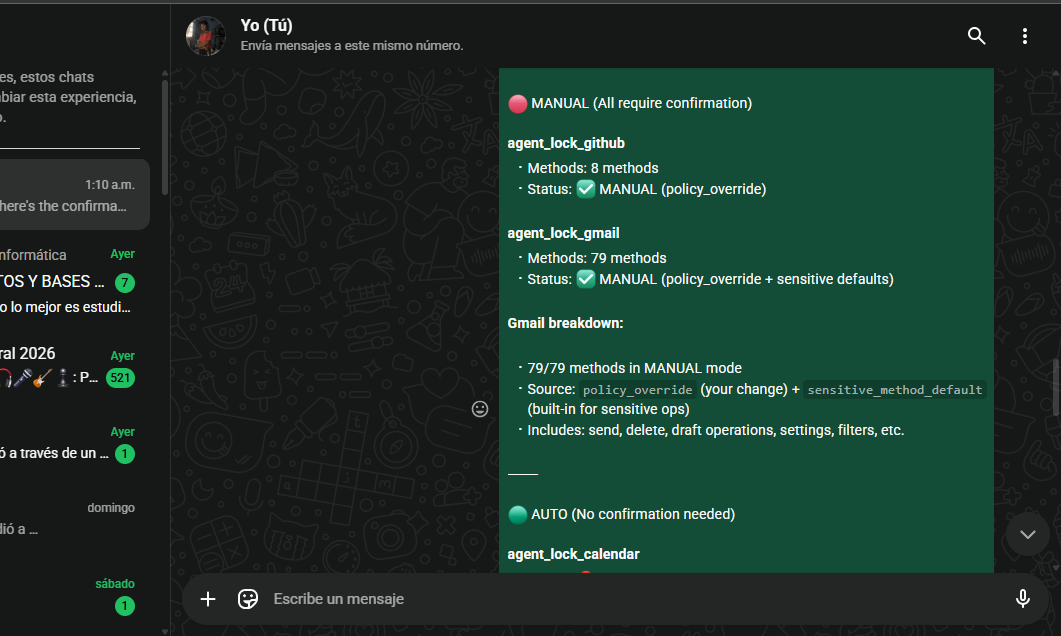
- Intercepts every tool call made by the agent and routes it through the governance layer before execution
- Classifies risk using static regex policies + Gemini 2.0 Flash AI intent validation — comparing what the agent does vs what the user asked for
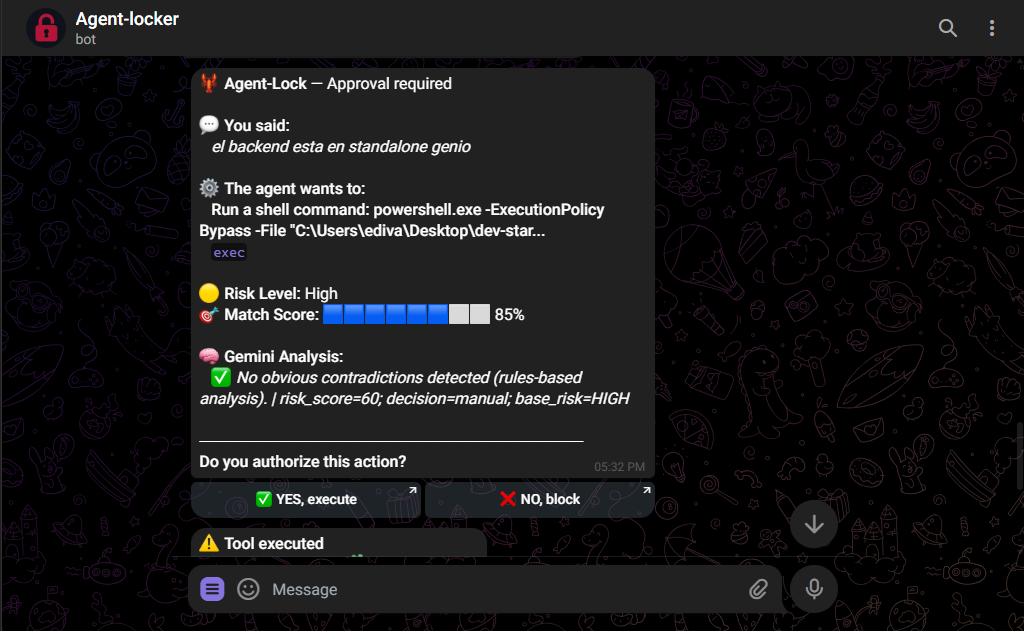
- Auto-approves LOW risk actions instantly; halts HIGH/CRITICAL actions with a full Telegram alert and waits for human ✅/❌ approval
- Fail-closed by design — if the backend is unreachable, all agent actions are blocked by default, never silently allowed
- Full audit trail — every decision (approved, blocked, timed out) is logged with timestamp, risk level, Gemini's semantic analysis, and decision source (auto or human)
Auth0 Token Vault — Broker Mode
This is the core of Agent Lock's security model. Rather than passing credentials to agents, Agent Lock exposes its own first-party secure tools that agents call directly:
| Tool | What it does |
|---|---|
vault/google/gmail/send |
Send email via Gmail — agent never sees the token |
vault/github/issues/create |
Create GitHub issues securely |
vault/slack/messages/send |
Send Slack messages without exposing credentials |
vault/google/calendar/events |
Create Google Calendar events securely |
For each call, Agent Lock:
- The user authenticates once via Auth0 Universal Login
- Agent Lock intercepts the agent's tool call request
- The backend exchanges the user's Auth0 session for a scoped, short-lived
federated token using Token Vault's grant type:
urn:auth0:params:oauth:grant-type:token-exchange:federated-connection-access-token - Agent Lock calls the provider API server-side (broker mode)
- The agent receives only the result — never the credential
This means AI agents are permanently decoupled from raw credentials at the infrastructure level, not the application level.
Next.js Dashboard
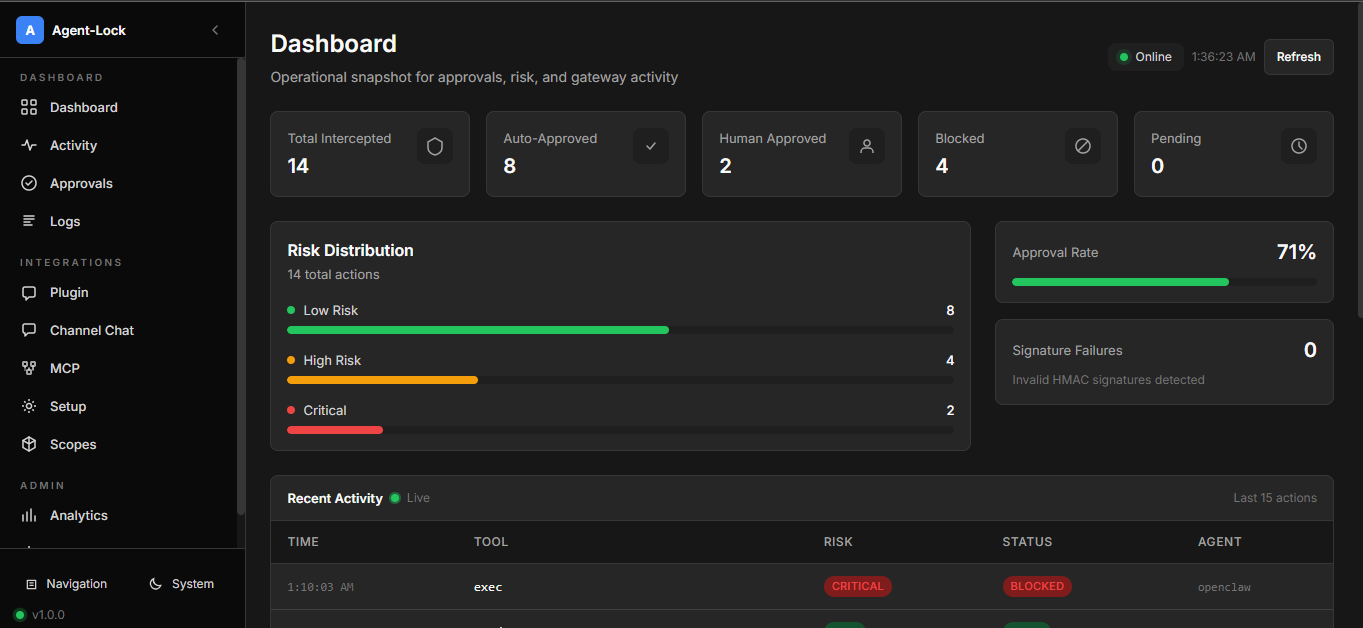
A real-time control panel that shows:
- Live activity stream of all agent tool calls
- Risk classification for each action
- Pending approvals queue
- Audit log viewer with CSV/JSON export
- Policy editor for custom risk rules
- MCP server manager
- Token Vault connection status per provider
How we built it
Backend: FastAPI (Python) deployed on Azure Web Apps, with SQLite persistence for pending actions that survive backend restarts. The backend exposes a full REST API consumed by both integration modes.
Risk Engine: Two-layer classifier:
- Static
policies.jsonrules with regex patterns for instant classification of known dangerous patterns (shell destruction, DB drops, file deletion) - Gemini 2.0 Flash for semantic intent validation — catches cases where the agent's action contradicts what the user actually asked for
Auth: Full Auth0 PKCE flow with Token Vault federated connection exchange
using the federated-connection-access-token grant type. Implemented broker
endpoints for Gmail, GitHub, Slack, and Google Calendar.
HITL Channel: Telegram bot with approve/reject inline keyboard buttons, deduplication to prevent notification spam, re-notify cooldown, and fail-closed timeout (if no human responds within the configured window, the action is cancelled).
MCP Layer: Python MCP server that proxies any number of target MCP servers through the governance layer. Claude/ChatGPT/Cursor sees all the target tools, but every call is intercepted before reaching the real server.
OpenClaw Plugin: TypeScript plugin using before_tool_call interception hooks,
published as an npm package (@agentlock/agent-lock).
Dashboard: Next.js app with real-time WebSocket updates, Server-Sent Events for live activity stream, and a full policy management interface.
Challenges we ran into
Auth0 Token Vault implementation: The federated connection grant type is
sparsely documented. Getting the correct grant_type, requested_token_type,
and connection parameters required significant testing and iteration. The
state hardening (nonce.signature format) for the auth callback also required
careful implementation to prevent CSRF attacks.
Fail-closed architecture: Designing a system where backend unavailability always results in blocked actions (not silent pass-through) required careful handling of timeouts, network errors, and partial failures across both integration modes.
Telegram conflict prevention: When both a local dev backend and the Azure
production backend are running simultaneously, the same Telegram bot token
causes a 409 Conflict on getUpdates. This required implementing
TELEGRAM_POLLING_ENABLED config flags and per-environment bot separation.
Deduplication of AUTH_REQUIRED actions: When an agent retries a blocked action, the system must recognize it as the same pending action rather than creating duplicate approval notifications. Implemented action-level deduplication with re-notify cooldown in SQLite.
Accomplishments that we're proud of
- A fully working Auth0 Token Vault broker mode for Gmail, GitHub, Slack, and Google Calendar — AI agents call these APIs without ever receiving or seeing a token
- A production backend deployed on Azure with real Auth0 integration and live endpoints
- Dual integration modes (MCP Gateway + OpenClaw Plugin) sharing the same governance backend — any MCP-compatible AI client can use Agent Lock without any code changes
- A complete audit trail that includes Gemini's semantic intent analysis for every single agent action
- A real-time dashboard with live WebSocket updates showing agent activity as it happens
What we learned
Auth0 Token Vault is a genuinely powerful pattern for agentic apps. It solves credential exposure at the infrastructure level — the agent never has an opportunity to leak, log, or misuse credentials because it never receives them.
AI intent validation catches a class of attacks that rule-based systems miss
entirely. A regex rule can catch rm -rf, but only Gemini can detect when an
agent asked to "summarize a file" suddenly tries to delete it.
Human-in-the-loop is only valuable if it's fast and non-blocking. The Telegram UX needed careful design — the alert had to be informative enough for a real decision, but fast enough that the developer doesn't just approve everything to get their work done.
Bonus Blog Post
I didn't plan to build a security middleware for AI agents. I planned to build something small with Auth0 Token Vault and see what happened.
What happened was Agent Lock.
The first real challenge hit on day two: understanding how Token Vault's federated
connection grant type actually works. The documentation covers the concept well,
but the implementation details — the exact grant_type string, the
requested_token_type, how to structure the Auth0 callback state to prevent CSRF
— required hours of testing and reading source code. When it finally clicked, and
I saw an AI agent send a real Gmail without ever touching a token, I understood
why this matters so deeply for agentic AI.
The second challenge was architectural. A system that only blocks bad agents is not enough — it also has to be unbypassable. That's where "fail-closed" became my north star: if the backend goes down, agents stop. Not slow down. Stop. Implementing that across both an MCP Gateway and an OpenClaw Plugin, both pointing to the same governance backend on Azure, forced me to think about failure modes I had never considered before.
The third challenge was the last 12 hours. The video wasn't finished. The dashboard had bugs. The Telegram bot had a conflict between local and production instances. I had to make hard decisions about what to ship and what to cut. I shipped the backend. The Token Vault broker endpoints are live. The MCP Gateway works with Claude, ChatGPT, Cursor, and Windsurf right now.
Building Agent Lock taught me that real AI security is not a feature — it's an architecture decision you make before writing the first line of agent code.
Built With
- auth0
- fastapi
- javascript
- mcp
- next.js
- python
- typescript


Log in or sign up for Devpost to join the conversation.