-
-
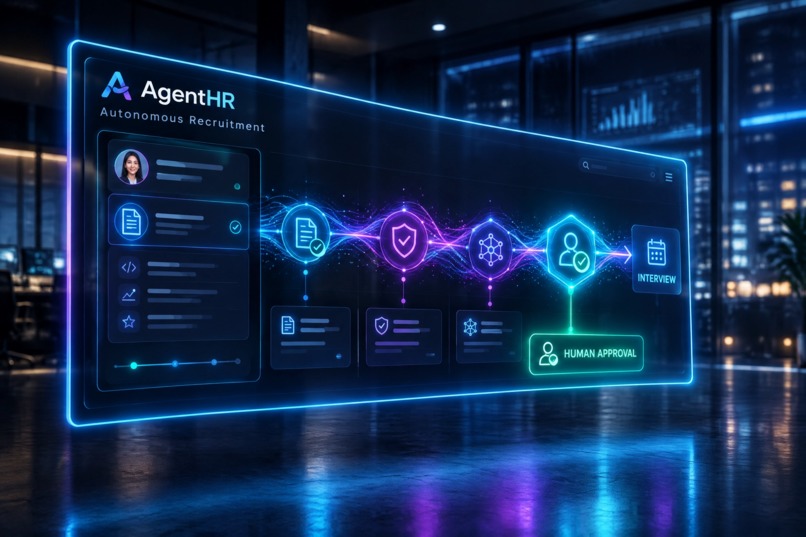
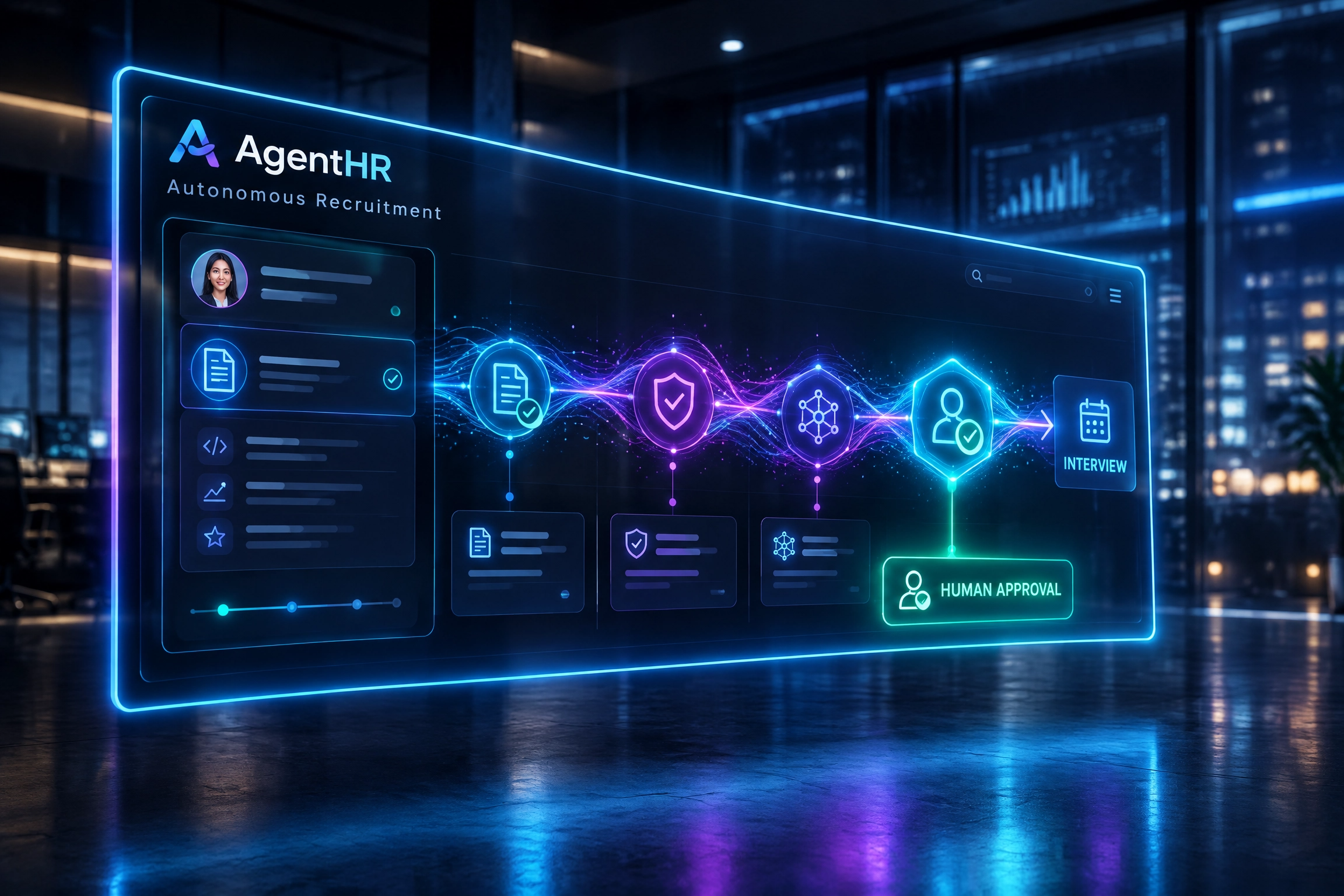
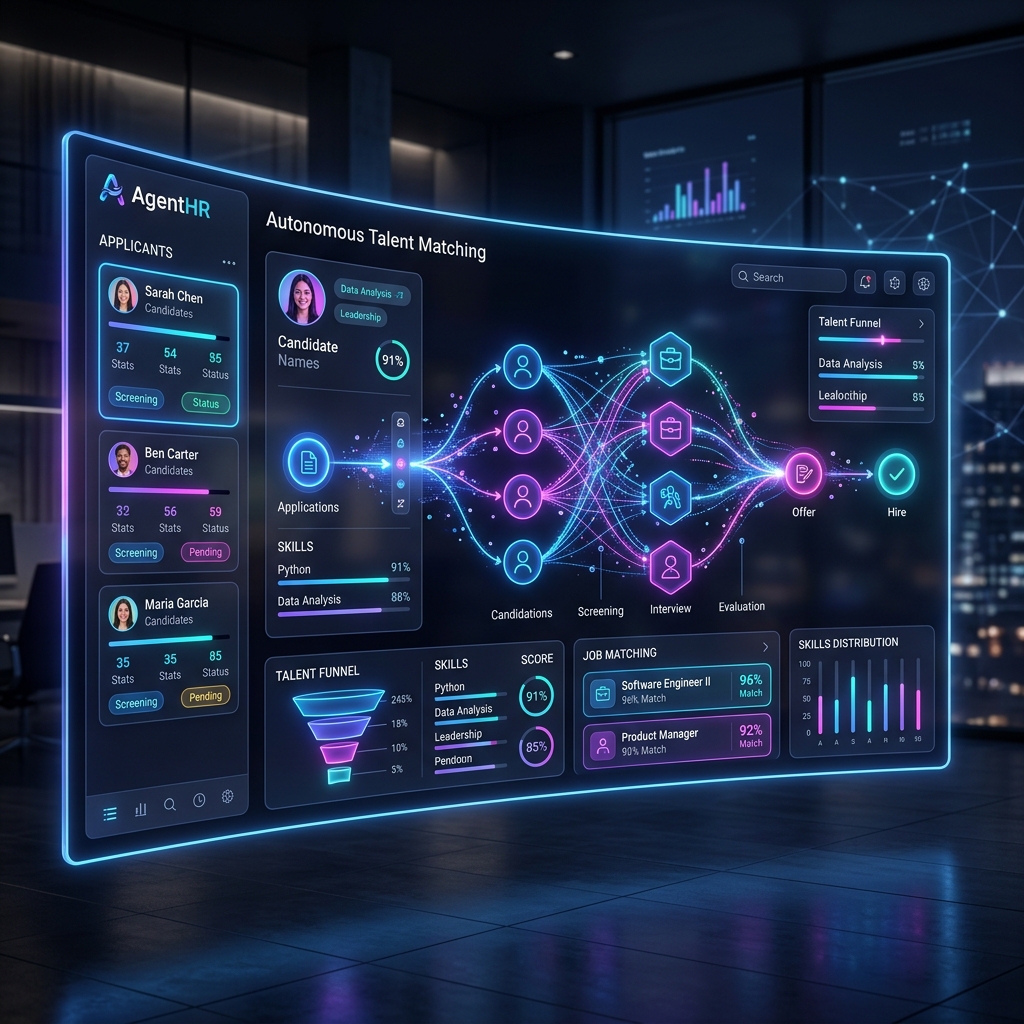
AgentHR turns candidate applications into coordinated recruitment actions through an autonomous AI workflow.
-
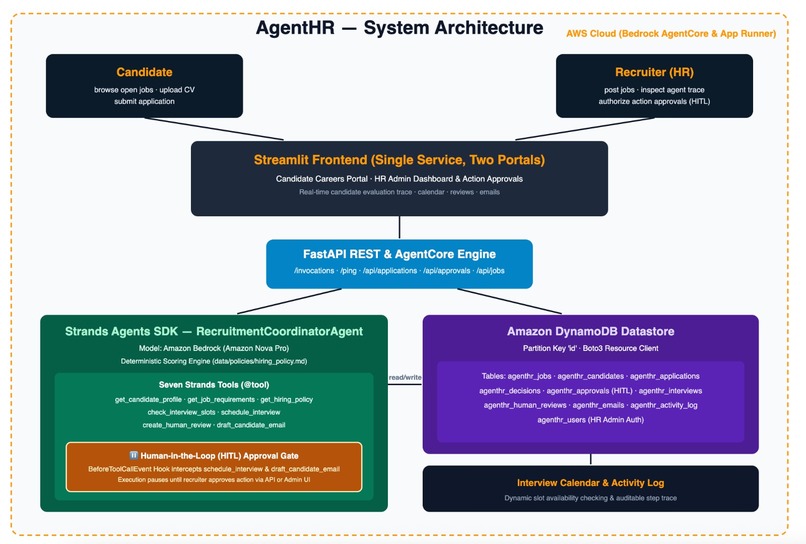
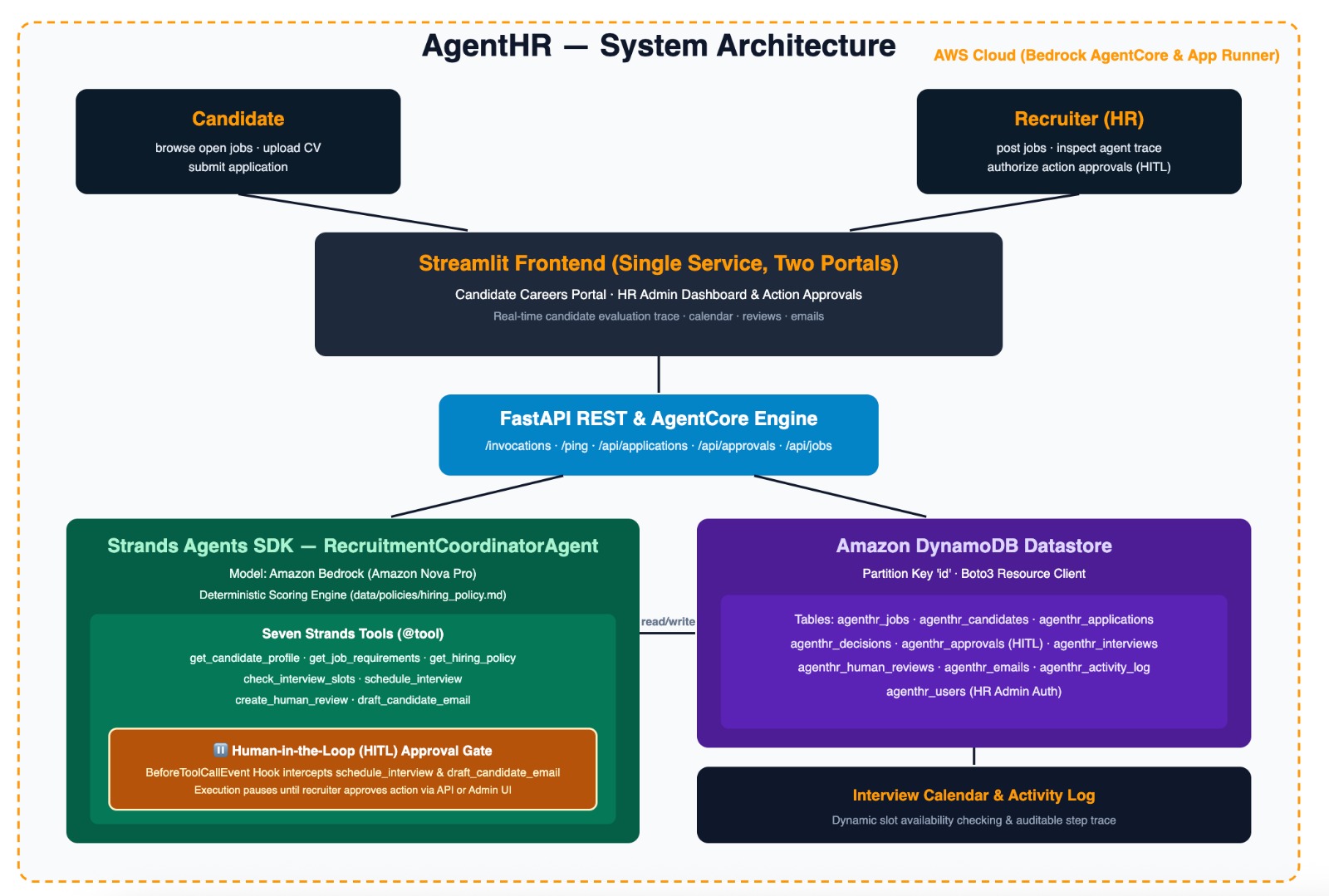
System Architecture
-
Agent-HR - Agentic Recruitment Platform
-
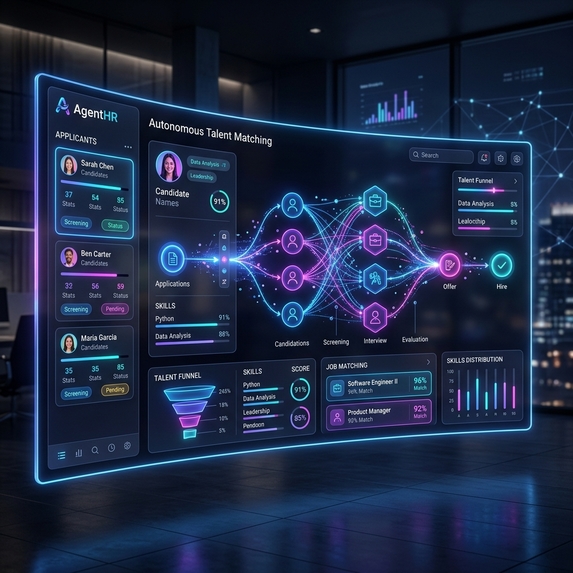
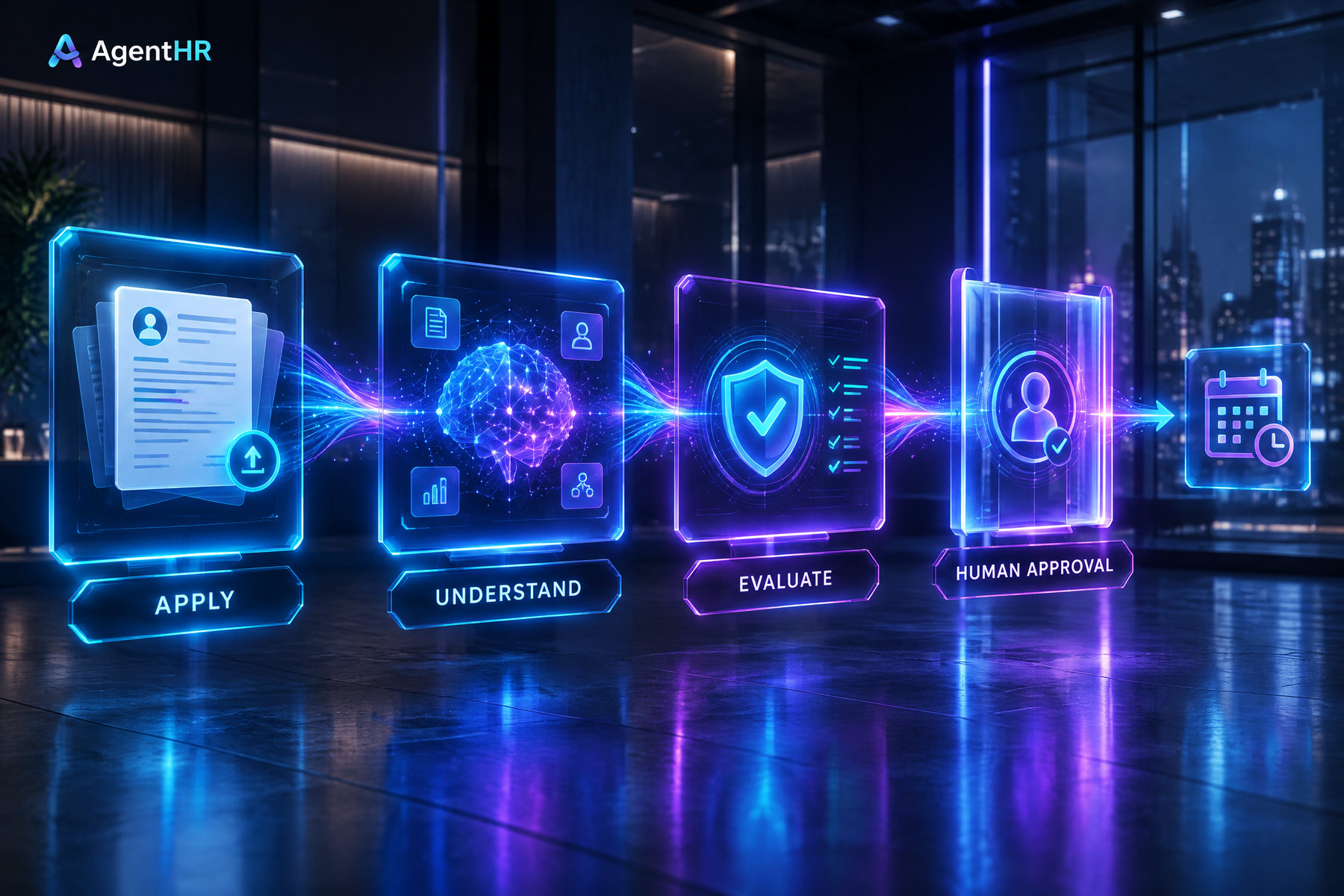
The AgentHR coordinator understands resumes, evaluates policy, and prepares the next recruitment step.
-
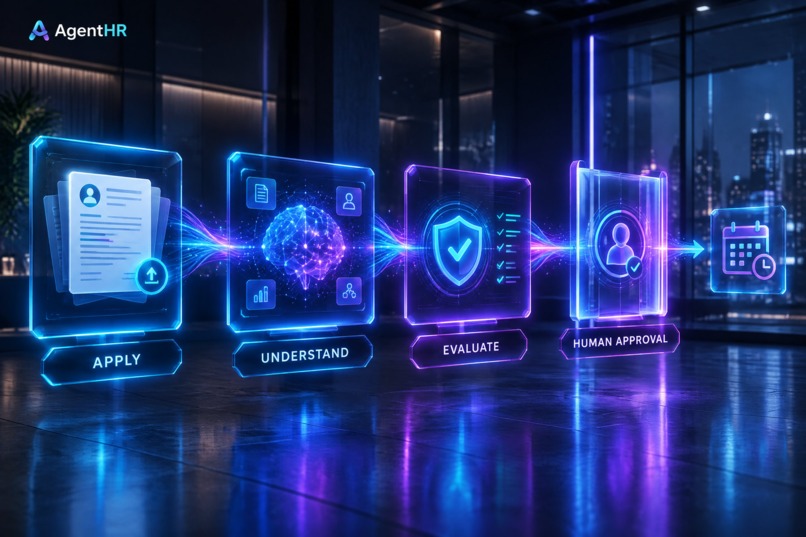
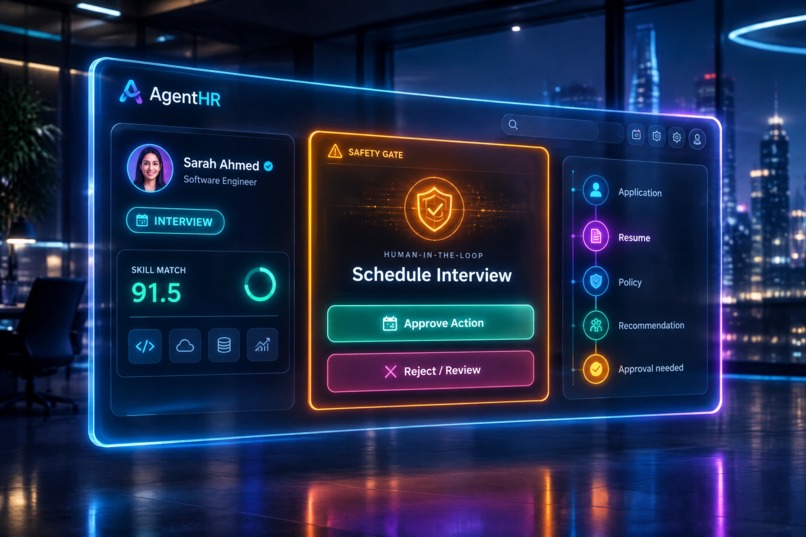
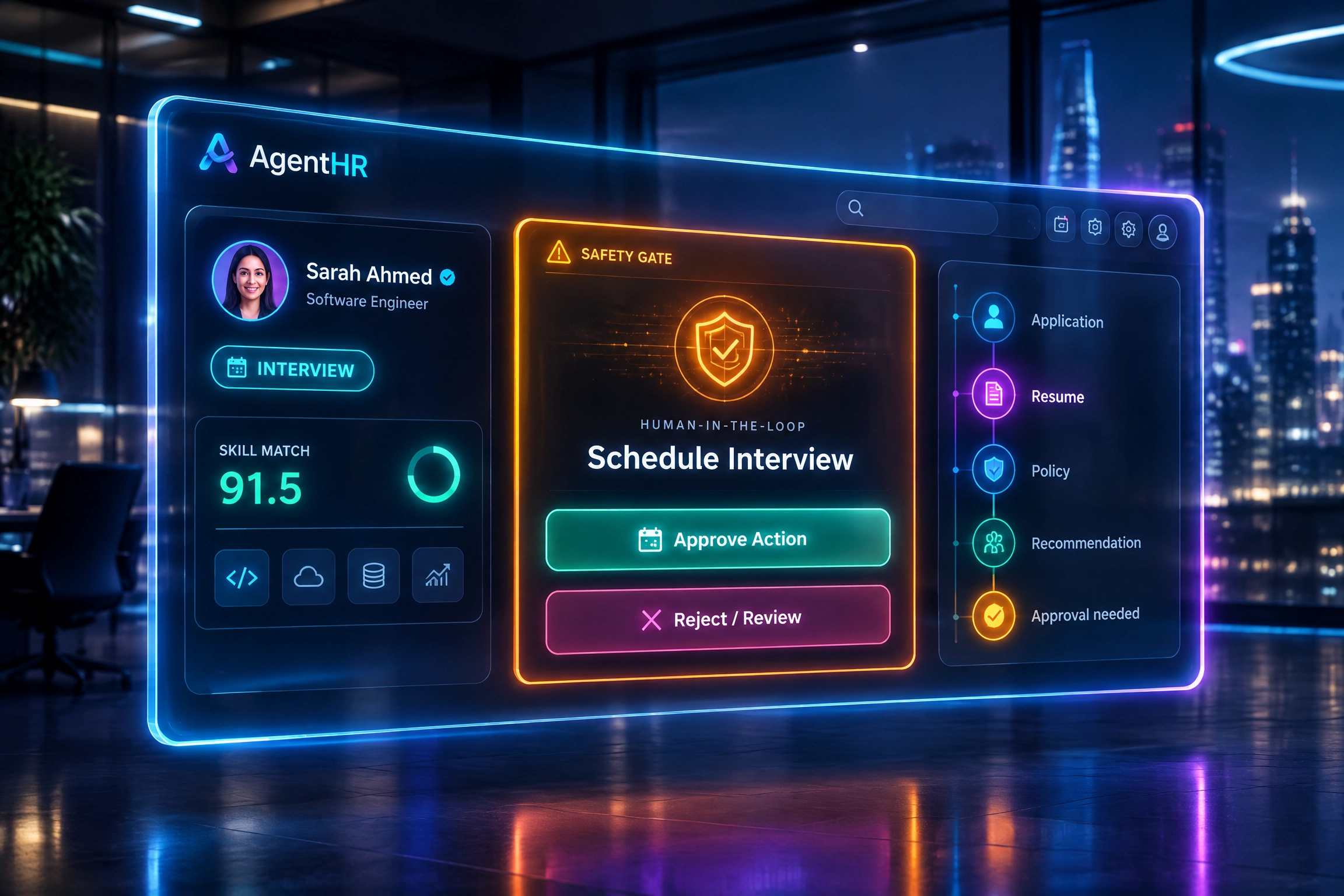
Every sensitive action pauses at a Human-in-the-Loop safety gate for recruiter approval.
-
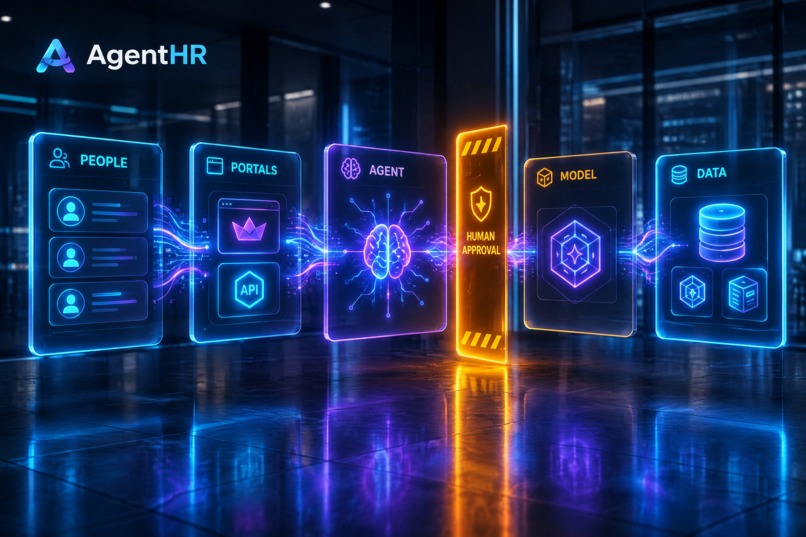
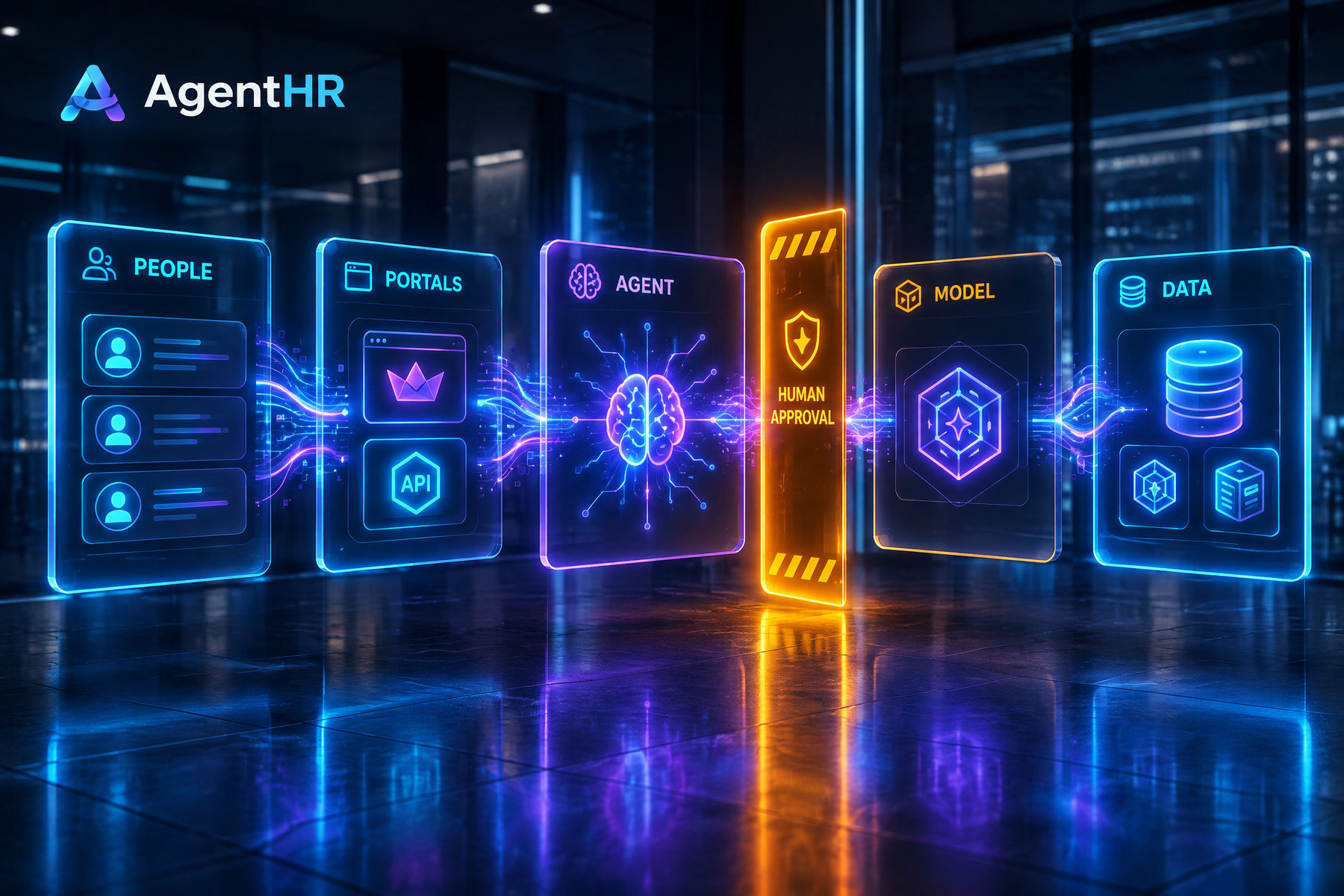
AgentHR combines Streamlit, FastAPI, Strands Agents, Amazon Bedrock, DynamoDB, and AWS runtime services into one supervised platform.
Inspiration
Recruitment teams spend countless hours on repetitive administrative work before they can focus on what truly matters: evaluating people. Reviewing resumes, checking hiring requirements, scheduling interviews, drafting emails, updating candidate statuses, and maintaining records are all necessary tasks, but they consume significant time and attention.
We asked a simple question:
What if an AI agent could handle the entire application-to-action workflow autonomously while keeping recruiters in control of important decisions?
That idea became AgentHR, an autonomous recruitment coordinator built for the AWS Agents for Humans Hackathon. Instead of creating another chatbot, we wanted to build an AI agent that actively performs work in the background and only involves humans when oversight is needed.
Our goal was to demonstrate how AI agents can reduce operational workload while maintaining transparency, accountability, and human supervision in sensitive hiring processes.
What it does
AgentHR is an agentic recruitment platform that transforms a candidate application into a recruitment action.
When a candidate submits an application, AgentHR:
- Parses PDF, DOCX, and TXT resumes.
- Extracts candidate qualifications, skills, education, and experience.
- Evaluates eligibility against company hiring policies.
- Calculates candidate suitability using deterministic policy rules.
- Decides the next recruitment action:
- INTERVIEW
- HUMAN REVIEW
- REJECT
- Creates recruiter review requests when human oversight is required.
- Schedules interviews when approved.
- Drafts recruiter-approved candidate communications.
- Maintains a complete audit trail of every action and decision.
To ensure responsible automation, AgentHR uses a Human-in-the-Loop (HITL) checkpoint that pauses sensitive actions before they are executed. Recruiters can review, approve, or reject actions such as interview scheduling and candidate communications.
This allows the agent to automate repetitive recruitment work while keeping final control in human hands.
How we built it
AgentHR was built using the Strands Agents SDK as the primary orchestration framework.
Core Agent Layer
We created a dedicated RecruitmentCoordinatorAgent powered by Amazon Nova Pro through Amazon Bedrock. The agent receives application context, evaluates hiring policies, reasons about candidate suitability, and determines the next recruitment step.
Strands Tools
We implemented specialized Strands tools for:
- Candidate profile retrieval
- Job requirement retrieval
- Hiring policy retrieval
- Interview slot checking
- Interview scheduling
- Human review creation
- Candidate email drafting
These tools allow the agent to interact with structured business workflows rather than simply generating text responses.
Human-in-the-Loop Safety Layer
One of the most important components of AgentHR is its Human-in-the-Loop approval system.
Using Strands lifecycle hooks and the BeforeToolCallEvent, the agent pauses before executing sensitive actions such as:
- Scheduling interviews
- Sending candidate communications
Recruiters must approve these actions before execution continues.
Policy-Driven Decision Engine
We implemented a human-readable hiring policy that acts as the system's decision framework.
The policy evaluates:
- Mandatory requirements
- Preferred requirements
- Missing information
- Candidate scoring thresholds
This ensures decisions remain consistent, explainable, and configurable without modifying application code.
AWS Architecture
AgentHR uses:
- Strands Agents SDK
- Amazon Nova Pro
- Amazon Bedrock
- Amazon DynamoDB
- FastAPI
- Bedrock AgentCore Runtime
- Streamlit
The system stores applications, decisions, interviews, approvals, activity logs, and recruiter actions while maintaining a fully auditable workflow.
Challenges we ran into
Designing safe autonomy
One of our biggest challenges was determining how much authority the agent should have.
Recruitment decisions impact real people, so fully autonomous execution without oversight would not be responsible. We spent significant time designing a Human-in-the-Loop workflow that allows automation while preserving recruiter control.
Balancing AI reasoning with deterministic policies
We wanted the flexibility of an LLM while maintaining predictable hiring outcomes.
To solve this, we combined Amazon Nova Pro's reasoning capabilities with policy-driven decision rules so that critical decisions remain transparent and explainable.
Building auditable agent workflows
Many AI systems provide answers without clearly documenting how they reached them.
We wanted every decision, tool invocation, approval, and action to be traceable. Designing an end-to-end audit trail required careful workflow and data-model planning.
Coordinating multiple system components
Integrating Strands Agents SDK, Amazon Bedrock, DynamoDB, FastAPI, AgentCore Runtime, and the frontend experience into a single coherent workflow required extensive testing and iteration.
Accomplishments that we're proud of
- Built a fully functional autonomous recruitment coordinator.
- Successfully integrated the Strands Agents SDK as the core orchestration layer.
- Implemented Human-in-the-Loop approvals using Strands lifecycle hooks.
- Created a policy-driven recruitment workflow with transparent decision making.
- Enabled resume understanding across multiple document formats.
- Built recruiter and candidate experiences through a unified platform.
- Designed a complete audit and activity logging system.
- Developed an architecture that can scale beyond hackathon use cases into real-world recruitment operations.
Most importantly, we built an agent that does real work rather than simply answering questions.
What we learned
This project reinforced an important lesson:
The future of AI is not just conversation. It is action.
We learned how agent frameworks can orchestrate complex workflows, interact with tools, enforce business policies, and collaborate with humans.
We also learned that trust is a critical requirement for agent adoption. Human-in-the-Loop mechanisms, transparency, and auditability are just as important as model intelligence.
Working with the Strands Agents SDK gave us practical experience in building production-style agent systems that coordinate reasoning, tools, approvals, and real-world actions.
What's next for Agent-HR - Agentic Recruitment Platform
AgentHR is designed as a foundation for a broader agentic recruitment ecosystem.
Future plans include:
- Integration with LinkedIn, Indeed, and major job boards.
- Automated candidate sourcing and talent discovery.
- Multi-agent recruiter teams for screening, interviewing, and onboarding.
- Calendar integrations with Google Calendar and Microsoft Outlook.
- Real-time recruiter dashboards and analytics.
- Candidate matching across multiple open positions.
- Interview feedback analysis and recommendation systems.
- Enterprise role-based access control and compliance features.
- Advanced hiring insights powered by Amazon Bedrock.
- Deployment through AWS-native production infrastructure using AgentCore and additional AWS services.
Our vision is to transform recruitment from a series of disconnected manual tasks into an intelligent, supervised, agent-driven workflow where recruiters spend less time on administration and more time connecting with people.
Built With
- agentcore
- ai-agents
- amazon-bedrock
- amazon-dynamodb
- amazon-nova-pro
- amazon-web-services
- autonomous-agents
- bedrock-agentcore
- fastapi
- hr-tech
- python
- strands-agents-sdk
- streamlit

Log in or sign up for Devpost to join the conversation.