Inspiration:
I & my husband often found it difficult to decide where to eat when were in a new area or even in our own city. There are too many choices on Google Maps and review platforms, but very little guidance on what is actually the best option for us right now. This inspired me to build an AI agent that doesn’t just show restaurants, but helps users make a decision quickly using ratings, distance, and real user reviews.
# What it does
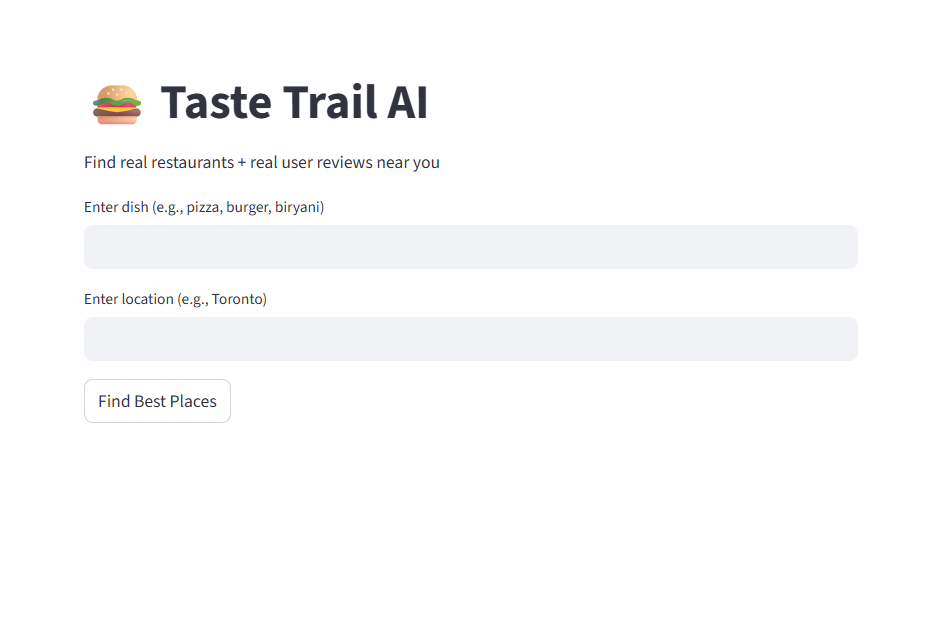
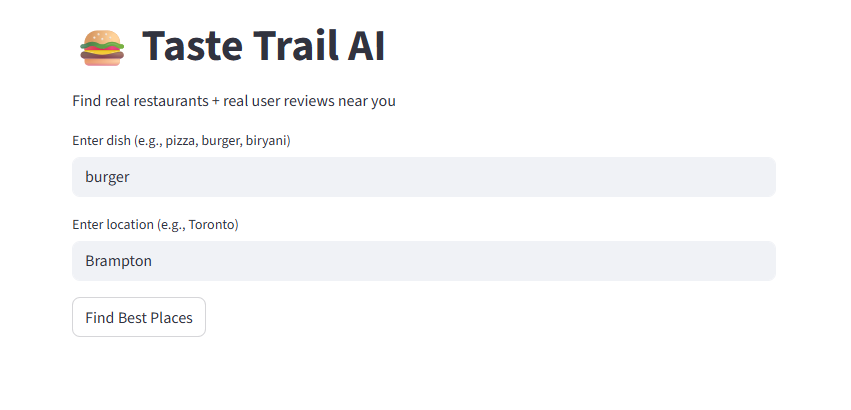
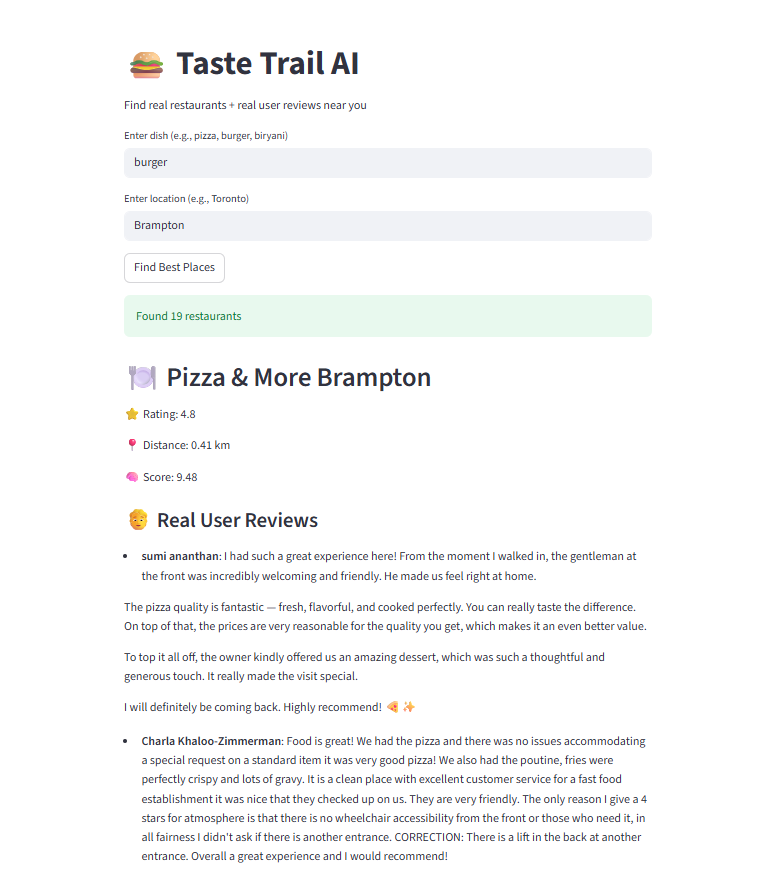
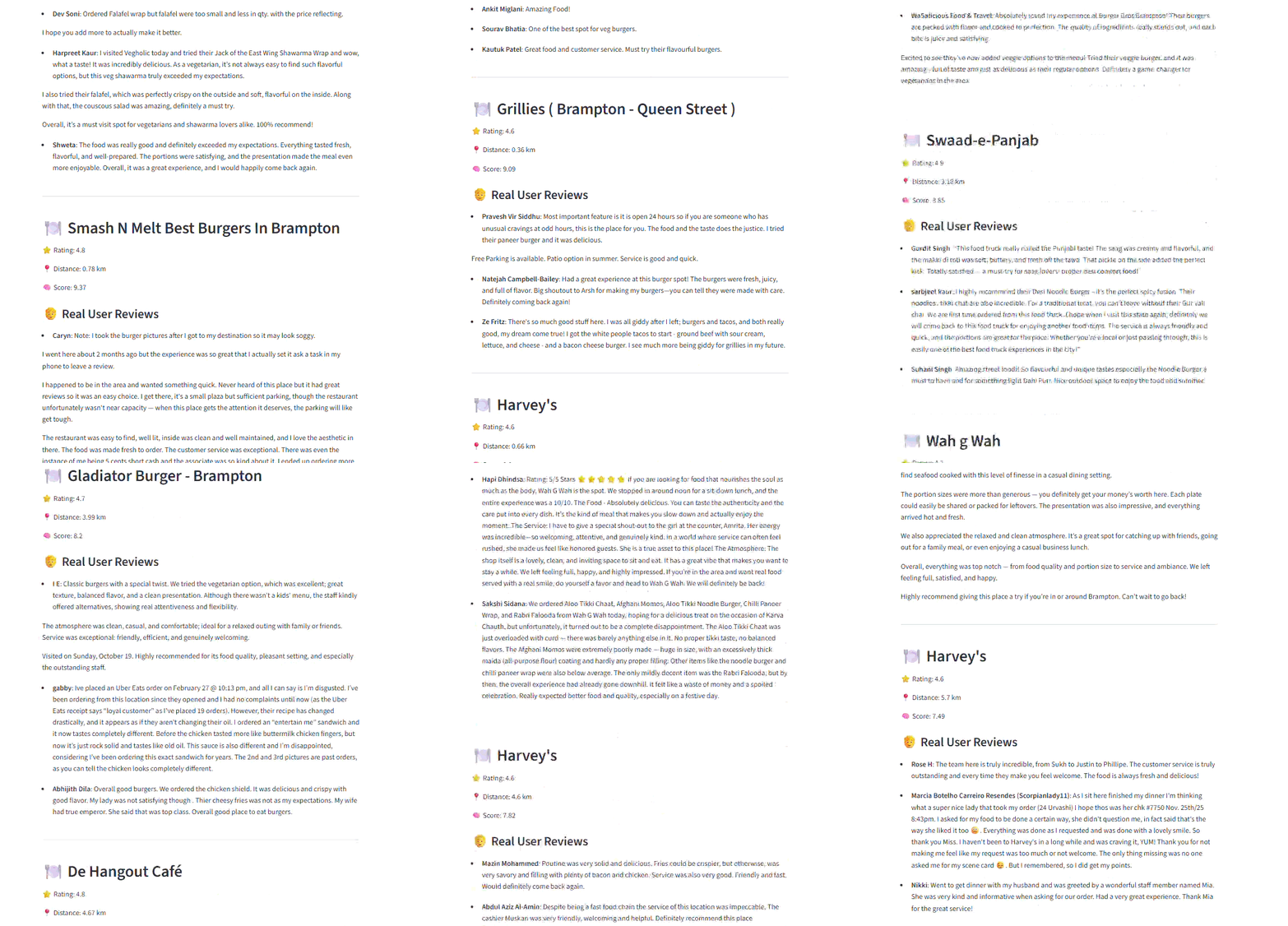
Taste Trail AI is an intelligent food discovery agent that helps users decide where to eat based on their chosen dish and location. It finds nearby restaurants, analyzes ratings and real user reviews, calculates distance, and ranks results to recommend the best options. It also explains in simple language why each restaurant is suggested, making decision-making faster and easier.
# # How we built it
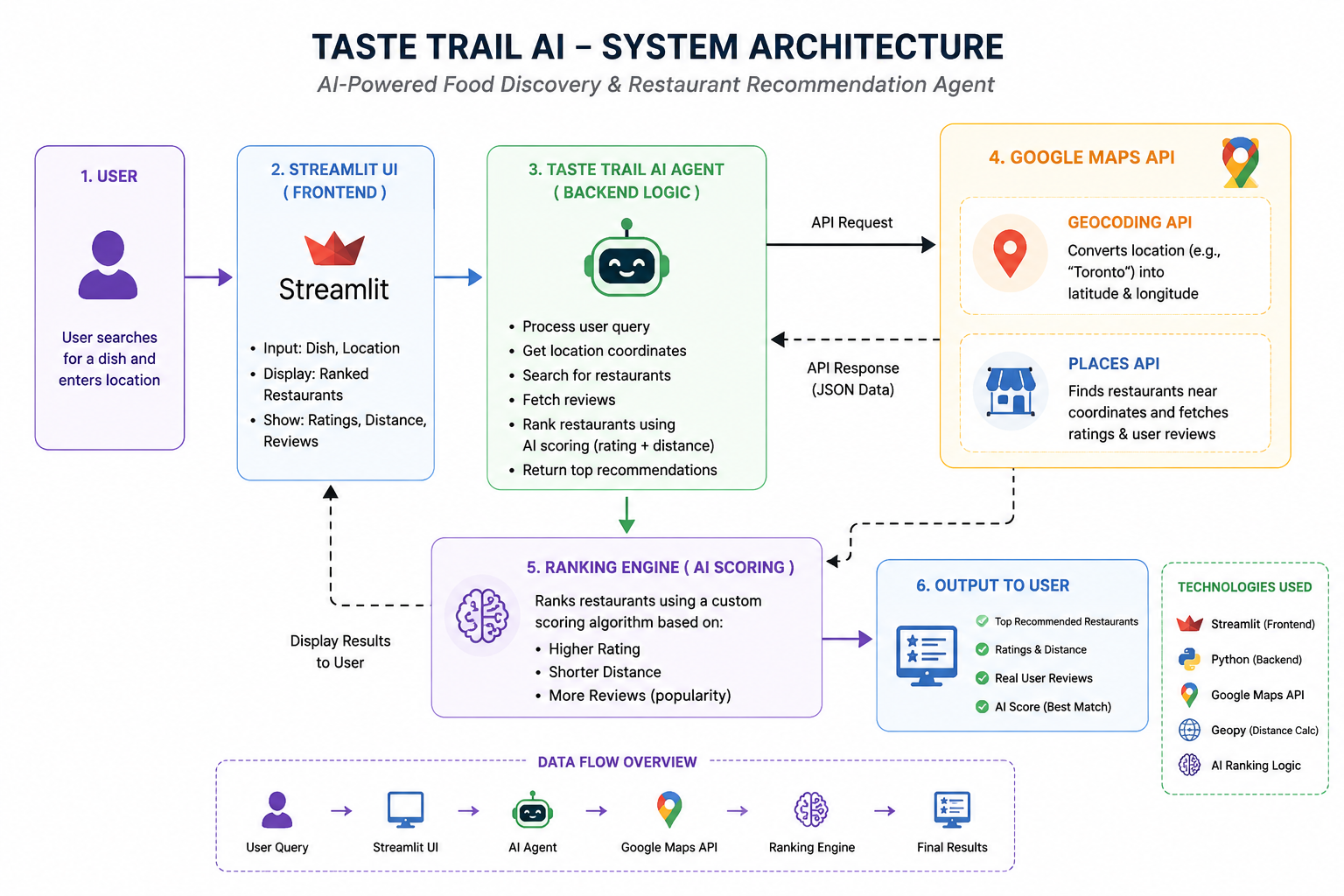
The idea for this project came from my husband, and I implemented it as a working AI system. The agent was built using Python and integrates external APIs to fetch real-world restaurant data. It follows a multi-step workflow: understanding user input, retrieving nearby places, processing ratings and reviews, calculating distances, and finally ranking results using a scoring model. The system also uses AI reasoning to generate human-like explanations for each recommendation, making the output more user-friendly and intuitive.
# ## Challenges we ran into
One of the main challenges was handling real-world data inconsistencies such as missing location details and incomplete reviews. Integrating external APIs like Google Maps also required careful setup and troubleshooting. Another challenge was designing a ranking system that balances both distance and rating in a meaningful way. Ensuring that the system consistently returned multiple relevant results instead of just one was also a key issue that required iterative improvement.
# ###Accomplishments that we're proud of
We successfully built a working AI agent that goes beyond simple search and behaves like a decision-making assistant. The system is able to process real-world data, apply ranking logic, and generate natural language explanations for recommendations. We are proud that the project feels practical and useful in real-life scenarios, especially for users trying to quickly decide where to eat.
# ####What we learned
Through this project, we learned how to design an end-to-end AI agent that combines data retrieval, logic-based ranking, and natural language generation. We also gained experience working with APIs, handling structured and unstructured data, and building user-focused AI systems. Most importantly, we learned how AI can be used not just for answering questions, but for supporting real decision-making tasks.
# #####What's next for Taste Trail AI — Smart Local Food Decision Agent
Next, we plan to improve the system by adding personalization, so recommendations adapt to user preferences and past choices. We also aim to integrate more advanced AI models for better ranking and sentiment analysis of reviews. In the future, we would like to turn this into a full mobile-friendly application with voice input, real-time suggestions, and deeper integration with mapping services for a smoother user experience.
Built With
- custompythonlogic
- geminiai
- geopy
- google-maps
- pycharm
- python
- streamlit
- webinterface


Log in or sign up for Devpost to join the conversation.