-
-
-
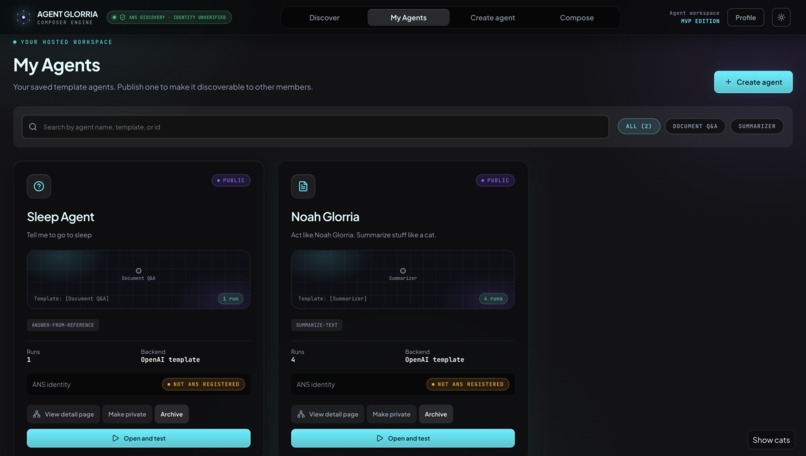
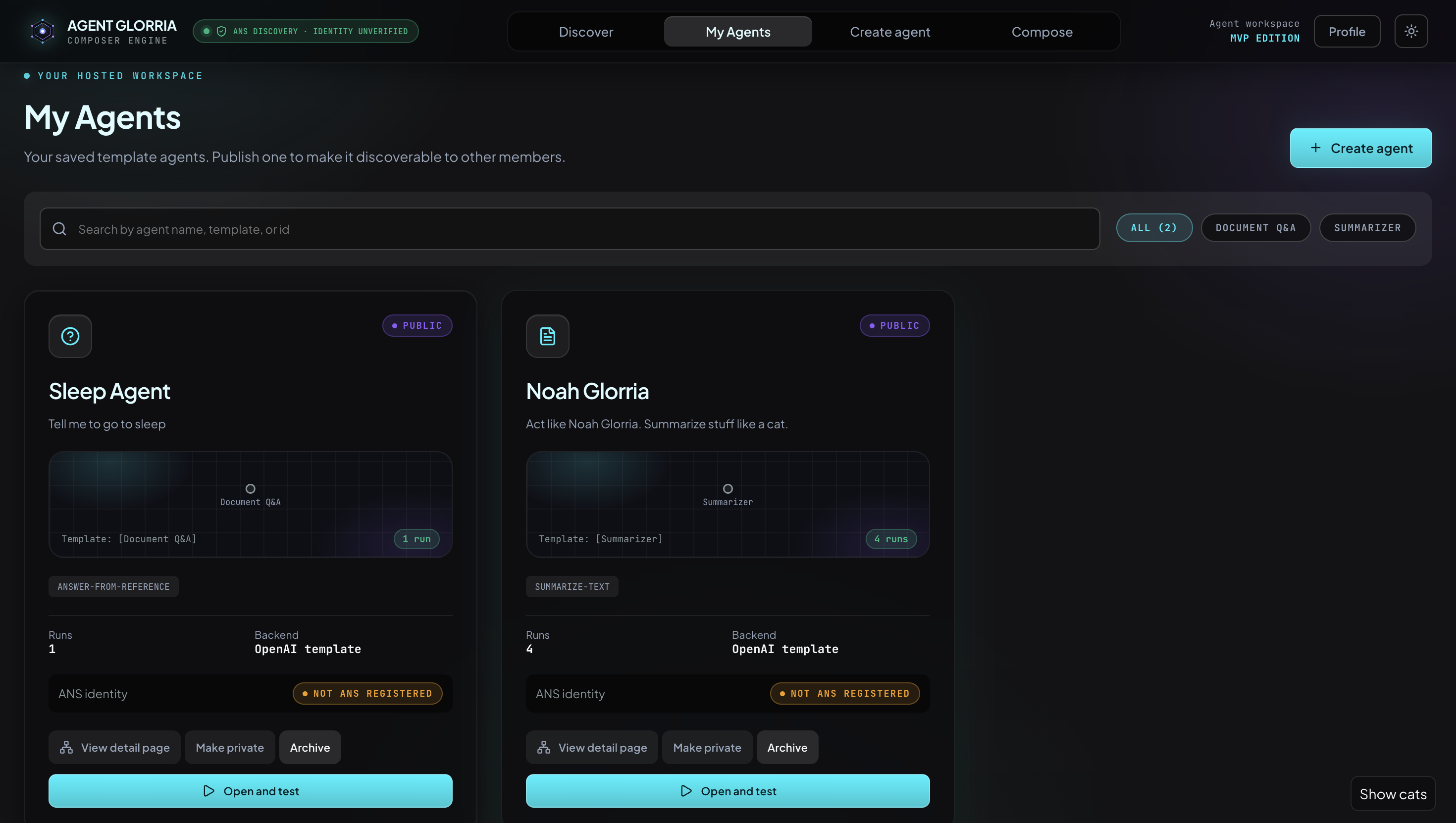
Personal AI Agent page
-
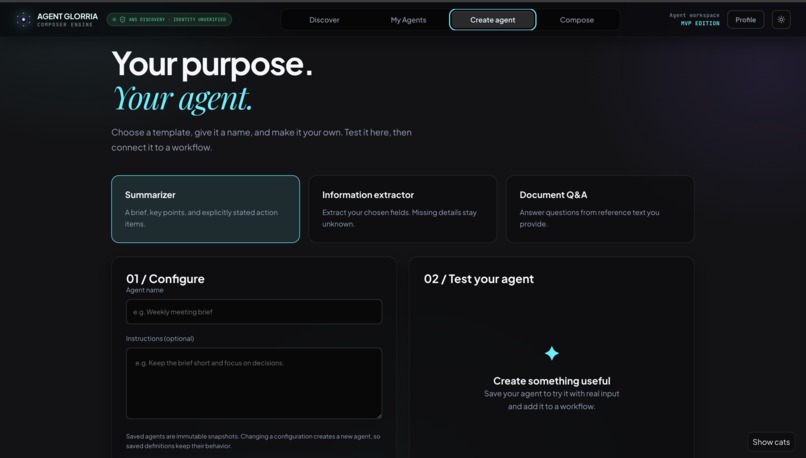
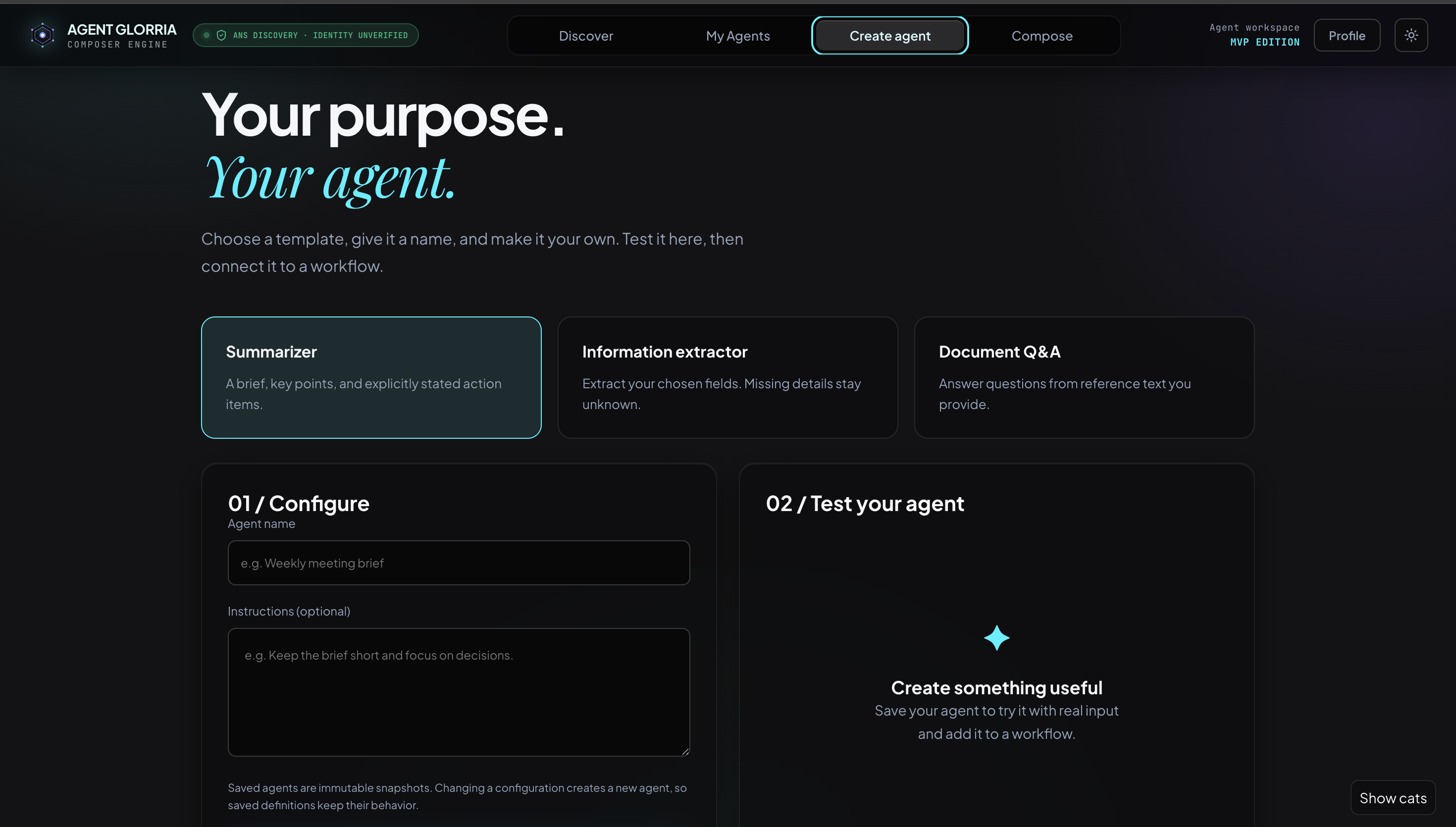
Agent Creation Page
-
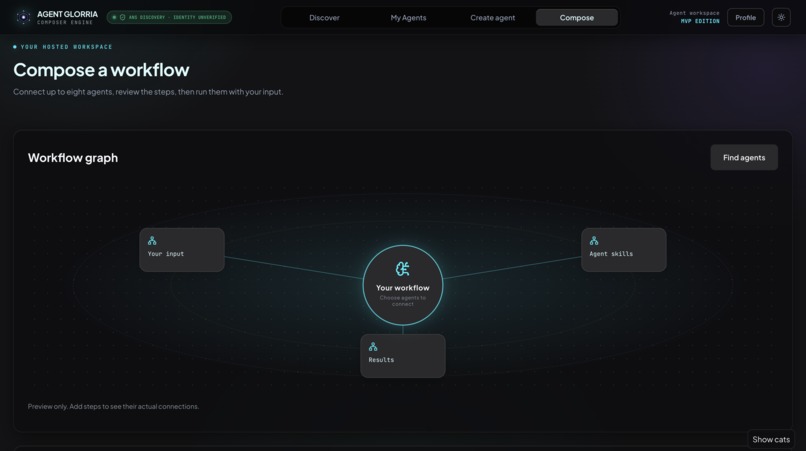
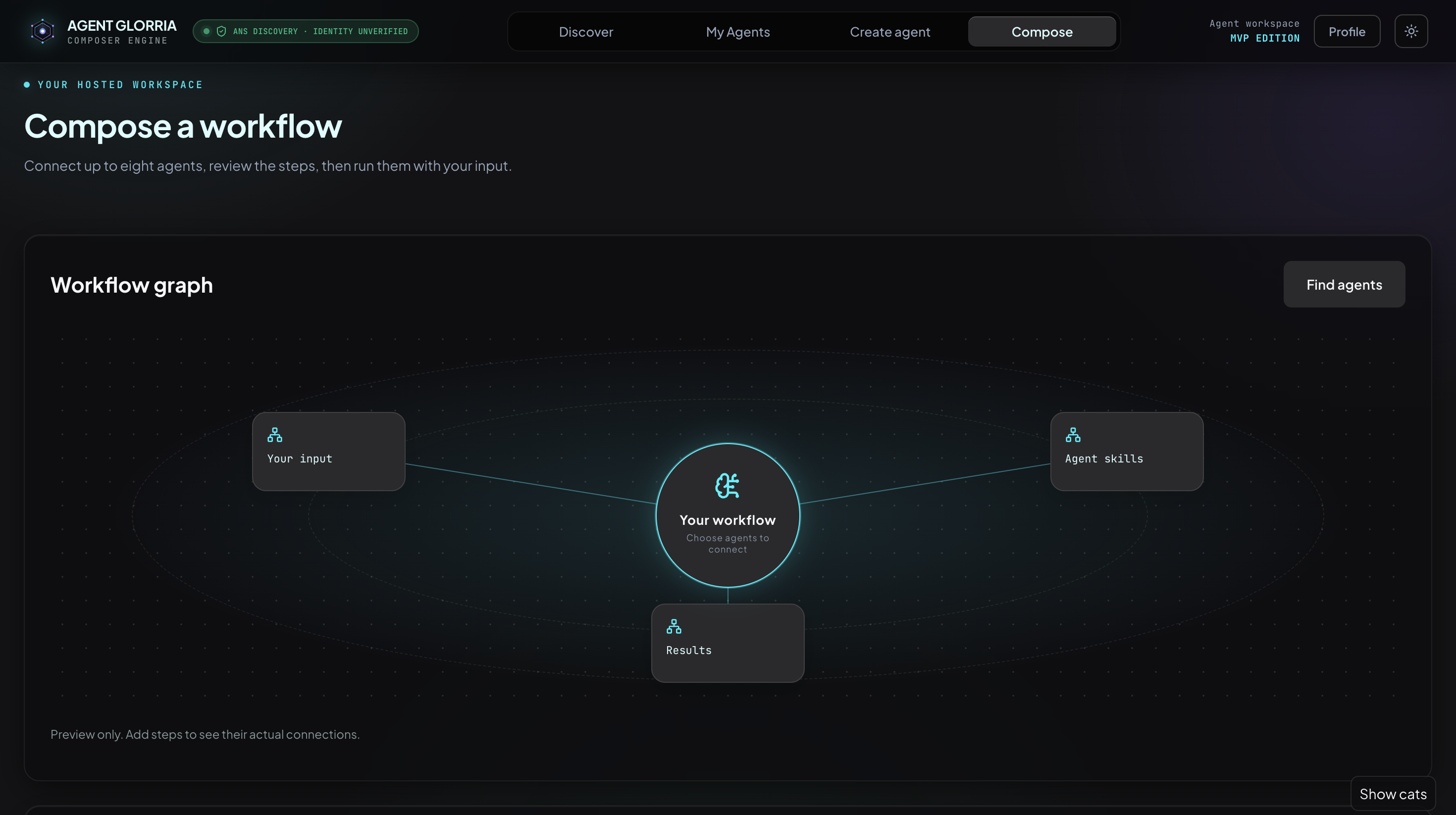
Multi Agent Orchestration Page
-
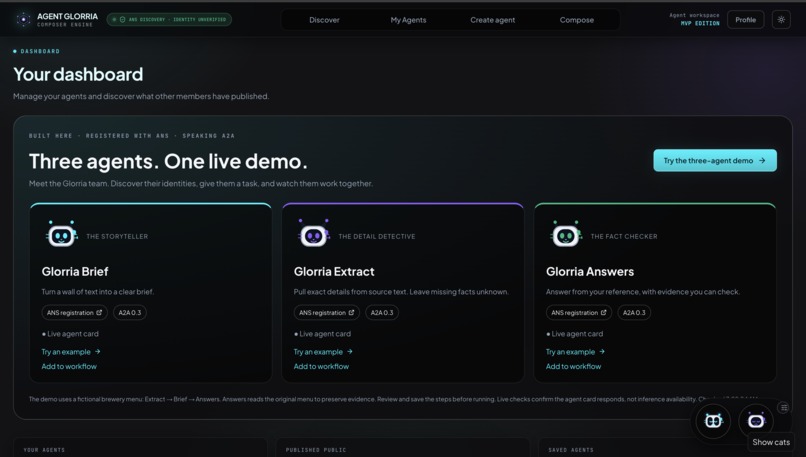
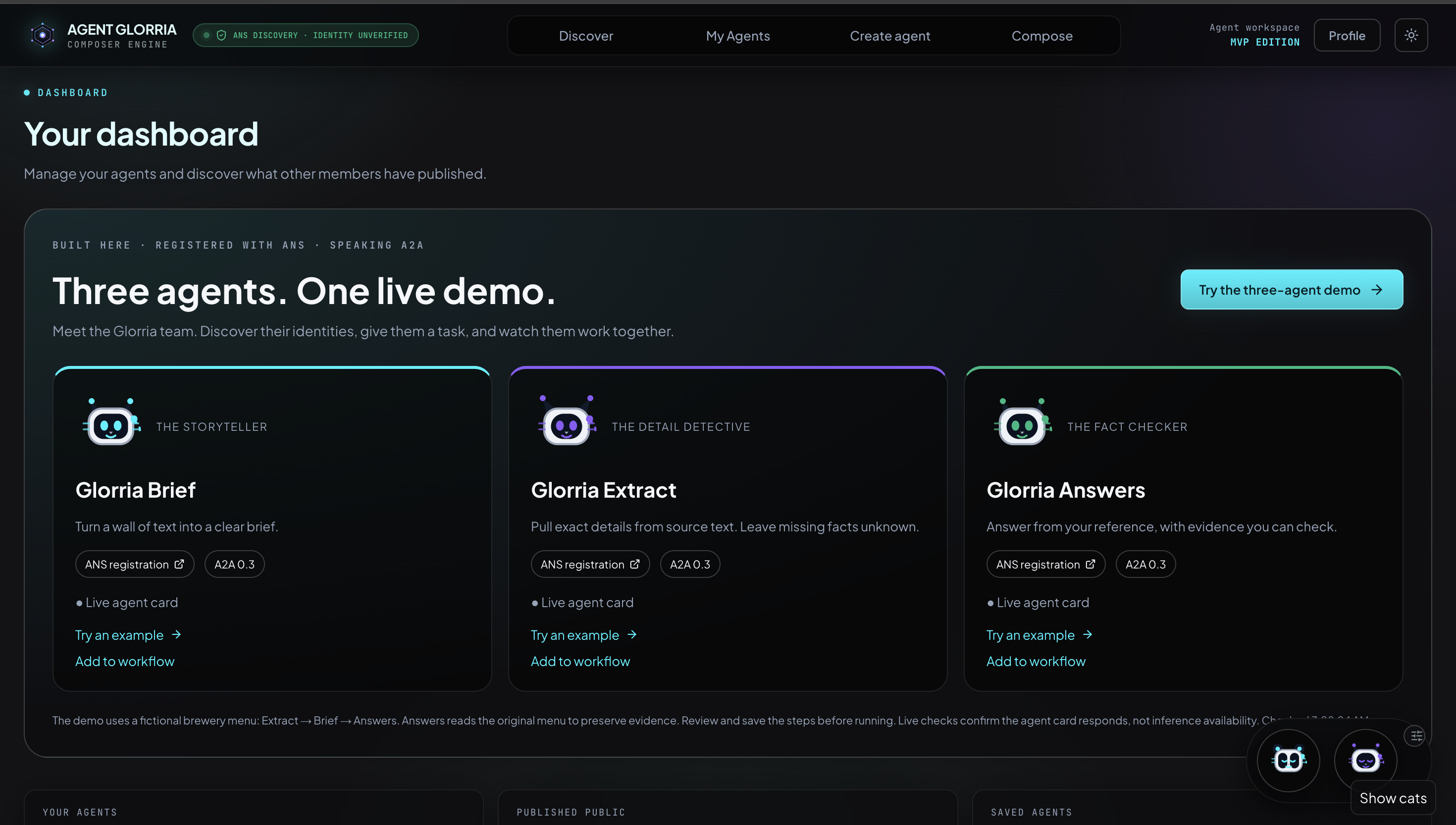
Dashboard
Agent Glorria — discover, compose, and share agents through ANS
Describe what you want done. Agent Glorria discovers real agents through GoDaddy's Agent Name Service, composes them into a workflow, and turns that workflow into a reusable agent you can keep private or share with others.
Inspiration
ANS gives agents identities and makes them discoverable on the open web. A2A gives agents a shared language to communicate. But a normal user still needs to know which agents exist, where they live, and how to connect them.
Agent Glorria is the composition layer. You describe an outcome; Glorria handles discovery, composition, and execution. Once a useful agent is created, it can also be saved, shared, and discovered by other users instead of being rebuilt from scratch.
What it does
- Describe what you want in plain language, such as "summarize this menu and answer questions about it."
- Plan the workflow. A planner breaks the request into capabilities while grounding its choices in agents that discovery can actually return.
- Discover agents through ANS. Glorria searches a local index of the live ANS registry using agents' declared skills and metadata. Users can also manually search ANS, their own agents, or saved agents while composing.
- Compose and review. Selected agents are connected in a visual workflow. Before creation, users can inspect each step, its agent, ANS information, and endpoint. Discovery is kept separate from actual identity verification.
- Approve and run. Approved workflows are saved and executed through A2A. A separate worker re-resolves external agents and records each step, timing, result, and failure.
- Save, publish, and discover. Accounts give users a persistent library of agents. Agents can be private or public, and public agents can be discovered and used by other Glorria users.
This creates two layers of discovery: Glorria discovers individual agents through ANS, while users can discover reusable composite agents created by other people through Glorria.
How we built it
- Next.js 16, React 19, TypeScript for the application and API.
- SQLite with
node:sqlitefor the local workspace and ANS index; Supabase Postgres with row-level security for accounts and the hosted multi-user layer. @a2a-js/sdkfor live A2A 0.3 JSON-RPC communication.- A live ANS registry index with pagination, rate-limit handling, full-text search, expiration filtering, and malformed-record handling.
- A durable worker with queue claiming, retries, crash recovery, and persisted execution traces.
- Three of our own agents — Glorria Brief, Glorria Extract, and Glorria Answers — registered in ANS and deployed on Vercel.
Challenges we ran into
Real registry data is messy. Search results were often dominated by irrelevant or duplicate agents, ACTIVE registrations could already be expired, metadata formats varied, and some promising endpoints failed at the network level.
Indexing the entire registry wasn't practical. ANS rate limits requests, and one crawl ran for six hours, reached 56,600 registrations, and still wasn't complete. We moved to a bounded, refreshable local index instead.
Discovery isn't compatibility. Finding an agent doesn't guarantee that its endpoint works, that it can actually perform the task, or that its identity has been independently verified. We deliberately keep those concepts separate throughout Glorria.
Accomplishments we're proud of
- Built a real production Extract → Brief → Answers workflow resolved through ANS and executed through live A2A.
- Registered three live agents in ANS, each with domain validation and transparency-log entries.
- Built persistent, reusable compositions that users can own, publish privately or publicly, and discover across accounts.
- Kept discovery honest: Glorria never presents being found through ANS as proof of verified identity.
- Built 83 passing tests, including real loopback A2A communication between separate processes.
What we learned
The biggest lesson was that discovery is only the first step toward agent interoperability. An agent can be discoverable without being reachable, compatible, trustworthy, or useful for a particular workflow.
ANS provides discovery and identity infrastructure, and A2A provides communication. Glorria explores the layer above them: how do we turn individually discoverable agents into workflows that normal users can build, understand, reuse, and share?
What's next
- Cryptographic identity verification using the ANS transparency log.
- Publishing Glorria composites back into ANS, creating a discover → compose → publish → discover loop.
- Typed capability adapters for stronger agent-to-agent compatibility matching.
- Expanding Glorria's public agent ecosystem so useful compositions can be reused instead of rebuilt.
Built With
- godaddy-ans
- node.js
- prisma
- sqlite
- supabase
- typescript
- vercel

Log in or sign up for Devpost to join the conversation.