-
-
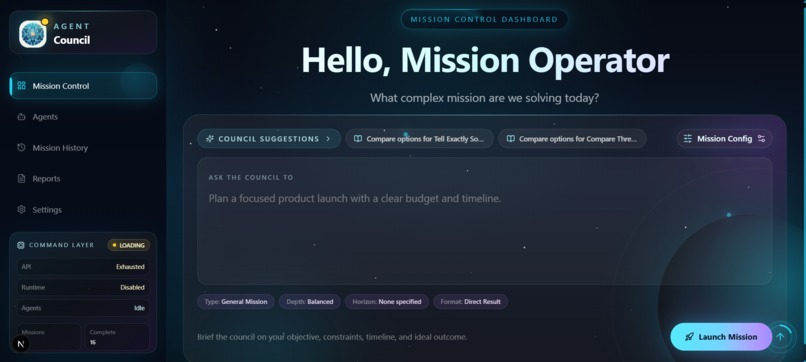
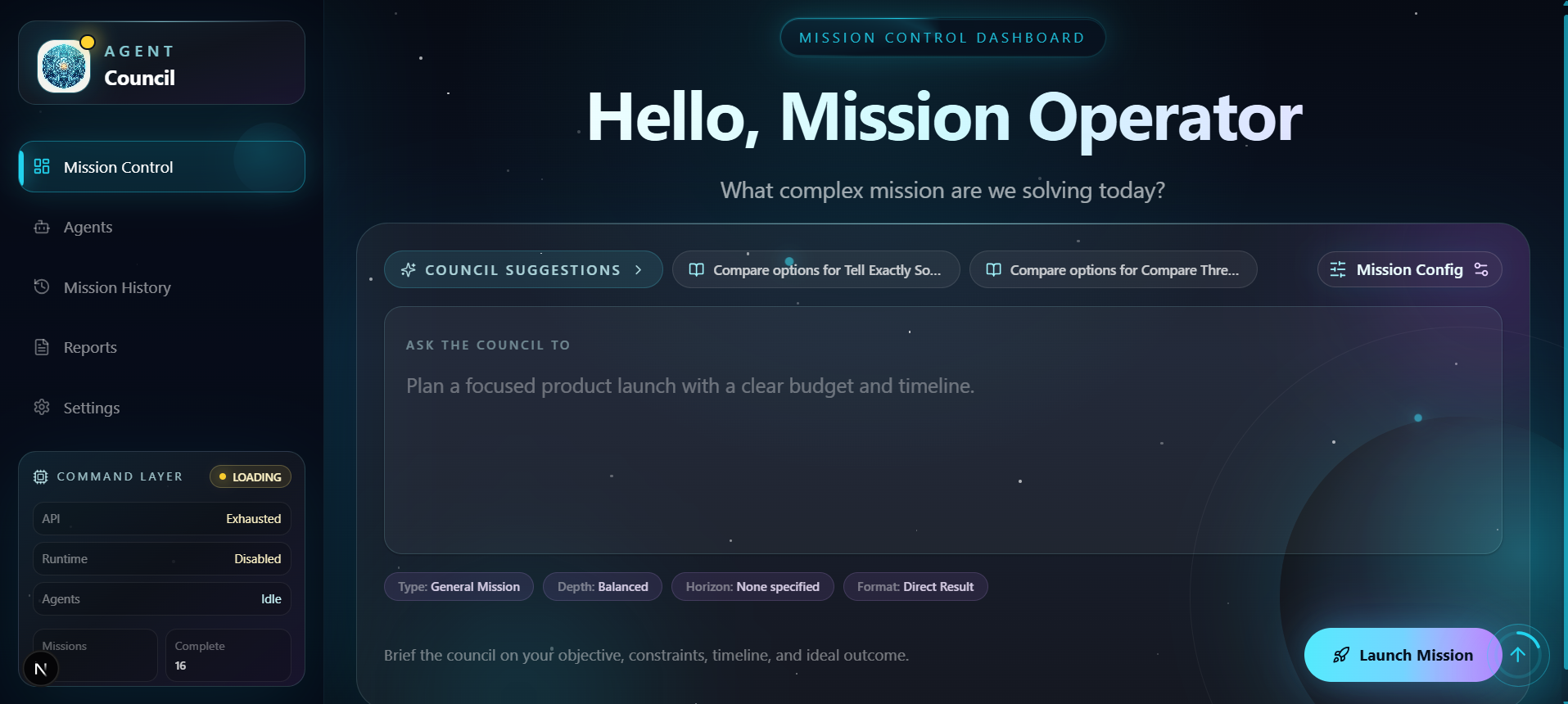
Mission Control Tab where the user prompt a mission and watch the agents collaborate to solve it
-
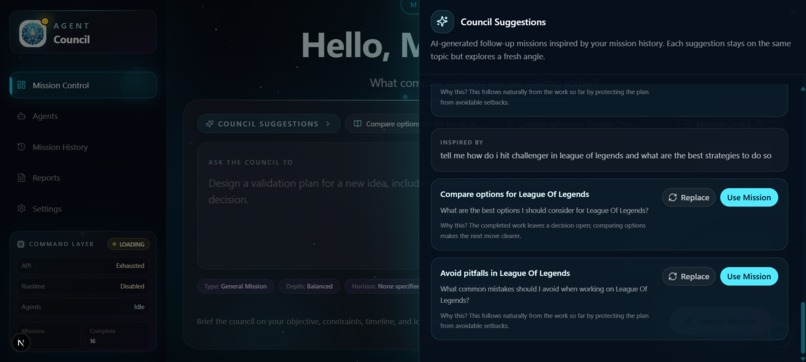
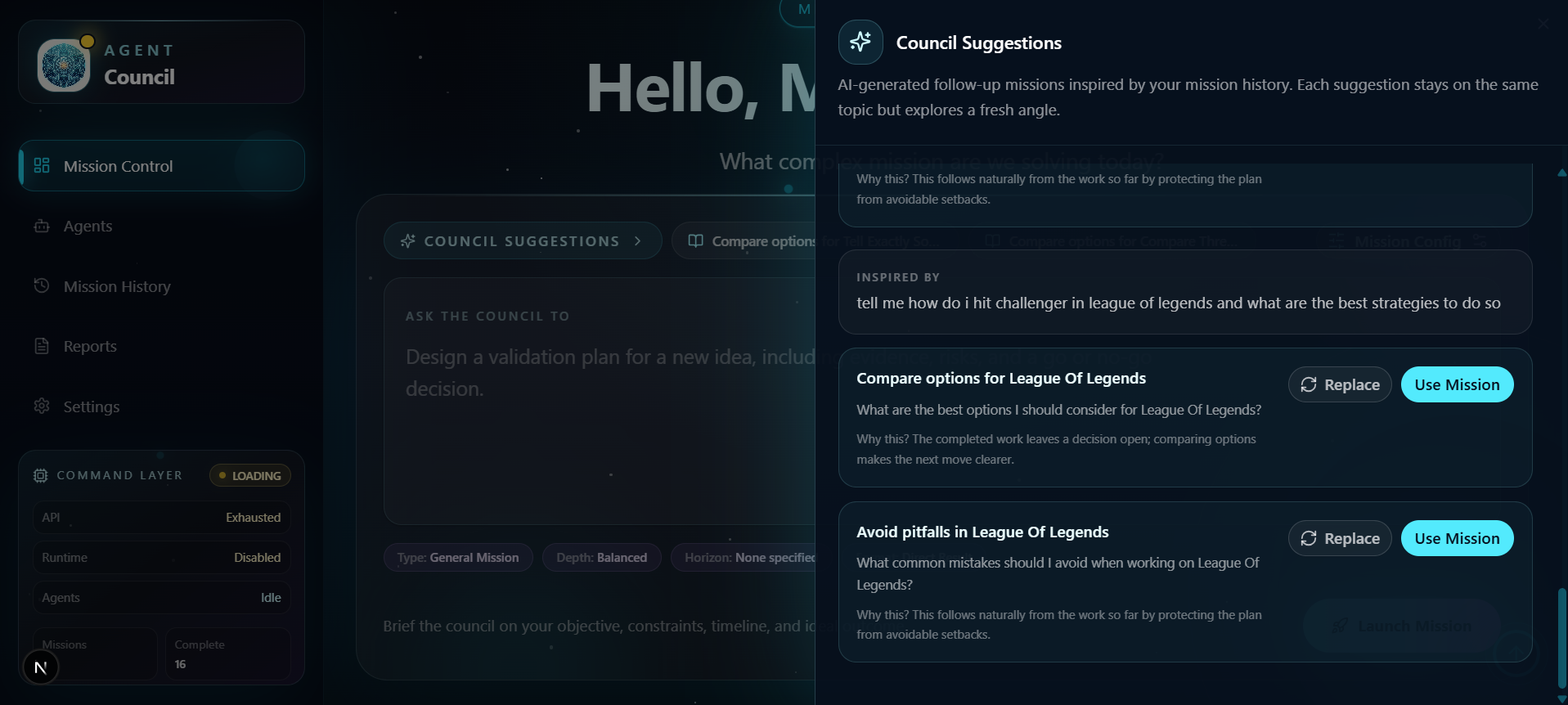
council suggested sub missions based on the user's old completed missions
-
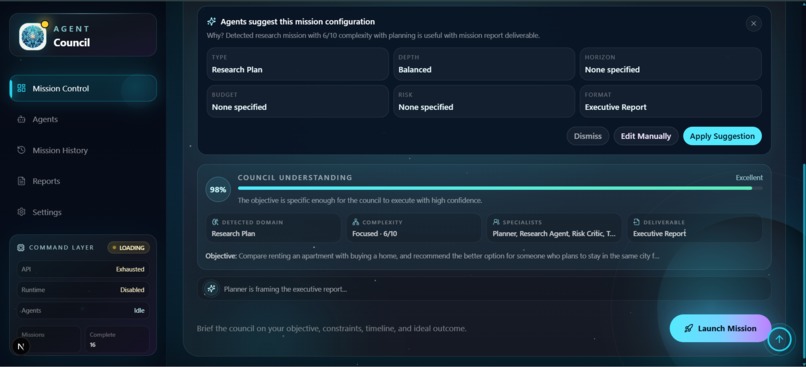
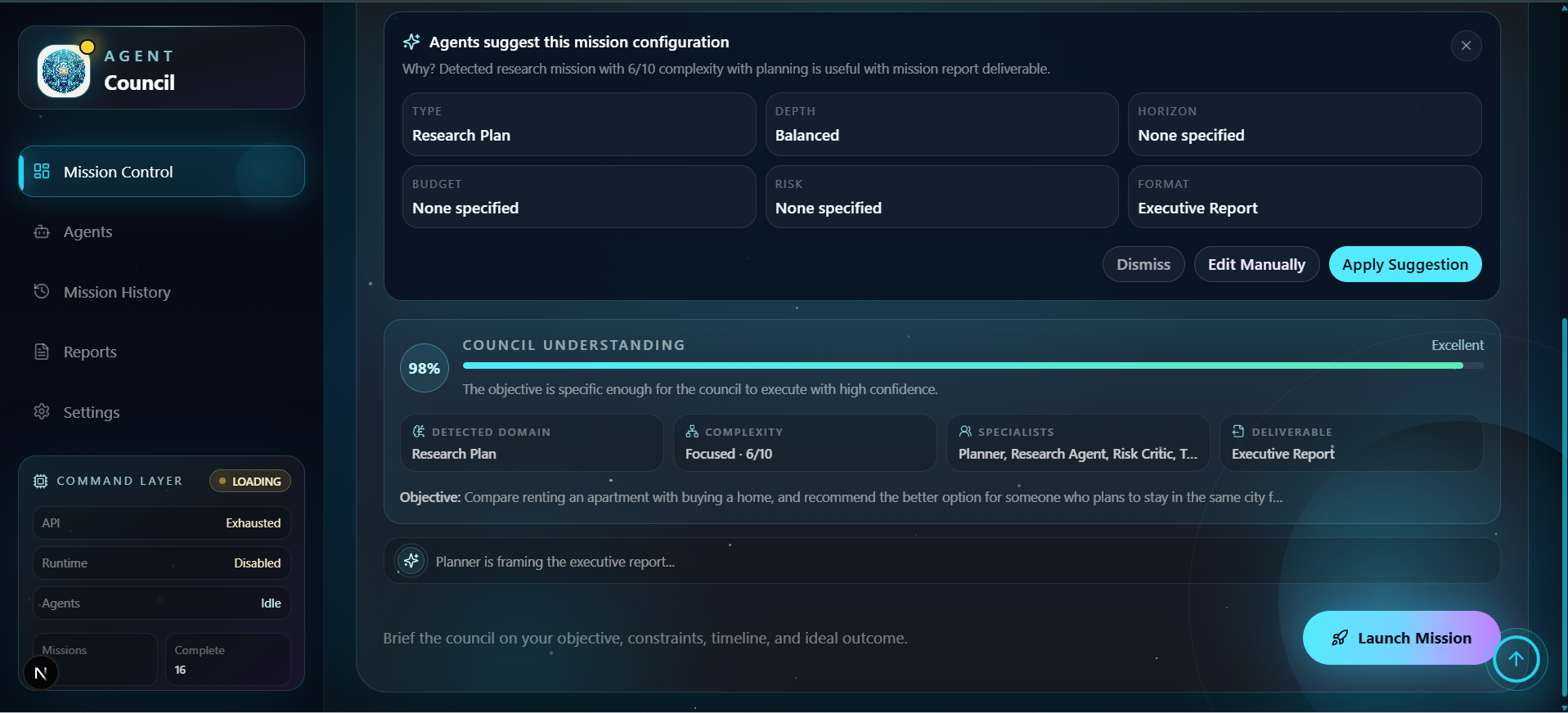
Council Generated mission configuration and suspected mission complexity and other additional details
-
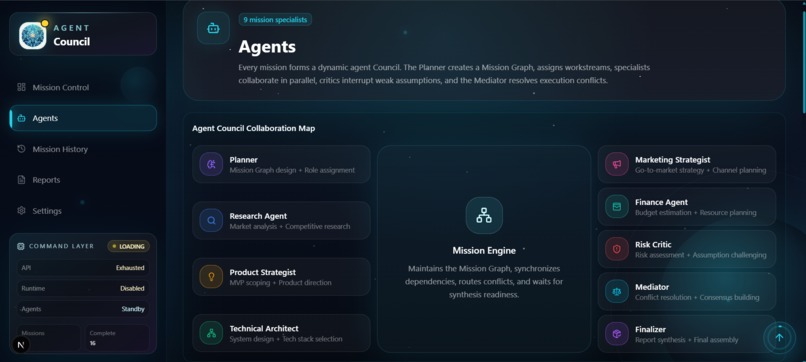
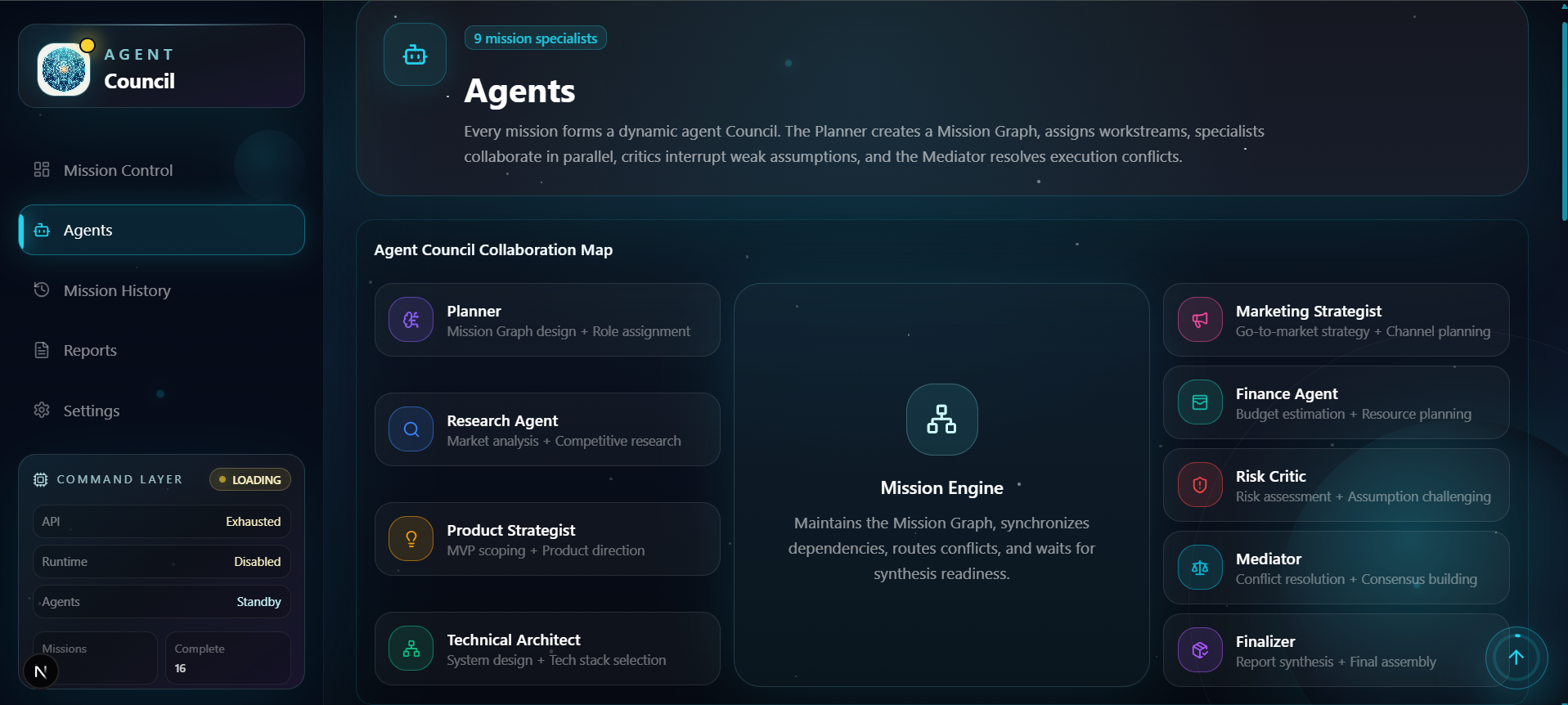
Agents tab showcasing a overview of all the agents , their roles , capabilities and confidence level based on previous missions
-
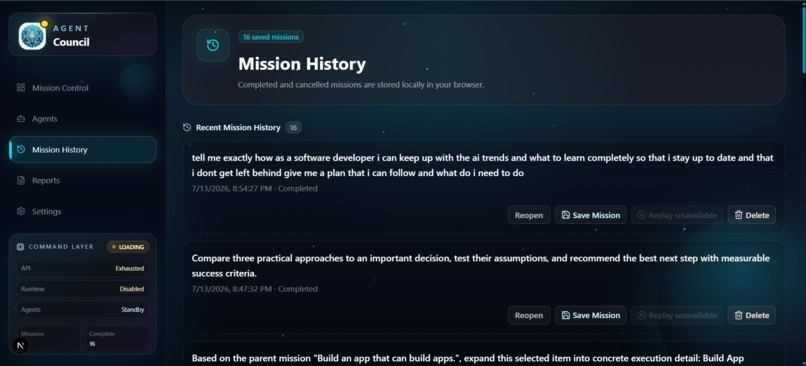
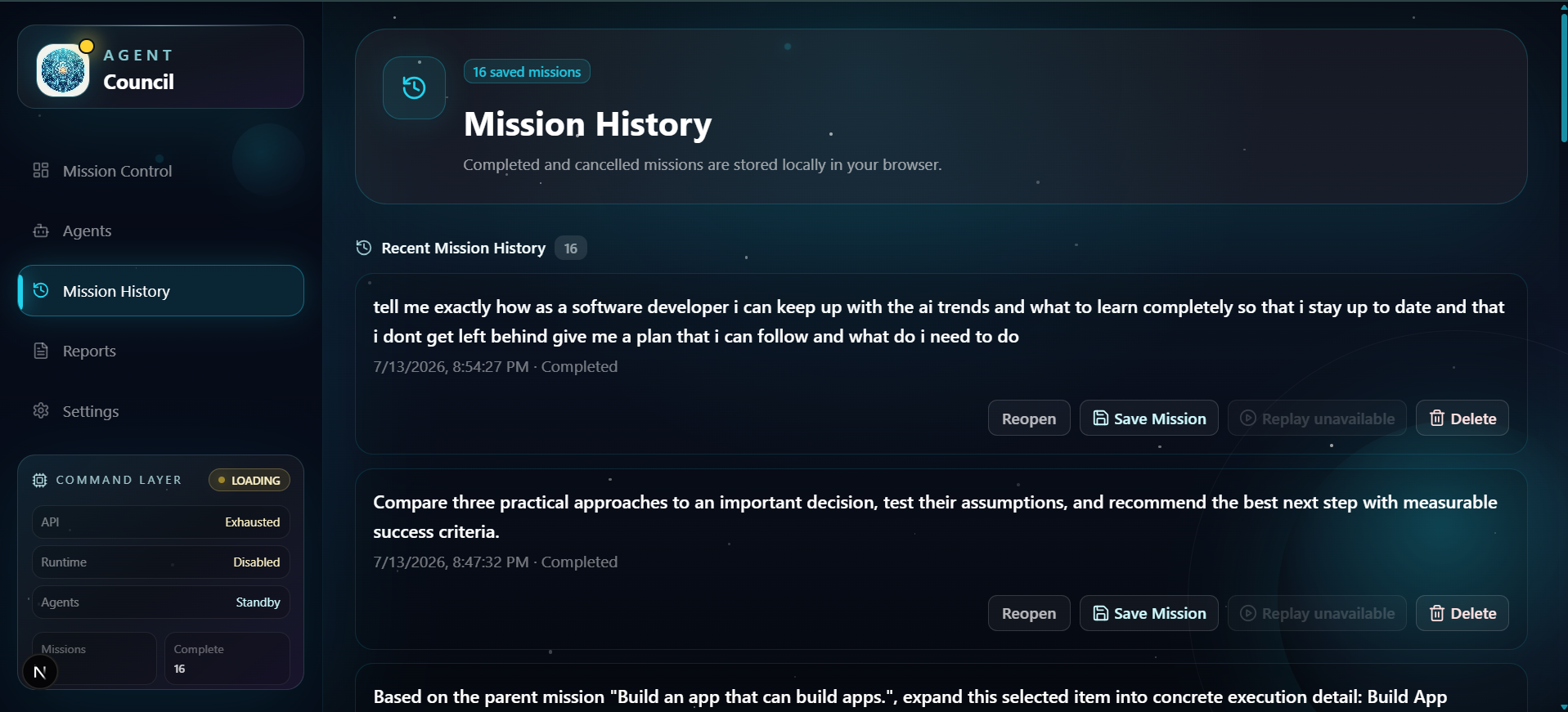
Mission history tab where we can re-open , replay and delete previous missions
-
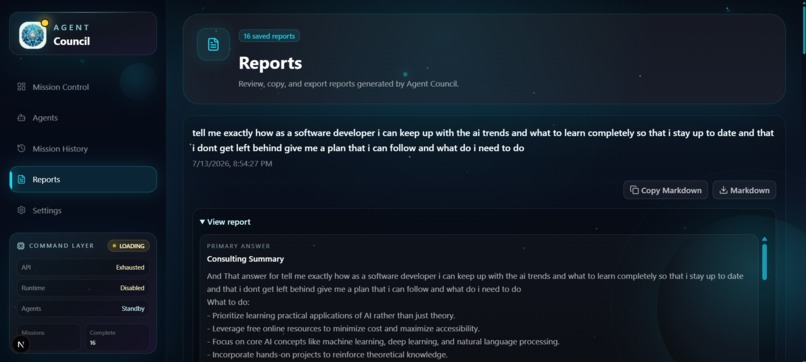
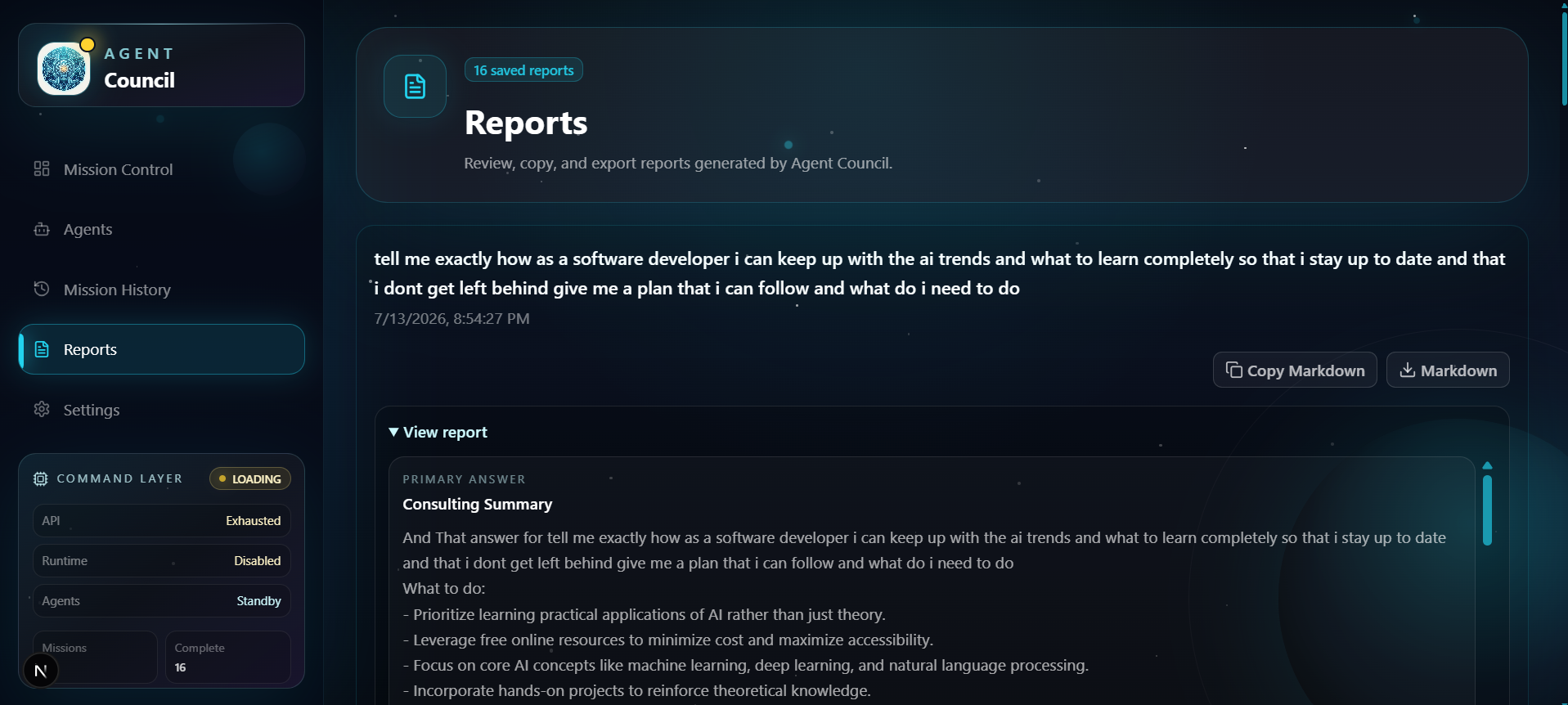
reports tab where we see previous generated reports , download them or copy them as markdown
-
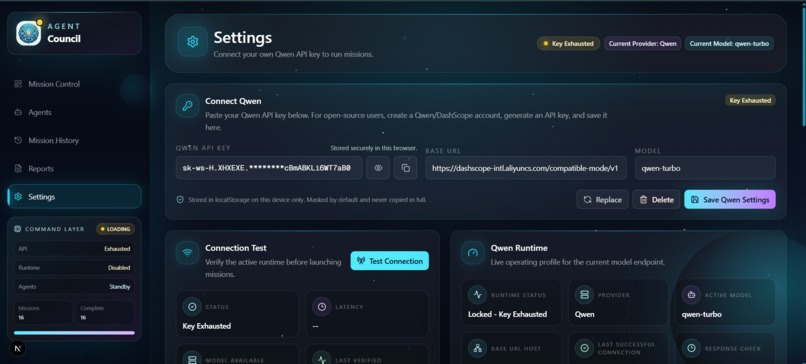
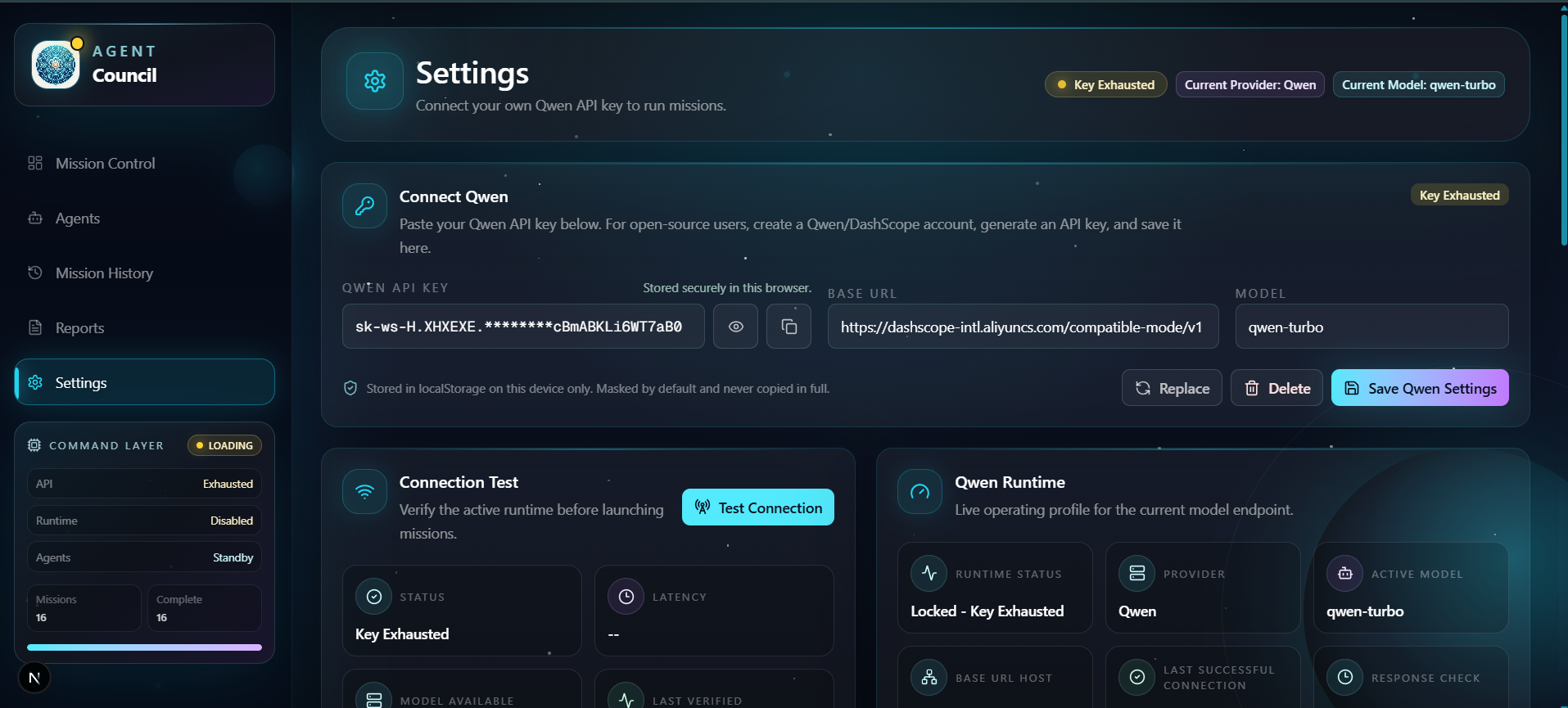
Settings page showcasing the api key input field
-
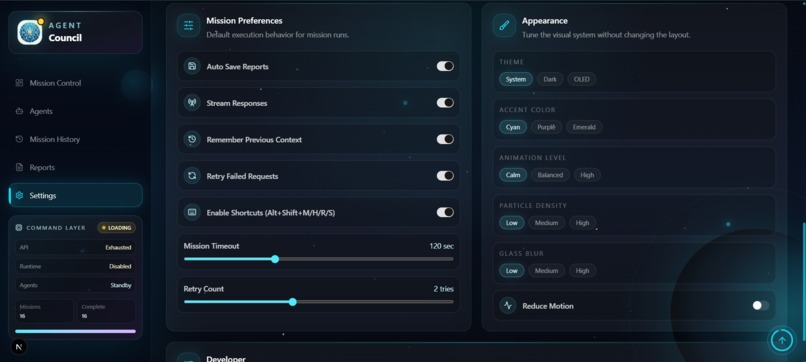
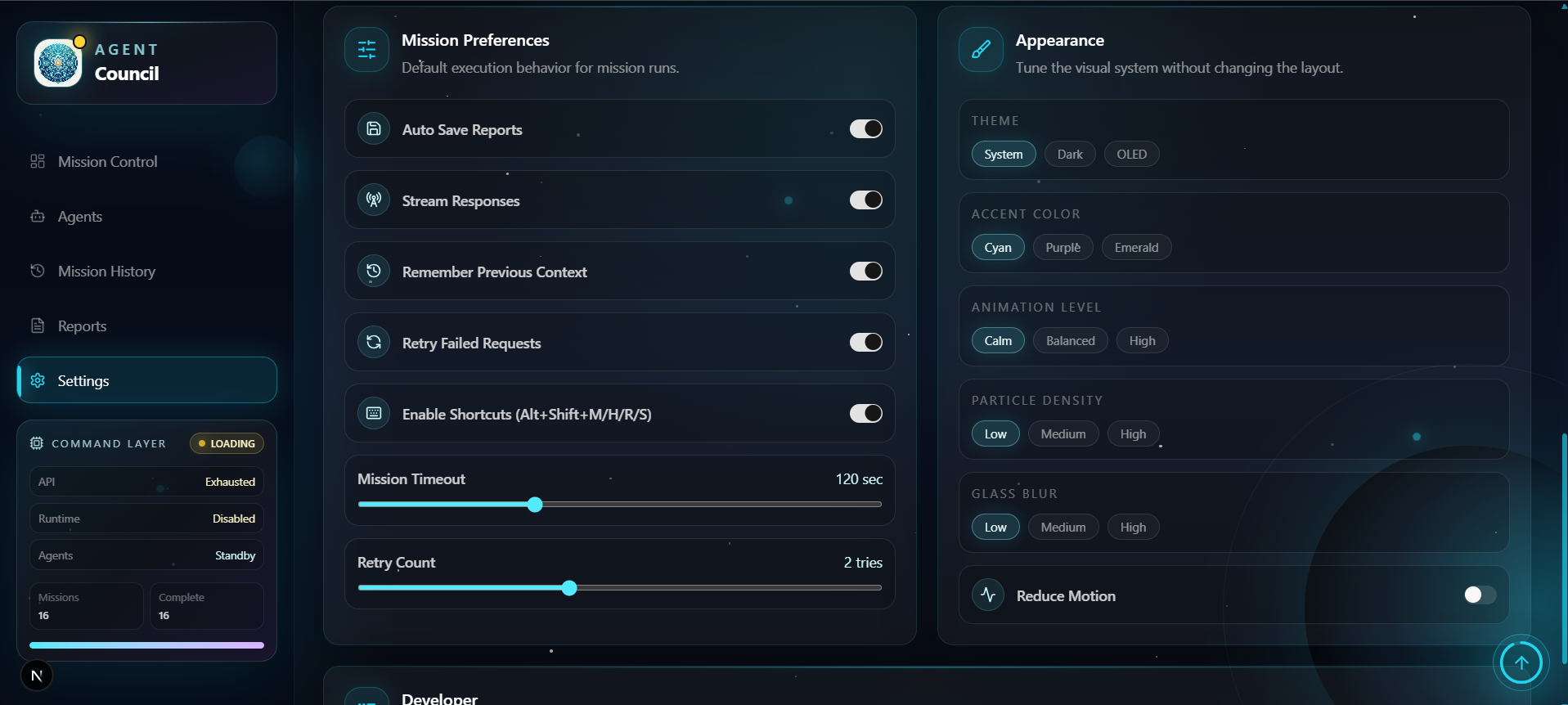
Settings page showcasing appearances and preferences options
-
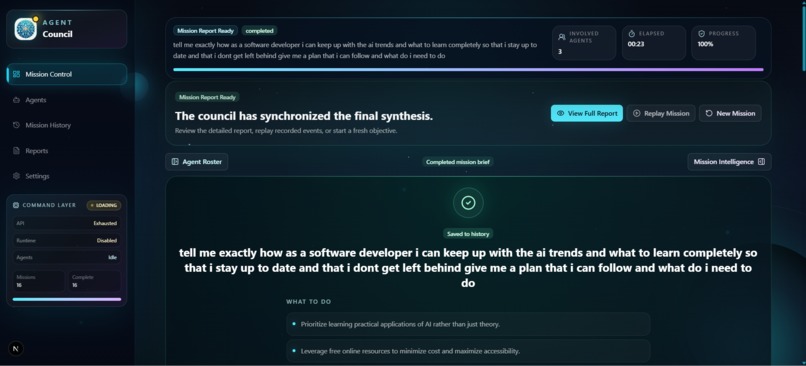
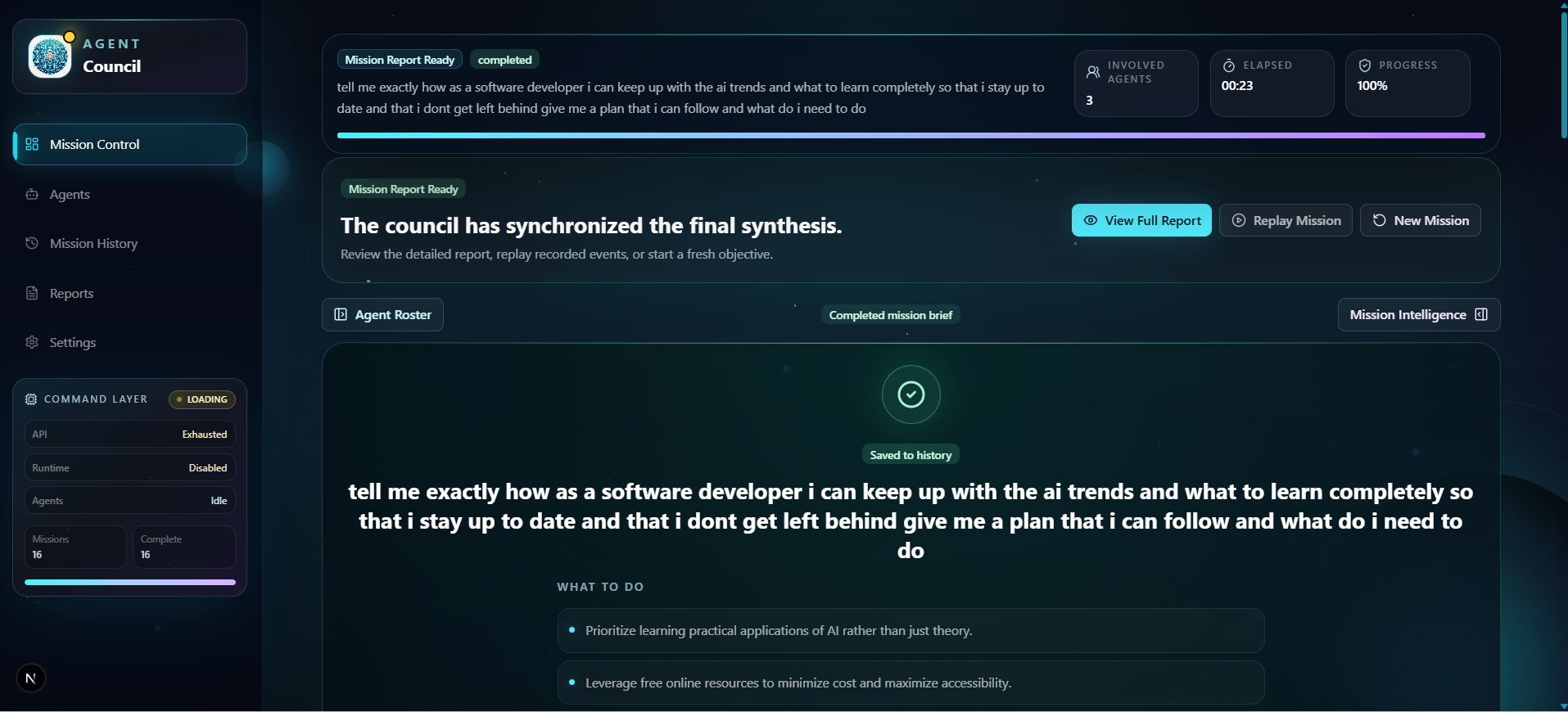
UI showcasing mission success
-
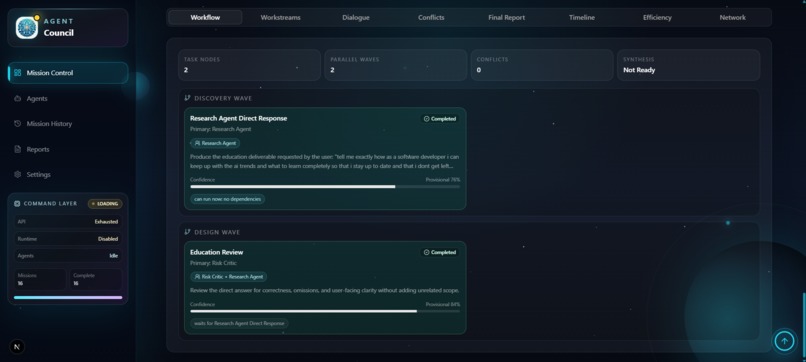
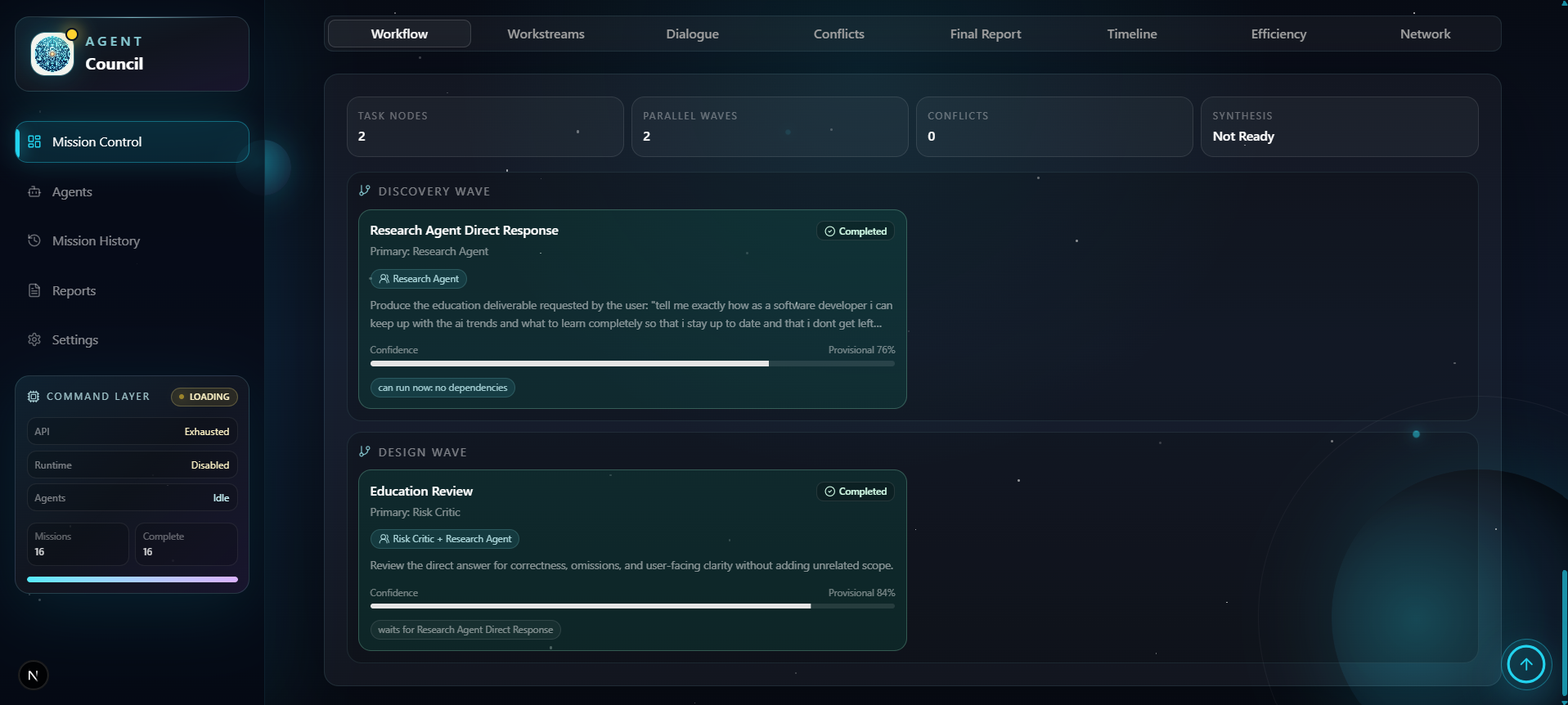
Visualize how the Mission executed, including task dependencies, execution order, and the overall coordination strategy between agents.
-
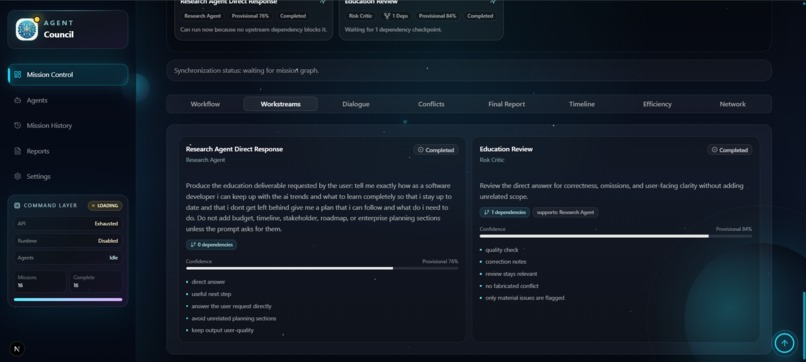
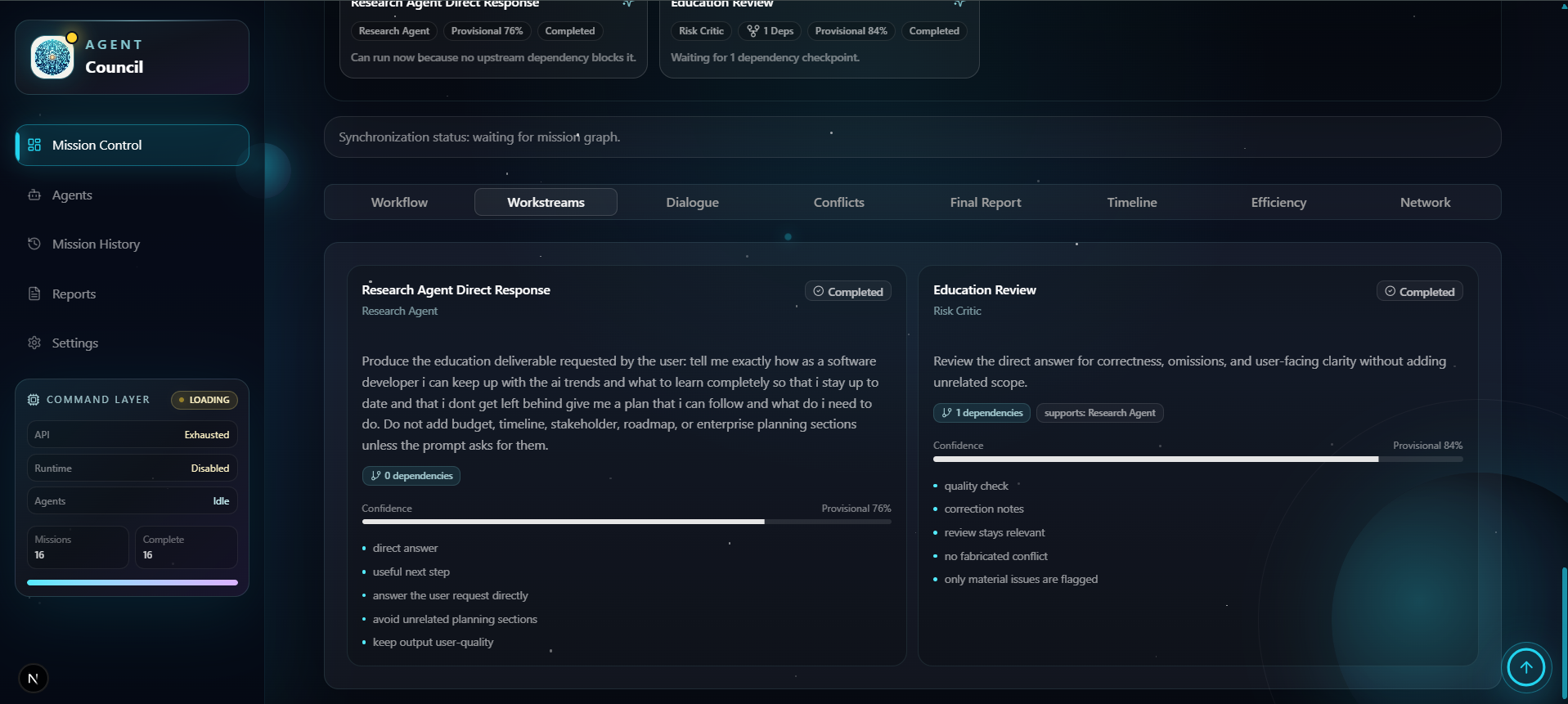
Explore every workstream generated including assigned specialists, dependencies, confidence scores, deliverables, and expected outcomes.
-
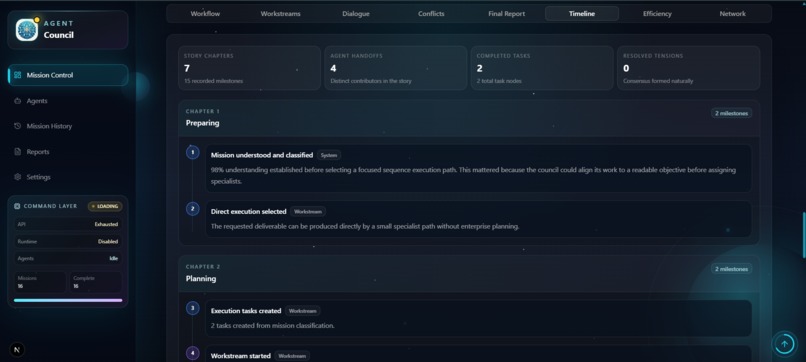
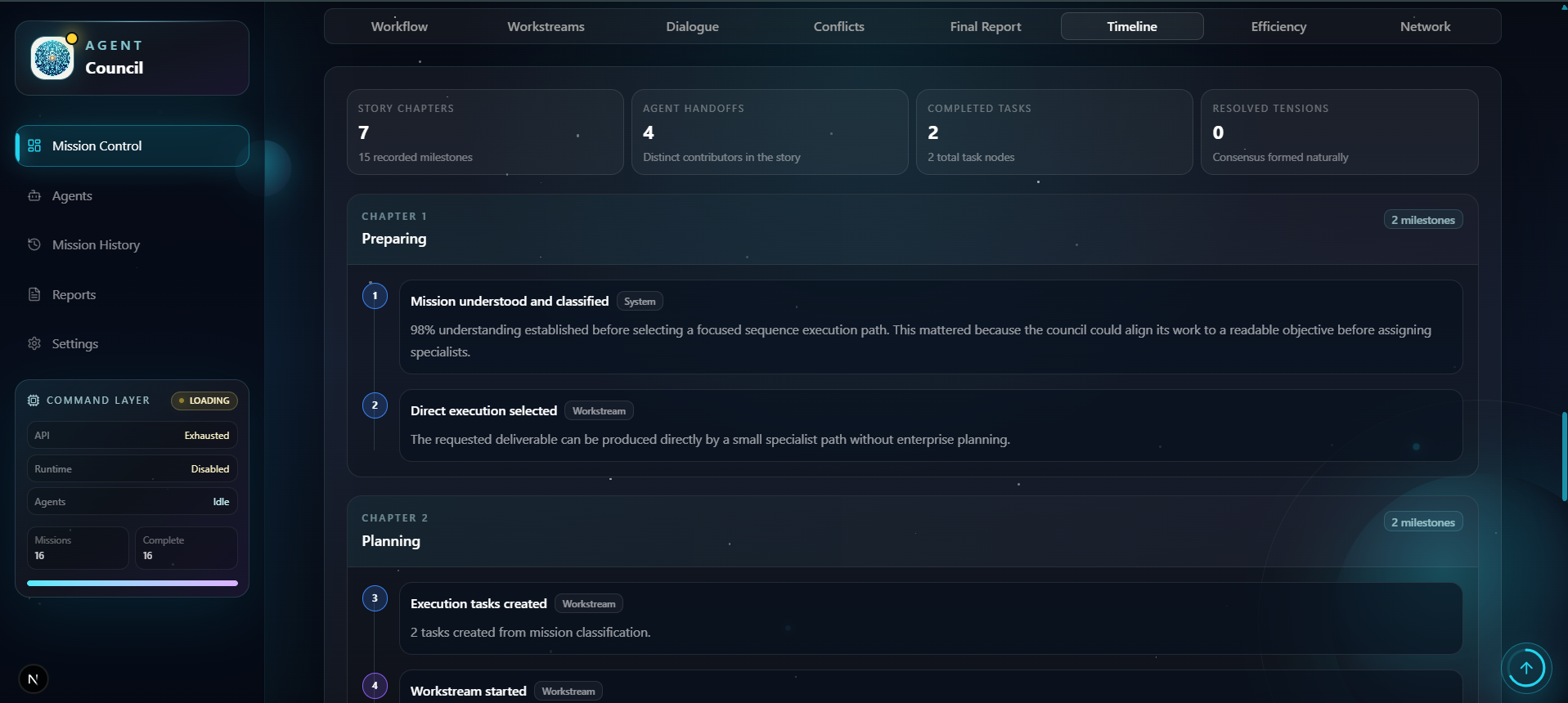
Follow the mission step by step timeline of planning, execution, agent decisions, milestones, and mission progress from start to completion.
-
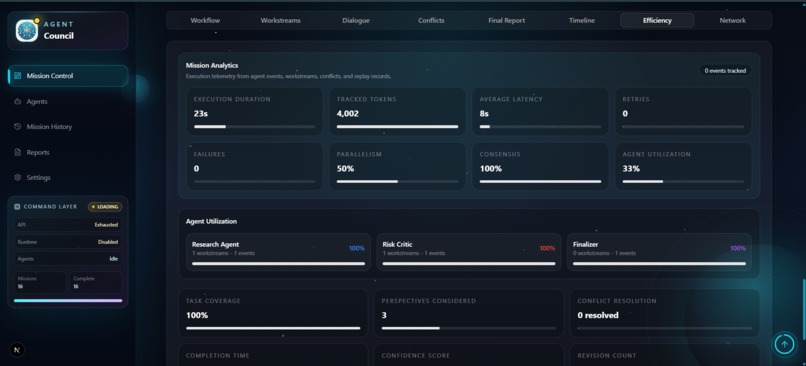
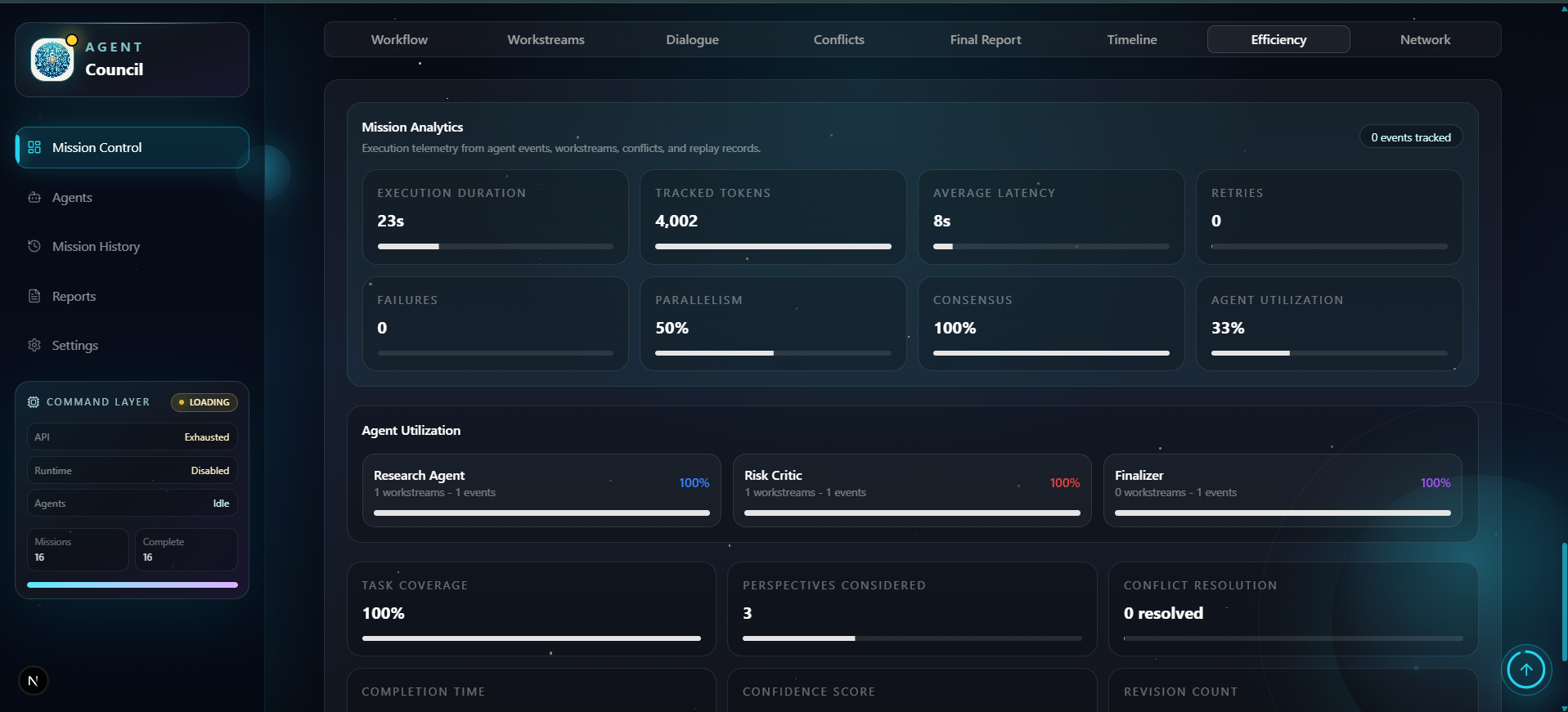
Analyze execution performance through mission analytics.
-
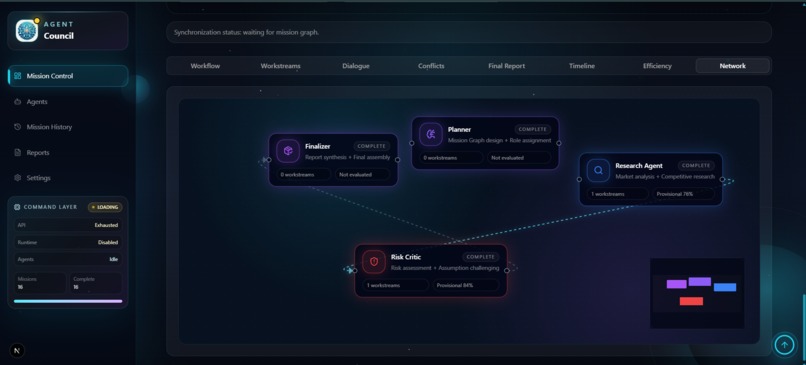
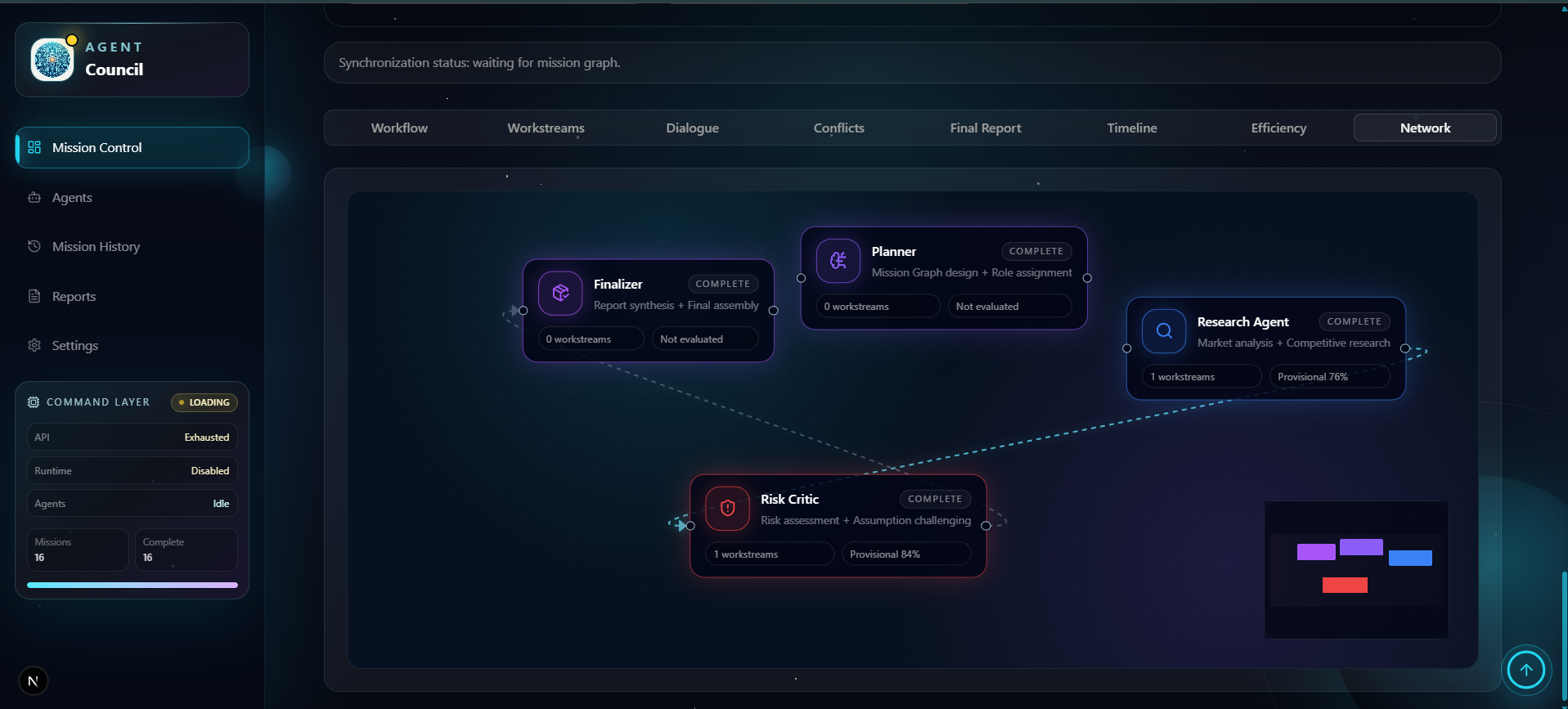
live visualization showing communication paths, dependencies, active relationships and information flow across the council.
Inspiration
Large language models are incredibly capable, but most AI applications still rely on a single agent to solve every type of problem. Complex tasks such as startup planning, software architecture, business strategy, or project execution naturally require multiple perspectives and coordinated decision-making.
Agent Council was inspired by the idea of treating AI like a collaborative team instead of a single assistant. Rather than asking one model to solve everything, the platform creates a dynamic council of specialized AI agents that work together, challenge assumptions, resolve conflicts, and produce transparent, high-quality results.
What it does
Agent Council is an AI Mission Control platform powered by Alibaba Cloud's Qwen API.
A user begins by describing a mission in natural language. Before execution, a Mission Classification Engine analyzes the request, predicts the optimal mission configuration, estimates complexity, and determines the smallest useful team of AI specialists.
For simple requests, the system executes a direct specialist workflow. For complex objectives, Agent Council automatically constructs a Mission Graph, decomposes the objective into workstreams, schedules dependencies, enables parallel execution, and coordinates collaboration between specialized AI agents including Planner, Research Agent, Technical Architect, Product Strategist, Marketing Strategist, Finance Agent, Risk Critic, Mediator, and Finalizer.
Throughout execution, users can monitor live agent collaboration, inspect workflow progress, review dialogue between agents, visualize dependencies, replay completed missions, and receive a polished final deliverable.
How I built it
Agent Council was built as a frontend-first application using:
- Next.js -Tailwind CSS
- Framer Motion
- Alibaba Cloud Qwen API
The application contains a custom Mission Engine responsible for mission classification, graph generation, workstream scheduling, dependency management, agent orchestration, replay recording, and report synthesis.
A dedicated Presentation Layer transforms structured mission data into human-readable reports, dialogue, workflow visualizations, and execution timelines, allowing users to inspect the reasoning process instead of only receiving a final answer.
Challenges I ran into
One of the biggest challenges was designing a collaboration model that genuinely behaved like a team instead of simply calling the language model multiple times.
This required building a Mission Graph capable of handling task dependencies, parallel execution, conflict detection, mediation, replay functionality, and dynamic agent participation while avoiding unnecessary orchestration for simple requests.
Another challenge was making the execution process understandable to users. Significant effort was invested in designing a Mission Control interface that exposes planning, collaboration, dialogue, workflow, and replay in a clear and intuitive way.
Accomplishments that I'm proud of
Some accomplishments I'm particularly proud of include:
- Building a dynamic Mission Classification Engine that decides when planning is actually necessary.
- Creating a Mission Graph execution model instead of relying on static workflows.
- Implementing transparent multi-agent collaboration with specialized AI roles.
- Developing a replay system that reconstructs missions without making additional API calls.
- Designing a premium Mission Control experience that makes complex AI reasoning understandable and interactive.
- Building the entire application as a polished end-to-end product rather than only demonstrating backend orchestration.
What I learned
Building Agent Council reinforced how important orchestration is for complex AI systems.
I learned that the quality of multi-agent collaboration depends far more on execution strategy, task decomposition, dependency management, and information sharing than simply increasing the number of model calls.
The project also deepened my understanding of prompt engineering, AI workflow design, frontend architecture, user experience, and integrating production-ready AI services through Alibaba Cloud's Qwen API.
What's next for Agent Council
The next step is transforming Agent Council into a full AI operating system capable of supporting long-running collaborative missions.
Future work includes persistent cloud synchronization, collaborative multi-user missions, external tool integrations, autonomous task execution, memory across missions, enterprise workflows, and support for additional AI providers while continuing to improve transparency, and real-world usability.
Built With
- framermotion
- next.js
- tailwind


Log in or sign up for Devpost to join the conversation.