Agent Control Plane — Project Story
Govern every AI action. Trust nothing by default.
Inspiration
AI agents are being handed real power — reading databases, changing data, and making decisions that affect customers, finance, and sensitive systems. In most deployments, that power is not governed: nobody can answer who is allowed to act, why an agent is trusted, what it did, or whether the trail can be trusted.
That gap inspired Agent Control Plane: a zero-trust gateway that sits between agents and data, treating agents as first-class principals with identity, policy, delegation bounds, and an auditable ledger.
What it does
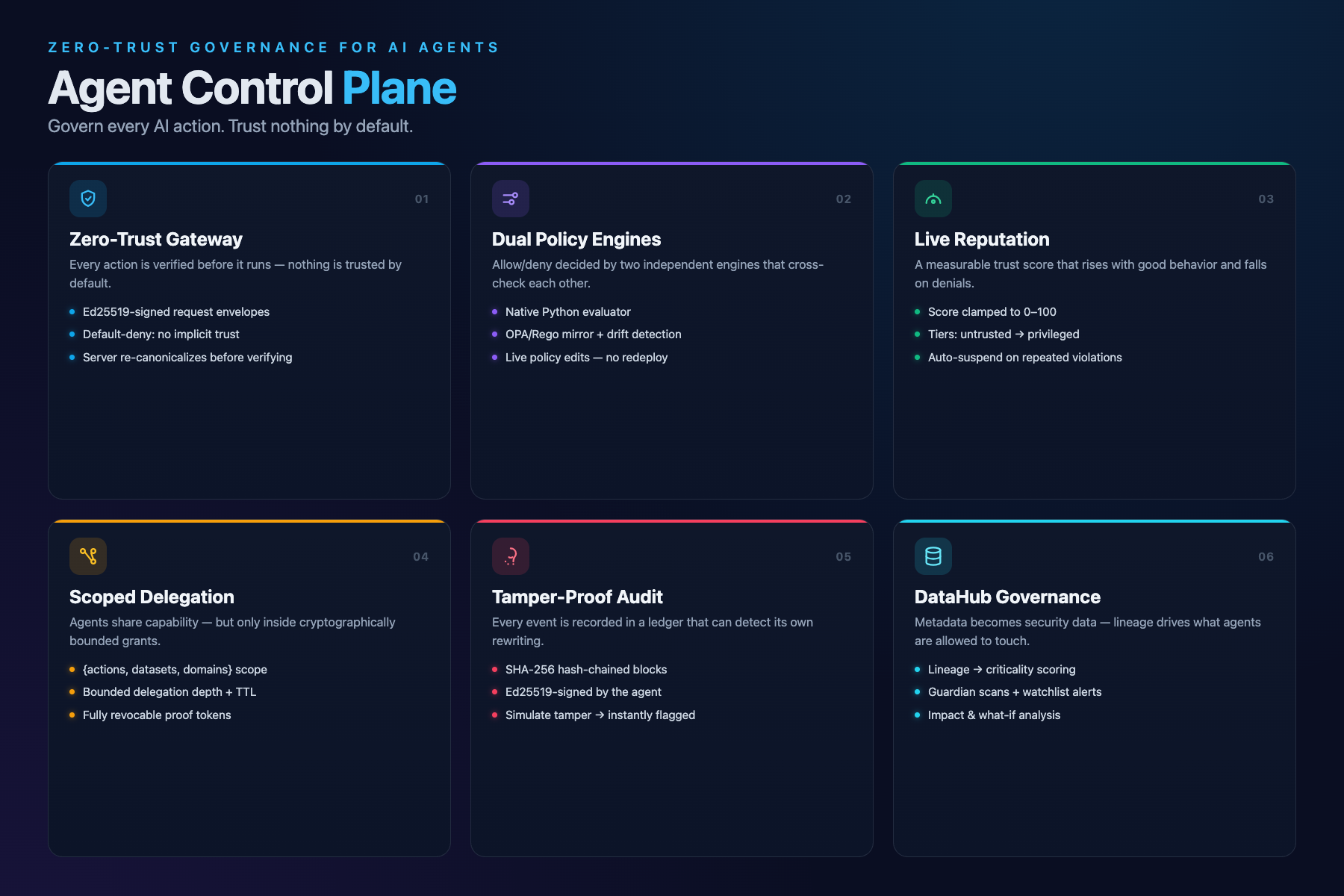
- Issues Ed25519 identities to agents and requires a signed envelope on every action.
- Decides every action with default-deny policy in both native Python and OPA/Rego, gated by a live reputation tier.
- Bounds delegation with cryptographically scoped
{actions, datasets, domains}tokens. - Records every event in a SHA-256 + Ed25519 hash chain that detects tampering.
- Uses DataHub as governance substrate, pulling domains, classification, lineage, and ownership into criticality, monitoring, and impact analysis.
How we built it
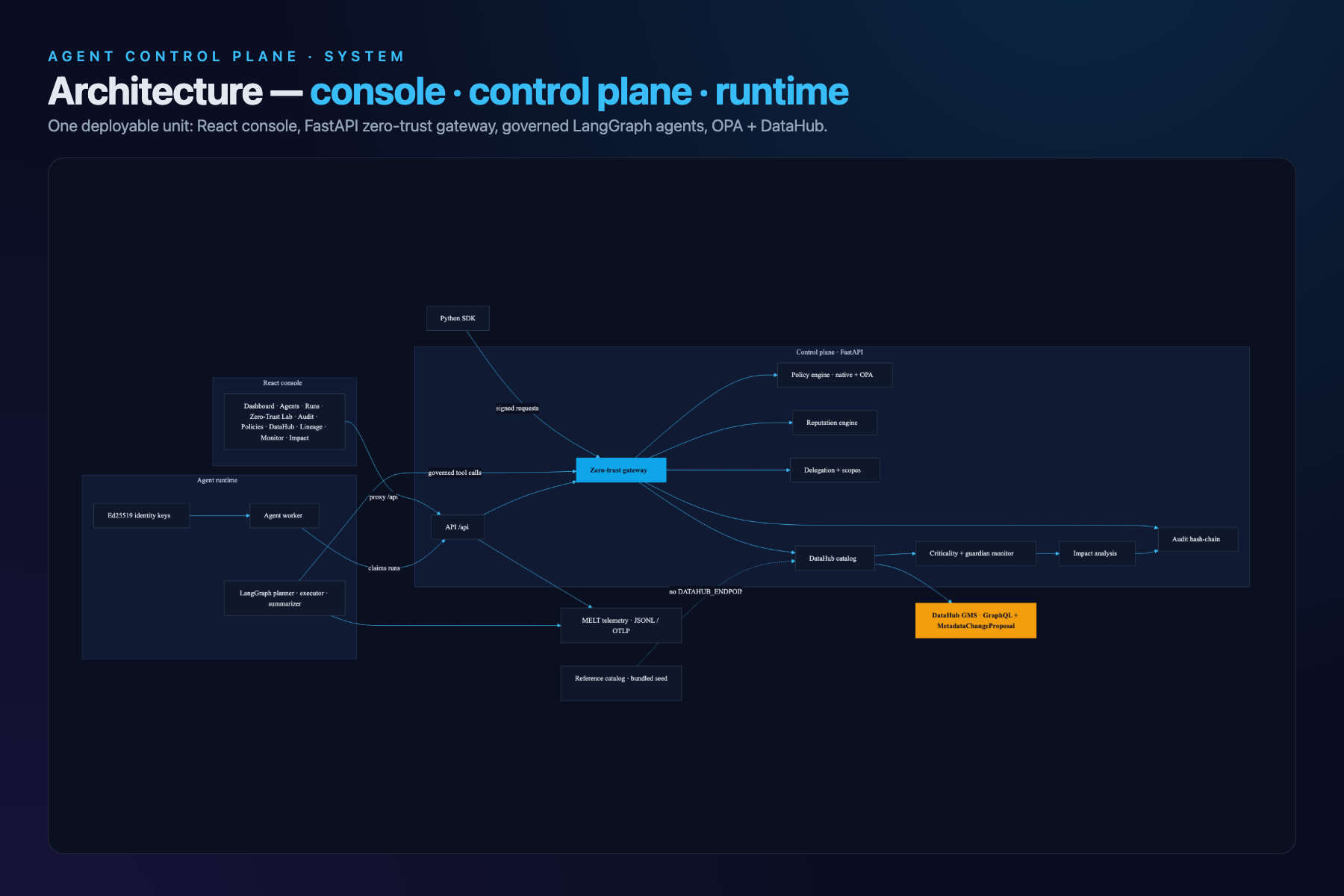
The stack is intentionally simple where it should be, and purpose-built where it needs to be: FastAPI + SQLite for the control plane, React/Vite for the console, LangGraph for governed agents, and OpenTelemetry for telemetry.
Key design choices:
- Signed request envelopes ensure no implicit trust. The client canonicalizes and signs the payload, and the server re-canonicalizes before verification.
- Reputation is a live, audited score. Actions adjust a clamped score in
[0,100], with tiers fromuntrustedtoprivilegedand sanctions for repeated violations. - DataHub lineage is treated as security data, not just metadata. Criticality is derived from lineage centrality, impact, classification risk, and blast radius.
- The audit ledger stores every event as a hash-chained, agent-signed block, making tampering visible and verifiable.
- The product is deployable as one multi-arch image with bundled OPA and a Python SDK for real agents.
Challenges we ran into
- Making governance feel alive required a live scenario, not just backend rules. We built a Zero-Trust Lab that shows reputation, delegation, and denials in real time.
- Deployment needed to work across Apple Silicon development and Linux/amd64
hosting. We solved that with
docker buildxmulti-arch builds and runtime selection of the correct OPA binary. - Free hosting environments have no persistent disk and can spin down quickly. We made boot-time reseeding first-class so the app starts fully populated even after cold boots.
- Documenting the architecture across two engines and one story was hard. We narrowed the narrative until a single Mermaid sequence diagram captured the signed-request flow clearly.
Accomplishments that we're proud of
- A governance plane with real cryptographic identity, policy, delegation, and audit, not just policy checks around a prompt.
- Dual policy engines so native Python decisions can be cross-checked by OPA, improving resilience and drift detection.
- A hash-chained audit ledger that detects tampering and ties every event back to the signing agent.
- A DataHub-integrated criticality model that uses real lineage, ownership, and classification data.
- A deployable, self-seeding system that works even in low-resource or ephemeral hosting environments.
What we learned
- Policy is a product, not a setting. The hard part is explainability, audit, and live mutability, not just allow/deny.
- Default-deny changes the threat model: missing grants become visible denials, not silent failures.
- Dual engines are a feature. Two implementations of the same rules surface drift and keep the system running when one engine is unavailable.
- Demo dependencies need a lightweight fallback. A reference catalog mode makes the app work without a full DataHub stack while clearly signaling limited mode.
What's next for Agent Control Plane
- Cross-engine policy verification in CI to compare native and OPA decisions.
- Streaming the audit chain into DataHub so the ledger lives alongside governed metadata.
- Policy-as-code for agents: let domain owners author policy naturally and compile it to both execution engines.


Log in or sign up for Devpost to join the conversation.