Inspiration
Every agent platform we looked at knows how to launch agents. None of them answers the question an operations team asks first: what happens when an agent fails in the middle of something that matters?
An agent stuck at 60 % of a procurement workflow is a stopped production line. The industry's answer is to make agents smarter. We think that is the wrong unit of reliability. A single agent will always be able to fail — the mission is what must not.
So we changed the question. Not "how do we make this agent better?" but "how do we keep the mission alive when the agent, the dependency, or the runtime goes down?"
What it does
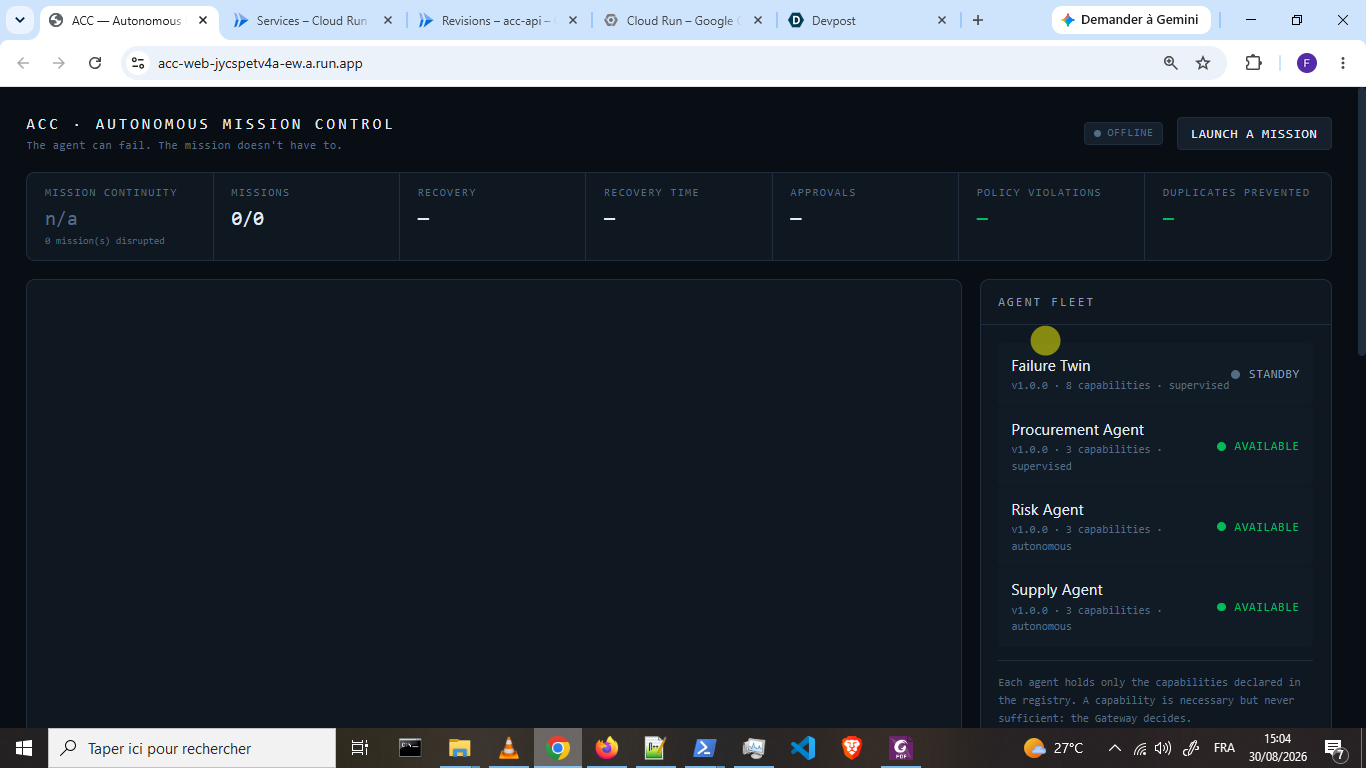
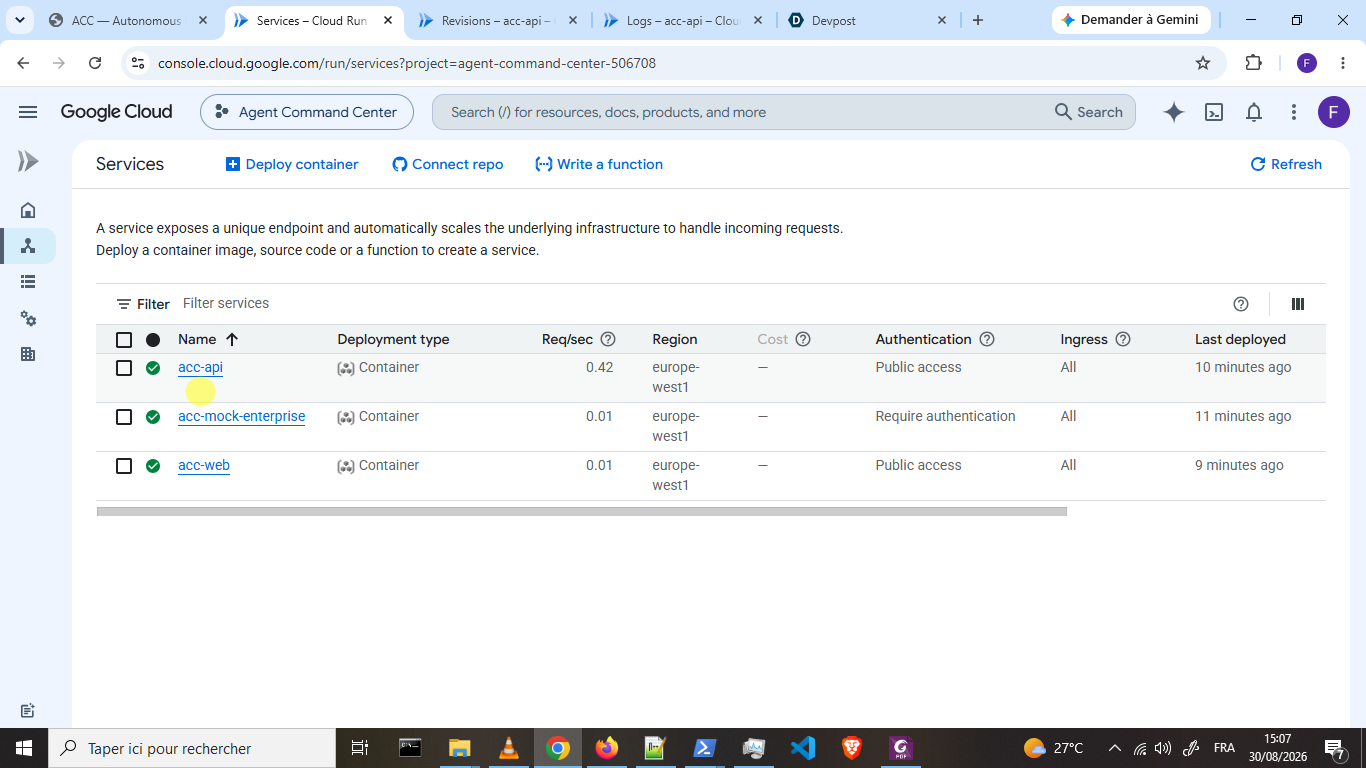
ACC is a control plane for autonomous enterprise missions. A governed fleet of four ADK agents executes a long-running mission; when reality breaks, ACC recovers it without leaving its authority boundary.
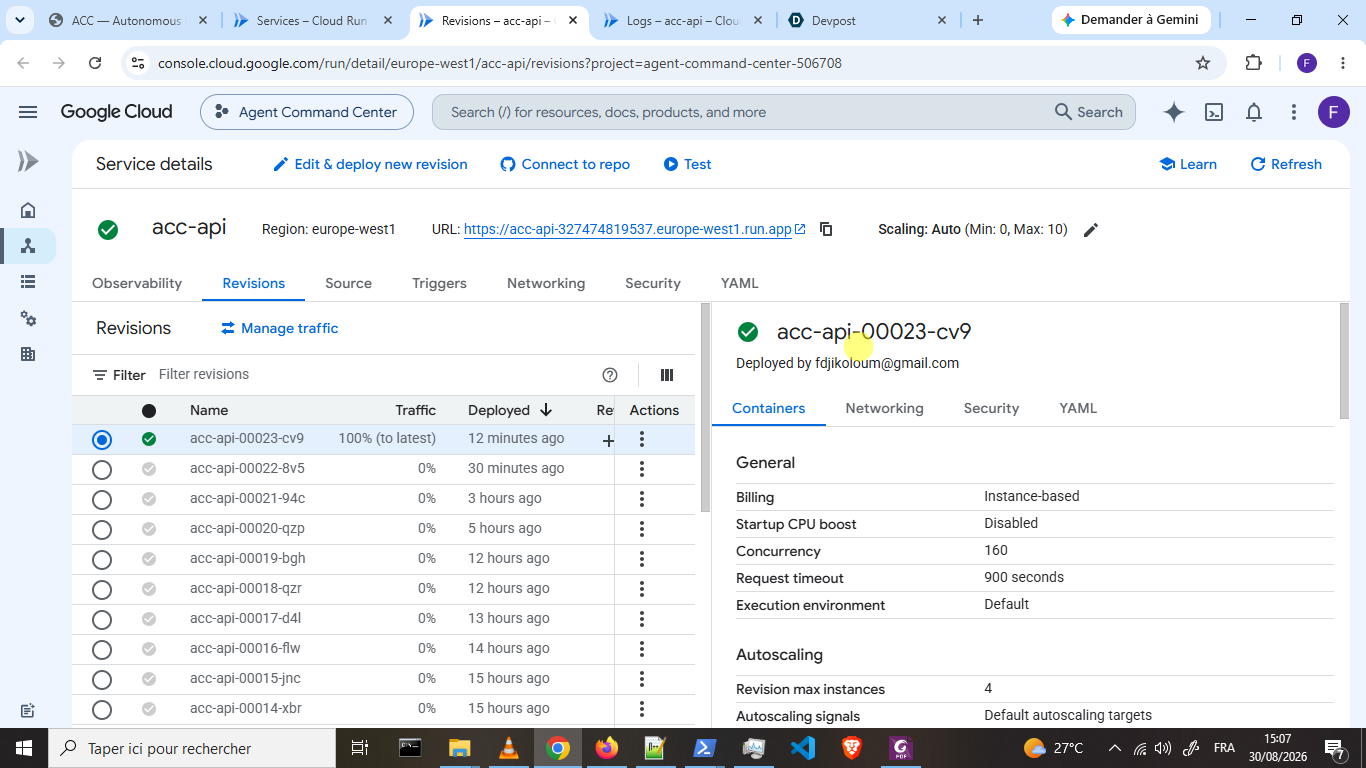
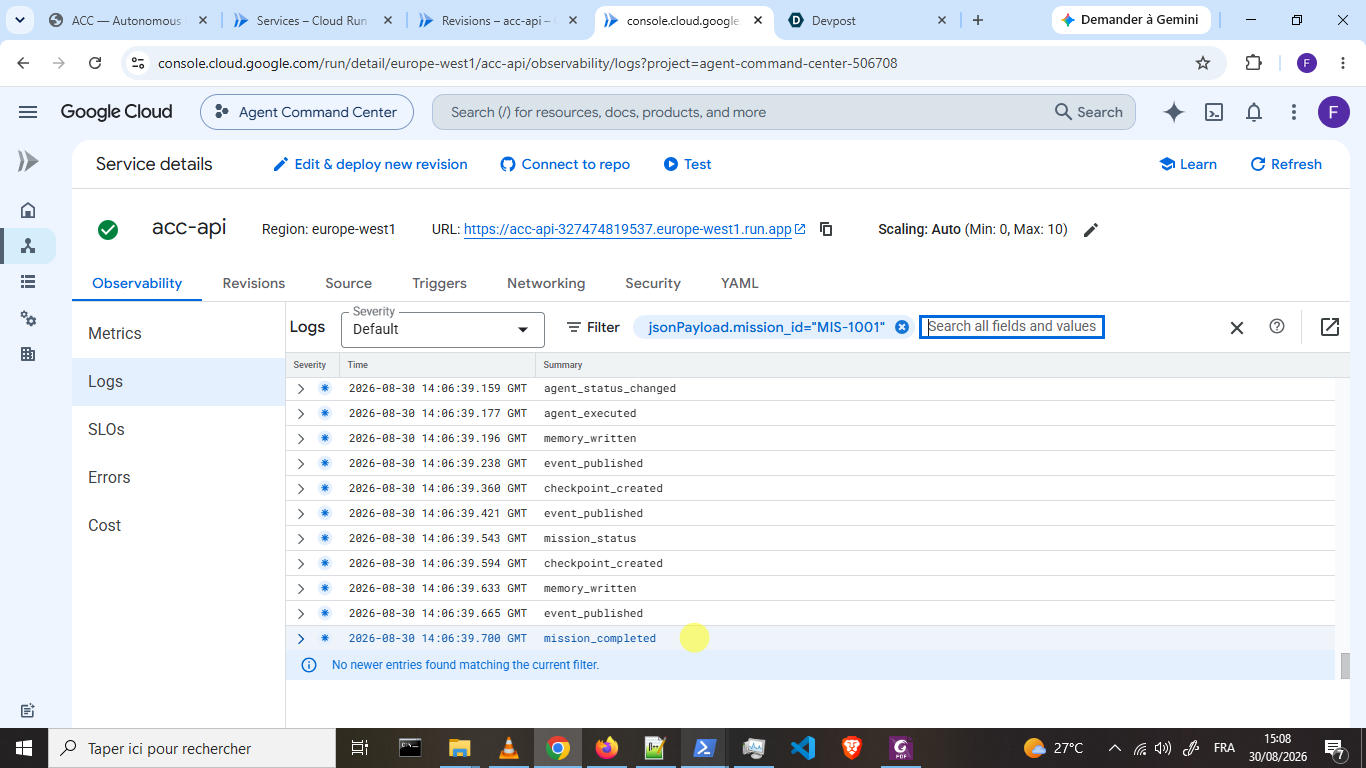
The hero scenario, running live on Cloud Run:
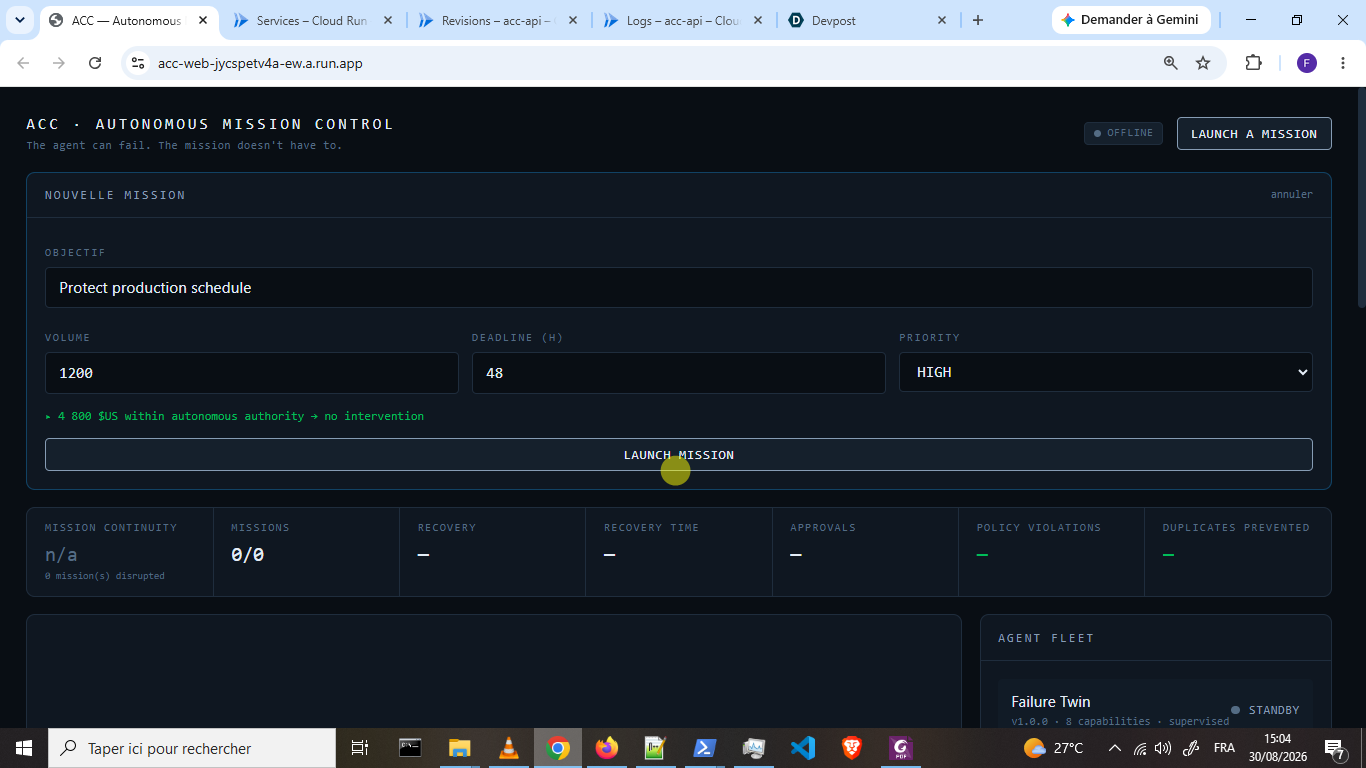
- A mission must secure 1 200 units within 48 hours. The fleet starts work.
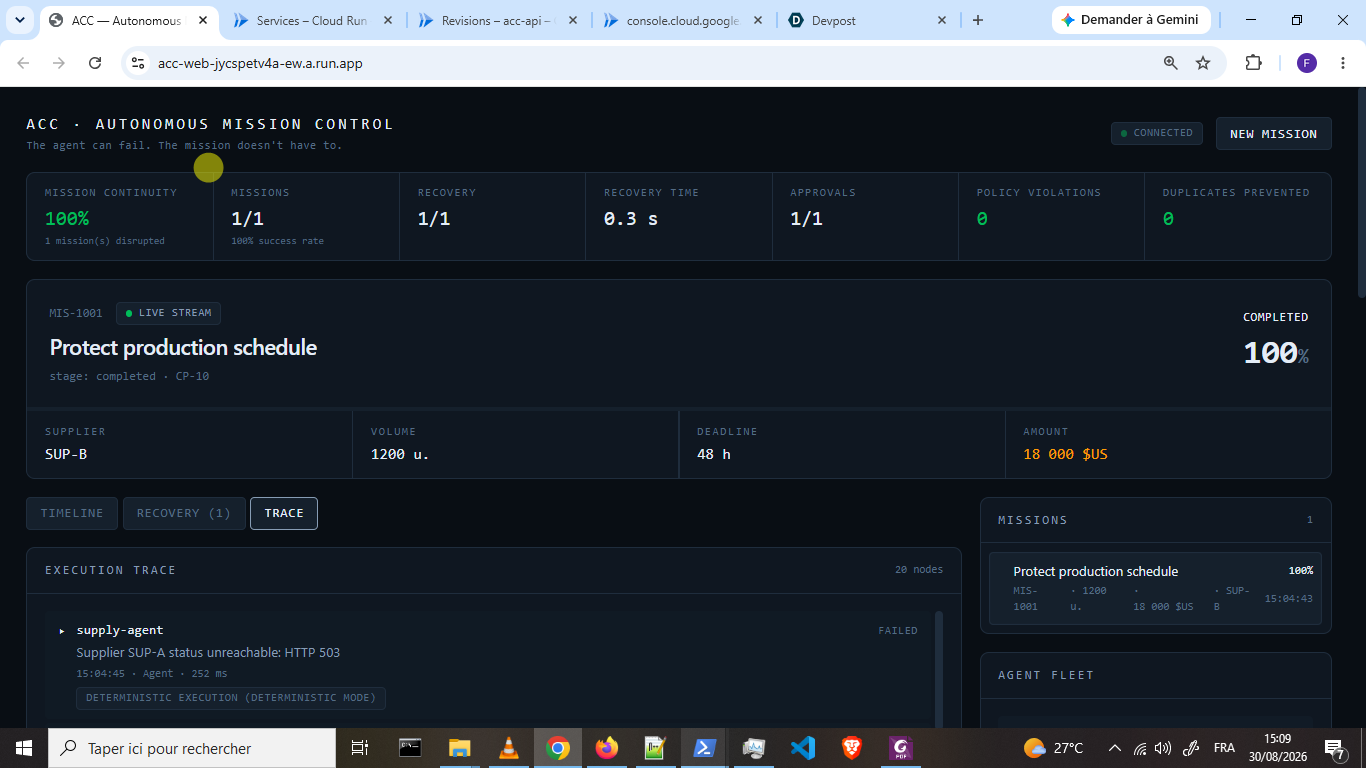
- The primary supplier returns HTTP 503. The mission is marked AT RISK.
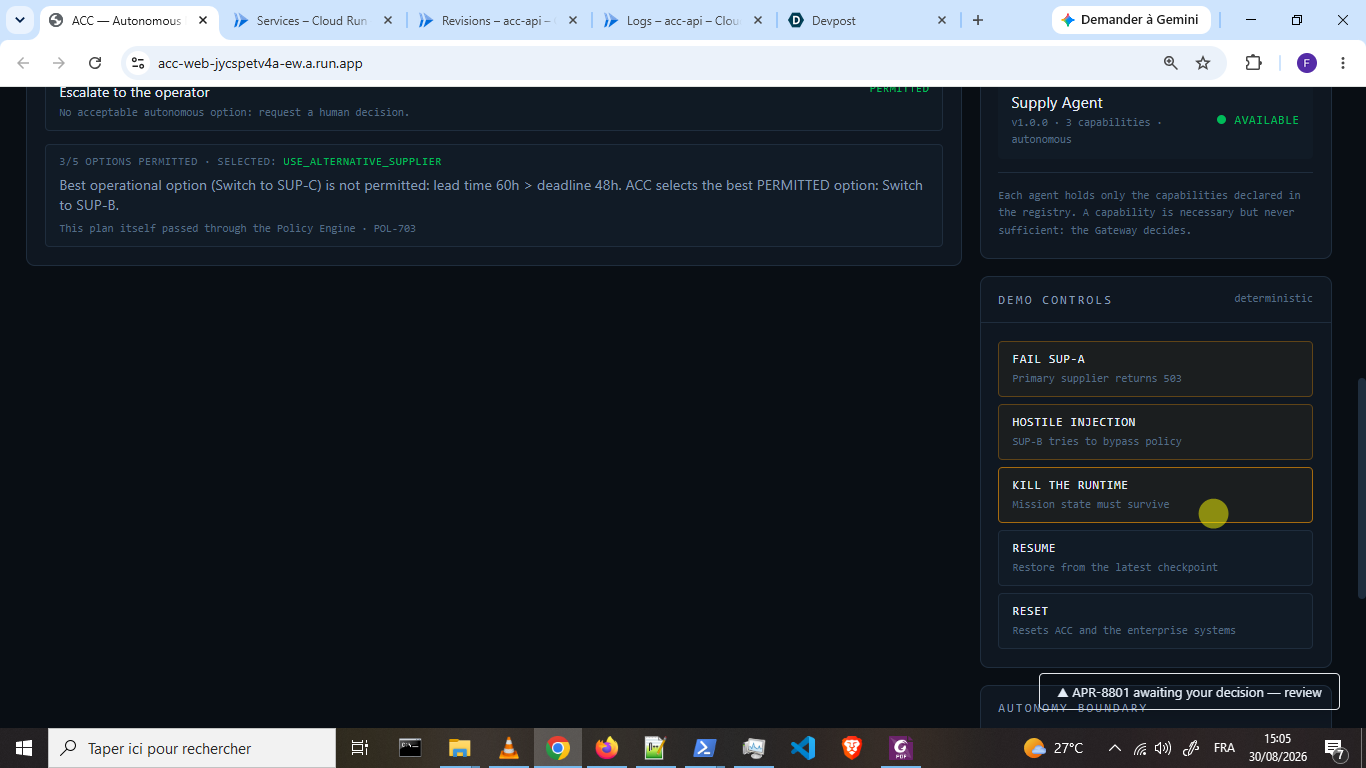
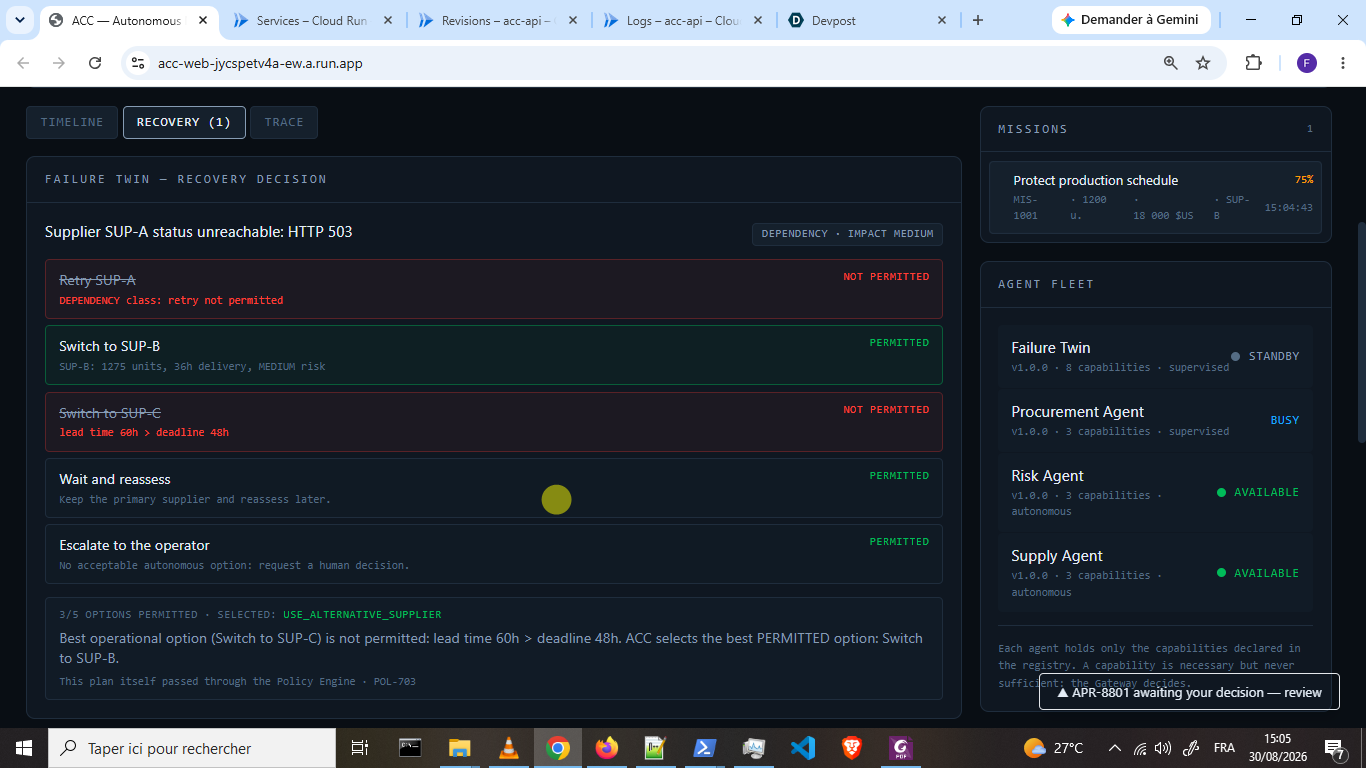
- The Failure Twin diagnoses it, evaluates five recovery options and rules out two: retrying a DEPENDENCY failure, and a cheaper supplier that would deliver in 60 h against a 48 h deadline.
- It selects the best permitted option — not the best one. That distinction is the product.
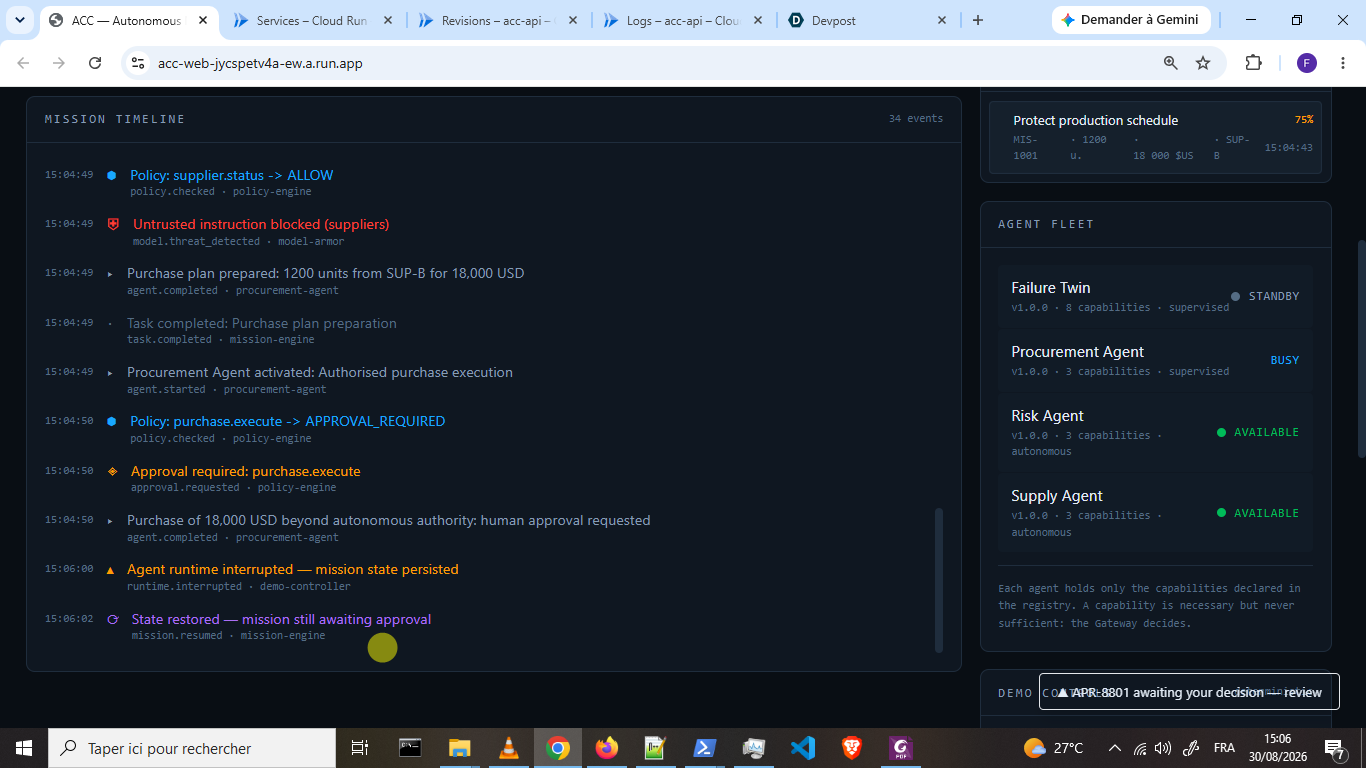
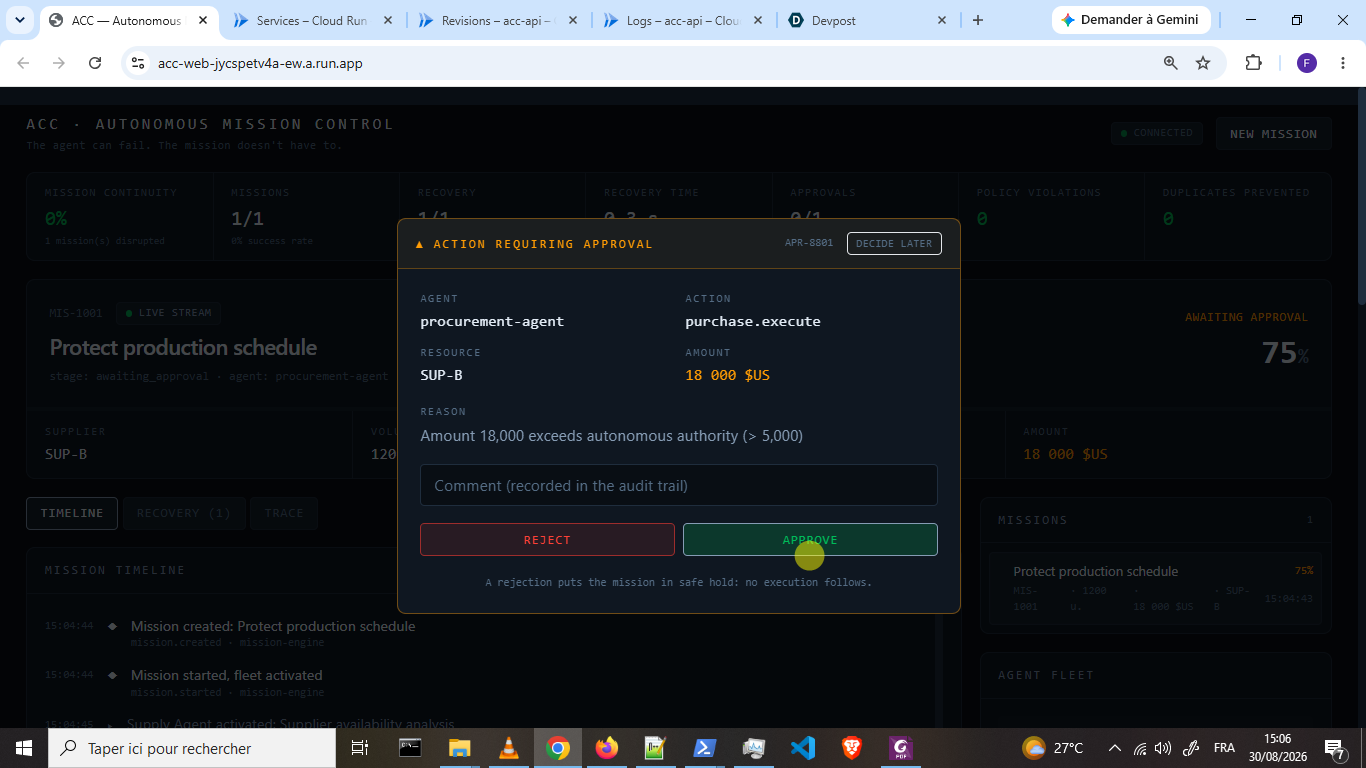
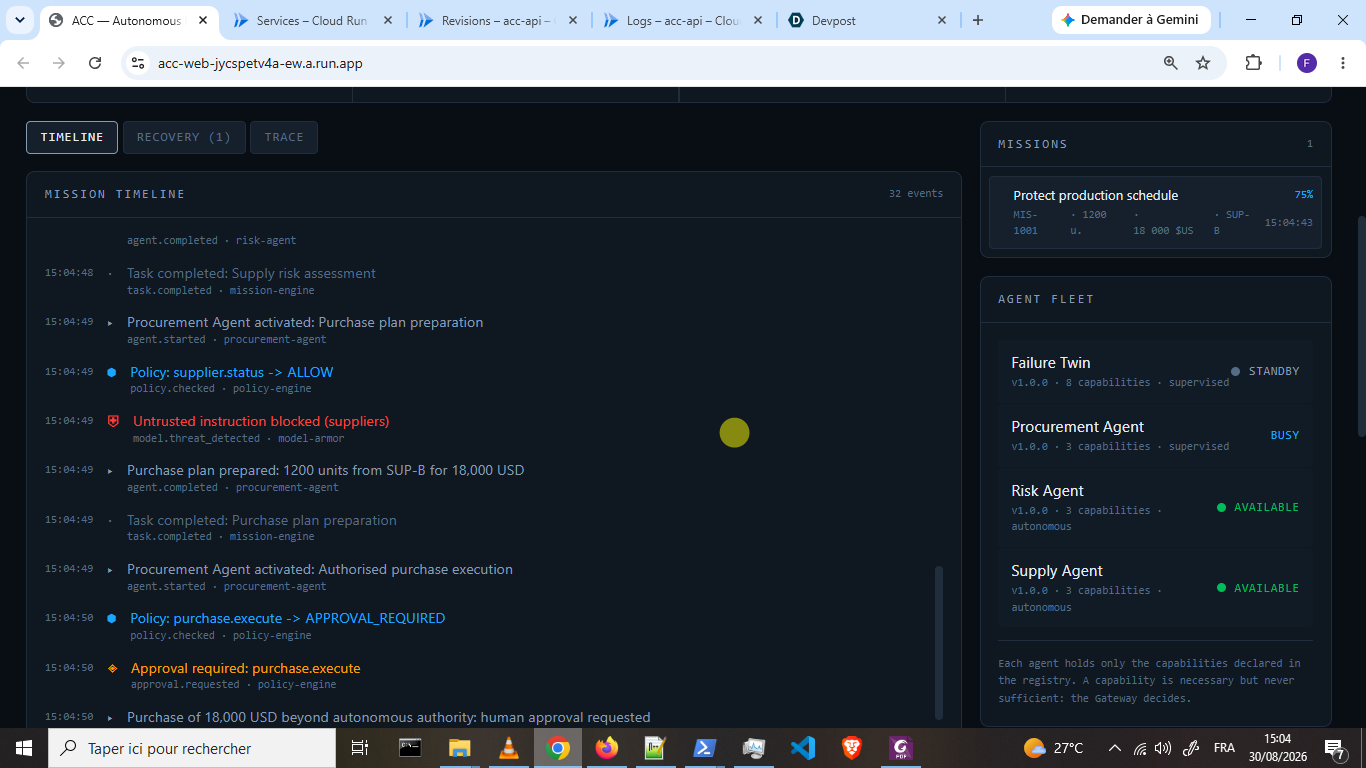
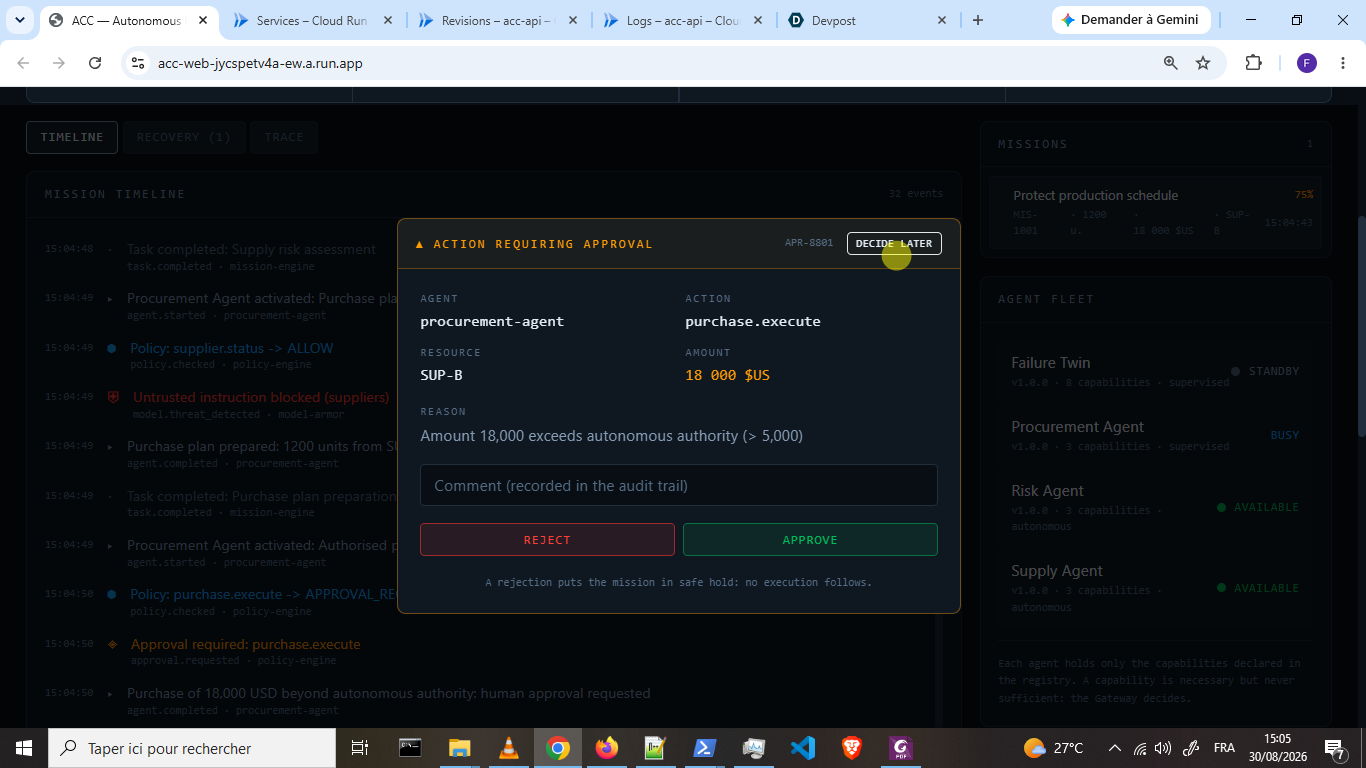
- The fallback costs 18 000 $, above the 5 000 $ autonomous threshold, so ACC stops and asks a human. In the nominal run the same mission costs 4 800 $ and completes with no intervention: it is the disruption that crosses the boundary.
- A hostile supplier message tries to bypass the policy. Model Armor blocks it; the approval is still required.
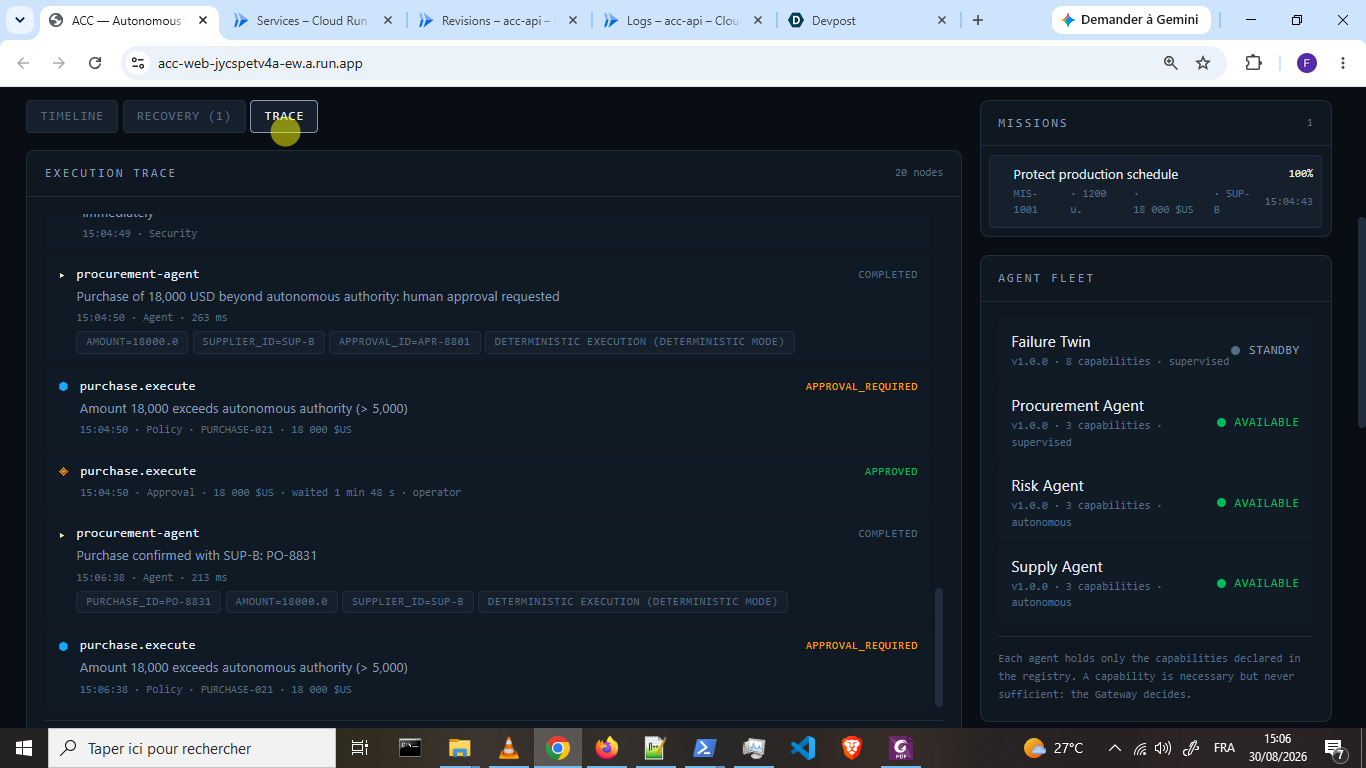
- The operator approves. The purchase executes exactly once, and the whole chain is reconstructable from the trace.
Two properties hold throughout: recovery is itself governed — the Failure Twin's plan goes back through the Policy Engine like any other action — and an approval is durable state, surviving a runtime kill and resuming when the human answers.
North star metric: Mission Continuity Rate, the share of disrupted missions that still reach their objective. The deployed run reports 100 % on one disrupted mission, with zero policy violations.
How we built it
- Control plane — FastAPI on Cloud Run: Mission Engine, Recovery Engine, Policy Engine, Approvals, Memory Bank, Agent Registry, Audit.
- Agent fleet — Google ADK with Gemini 3.6 Flash: Supply, Risk,
Procurement and the Failure Twin. Three execution modes (
adk,hybrid,deterministic); the deterministic path calls no model but still traverses the Agent Gateway, so governance is demonstrable without a quota. - The Agent Gateway is the single execution boundary:
IDENTITY → CAPABILITY → POLICY → APPROVAL → IDEMPOTENCY → TOOL → MODEL ARMOR → AUDIT. No line of code lets an agent reach an enterprise system any other way. - State — Firestore is the source of truth; Pub/Sub carries asynchronous continuation, so no mission depends on an HTTP request or a container's lifetime.
- Security — Model Armor on prompts and tool output, Secret Manager for generated secrets, per-service IAM identities, OIDC between services.
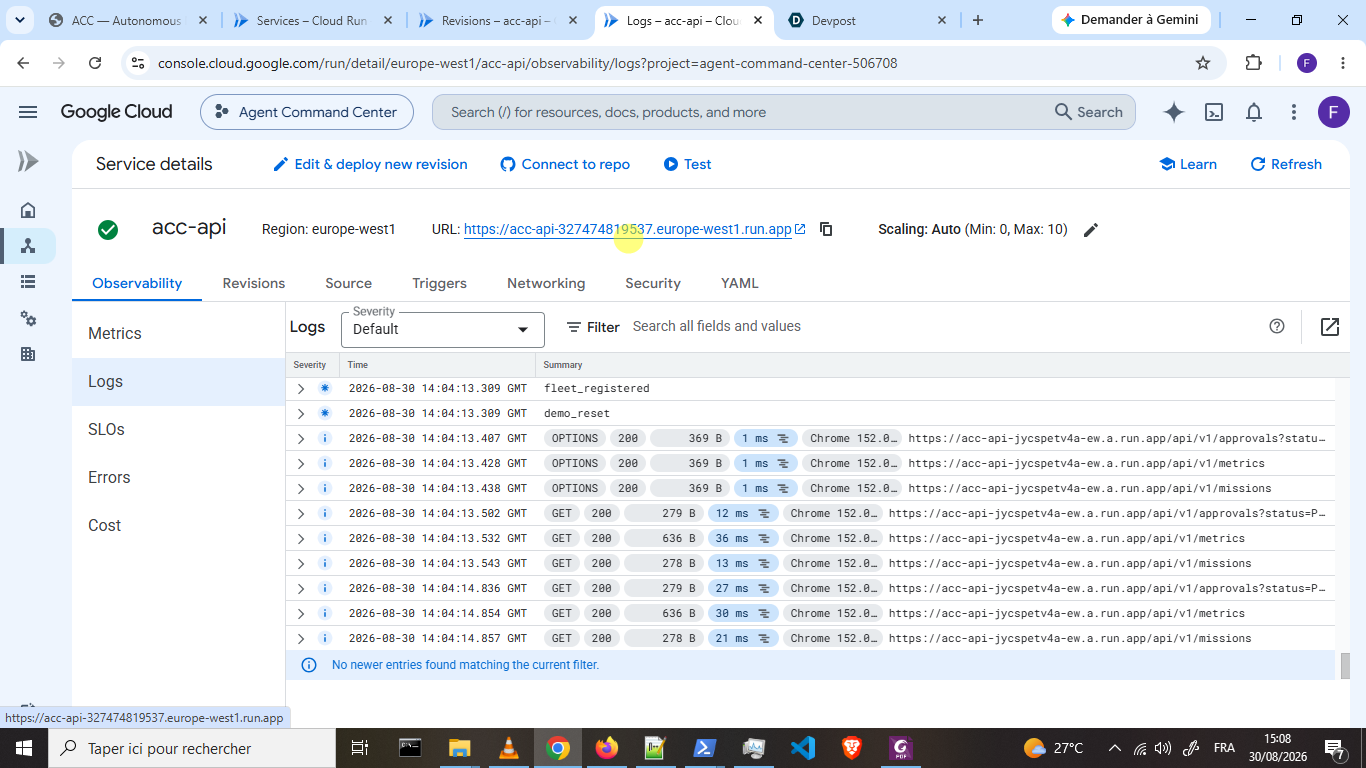
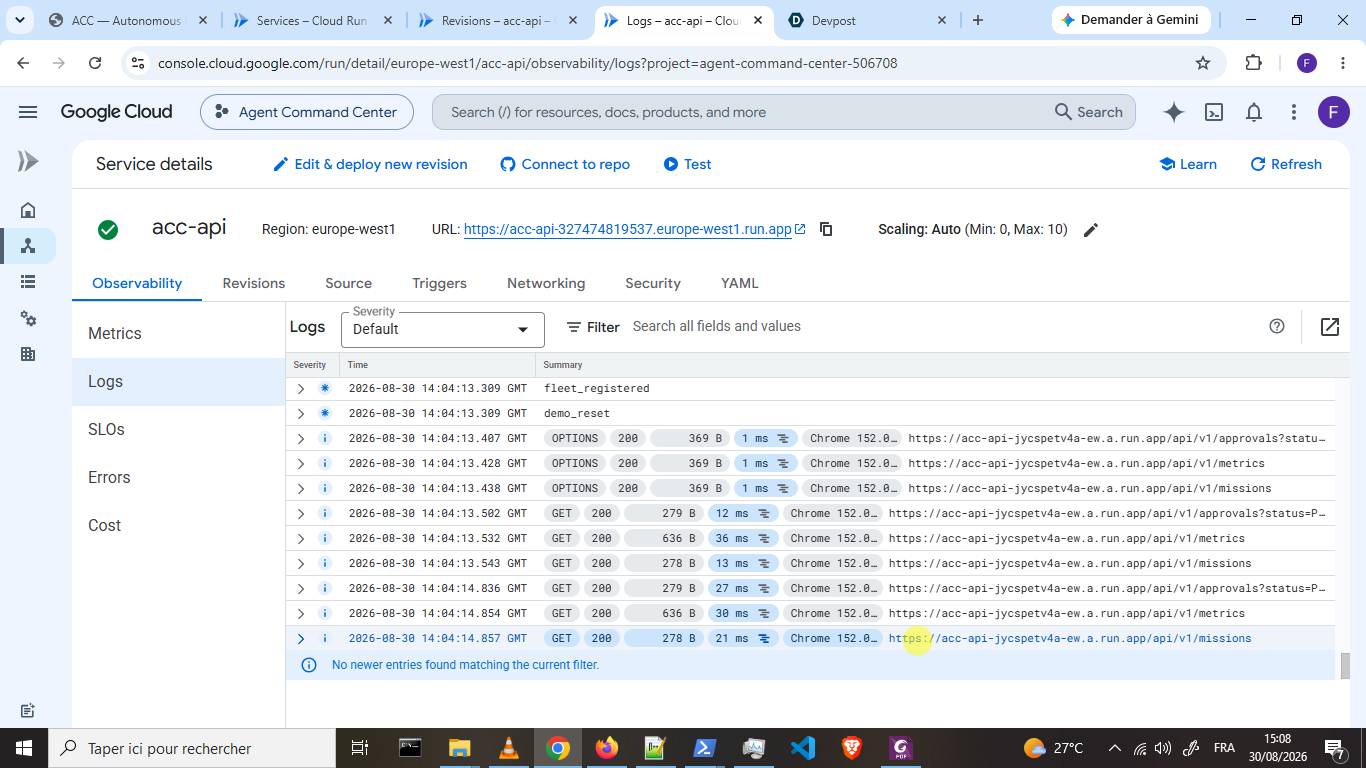
- Frontend — Next.js 15 on Cloud Run, live SSE with automatic polling fallback.
- Infrastructure — Terraform, Cloud Build, Artifact Registry, one cross-platform Python deployment script with a preflight that verifies credentials, APIs and build identity before spending anything.
Challenges we ran into
Almost every real defect had the same shape: a mechanism that was correct in the deterministic path and wrong the first time a model made its own choices, or correct in memory and wrong the first time state crossed a process.
- Two purchase orders for one mission. The idempotency key contained the task id. A mission has a planning task and an execution task; the model purchased from both. Fixed by keying a consequential action on the mission and on what it does — while keeping a fallback purchase from another supplier a genuinely different action.
- A recovery that recovered nothing. The switch to the fallback supplier was written on the caller's object and never persisted. The in-memory store shares instances, so every local test passed; Firestore returns a copy, and the retry queried the supplier that had just failed.
- CORS that was never CORS. The browser reported a CORS failure for days. The real cause was three layers down: an OpenTelemetry instrumentation crashing on FastAPI ≥ 0.141, before the CORS middleware, so every request became a 500 with no headers.
- Authentication mechanisms checked against what the caller cannot send.
Pub/Sub push cannot set a custom header. Neither can
EventSource. Both were authenticated by a header. - A UI that asserted what it did not know. The demo panel printed "deterministic" as a literal string while the fleet ran on Gemini — turning 20-second agent calls into a suspected performance problem.
Accomplishments that we're proud of
- The hero scenario runs end to end on Google Cloud, and every figure the demo script quotes is verified by an executable test — option counts, thresholds, amounts, even the mandatory click order.
- 423 tests and an 87-requirement coverage audit that links each blueprint
requirement to a real pytest node id: you cannot tick a box by renaming a test.
The suite also passes with
google-adkuninstalled. - 68 numbered architecture decisions, most of them recording a defect found by running the system rather than by reading it — including the ones above.
- Recovery that cannot bypass governance, and a Failure Twin that explains why the best option was refused.
What we learned
A test that inspects source text proves the code was written, never that it runs. Two production 500s reached us through tests asserting that a string appeared in a file.
The in-memory store lies about two different things — concurrency, and object identity. A test asserting something was saved must read it back through a boundary that copies.
A prescribed sequence needs a test that the product permits it. Our demo script was verified against the backend and still described an impossible click order, twice.
And the one that cost the most: every rule left for the model to apply is a rule that will eventually be applied differently. Precedence, fallback, defaulting — resolve them in code and hand the model the answer, not the inputs and the policy.
What's next for Agent Command Center (ACC)
- Proxy the API through the Next.js server so the operator key never reaches the browser bundle — the honest limitation of the current deployment.
- Replace our hand-written French-phrase detector with a real language check on string literals.
- Multi-mission fleet scheduling, agent suspension on anomaly, and recovery strategies learned from the recovery history ACC already records.
Built With
- artifact-registry
- cloud-build
- cloud-run
- fastapi
- firestore
- gemini
- google-adk
- model-armor
- next.js
- opentelemetry
- pub-sub
- python
- react
- secret-manager
- tailwindcss
- terraform
- typescript
- vertex-ai

Log in or sign up for Devpost to join the conversation.