-
-
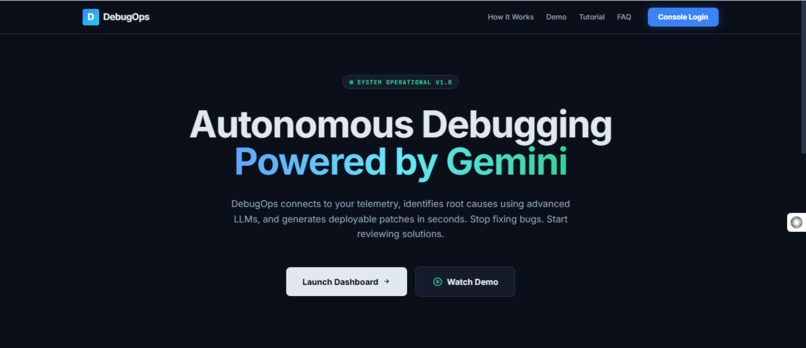
Landing page
-
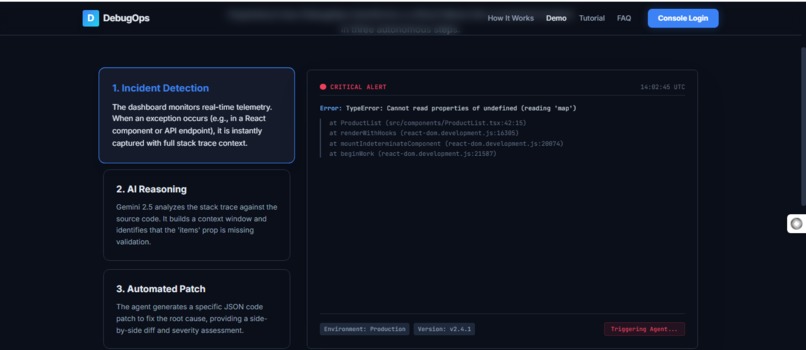
demo
-
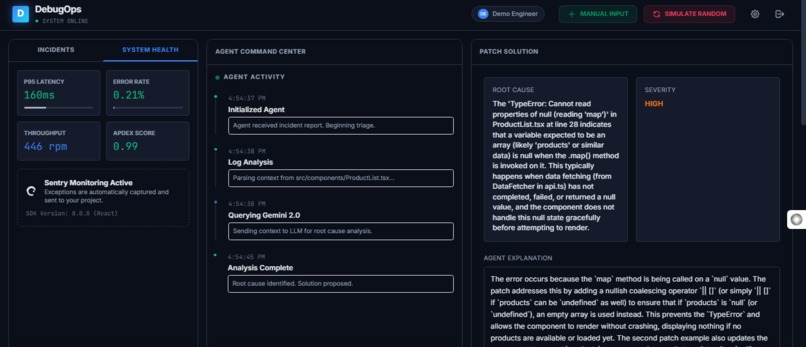
dashboard
-
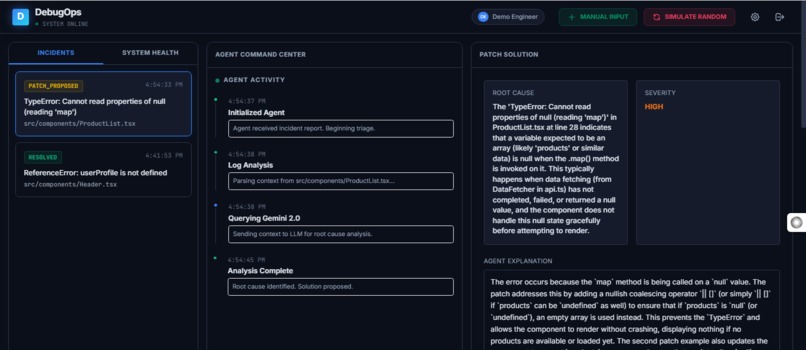
dashboard


About DebugOps Agent
DebugOps Agent was inspired by the idea of creating autonomous agents that not only work but handle errors smartly. I wanted a system that combines AI-powered automation with real-time monitoring, so tasks execute reliably, errors are caught immediately, and performance is tracked—all in one interface.
What I Built
- A web dashboard with multiple pages: How It Works, Demo, Tutorial, and FAQ.
- An autonomous agent capable of debugging code snippets, fetching and summarizing data, and handling multiple input types (text, files, URLs, and voice).
- Sentry integration for capturing errors, exceptions, and performance metrics in real time.
- Optional voice feedback and interactive widgets to enhance usability and showcase versatility.
What I Learned
- Building a full-stack application quickly with React/Next.js frontend and Python/Node.js backend.
- The importance of robust error handling and monitoring for production-ready agents.
- How to integrate tools like Sentry for logging and Telnyx for voice interaction.
- Managing multiple input types and routing them correctly to maintain consistent results.
Challenges Faced
- Coordinating frontend and backend updates in real time while keeping the UI responsive.
- Handling different input types without breaking the agent logic.
- Ensuring Sentry captured all errors accurately and displayed them neatly on the dashboard.
- Optimizing performance so tasks complete quickly and reliably for a live demo.
Optional LaTeX Example (for math/statistics on agent performance)
Agent success rate can be calculated as:
[ \text{Success Rate} = \frac{\text{Number of Successful Tasks}}{\text{Total Tasks}} \times 100 ]

Log in or sign up for Devpost to join the conversation.