Inspiration
Academic research rarely starts with a clear problem statement.
More often, it begins with a vague idea, a few keywords, or an intuition that something is worth exploring.
However, most existing AI tools assume that users already know what to search for. In reality, researchers often struggle with an earlier and more fundamental challenge: figuring out the right research direction and framing the problem itself.
This project was inspired by my own experience of getting stuck at the beginning of research—knowing the topic, but not knowing how to systematically think through the space or identify meaningful literature to read.
What It Does
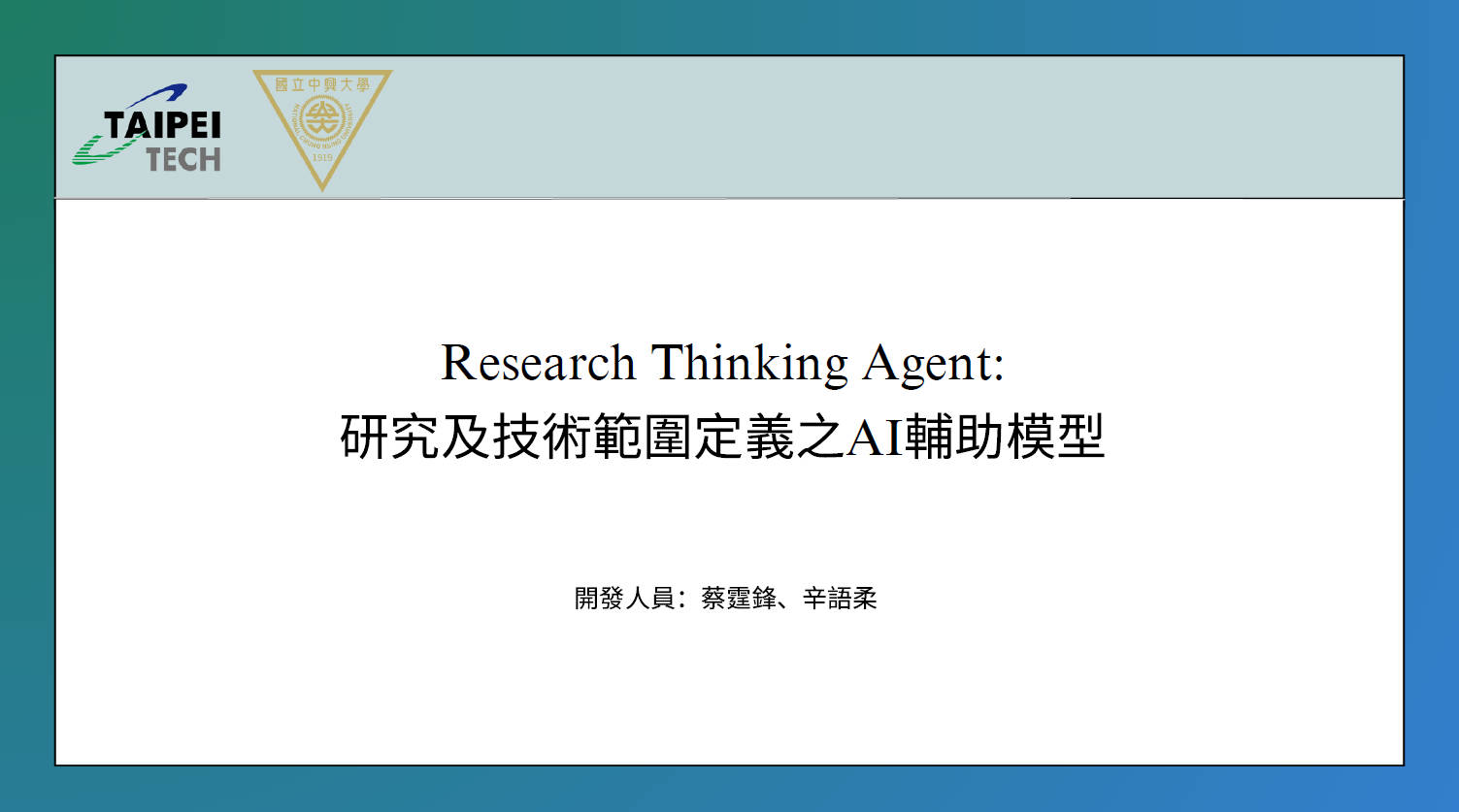
This project is an AI research thinking agent designed to support researchers before they start reading papers.
Given a small set of keywords or a high-level research idea, the agent:
- Decomposes the idea into structured sub-problems
- Identifies common methodologies and learning paradigms for each sub-problem
- Generates well-scoped academic search queries and research directions
- Mimics the reasoning process of an experienced research advisor
Instead of returning a list of papers, the agent focuses on helping users think, explore unfamiliar research spaces, and build a clearer mental model of the field.
How I Built It
The system is implemented as a command-line AI agent using the Google Gemini API.
The agent operates in multiple reasoning stages:
- Concept Expansion – Breaking down vague research ideas into concrete sub-problems
- Method Mapping – Connecting each sub-problem to commonly used approaches in academia
- Search Strategy Generation – Producing structured, high-quality search keywords and venues
Gemini models are prompted to act as a research advisor, producing structured JSON outputs that represent intermediate reasoning steps. These outputs are then transformed into human-readable Markdown summaries for research planning.
This agent-based design keeps the reasoning process transparent, inspectable, and reusable.
Challenges I Ran Into
One major challenge was preventing the model from skipping reasoning and immediately listing papers or buzzwords.
To address this, I had to carefully design prompts that enforce step-by-step decomposition, role constraints, and structured outputs.
Another challenge was finding the right balance between flexibility and structure—ensuring the agent remains useful across different research domains while still providing consistent, high-quality guidance.
Accomplishments That I'm Proud Of
- Designing an AI agent that focuses on research thinking, not just information retrieval
- Creating a reusable, structured reasoning pipeline instead of a single-pass response
- Successfully using Gemini models to perform multi-stage, research-oriented reasoning
- Building a tool that reflects how real researchers actually think and explore ideas
What I Learned
Through this project, I learned:
- How to design agent-based workflows around large language models
- How structured reasoning improves clarity and research productivity
- How prompt design directly affects abstraction, decomposition, and long-horizon thinking
- How AI can augment human cognition rather than replace it
What's Next for the Agent
Future directions for this agent include:
- Integrating direct connections to academic databases (e.g., arXiv or Semantic Scholar)
- Adding iterative refinement, where users can guide or constrain the agent’s reasoning
- Supporting visual research maps and citation graphs
- Expanding the agent to assist with experiment design and hypothesis formulation
The long-term goal is to evolve this agent into a true AI research collaborator.


Log in or sign up for Devpost to join the conversation.