Inspiration
High-performance computing (HPC) is a rapidly growing $60 billion industry that enables powerful simulations and large-scale analysis, but using it often requires deep technical expertise. Many users know exactly what they want to analyze or build, but they struggle to translate natural language intent into HPC-specific workflows. As demand for large-scale computation grows, we wanted to minimize this friction by letting users get the most out of their ideas without needing to understand the complexity of the underlying infrastructure.
What it does
North Star acts as an HPC Technical Architect that:
- Synthesizes user intent: Interacts with the user to infer technical specifications and runtime goals, such as node counts, CPU allocation, and memory buffers
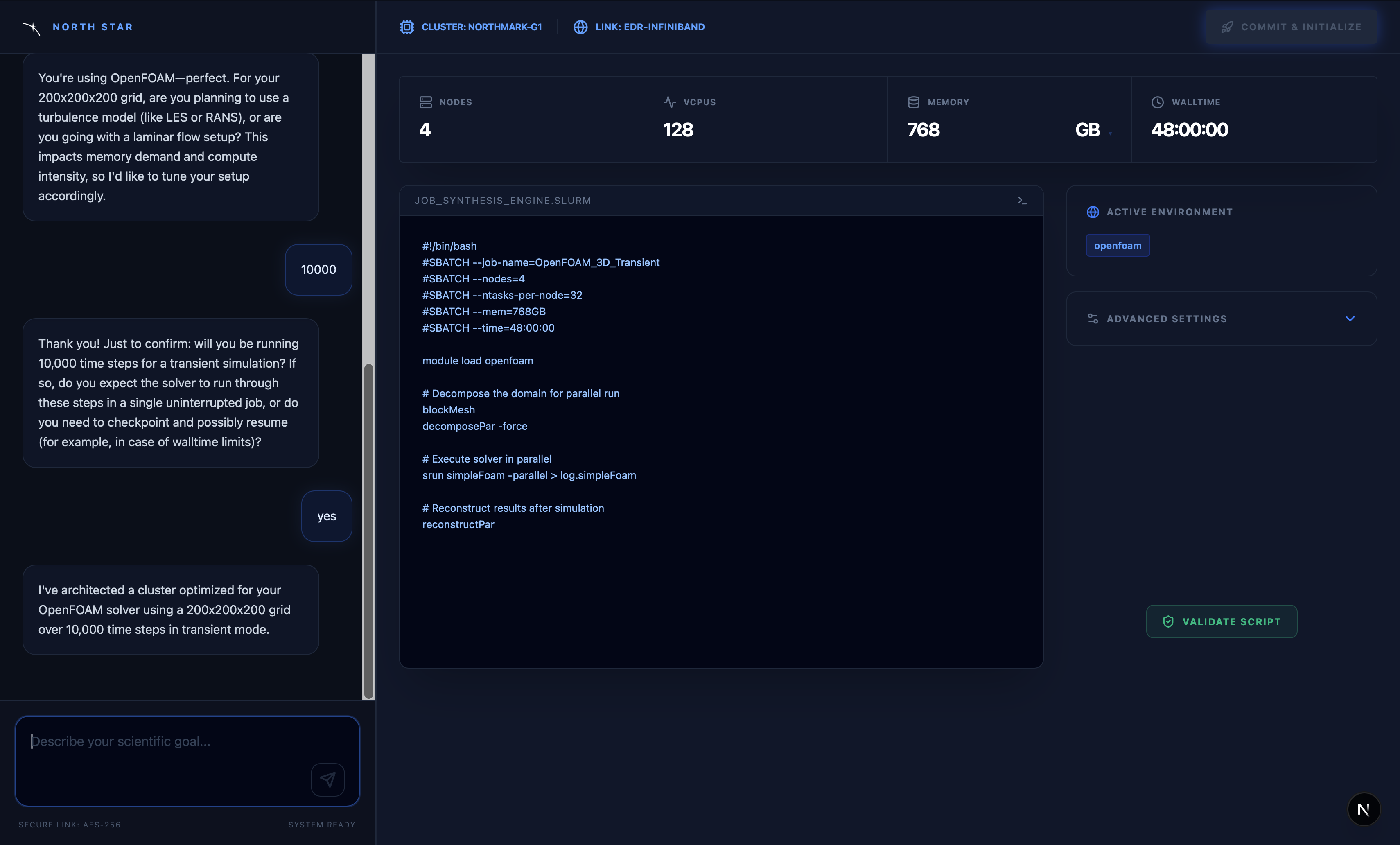
- Generates optimized configurations: Automates the creation of SLURM bash scripts and environment settings from user context
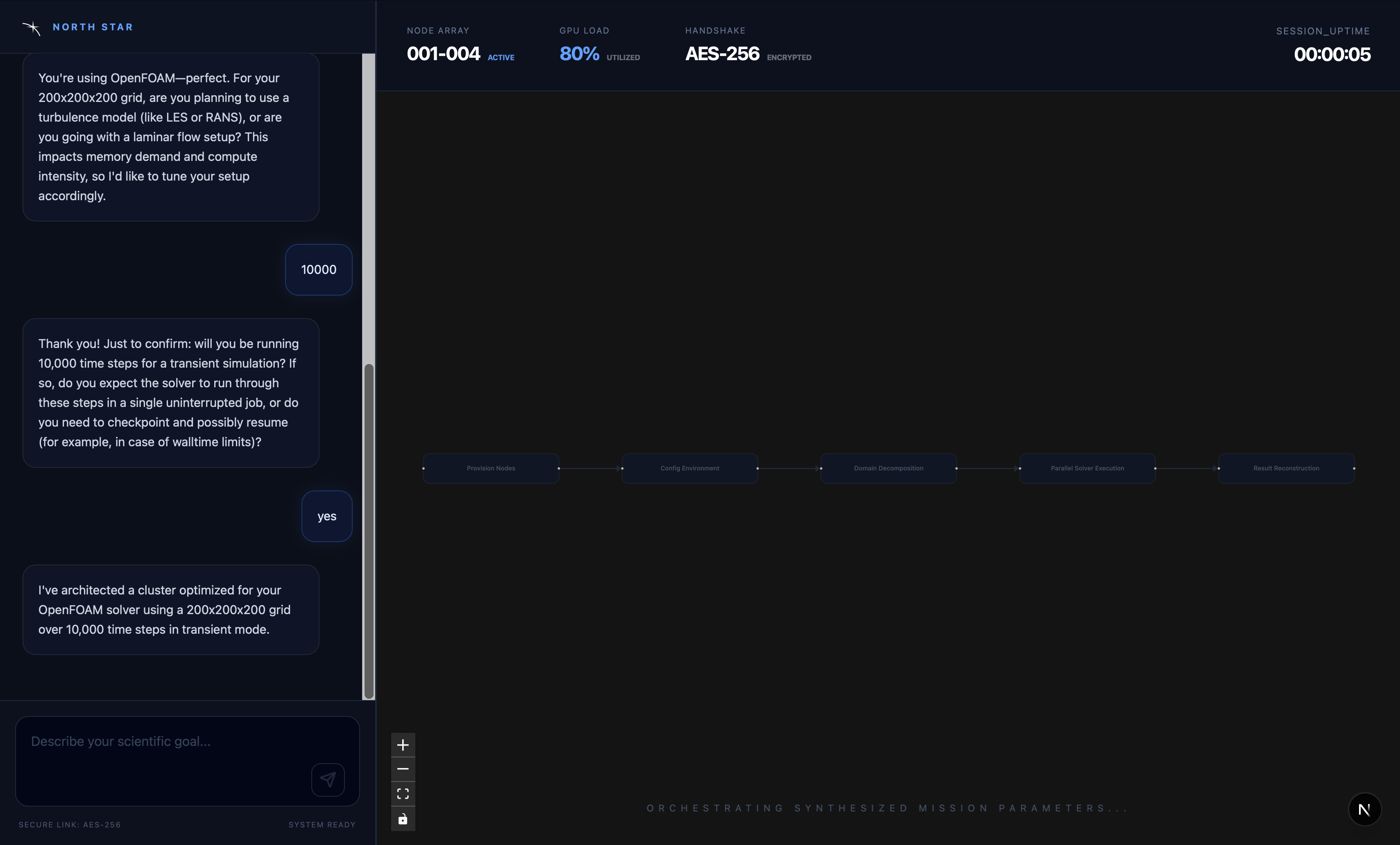
- Visualizes live execution: Provides a "mission control" view by syncing real-time hardware metrics with an interactive graph visualization
How we built it
North Star is composed of three coordinated layers:
Frontend UI
- Built with Node.js, TypeScript, and Tailwind CSS
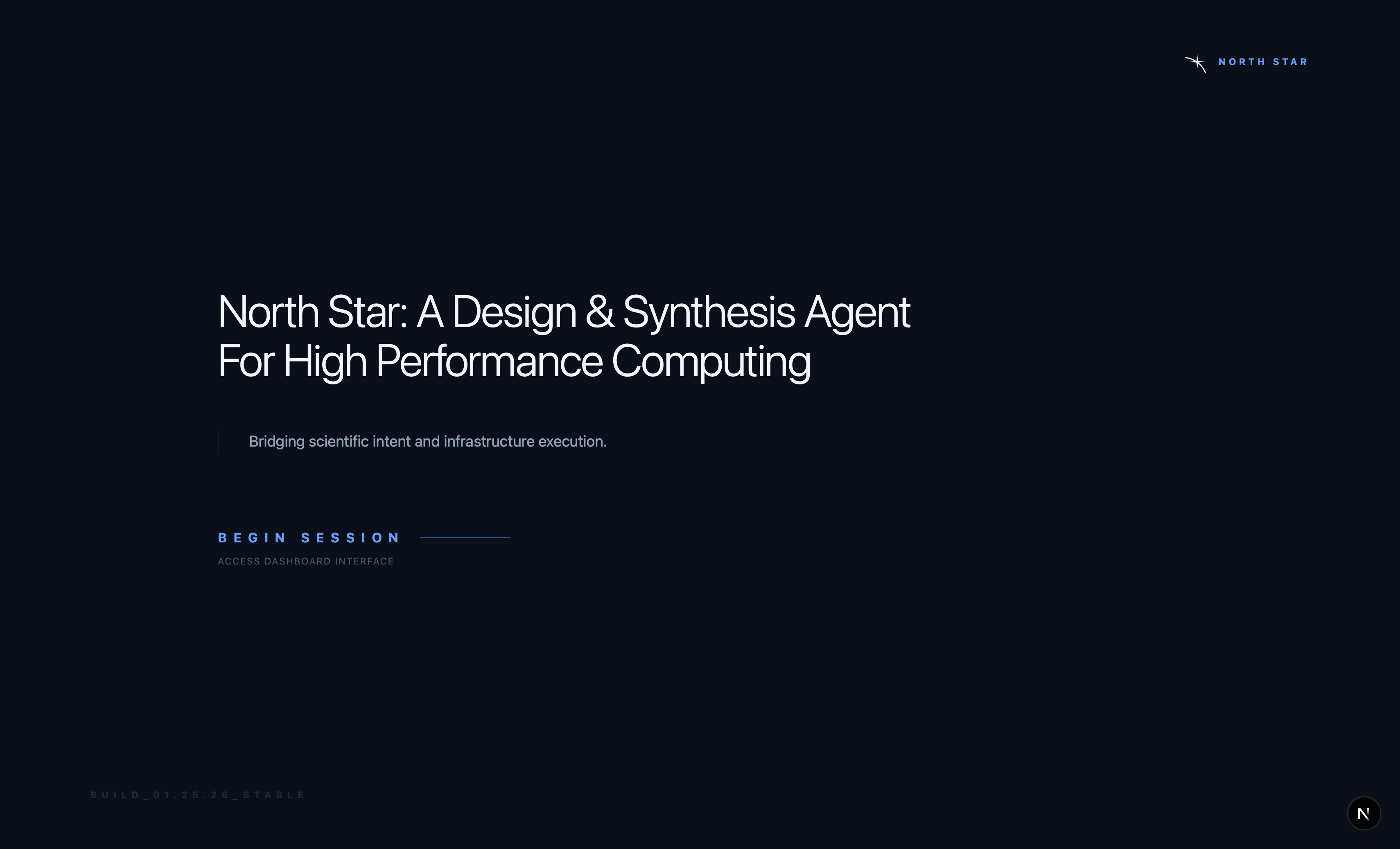
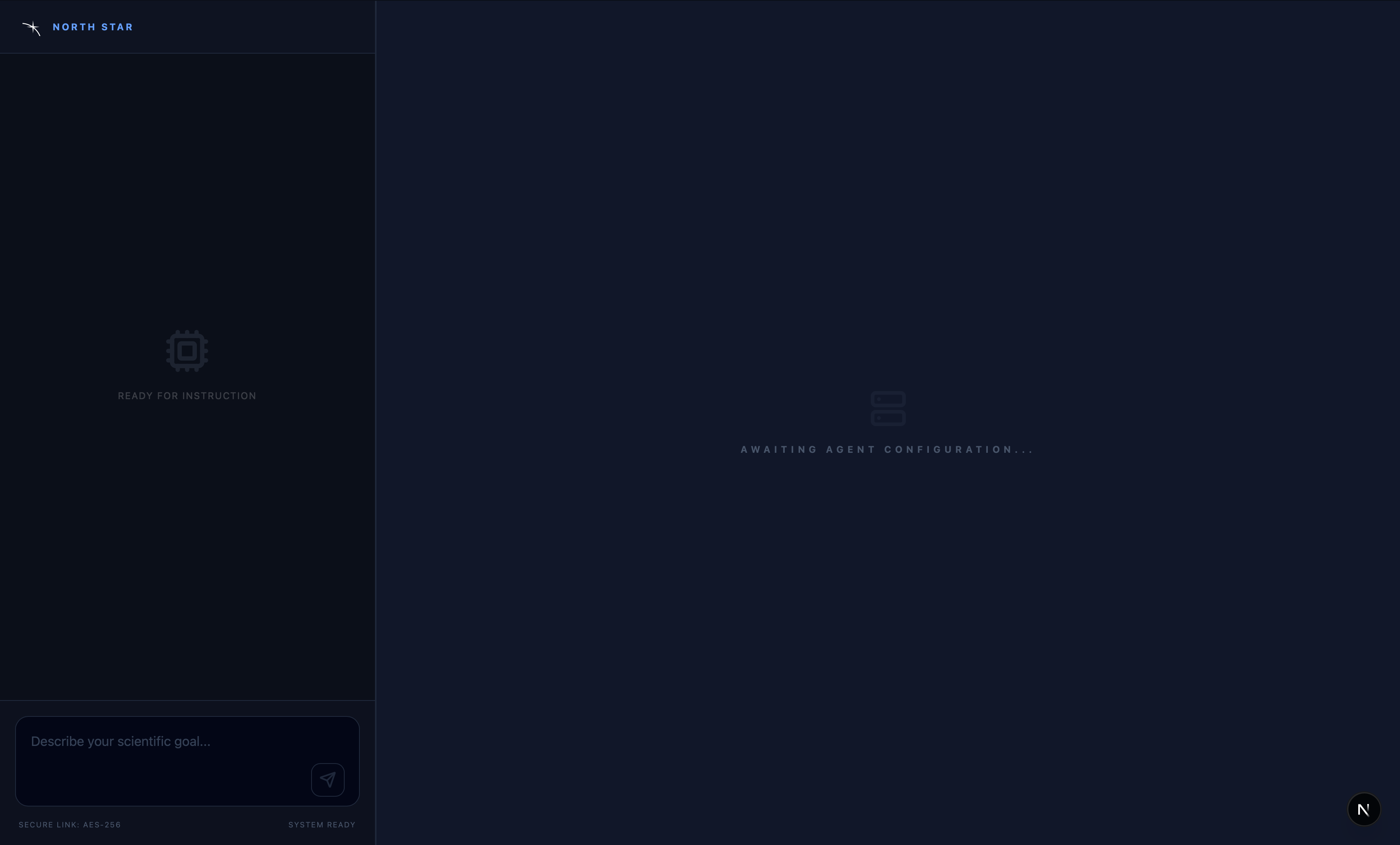
- Employs a minimalistic "mission control" aesthetic
- Maps context from the conversation agent panel to the configuration dashboard
Conversation Agent
- Built with OpenRouter API and Pydantic
- Operates a domain-expert persona to infer infrastructure needs from high-level scientific goals
- Generates a reference SLURM script tailored to user needs
Simulation Orchestrator
- Built with Python and FastAPI
- Uses React Flow to produce a draggable canvas for visualizations
- Simulates runtime environment by generating updates every few seconds
Challenges we ran into
- Ensuring that the underlying language model consistently returned valid JSON outputs for the configuration data
- Designing conversation agent prompts in a way that preserved memory across user messages
- Creating an interactive visualization of the runtime workflow in the form of a directed acyclic graph (DAG)
Accomplishments that we're proud of
- Achieving a clean, minimal frontend that mirrors the aesthetics of modern scientific tools
- Configuring the three components of our architecture into an end-to-end application
- Enabling configuration settings and runtime workflows to be highly customizable via the context captured by the conversation agent
What we learned
- Working with the nuances of high-performance computing to run parallelized and resource-intensive tasks
- Capturing context efficiently through iterative agent loops (conversation → reasoning → storage)
What's next for North Star
- Multi-User Workflow Persistence: Implementing support for multiple users to allow research teams or open-source communities to share work
- Physical 3D Mapping: Visualizing the physical job distribution across a 3D model of the cluster's rack array
- Workflow Templates: Creating established templates for common HPC tasks to standardize high-frequency scientific pipelines
Built With
- css
- fastapi
- gemini
- next.js
- openrouter
- python
- typescript


Log in or sign up for Devpost to join the conversation.