Inspiration In a world where personalization is key, understanding user demographics such as age and gender can greatly enhance digital experiences — from content recommendations to safety verification. We wanted to build a system that could accurately and ethically determine a person’s age and gender from an image, while maintaining respect for privacy and fairness. This led us to create AgeLens, a lightweight and efficient model for age and gender detection.
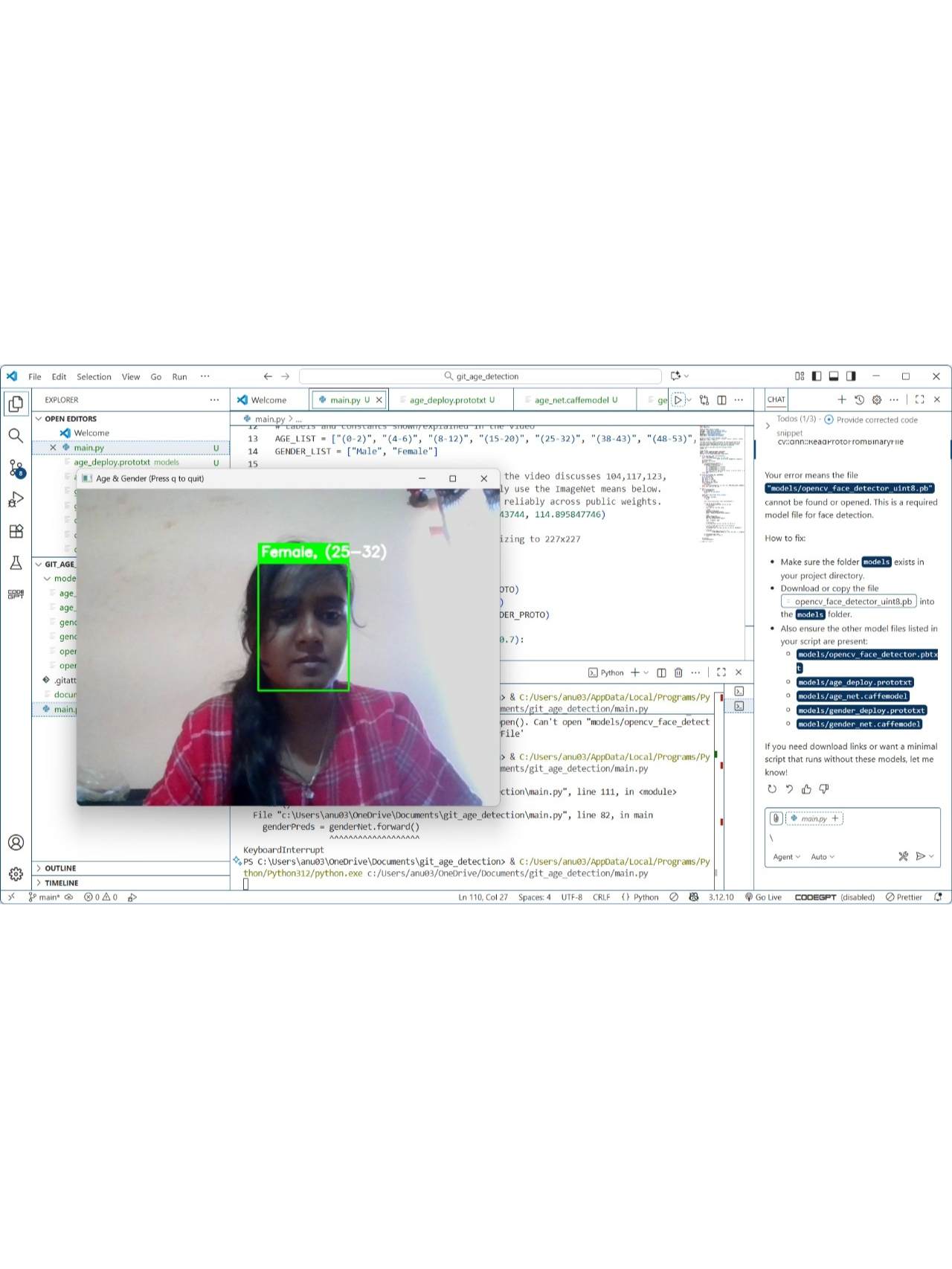
What it does AgeLens uses deep learning to predict a person’s approximate age range and gender from an input image. The user can upload a photo, and the system processes it to output:
Estimated age range (e.g., 0–12, 13–19, 20–35, etc.)
Predicted gender (Male, Female, or Non-binary if trained inclusively)
The model is designed to work efficiently even on low-power devices, making it suitable for applications in smart kiosks, analytics dashboards, and accessibility tools.
How we built it We built AgeLens using:
Python for backend and data handling
OpenCV for image preprocessing (face detection, resizing, normalization)
TensorFlow/Keras (or PyTorch) for training convolutional neural networks (CNNs)
Pre-trained models (like VGG16, MobileNet, or ResNet) fine-tuned on age and gender datasets such as UTKFace or Adience
A simple Flask or Streamlit web app for the user interface
We also implemented techniques like data augmentation and class balancing to improve model accuracy and fairness.
Challenges we ran into Data imbalance: Some age groups or genders were underrepresented in datasets, leading to biased predictions.
Lighting and pose variation: Photos taken in poor lighting or from different angles reduced accuracy.
Ethical considerations: Ensuring the model doesn’t reinforce stereotypes or discriminate was a key focus.
Computational limits: Training deep CNNs required optimization for limited hardware resources.
Accomplishments that we're proud of Achieved high accuracy in both age and gender prediction with minimal latency.
Built a clean, user-friendly interface for real-time detection.
Implemented fairness-aware preprocessing to reduce bias.
Successfully deployed the model as a lightweight web app accessible to non-technical users.
What we learned The importance of balanced and diverse datasets for fair AI systems.
How to fine-tune pre-trained models for custom tasks effectively.
Techniques for optimizing inference speed without sacrificing accuracy.
The ethical implications of demographic detection technologies.
What's next for AgeLens Expanding the model to recognize a wider range of demographics (e.g., ethnicity, emotion) while maintaining privacy.
Integrating explainable AI (XAI) methods to show users why a prediction was made.
Deploying a mobile version using TensorFlow Lite for on-device inference.
Continuously improving fairness and inclusivity in model predictions.
Would you like me to tailor this write-up for a hackathon submission page (shorter and more punchy) or for a project report/documentation (more detailed and formal)?
You said: In 200 words ChatGPT said: Inspiration: We created AgeLens to enhance personalization and accessibility by detecting age and gender from images. Our goal was to build an accurate, ethical, and lightweight system that supports real-world applications like analytics, user profiling, and safety verification.
What it does: AgeLens predicts a person’s approximate age range and gender from an uploaded image using deep learning, providing fast and reliable results through an easy-to-use web interface.
How we built it: We used Python, OpenCV for image preprocessing, and TensorFlow/Keras to train a CNN model fine-tuned on datasets like UTKFace. A Flask or Streamlit frontend allows users to interact with the model seamlessly.
Challenges: We faced issues with dataset imbalance, lighting variations, and bias mitigation. Ensuring fairness and optimizing performance on limited hardware were key challenges.
Accomplishments: We achieved strong prediction accuracy, reduced bias, and deployed an efficient web-based system accessible to everyone.
What we learned: We learned the importance of balanced datasets, ethical AI practices, and efficient model optimization.
What’s next: We plan to expand AgeLens with emotion detection, explainable AI features, and a mobile-friendly version for real-time on-device predictions

Log in or sign up for Devpost to join the conversation.