-
-
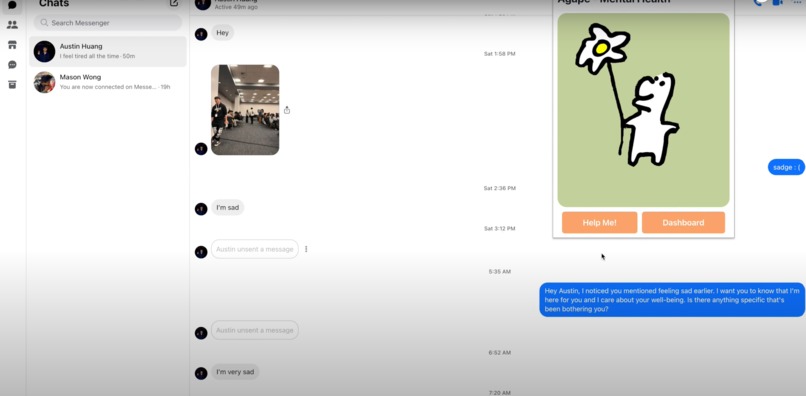
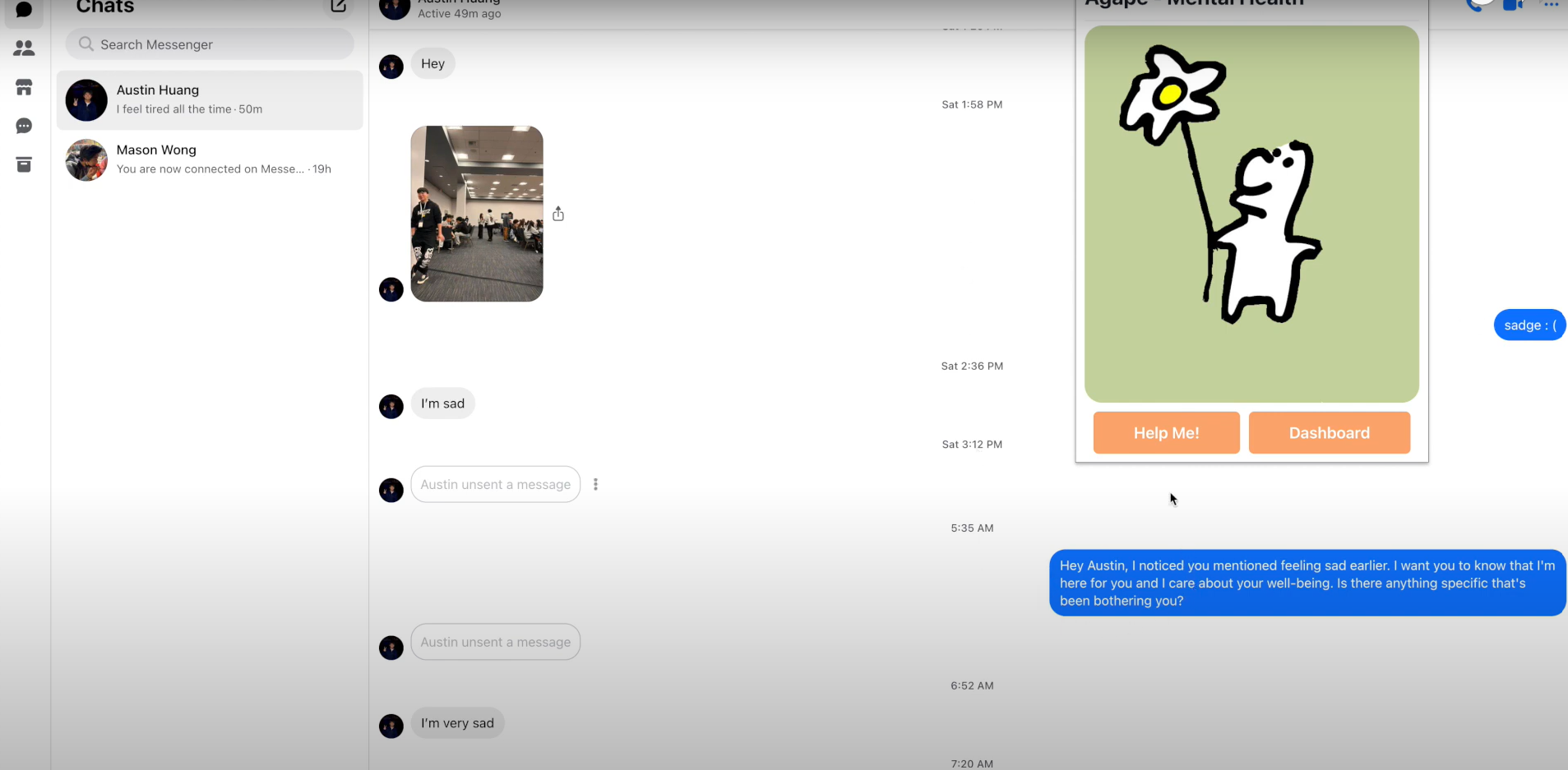
From Chrome, just click on our extension to bring up the pop-up.
-
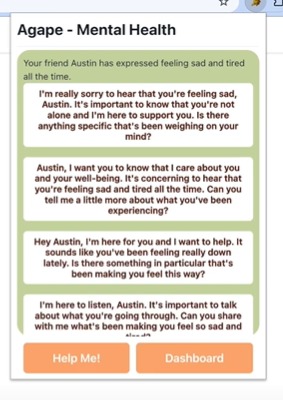
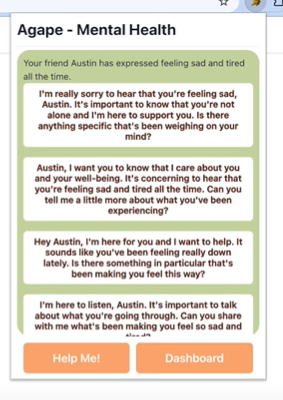
Apage analyzes the chat log and returns suggested responses.
-
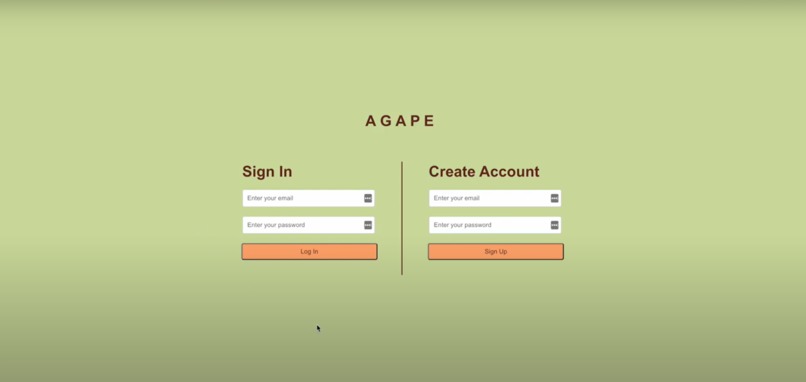
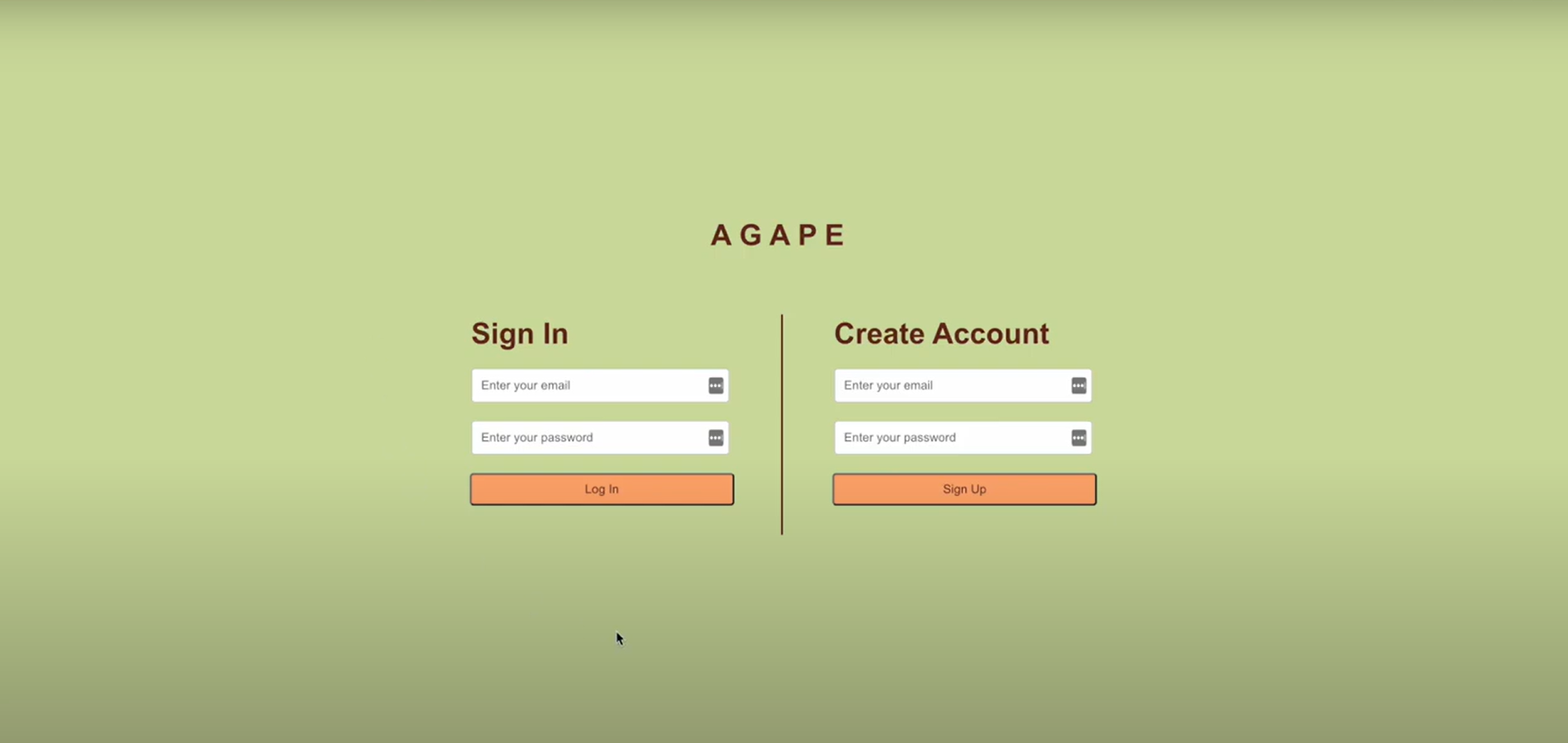
By clicking Dashboard, our website will be linked and prompt you to either create an account or sign-in.
-
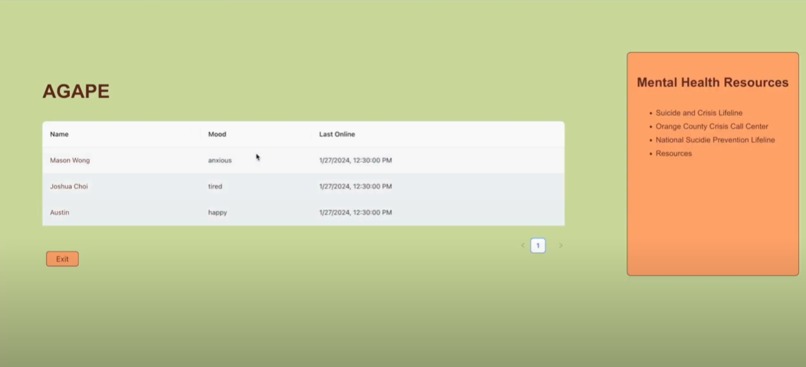
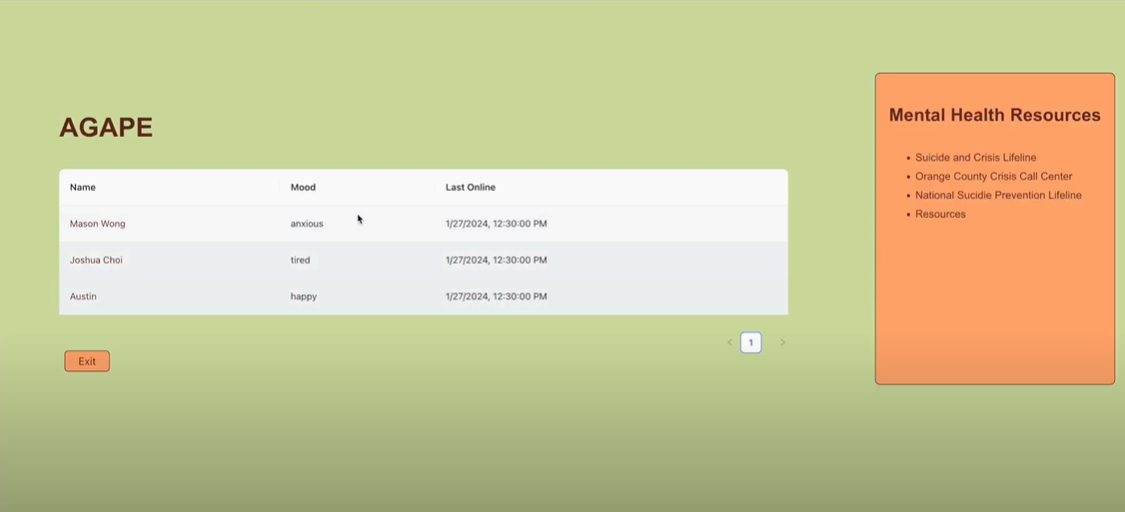
After signing in, there will be a home screen with data on individuals scanned by the chat log and also mental health resources.
-
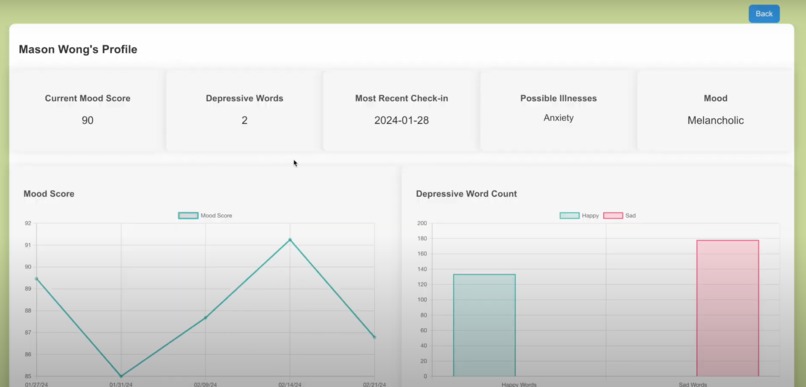
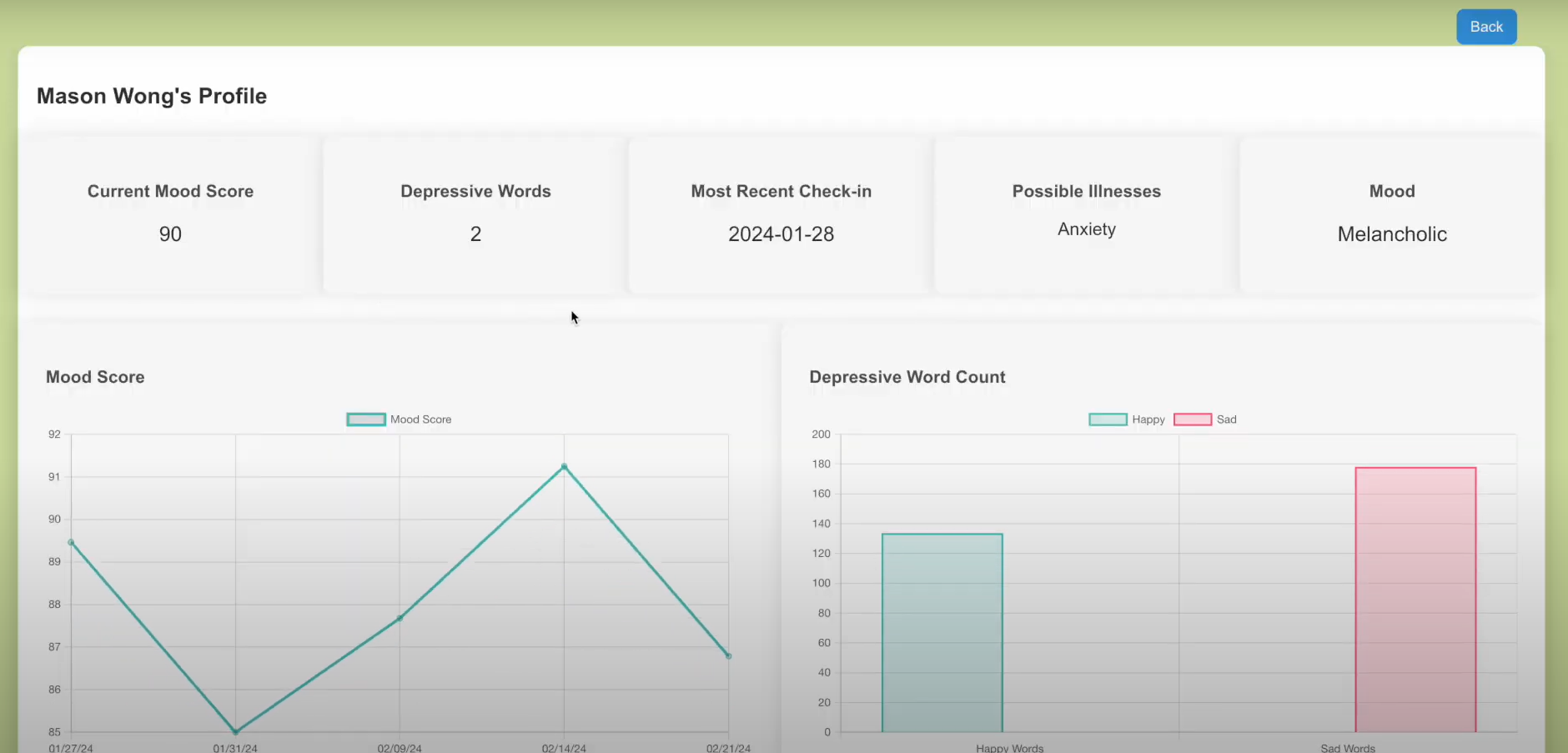
Each individual has a personalized profile dashboard with data extracted from their chat logs. Accessible by clicking on their profile.
TLDR:
- Over 48 million individuals struggle with mental illness, and more than 52% do NOT get mental health treatment
- These individuals often don't have anyone to help them, so it is up to close friends and family to help them through difficult times
- However, dealing with heavy topics like depression, anxiety, or suicide can be difficult to navigate - what if we say the wrong things or take the wrong course of action
- So we built Agape to empower individuals to help guide their loved ones struggling with mental illness to get the proper care they need
- Created Google Extension that scrapes data from chat logs to recommend emotionally-mature ways to tackle difficult conversations - powered by OpenAI
- Created dashboard to keep track of friend's moods and offer insight on mental illness improvements as well as mental health resources to point friends to
The Problem
Every year, over 48 million individuals struggle with mental illnesses, and over 52% of those numbers do not seek or do not receive the vital treatment they need.
This is a staggering statistic and an unfortunate reality where mental illnesses are stigmatized, making it challenging for those impacted to seek help and navigate through their struggles.
According to a research study done by Mental Health America, 71% of people surveyed turned to a friend or family connection in times of stress. This highlights the impactful role of loved ones during these times.
However, it can be difficult for these folks to respond to heavy texts regarding suicide or other difficult topics, leaving many hopeless and feeling inadequate to navigate others through rough mental times.
Now this is where Agape comes in to empower those to love on their loved ones struggling with mental illness.
The Solution
Agape empowers individuals to handle difficult conversations by analyzing chat logs and suggesting emotionally mature responses. This way, anyone who may have thought they were inadequate or helpless to care for some one with mental illness now has the education and guidance to help others get the care they need.
We have built an effective web scraper ( also a neat google extension ) that leverages OpenAI's LLMs to give empathetic and proactive conversation suggestions. We have also integrated AWS Cloud services to curate data and graphs to help track the moods and improvements of our loved ones' conditions.
Many people often build mental health tools to directly target those struggling with mental health; however, the efforts are often overlooked as those with mental illness often are too tired in life to look out after themselves. That is why it is up to friends and family to look after loved ones through these difficult time, and it all starts with a conversation.
The inspiration
All of our team mates have encountered situations, especially in university, where we have first-handedly read emotionally-heavy text messages from friends, pertaining to self destructive behavior, mental illness, and self harm.
These topics are serious and cannot be dealt with flippantly, and it's all the more pressure for us to respond in the proper way - in a way that will help guide our friends to getting care.
Other Use Cases
Post-surgery patients, such as those recovering from significant procedures like cancer or heart surgery, often face mental health struggles after physical recovery. At home, away from hospital care, they encounter a lack of accessible mental health resources. Our solution is an AI-powered mental health assistant, designed to enable individuals to effectively support their loved ones grappling with these mental health challenges.
How we built it
We built Agape through a collaborative process, combining innovative ideas with OpenAI technology to integrate mood tracking and mental health support into the digital realm. To achieve this, we organized our development into distinct repositories, branching into four segments: google extension, web, server, and API.
The Google extension was constructed using React.js, integrating anything-but-seamlessly with Chrome's extension architecture. We also ventured many ways to scrape data, jumping through obstacles of encrypted data to reach our sweet payload of chat logs - take that Facebook!
For the database server, we leveraged AWS for database management and implemented SQL to design tables for storing information destined for the web.
The website was developed using React.js and Chakra UI, allowing for a neat and dynamic user interface. Firebase was employed for the sign-in functionality, enhancing security and ease of access. The website's essential components—the sign-in page, home page, and profile dashboard were crafted using a combination of CSS for styling and JSX for React component development.
The backend API server, a critical link in the system, was built using Express to facilitate requests to the OpenAI API, make AWS API calls, and deliver obtained information on our React application.
Connecting these diverse components into a cohesive system was accomplished through data flow management.
Challenges we ran into
Building the web scraping google extension was by far the most frustrating and confusing challenge that we have ran into. Not only was finding ways to access Facebook's encrypted data a tedious task but also developing the monstrosity Google Extensions was a difficult but rewarding process. API calls and state management that I once took for granted developing in react was a luxury that I could only dream of during my time in Google Extension development.
Developing the backend API servers that linked the AWS servers, OpenAI API, and data pipeline to the website proved to be a difficult task as it was the first time that 3 out 4 of our members were first exposed to cloud technology let alone API development. But with enough time, sweat, and youtube videos we managed to pull through with a robust backend.
Accomplishments that we're proud of
One accomplishment that we're proud of is the integration of all components in our project—the Google extension, the API, the server, and the website. This linking process is crucial to the project's bigger picture, enhancing its functionality as a comprehensive mental wellness bot. Connecting the Google extension to the API ensures that real-time data from user interactions is efficiently transmitted to the server. The server, in turn, processes this data and stores it in our AWS database, creating a centralized repository. The website acts as the user interface, allowing users and their loved ones to access and interpret this data in a user-friendly manner. Each component plays a vital role, offering a holistic view of the user's mental wellness journey. This interconnectedness reflects our commitment to creating a mental wellness bot where each component contributes to the overall purpose—providing valuable insights, support, and fostering a healthier digital experience for users. The attention to detail in connecting these elements ensures the project's effectiveness in addressing mental health challenges and reflects our dedication to creating a comprehensive solution.
Another accomplishment that we're proud of is successfully creating a Google extension, a struggle that set this project apart from conventional applications and brought its own set of challenges. Crafting a Google extension required a distinct approach, and we had to delve into unfamiliar territory, navigating the concepts of extension development. Learning how to integrate the functionalities of our mental health support system into the Google extension was a significant achievement. This process involved understanding and adapting to the specific requirements and constraints posed by the extension environment. We had to decipher how to effectively communicate with Chrome's extension framework, implement functionality in a way that integrated with Messenger, and ensure optimal performance within the extension. In overcoming the learning curve associated with Google extension development, we gained valuable insights into a specialized domain of web development. This achievement not only expanded our technical skills but also highlighted our team's adaptability and problem-solving ability. The successful implementation of the Google extension further highlights our commitment to developing innovative solutions that surpass the boundaries of traditional applications.
What we learned
Throughout the development of our mental wellness bot, we've encountered and successfully navigated various challenges, each contributing to our learning and growth. On the technical side, we gained insights into the complexities of web scraping, extension development, and the intricacies of integrating diverse components like the Google extension, API, server, and website.
The journey has not only enriched our technical skills but also emphasized the holistic nature of our mental wellness bot. We've learned to appreciate the balance between technology and empathy, understanding that successful mental health support requires a combination of innovative solutions and a user-centered approach. In essence, our learning journey has been multifaceted—technical challenges provided opportunities for skill development, while the project reinforced the importance of user-centric design in mental health applications. As we continue to refine and enhance our mental wellness bot, these learnings will undoubtedly shape our future projects and our commitment to creating impactful and user-friendly solutions in the realm of digital well-being.
What's next for Agape
Strategic Alliances with Health Organizations: In our forward-looking strategy, Agape aims to establish partnerships with prominent health organizations, fostering a collaborative effort that goes beyond amplifying the platform's impact. By facilitating the exchange of aggregated data, Agape enables health organizations to gain invaluable insights into mental health trends, user behavior, and critical areas of focus. Through these strategic alliances, Agape envisions a collective endeavor toward a more comprehensive and informed approach to mental health support.
Agape's commitment to innovation extends to the integration of real-time emotion analysis through facial recognition technology, particularly during FaceTime calls: This approach not only enhances the depth and quality of support provided but also offers users a unique view of their emotional states in real-time. Importantly, Agape acknowledges the ethical implications of facial recognition and prioritizes user privacy. Robust frameworks are implemented to ensure the responsible and secure utilization of this technology within the mental health support landscape. This dedication to ethical practices highlights Agape's commitment to creating a supportive and trustworthy environment for its users.
Built With
- amazon-web-services
- chrome
- css
- express.js
- html
- javascript
- node.js
- openai
- react.js
- sql
- web-scraping


Log in or sign up for Devpost to join the conversation.