-
-
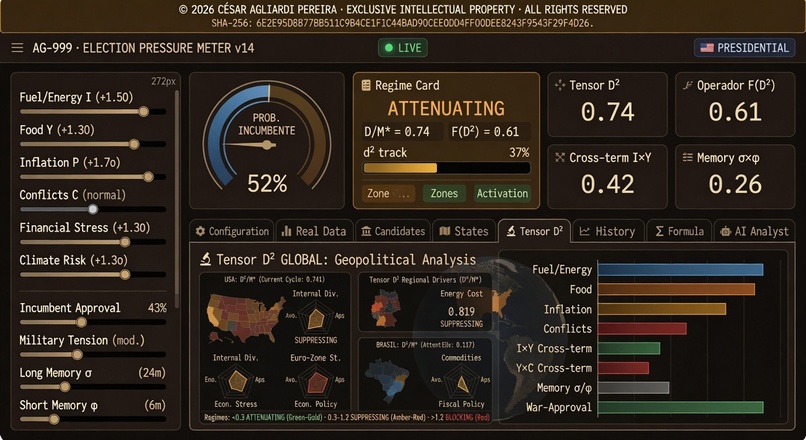
Global Electoral Crisis Radar (AG-999)
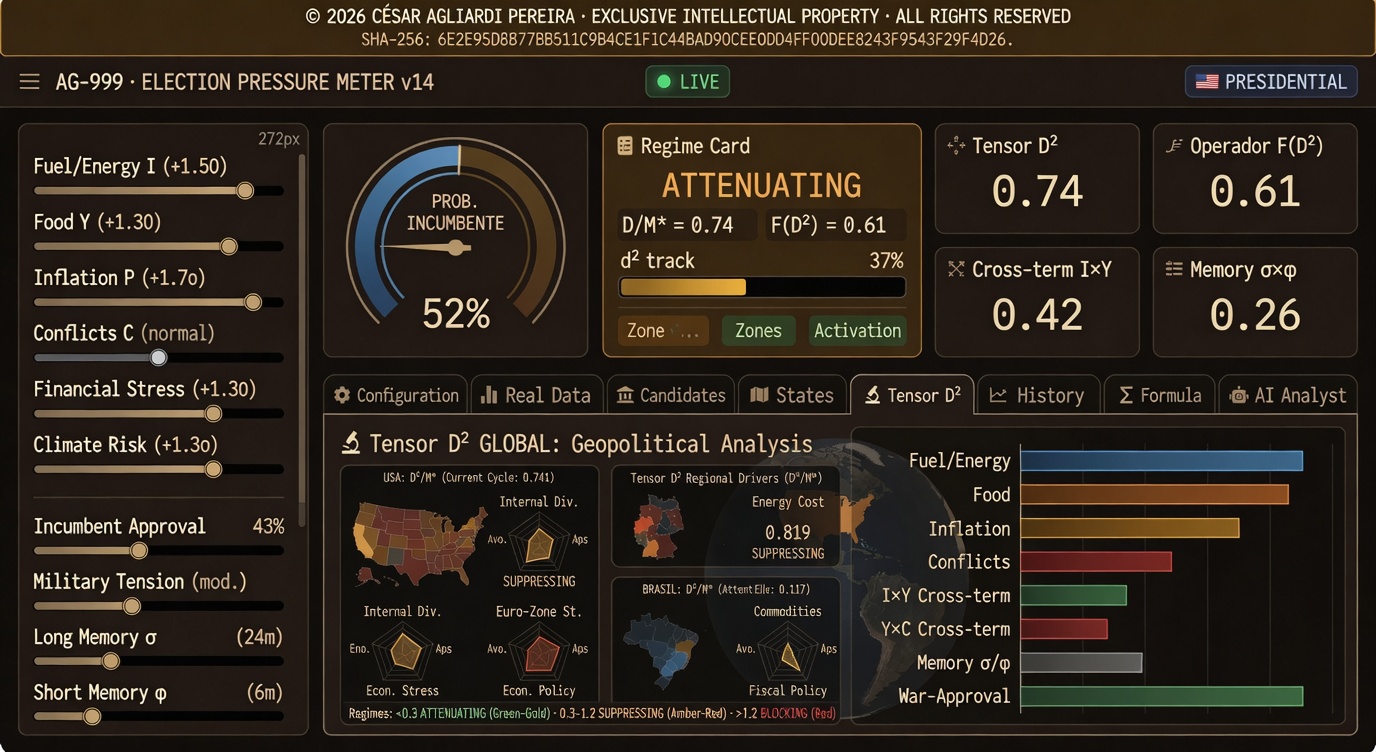
Modern election forecasting relies heavily on polling and linear models. However, real-world political shifts often behave non-linearly — small pressures can suddenly trigger large systemic changes.
I was inspired by the idea that elections are not just influenced by isolated variables like inflation or approval ratings, but by the interaction of multiple pressures acting simultaneously. This led to the creation of AG-999, a system designed to model political environments as dynamic regimes rather than static probabilities.
Live demo: https://cesaragliardi-creator.github.io/ag999-political-pressure-meter/
What it does
AG-999 (Global Electoral Crisis Radar) is a non-linear simulation engine that analyzes how systemic pressures affect electoral outcomes.
Instead of asking “who is winning?”, the model asks:
What regime is the system currently in?
The system computes a pressure tensor D 2 , representing combined economic, social, and geopolitical stress. This value is passed through a non-linear operator to classify the system into one of four regimes:
INACTIVE (stable) ATTENUATING (moderate pressure) SUPPRESSING (instability rising) BLOCKING (high probability of political disruption)
The output includes:
Probability of incumbent survival Real-time regime classification Systemic pressure visualization How I built it
The project was built as an interactive web-based simulation using:
HTML, CSS, JavaScript Custom mathematical modeling (non-linear aggregation + cross terms) Dynamic UI (sliders, gauges, charts)
Interactive web application: https://cesaragliardi-creator.github.io/ag999-political-pressure-meter
Key components:
Cross-variable interactions (e.g. energy × food) Temporal memory: σ: long-term memory ϕ: short-term shocks Non-linear transformation of pressure into political outcomes Challenges I ran into
One of the biggest challenges was designing a system that feels realistic without relying entirely on historical datasets.
Balancing:
interpretability non-linearity usability
was difficult. Another challenge was translating abstract mathematical ideas into an interface that is intuitive and interactive.
What I learned Political systems behave more like complex systems than linear models Small combined pressures can create large regime shifts Interactivity is key to understanding abstract models Building explainable simulations is as important as accuracy What's next Integrate real-world datasets (FRED, prediction markets, Google Trends) Add AI-generated analysis layer Deploy as a public API Expand into a real-time global monitoring system Why it matters
AG-999 shifts the perspective from prediction to system understanding.
Instead of asking “Who will win?”, it helps answer:
“When does a system become unstable enough that predictions fail?”
Built With
- css
- custom-simulation-engine
- data
- html
- interactive-ui
- javascript
- non-linear-systems-modeling

Log in or sign up for Devpost to join the conversation.