Inspiration
Afya Pochi was born from a simple but devastating observation by Denice Wakio — that most preventable deaths in Kenya aren't caused by a lack of medicine, but by a lack of incentive to seek care before it's too late. In the informal economy, a mother loses a day's income to take her child for a routine vaccination. The vaccine is invisible. The lost income is immediate. So she skips it. Denice brought the idea to four people she trusted: Marshall Israel, a fullstack developer; Paul, an AI specialist; Allan Otieno, a data scientist; and Duncan, a product designer — and the five of them, fittingly, first met in full alignment at a mental health awareness walk, where the conversation turned to a single question that became the soul of everything: what if showing up for your health actually paid?
What it does
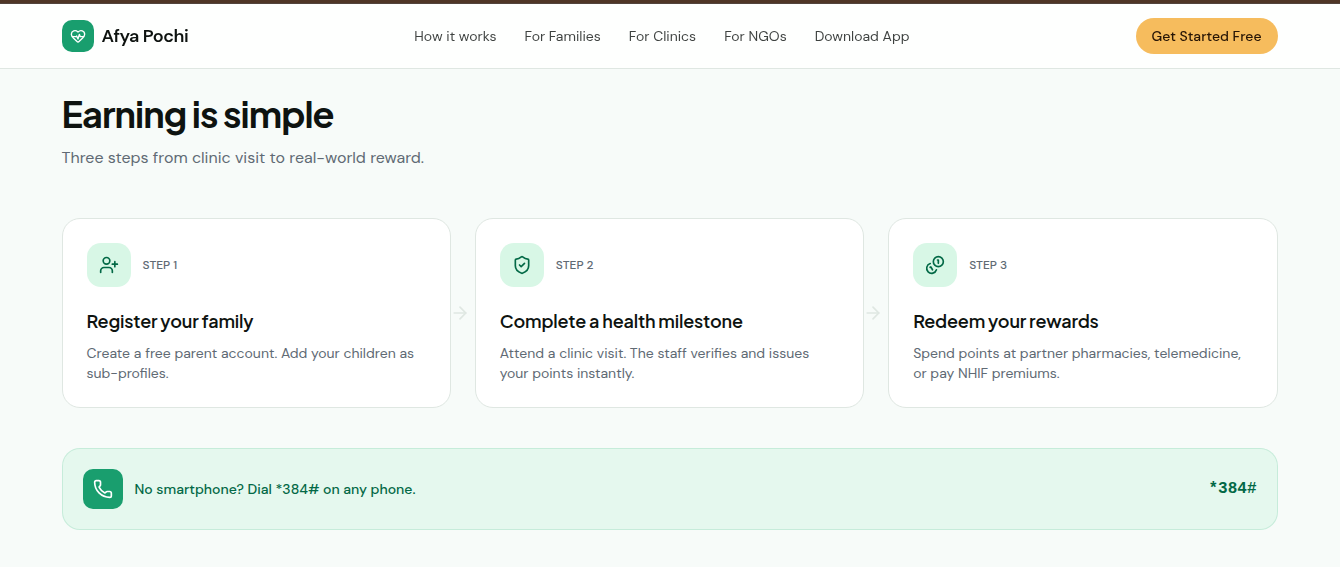
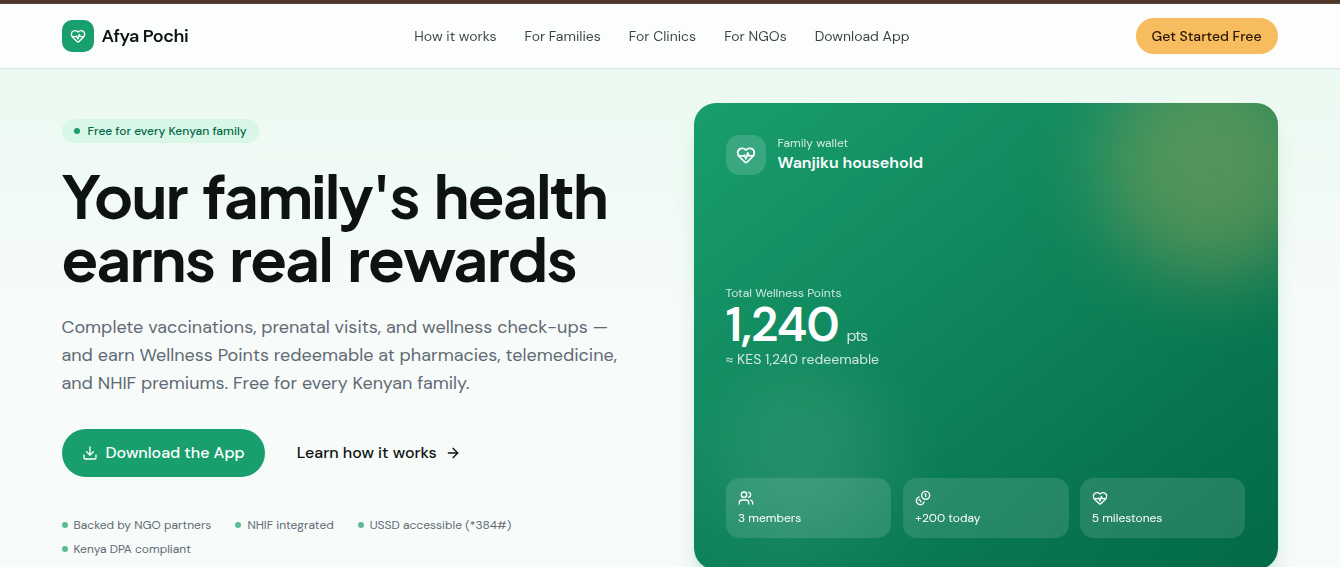
Afya Pochi is a wellness points economy that transforms preventative healthcare into a rewarding, self-sustaining ecosystem. Families earn Wellness Points (1 pt = 0.5 KES) by completing verified health milestones — childhood immunizations, prenatal check-ins, and mental health counseling — directly into a parent-managed family wallet. Points are funded on the backend by NGO and corporate health sponsors, and redeemed at partner pharmacies, telemedicine vendors, or toward NHIF premiums. The platform runs as a polished smartphone app and a zero-rated USSD interface via *384#, ensuring no Kenyan family is locked out by device or data costs.
How we built it
We designed a decoupled, privacy-first architecture from the ground up. Personal identity data lives in an AES-256 encrypted ledger database, completely segregated from an anonymized health telemetry database — ensuring full compliance with Kenya's Data Protection Act. A real-time anomaly engine scores every transaction from 0 to 100, triggering automated responses from soft SMS flags to full account lockdowns. We integrated a Gemini 2.5 Flash analytics node that receives anonymized health payloads and returns structured JSON — a bilingual health score, Swahili-language recommendations, and next milestone guidance — without ever touching a patient's identity. The clinic staff portal enforces a staff-level audit trail, an invoice gate for high-value transactions, and a 48-hour dispute resolution lifecycle. On the frontend, we built a mobile-first patient app and a desktop-first clinic portal using the Vite framework, with mock-data seeds modelling real Kenyan families, campaigns, and partner pharmacies.
Challenges we ran into
The hardest problem wasn't technical — it was ethical. Designing a system that handles children's health records, national ID verification, and mental health data in a low-income context demanded we think carefully about every data boundary. We had to architect a parent-child relational model that prevents point-farming via synthetic child profiles while preserving due process for legitimate families. Balancing fraud prevention with fairness was equally difficult — a trigger-happy anomaly engine could freeze the wallet of a rural mother who genuinely attended three clinics in one day during a community health drive. Getting those thresholds right required thinking like both an engineer and a community health worker simultaneously.
Accomplishments that we're proud of
We're proud that the platform works for every Kenyan — not just the smartphone-owning, data-connected middle class. The USSD *384# channel means a grandmother in Turkana and a parent in Nairobi West access the exact same rewards system. We're also proud of the mental health integration — making counseling a first-class, points-earning milestone, logged only as a generic token to protect therapeutic privacy, was a deliberate design choice that we believe is rare in health-tech platforms targeting this market. And we're proud that the financial architecture is airtight: a hard-pegged escrow model means sponsors know exactly where every shilling goes, and families never hold points that don't have real money behind them.
What we learned
We learned that inclusion is an architectural decision, not a feature you add later. USSD support, privacy-by-separation, and the parent-child wallet model all had to be baked into the data model from day one — retrofitting them would have broken everything. We also learned that the Kenyan informal economy has its own fraud patterns that don't map neatly onto Western fintech threat models, and designing the anomaly engine required genuine local context. Most importantly, we learned that the most powerful thing you can do in public health technology is make the right behavior the easy behavior — and that sometimes all it takes is a point.
What's next for Afya Pochi
The immediate next step is piloting with two or three partner clinics in Nairobi to stress-test the issuance flow and anomaly engine against real-world usage. From there, we're building out three features from the roadmap: Digital Immunization Passports — offline, tamper-proof QR codes for instant vaccine verification at schools and borders; Chronic Illness Adherence Loops — daily medication streak tracking with pharmacy refill scan bonuses for hypertension and diabetes management; and the Community Health Promoter Portal — a split-incentive model that rewards both the family and the CHP who conducted the home screening, driving trusted, grassroots growth across Kenya's 47 counties. The long-term vision is a national wellness infrastructure layer — open to any NGO, any corporate health budget, and any Kenyan family, regardless of what phone they carry.
Built With
- vite

Log in or sign up for Devpost to join the conversation.