

Inspiration
Services like StoryWorth have shown that families are willing to invest in preserving the memories of parents and grandparents. However, the experience still largely depends on written prompts and individual responses.
That format creates friction. Many older adults prefer speaking to typing, while turn-based voice systems can mistake silence for the end of a turn, creating rigid, unnatural back-and-forth.
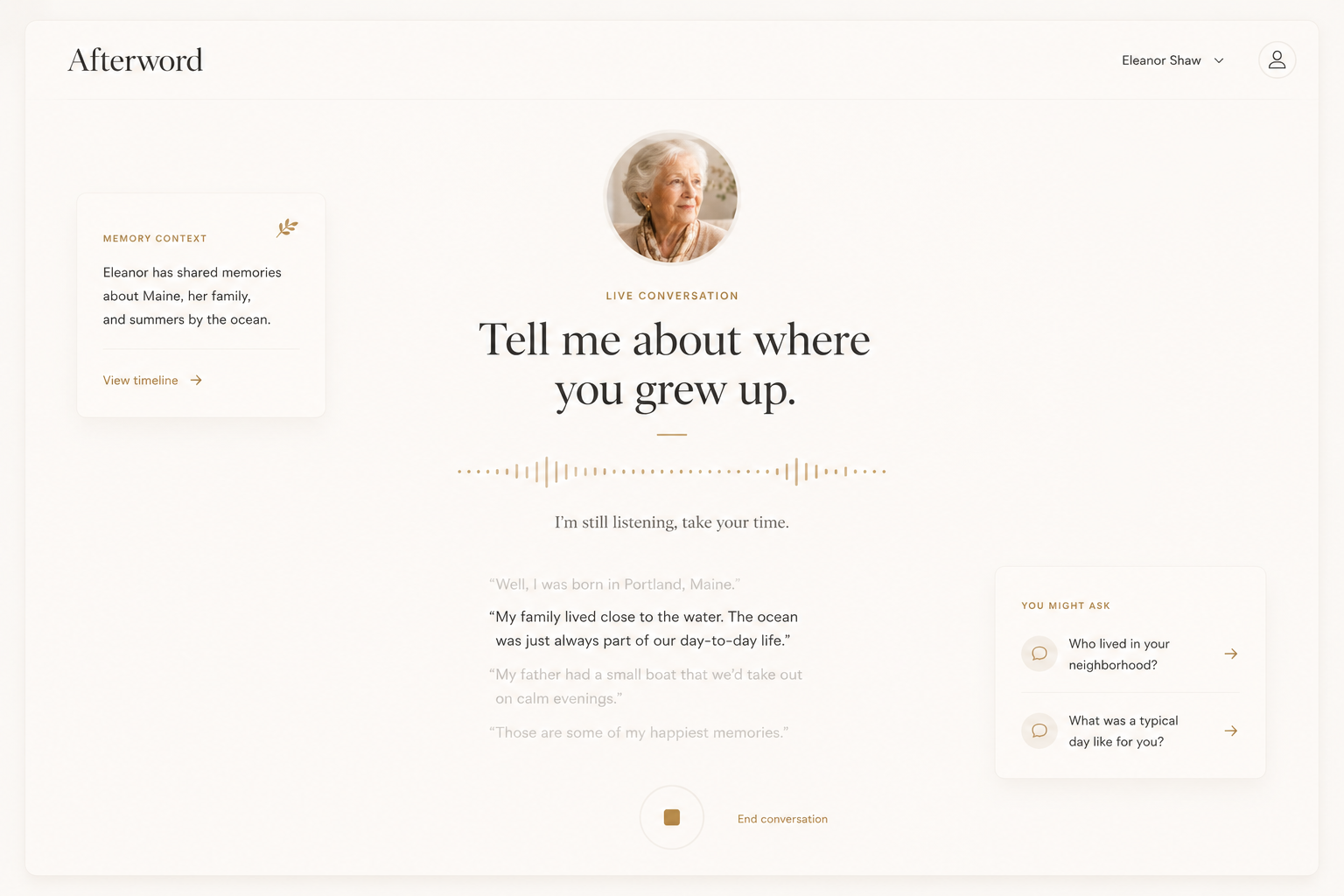
Afterword is designed around a different idea: a good biographer should know when to speak, when to listen, and when to stay quiet. It will use GPT-Live’s full-duplex architecture to continuously listen and respond, acknowledge the speaker naturally, tolerate moments of reflection, and maintain the flow of a real conversation. :contentReference[oaicite:0]{index=0}
What it will do
Afterword will be an AI biographer that helps people preserve their life stories through recurring voice conversations.
During each session, the interviewer will:
- listen continuously without forcing rigid turns
- remain quiet while the person gathers their thoughts
- respond with natural acknowledgements and gentle follow-ups
- remember people, places, and events from previous sessions
- notice unfinished stories, missing periods, and unexplained relationships
- return to those gaps later, when it feels natural
- ask whether anything important was missed before completing a chapter
A background reasoning layer will build an evolving timeline while the conversation continues. It will identify connections, contradictions, and gaps without turning the live interview into a checklist or interrogation.
Every session will contribute to one continuous memoir. The result can be organized chronologically or thematically, exported as a readable book, and preserved with the original recordings as an audio memoir in the storyteller’s own voice.
How we plan to build it
The system is designed around two layers.
The live conversation layer will use GPT-Live to manage continuous, full-duplex interaction. GPT-Live can process audio while generating output and repeatedly decide whether to speak, continue listening, pause, interrupt, or invoke a tool. This makes it suitable for long-form oral history, where hesitation, silence, and unfinished thoughts are part of the story rather than simple turn boundaries. :contentReference[oaicite:1]{index=1}
A second reasoning layer will analyze the conversation asynchronously. It will extract people, events, dates, relationships, unresolved stories, and contradictions into a structured life timeline. It will then prepare useful follow-up questions for the current session or save them for a future conversation.
This architecture follows GPT-Live’s delegation model, separating continuous interaction from deeper background reasoning so that the interviewer can remain present while more complex work happens in parallel. :contentReference[oaicite:2]{index=2}
GPT-Live API access is required to build the intended interview experience. The timeline, memory, follow-up, and memoir-generation systems can be prototyped separately, but the central full-duplex conversation layer depends on GPT-Live.
Challenges
The first challenge will be shaping GPT-Live’s continuous interaction for sensitive, long-form storytelling. The interviewer must balance active listening, short acknowledgements, silence, and follow-up questions without feeling rushed, intrusive, or overly passive.
Another challenge will be deciding which details deserve to be revisited. The system must distinguish between a meaningful missing story and an unimportant gap, then introduce the follow-up naturally rather than presenting it as an interview checklist.
Maintaining continuity across sessions will also be essential. Afterword must remember enough to make the storyteller feel genuinely heard, while avoiding repeated questions or imposing an incorrect interpretation on their memories.
What we hope to learn
We want to explore how GPT-Live’s continuous interaction and delegation architecture can support conversations that are longer, slower, and more reflective than typical voice-assistant interactions.
The core hypothesis is that a convincing AI biographer requires more than good speech generation. It requires active listening, conversational restraint, long-term memory, and the ability to perform deeper reasoning without disrupting the human telling the story.
What’s next
The first step is gaining GPT-Live API access and building the full-duplex interview layer.
After that, we plan to add collaborative family editing, photo and historical-context contributions, print-ready book exports, audio chapters, and tools that let the storyteller review, correct, or expand individual memories before the memoir is finalized.
Built With
- codex
- gpt-5.6
- gpt-live
- openai
- postgresql
- speech-to-text
- typescript
- websockets

Log in or sign up for Devpost to join the conversation.